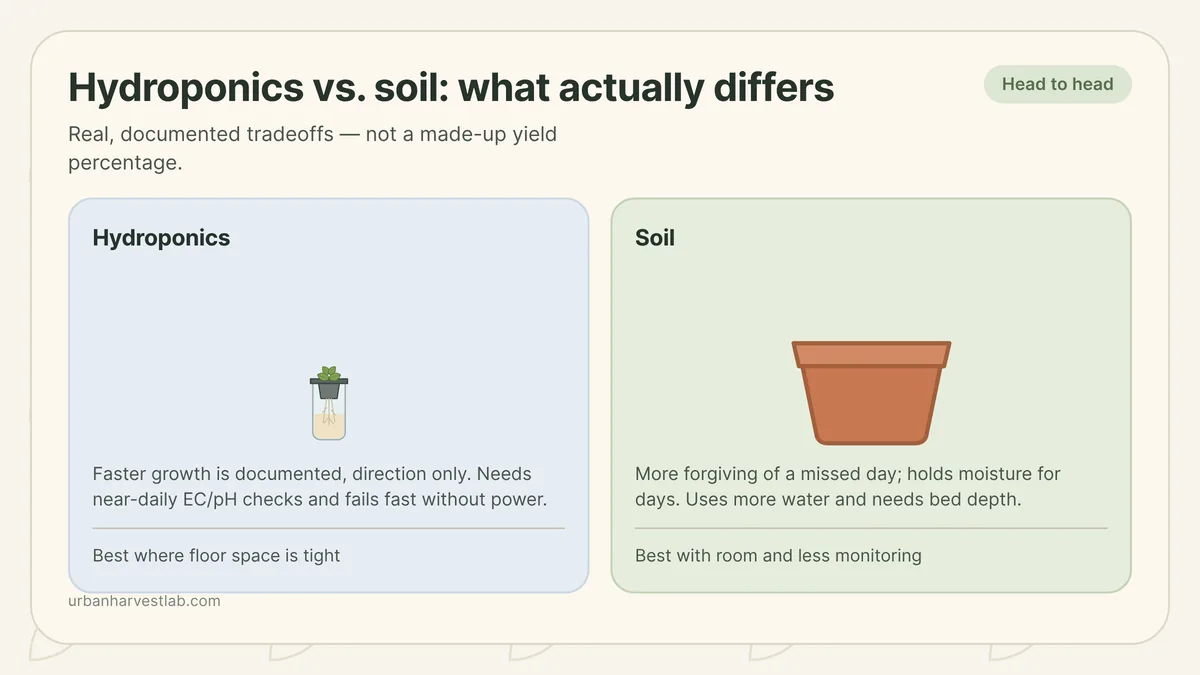
Hydroponics versus soil, by the factor a reader actually asked about
| Factor | Hydroponics | Soil |
|---|---|---|
| Growth rate | Faster growth is documented, direction only, no measured multiple | Baseline; depends on soil quality and weather |
| Water use | Closed loop; water is reused rather than draining away | Water drains through the medium and is lost to runoff and evaporation |
| Space efficiency | Vertical and tabletop systems pack more plants per square foot indoors | Needs bed depth and spacing; less stackable indoors |
| Startup cost | Pump, reservoir, meters, often supplemental light | Containers, growing medium, and fertilizer; usually cheaper to start |
| Ongoing effort | Daily or near-daily EC and pH checks; solution changes | Watering and occasional feeding; more forgiving of a missed day |
| Failure risk | Pump or power failure can stress the crop within hours | Holds moisture and nutrients for days without intervention |
Hydroponics and soil differ in ways that are genuinely documented — growth rate, water use, space, cost, and effort — but a specific yield percentage comparing the two is not one of them. University of Minnesota Extension states plainly that hydroponics allows faster growth and higher yields than soil and uses less water, without attaching a number to any of those claims. No extension service reviewed here publishes a measured yield-per-plant, water-per-kilogram, or head-to-head cost comparison between the two methods. What is well documented is the mechanism behind the difference, and the real tradeoffs in cost, effort, and failure risk that come with it.
If you are still deciding which hydroponic system to start with once you have chosen hydroponics, the NFT vs DWC vs Kratky comparison covers that next step.
The short answer
Hydroponics feeds a plant’s roots a nutrient solution directly, in water, instead of relying on soil chemistry and microbial activity to make nutrients available. University of Minnesota Extension credits that direct delivery with faster growth and higher yields than soil growing, and with lower water use, because the system recirculates rather than losing water to runoff and evaporation. What is measurable and specific is the rest of the comparison: hydroponics needs more upfront equipment and near-daily monitoring, is more space-efficient indoors, and fails faster and harder when a pump or power supply goes down. Soil is more forgiving, cheaper to start, and slower to punish a missed day, but it uses more water and gives up some of the growth-rate advantage.
Why growth is faster in hydroponics, and where the evidence stops
The mechanism is not mysterious. In soil, a plant’s roots depend on soil chemistry, moisture, and microbial breakdown to make nutrients available, and all three vary with soil type, weather, and season. In hydroponics, the grower controls the nutrient solution directly — its concentration, its pH, and how much of it reaches the roots — because the plant is not filtering nutrients through soil at all. University of Minnesota Extension’s own framing is that this direct control is what produces faster growth and higher yields, and what allows recirculating water rather than water draining away into the ground.
That framing is a real, extension-sourced claim about the direction of the difference. It is not a number. No yield-per-plant figure, no percentage-faster figure, and no water-litres-per-kilogram comparison between hydroponic and soil growing turned up in the extension sources reviewed. Where a number does exist, it describes hydroponics alone rather than a comparison: the University of Kentucky Center for Crop Diversification reports hydroponic lettuce harvested at 100 to 210 grams per head 21 to 35 days after transplant, and Cornell’s CEA program reports a similar 150 grams per head on a 35-day cycle. Those are real, measured hydroponic outputs, but neither source ran the same crop in soil alongside it, so there is no controlled comparison to draw a multiple from. A specific “X% more yield” or “grows twice as fast” figure circulating for hydroponics versus soil is not backed by the university extension research checked here, and should be treated as unsourced until it is.
Water use: a closed loop versus water that drains away
This is the comparison with the clearest documented mechanism, even without a number attached. A hydroponic reservoir recirculates the same nutrient solution past the roots repeatedly, topping up only what evaporates or what the plants take up. Soil growing, by contrast, loses water to drainage below the root zone and to evaporation from the surface, and that lost water is not recovered.
University of Minnesota Extension’s own guidance for keeping a hydroponic reservoir stable makes the same point from the maintenance side: solution volume drops from evaporation and plant uptake, and the grower tops it up with fresh nutrient solution at the same concentration rather than replacing a soil bed’s water supply from scratch each time. The direction is consistent across the sources reviewed: less water lost, more water reused. The one water figure the sources give is a magnitude rather than a comparison: the University of Kentucky puts deep water culture use at more than 4 litres, or more than a gallon, of water per plant.
Space efficiency: why hydroponics wins indoors
Space is where hydroponics has a clear, structural advantage for anyone growing inside an apartment or a small room. The University of Kentucky’s planting-density figures for lettuce show how tightly hydroponic systems can pack plants: deep water culture supports 3 to 4 plants per square foot, nutrient film technique about 2 plants per square foot, and ebb-and-flow around 2 plants per square foot. University of Minnesota Extension’s tabletop NFT design fits six 4-foot channels and 36 plant spaces into a 55 by 55 by 31 inch footprint.
Soil growing in containers needs bed depth for root development and wider spacing between plants to avoid competition, and it is harder to stack vertically indoors without adding weight and drainage problems at every tier. For a windowsill, a closet, or a balcony where floor space is the limiting factor, hydroponic density is a real and measurable advantage. For an outdoor garden with unused ground, this advantage mostly disappears.
Cost and effort: what soil gets you out of
Hydroponics is not the cheaper way to start growing. A basic setup needs a reservoir, a pump or air stone, and usually a pH and EC meter to keep the solution in range — University of Missouri Extension prices a quality pH or EC meter at 100 to 300 US dollars as of 2025, on top of the reservoir and pump hardware itself. Soil growing needs containers, a growing medium, and fertilizer, which is typically a smaller one-time cost, and it needs no calibrated instruments to get started safely.
Running the system costs less than starting it. University of Minnesota Extension’s own worked example is a 9-watt LED grow light with a PPF of 16 µmol/s (about $15), run 14 hours a day, every day — 5,110 hours a year — which draws about 45,990 watt-hours annually and costs roughly 45 cents a month, or $5.44 a year, at 12 cents per kilowatt-hour. The ongoing electricity draw of a small system is small; the startup hardware, not the power bill, is what actually separates hydroponics from soil on cost.
Effort runs the same direction. Oklahoma State University Extension recommends checking pH and EC daily in a hydroponic system, checking pH again once EC is confirmed in range. University of Minnesota Extension gives a looser cadence for a small passive system — testing every few weeks rather than daily — but even that looser routine is more instrumented than watering a container of soil and checking the leaves. Soil buffers a missed day: the medium holds moisture and nutrients on its own for a while. A hydroponic reservoir does not buffer in the same way, because the whole nutrient supply sits in one measured volume of water that can drift in concentration or pH between checks. A soilless system also carries no weeds and no soil-borne pest reservoir to manage, so the effort trade is instrumented monitoring against weeding and soil upkeep, not one method simply costing more attention than the other. Get the EC and pH basics in place before troubleshooting drift — the nutrient, EC, and pH basics guide covers what those two numbers mean and how they interact.
Failure modes: what breaks, and how fast
This is the tradeoff that most comparisons skip, and it is where soil’s forgiveness becomes concrete. In nutrient film technique and drip systems, the University of Kentucky notes that a pump failure causes rapid dry-out at the roots, because the thin film or drip line is the plant’s only water source and there is no standing reservoir underneath it. University of Minnesota Extension adds that if the water level in an NFT reservoir falls below the pump intake, the pump itself can be damaged, and names dependence on electricity and pumps during a power outage as a real downside of more complex hydroponic systems.
Deep water culture and the Kratky method are more forgiving of a short outage because the roots already sit in standing water rather than depending on continuous flow, though an aerated DWC bucket still loses its air supply when the pump stops — see whether an air pump is worth adding for what that dependency actually buys you. None of the sources reviewed give a survival time in hours for any system before root damage sets in — that depends on reservoir depth, root mass, and water temperature, which is exactly what a grower needs to gauge for their own setup rather than rely on one published number.
Soil growing has no equivalent single point of failure. A missed watering stresses a plant over days, not hours, and there is no pump, air stone, or electrical draw to fail in the first place.
The disease-spread risk that is specific to hydroponics
One disadvantage of hydroponics is structural rather than a matter of diligence: a shared, recirculating nutrient solution can spread a pathogen to every plant in the system at once. The University of Kentucky lists waterborne pathogens spreading through shared solution as a defining disadvantage of both deep water culture and nutrient film technique — root rot organisms like Pythium can establish in the solution and reach every root in the reservoir through the same water. Soil-grown plants in separate containers do not share a water supply in the same way, so a root disease in one container is far less likely to reach its neighbor through the growing medium alone.
This is also why sanitizing a hydroponic system between crops matters more than sanitizing individual soil containers: the shared solution is the transmission route, and closing it off between plantings is how growers manage the risk. Watch for the early signs described in preventing hydroponic root rot rather than waiting for a whole reservoir to turn.
Which one fits your situation
None of this makes hydroponics or soil the wrong choice; the decision rests on the tradeoffs that are actually documented — space, cost, effort, and failure risk.
Choose hydroponics if floor space is your binding constraint, you can commit to checking the reservoir on a schedule, and you have a way to keep the system powered through a typical outage in your area. Countertop and small tabletop systems make the entry cost manageable, and which herbs grow best hydroponically is a reasonable place to start if leafy greens and herbs are the goal.
Choose soil if you have outdoor space or a windowsill with real depth to spare, you want a setup that tolerates a missed day or a short power outage without consequence, and you would rather not calibrate a meter to keep a crop alive. Soil also remains the simpler choice for anyone not ready to take on daily monitoring as part of the routine.
Many growers end up doing both: soil outdoors where space and forgiveness matter more, hydroponics indoors where space is tight and closer monitoring is part of the appeal rather than a burden.
Sources
- University of Minnesota Extension: Small-scale hydroponics
- Oklahoma State University Extension HLA-6722: Electrical Conductivity and pH Guide for Hydroponics
- University of Kentucky CCD-CP-63: Hydroponic Lettuce Production in Controlled Environments
- Cornell University CEA Program: Hydroponic Lettuce Handbook
- University of Missouri Extension G6984: Hydroponic Nutrient Solutions
Compare systems and get started
If hydroponics looks like the right fit, these guides cover choosing a system and your first setup.
Common questions
Does hydroponics actually grow food faster than soil?
Extension sources describe faster growth in hydroponics as a real, direction-of-effect finding, driven by nutrients being delivered directly in solution rather than depending on soil chemistry and microbial breakdown. None of the university sources reviewed publishes a measured percentage or multiple for how much faster, so a specific figure you see quoted elsewhere is not backed by that research.
Does hydroponic produce taste different from soil-grown produce?
No extension source in this research measured or compared flavor between hydroponic and soil-grown crops, so there is nothing here to confirm or deny a taste difference either way.
Is hydroponics cheaper than growing in soil?
Not up front. Hydroponics adds the cost of a pump, an air stone or reservoir, and often supplemental lighting, plus an ongoing electricity draw that soil growing does not require. Soil's costs are mostly one-time: containers, growing medium, and fertilizer. Hydroponics can save water over the growing cycle, because water that drains below the root zone or evaporates from a soil surface is not recovered.
What happens to a hydroponic system if the power goes out?
It depends on the system. A pump failure in NFT or drip causes rapid dry-out at the roots because there is no reservoir of moisture to fall back on. Deep water culture and the Kratky method keep roots sitting in standing water, so they tolerate a short outage better, though an aerated DWC bucket still loses its air supply. Soil holds moisture and nutrients through a power outage without any special planning.
Related guides
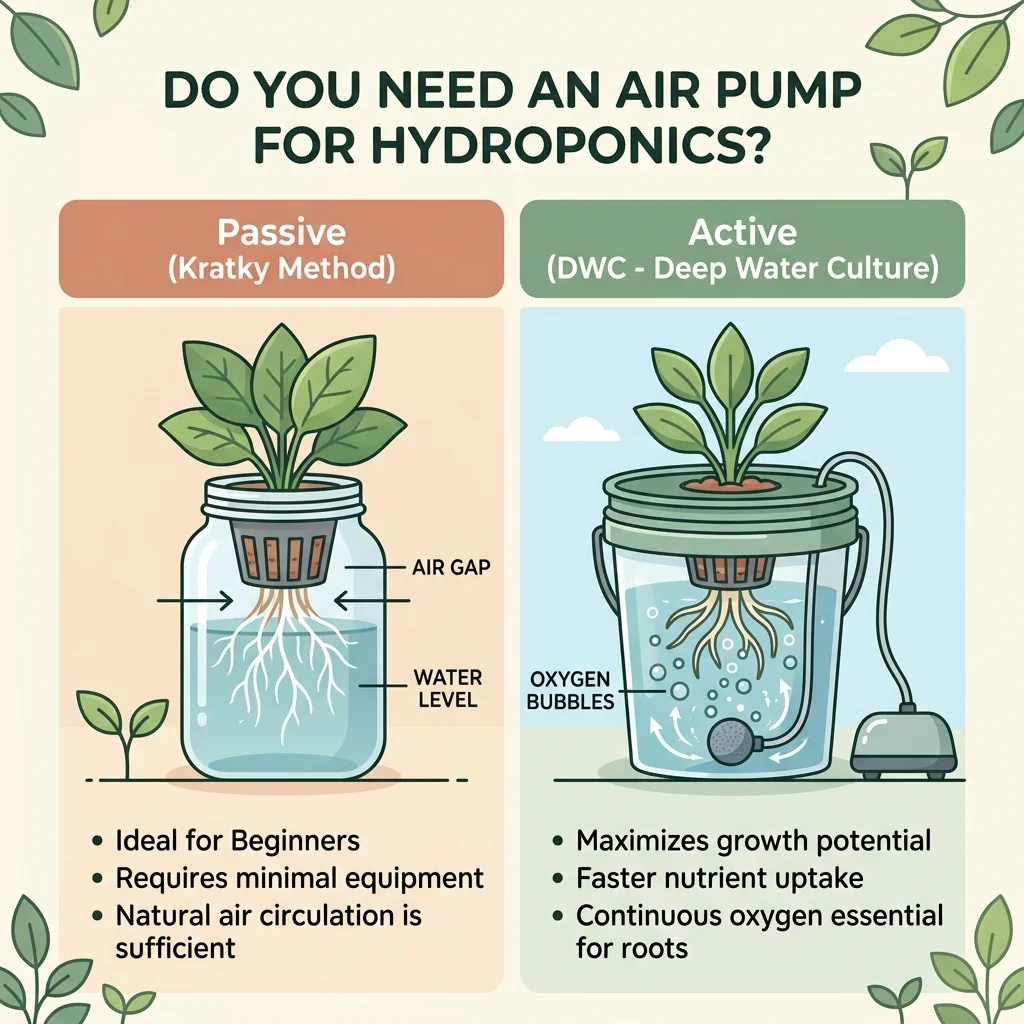
Do you need an air pump for hydroponics?
If you search for hydroponic tutorials, you will see a maze of air pumps, plastic tubing, and bubbling airstones. But do you actually need electrical aeration to grow plants in water? Here is the science of passive vs. active hydroponic setups.
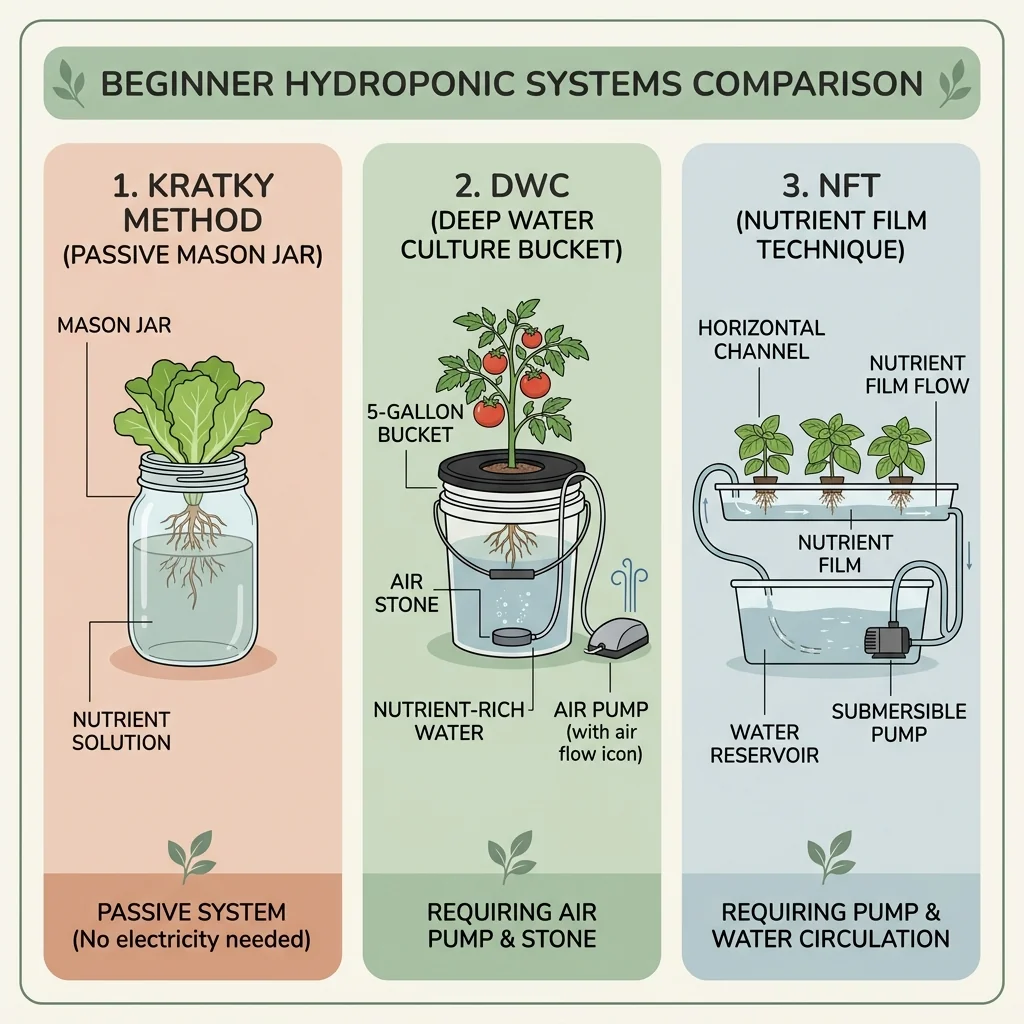
NFT vs DWC vs Kratky: which should a beginner pick?
Three systems dominate small-space hydroponics: Kratky, DWC, and NFT. This comparison shows how they differ and which one a beginner should actually start with.
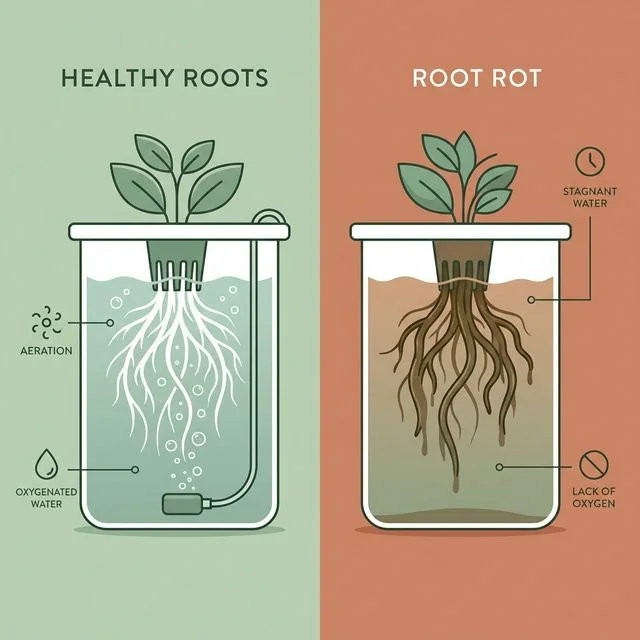
Hydroponic root rot: how to spot it early and stop it
Brown, slimy or swampy-smelling roots mean root rot. Catch it early and fix the conditions behind it — warm water, low oxygen and stagnant flow.