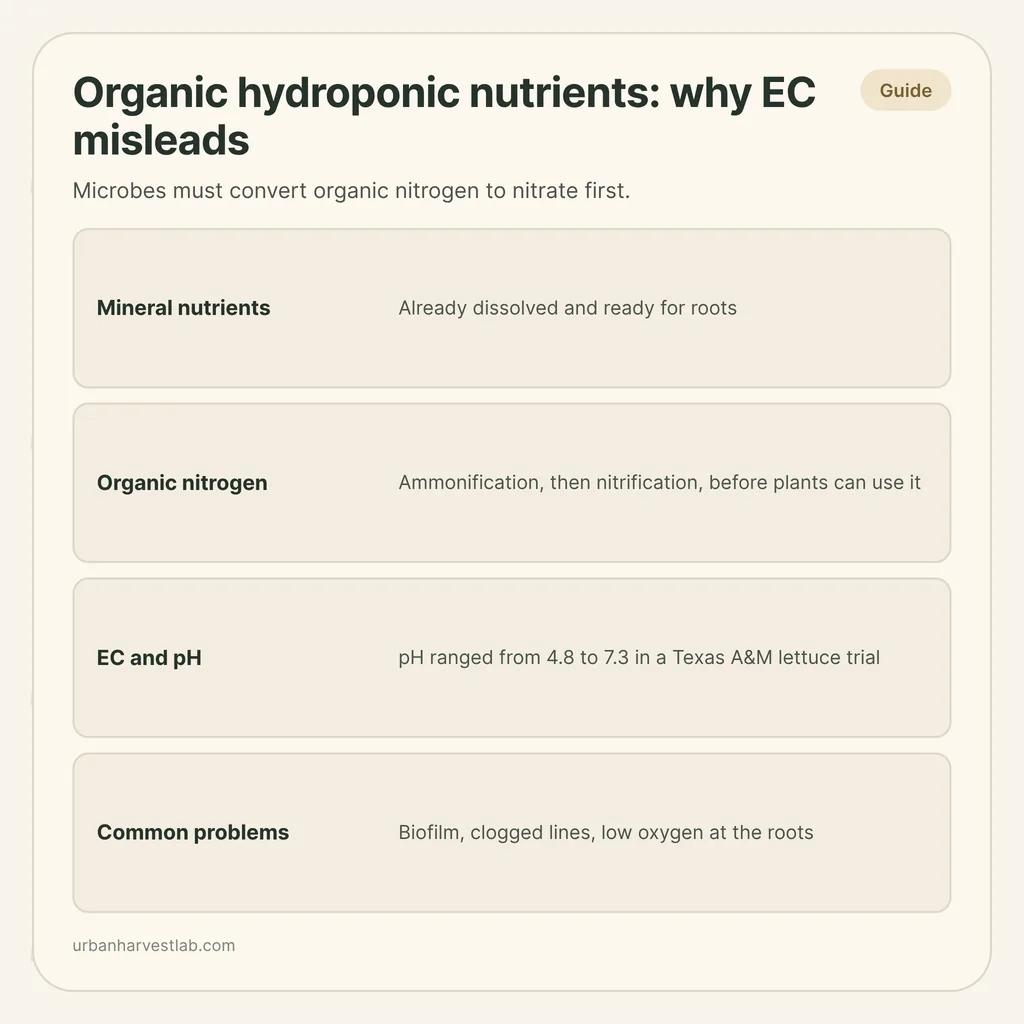
Organic fertilizer can feed hydroponic plants, but only after microbes convert its nitrogen to nitrate, and that conversion is what makes the reservoir harder to run. Mineral nutrients arrive already dissolved and ready for roots. Organic ones arrive as a food source for bacteria, and your reservoir becomes a small, unstable ecosystem. If you want predictable results in a home system, start with the mineral approach in hydroponic nutrient basics. If you have a reason to go organic, the research below shows what to plan for.
Why organic nutrients are not a drop-in swap
The case for mineral nutrients is simple chemistry. A Japanese team from Nagoya University and NARO notes that in conventional hydroponics organic fertilizer cannot be used, because organic matter “should be phytotoxic and inhibit crop growth.” The method they work on, called multiple parallel mineralization, adds the organic fertilizer to the solution and lets two microbial steps run in the same tank: ammonification, then nitrification.
University of Florida IFAS Extension describes the same problem from the grower’s side. Its Orange County office says microbial conversion of nitrogen to nitrate cannot occur in anaerobic, flooded conditions, which are more likely to create the ammonium form, and that hydroponics, being essentially flooded, can inhibit the conversion of organic nitrogen to nitrate. The same post notes that a hydroponic operation meeting the USDA National Organic Program requirements can be certified USDA Organic, so the label question is separate from the biology question.
The nitrifying bacteria that do the final step are generally aerobic, according to a NARO and Nagoya University paper in Scientific Reports. They need oxygen, and the same paper reports that a high concentration of organic substances suppresses nitrification in soil-less substrates. That is the tension: you are adding the very thing that slows the step you depend on.
How long the conversion takes
In the Nagoya University and NARO work on solid food waste, the tank was aerated and the organic material was added over four days. Around 2 months was required for nitrate to be generated with the solid food waste. For liquid organic fertilizer, the authors cite 2 weeks from earlier studies; that figure was not measured in their food-waste experiment. The authors also flagged a risk: anaerobic conditions at the bottom of a container with solid organic matter might stimulate denitrification, which loses nitrogen.
A NARO team in Scientific Reports, building a rockwool carrier for nitrifying bacteria, added fish fertilizer daily for 2 to 3 weeks, in rockwool tubes incubated at 25 C, until nitrate appeared in the leachate. These are research-scale figures from controlled, aerated setups. They show that a new organic reservoir has a start-up period in which the plants may have little usable nitrogen.
What happens to EC and pH
Texas A&M AgriLife researchers grew lettuce in NFT channels with a certified organic liquid fertilizer, with and without a microbial inoculant, against a mineral control. Their findings are the best available picture of what a grower would see on the meters:
- The EC and pH of the organic solutions fluctuated widely. Over both experiments, pH ranged from a low of 4.8 to a high of 7.3.
- EC in the organic treatments rose steadily in the first run. The authors explain this as mineralization releasing ions, and note that the mineral control’s EC did not rise because that fertilizer is already inorganic.
- With the inoculant, lettuce matched the control’s shoot weight in the first run. When the same solution was reused in a second run, weight fell below the control.
- In the second run, the Texas A&M team needed roughly 25% of the original amount of liquid organic fertilizer to reach the target EC.
For a grower this means an EC reading mixes two things: what you added and what the microbes have converted so far. A flat or rising line does not tell you whether plants are being fed. Compare it with leaf colour and growth, and read why EC rises or falls for the mineral baseline. The Texas A&M authors also note that large pH swings are hard to manage in an organic solution, and that a pH near 7.0 may suit mineralization better than the 5.8 to 6.4 range they cite as recommended for most hydroponic plants. Those two aims pull in opposite directions.
Biofilm, clogging and oxygen
Liquid organic fertilizers have a known set of problems. The Texas A&M paper lists clogged tubing in the delivery system, biofilm formation, low nitrogen availability and possibly high levels of unwanted minerals such as sodium. It adds that many products do not give an accurate or detailed listing of their contents. An Ohio State University and USDA Agricultural Research Service study of liquid organic fertilizer in four hydroponic systems cites the same limitations: biofilm in stock nutrient tanks, clogging of irrigation equipment, and quick mineralization and leaching.
The Texas A&M trial did not see tube blockage. It did see biofilm inside the propagation plugs, and roots developed poorly there, which the authors link to low dissolved oxygen. When they changed the nutrient supply to 15 minutes per hour, giving the roots a dry period, crop performance improved. That fix was for NFT with plugs; it does not transfer to a deep water tank, where roots sit submerged. See dissolved oxygen in small systems for what the oxygen side looks like in your own setup, and foam in the reservoir for one visible sign that something organic is going on in the tank.
Which system tolerates organic nutrients best
The Ohio State team compared lettuce on one liquid organic fertilizer across NFT, deep water culture, Dutch bucket and regular plastic containers. Growth in the plastic containers was 29% to 60% higher than NFT and 15% to 44% higher than deep water culture for measures such as leaf area and shoot weight, and Dutch bucket and plastic containers were negligibly different. Root growth in NFT and deep water culture was significantly lower than in the substrate-based systems. They also state that none of the earlier studies had explored how these fertilizers fit different hydroponic systems, so this is one trial, not a settled ranking.
Practical reading: if you try organic, a substrate-based setup such as a Dutch bucket gives microbes a surface to live on and roots a less saturated zone. A reservoir that recirculates one volume through narrow channels or sits stagnant is where the research reports the most trouble.
Mineral or organic: a decision table
| Question | Mineral nutrients | Organic liquid fertilizer |
|---|---|---|
| Nitrogen form at mixing | Already dissolved ions | Organic, needs ammonification then nitrification |
| What the EC reading reflects | What you dissolved | A mix of what you added and what microbes have converted |
| EC and pH behaviour in the Texas A&M trial | EC did not rise in the mineral control | EC rose in the first run; pH ranged from 4.8 to 7.3 |
| Main failure modes | Not compared in these sources | Biofilm, clogged lines, low root-zone oxygen |
| Best-fit system in the Ohio State trial | Not tested in this trial | Substrate-based containers grew more lettuce (29% to 60% over NFT, 15% to 44% over deep water culture) |
Choose mineral nutrients when you want the reservoir to behave the same way every week. Choose organic when the label matters to you, you accept a start-up period, and you are ready to change solution often and watch roots rather than trust a meter. Spreading regular garden fertilizer into a hydroponic tank is a separate question, covered in using soil fertilizer in hydroponics, and the soil-side comparison of the two fertilizer types is in organic vs synthetic fertilizer.
The Texas A&M authors found organic hydroponic production of lettuce feasible, with yields similar to conventional fertilizer when a microbial inoculant was used (the reused second run fell below the control, as described above), but that managing the solution over multiple growing cycles can be challenging, and that more research is needed on mineralization.
Sources
- Hooks, Masabni, Sun and Niu, Texas A&M AgriLife Research and Extension, Technology in Horticulture 2022
- Kawamura-Aoyama et al., Nagoya University and NARO, JARQ 2014
- Meeboon et al., NARO and Nagoya University, Scientific Reports 2022
- Chowdhury, Samarakoon and Altland, Ohio State University and the USDA Agricultural Research Service, Frontiers in Plant Science 2024
- UF/IFAS Extension Orange County, The Hydroponic Organic Conundrum
Nutrient solution basics and troubleshooting
Start from mineral nutrient basics, then check what the reservoir is telling you.
Common questions
Can you use organic fertilizer in a hydroponic system?
It can work, but not as a drop-in swap. Research groups in Japan and at Texas A&M grew lettuce on organic fertilizer, using microbes to convert the nitrogen into nitrate. Texas A&M also reported wide EC and pH swings, and biofilm in the propagation plugs, so expect more management than with mineral nutrients.
Why do organic nutrients cause biofilm in a hydroponic reservoir?
Organic matter feeds microbes. Researchers working with liquid organic fertilizers list biofilm formation in stock tanks and clogged irrigation equipment as known limitations. In the Texas A&M trial, biofilm inside propagation plugs went with low dissolved oxygen and poor root development.
Can I trust my EC meter with organic hydroponic nutrients?
Treat it with caution. In the Texas A&M trial, EC in the organic solutions rose steadily while conventional solution did not, which the authors tied to mineralization releasing ions. EC and pH also fluctuated widely, so pair the meter with plant symptoms and a plan for frequent solution changes.
How long does organic fertilizer take to become nitrate in water?
In Japanese work from Nagoya University and NARO, about 2 months was measured for solid food waste, while the authors cite about 2 weeks for liquid organic fertilizer from earlier studies. Those are research-scale figures from aerated tanks, not a schedule for a home reservoir.
Related guides
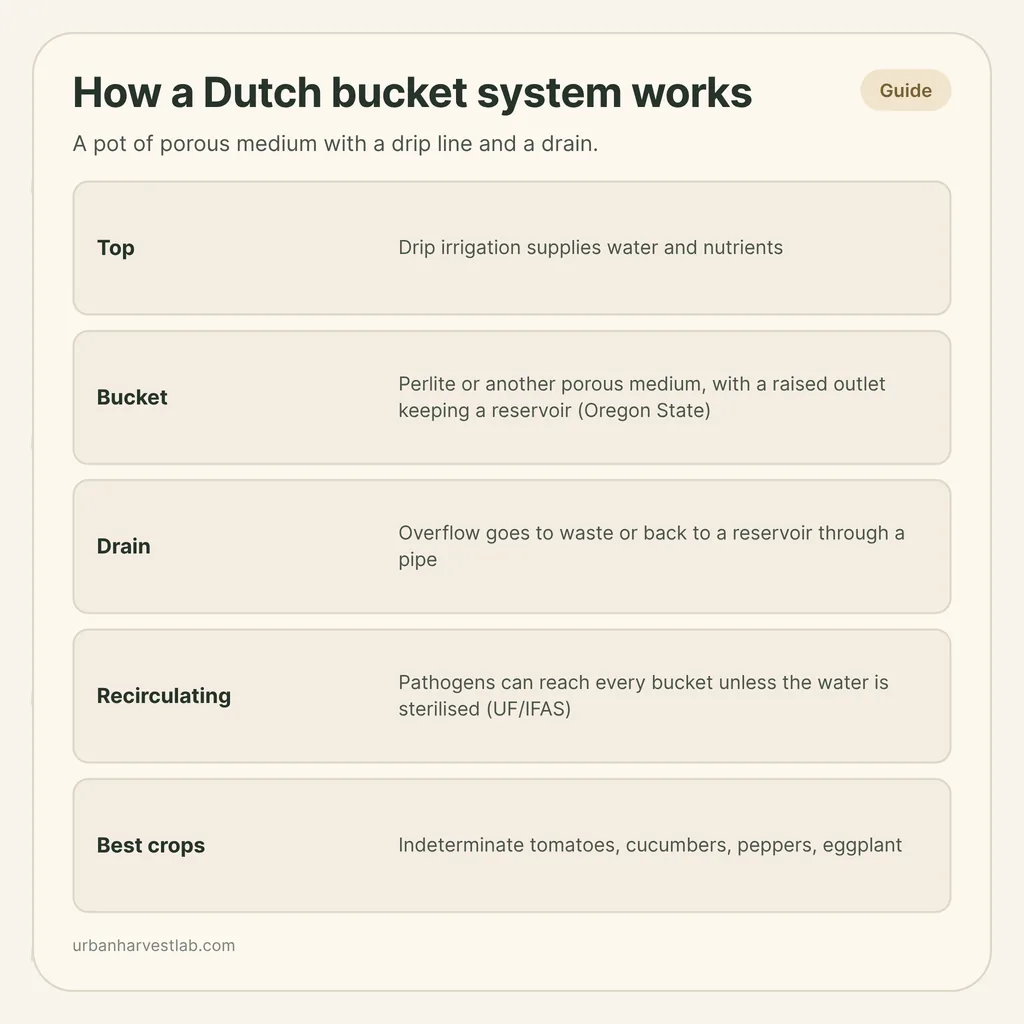
Dutch bucket hydroponics: how the system works and what to build
A Dutch bucket is a media-filled pot with a drip feed on top and a drain at the bottom. Here is what Oregon State and UF/IFAS say about building and running one.
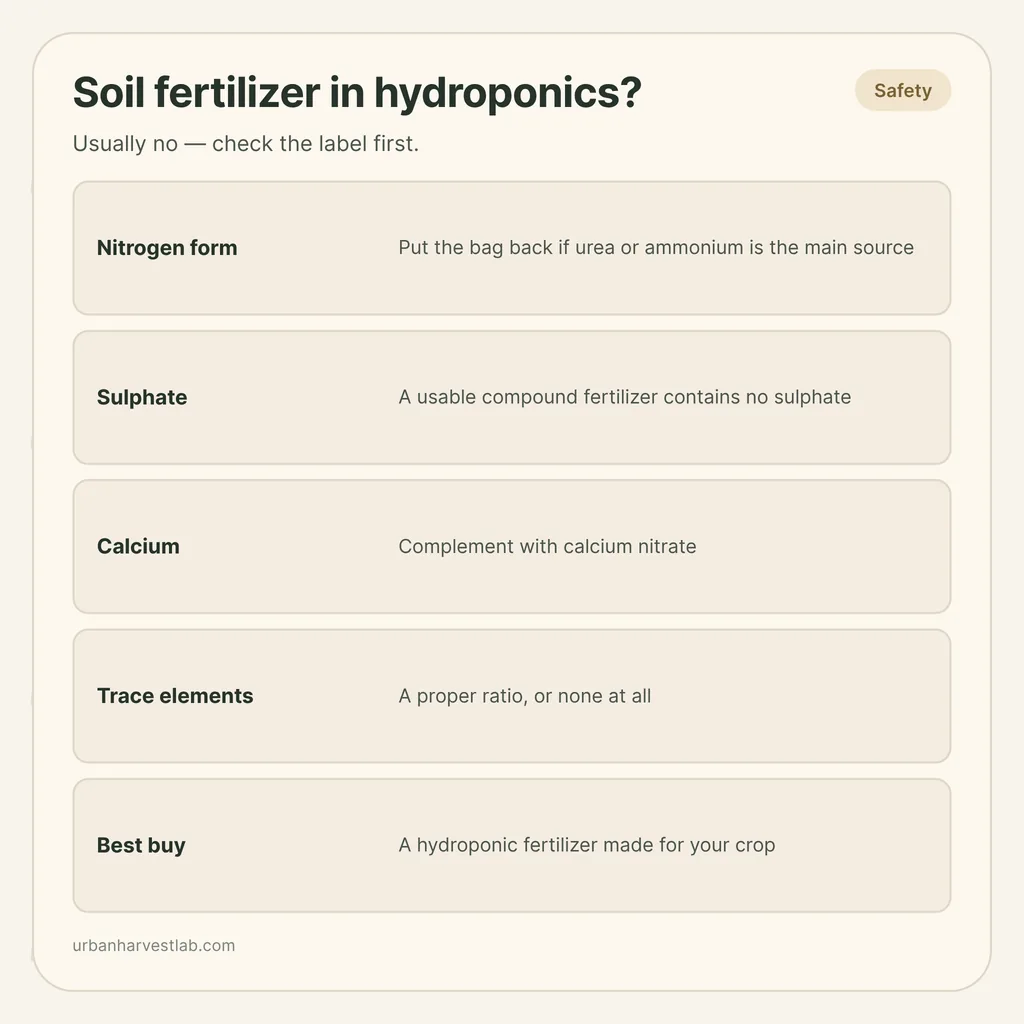
Can you use regular soil fertilizer for hydroponics?
A box of garden fertilizer is built for soil that supplies the rest. In a bare-water reservoir the label has to carry everything, and these are the checks that decide whether it can.
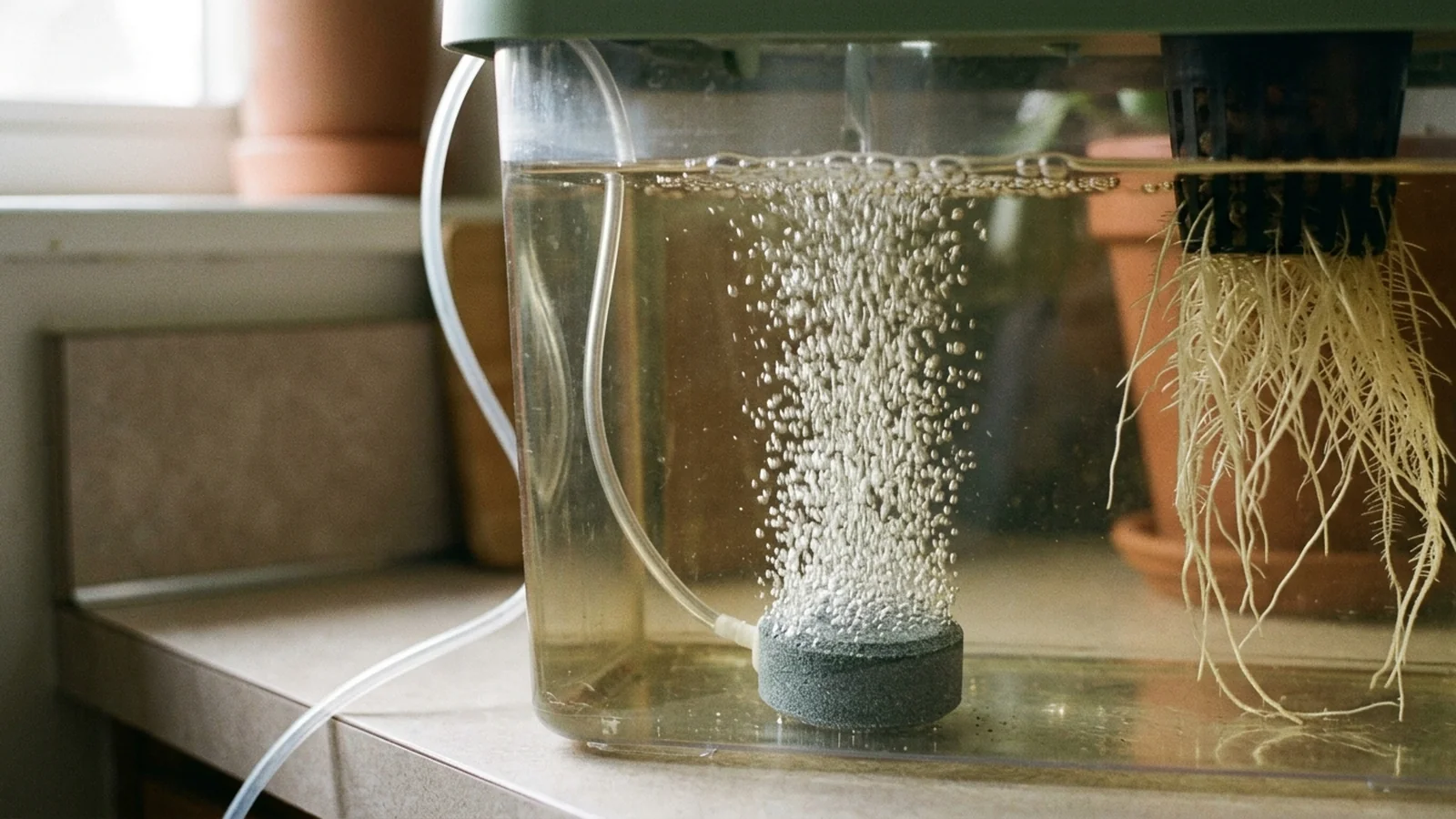
Dissolved oxygen in small hydroponic systems
Roots breathe oxygen dissolved in the water around them, not the air above it. Here are the actual targets, what temperature really does to that oxygen, and how to check yours without a lab meter.