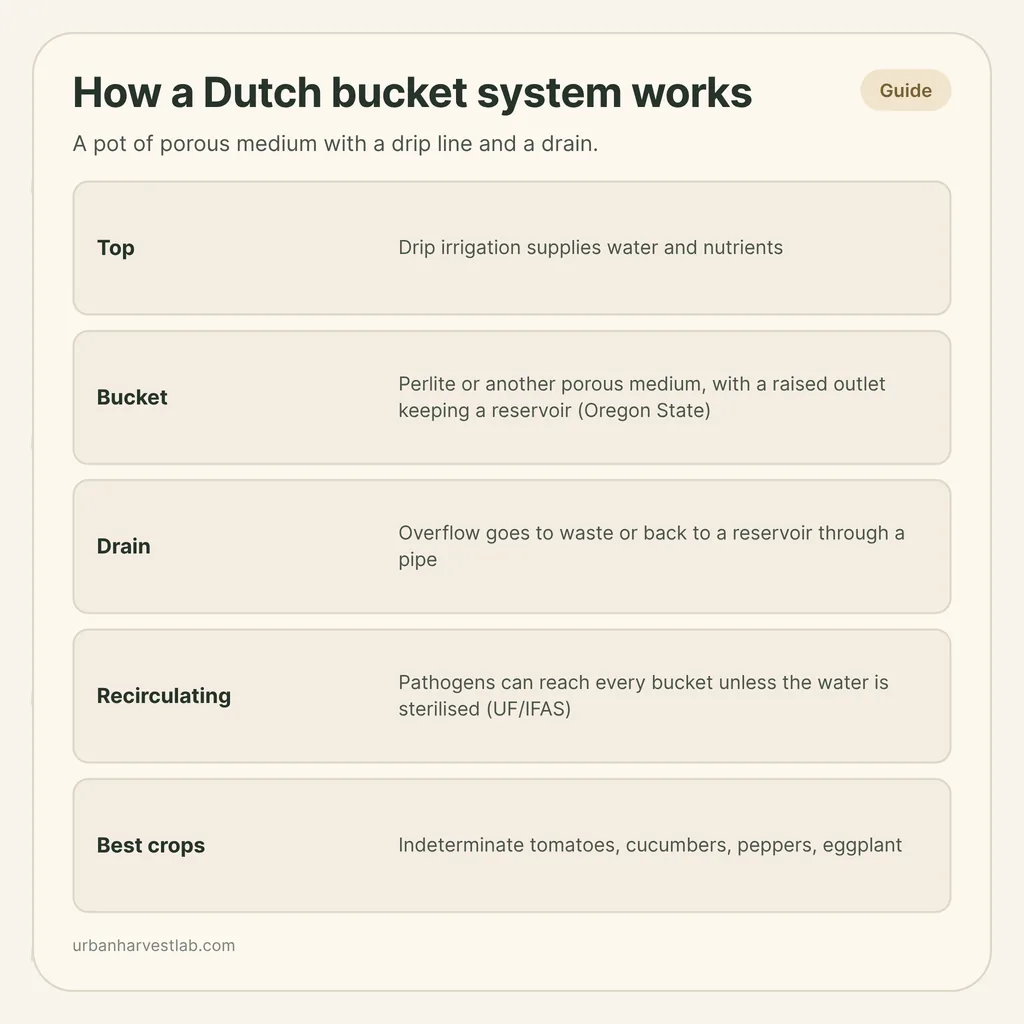
A Dutch bucket is a pot of porous medium with a drip line on top and a drain at the bottom. It suits big plants that a lettuce system cannot carry, mainly indeterminate tomatoes and cucumbers, and it can be run either recirculating or to waste.
Oregon State Extension, which publishes the clearest home-scale guide, puts the appeal this way: compared with the nutrient film technique, bucket systems offer a larger rooting volume and so greater buffering capacity. If you are still choosing between systems for a tomato, start with hydroponic tomatoes indoors; what follows assumes you have chosen buckets.
How one bucket works
UF/IFAS describes the commercial pattern as plastic, two-gallon buckets containing perlite, with a reservoir about two inches deep at the bottom. Drip irrigation supplies water and nutrients, which overflow that reservoir and are collected to drain or be recycled through a PVC pipe.
Oregon State describes the same idea from the DIY side: the outlet can be raised above the floor of the bucket so that a minimum reservoir stays inside it.
Oregon State also explains why the medium and drip combination works: porous media such as perlite, fed by drip, can give roots adequate oxygen without extra aeration equipment. That is the practical difference from deep water culture, where you need an air pump and stones. Compare it with ebb and flow, where a whole tray floods and drains, while here every plant has its own container.
What to put in the bucket
Oregon State lists lightweight expanded clay aggregate, perlite, coir, washed river rocks and gravel as options, and says the choice depends on water-holding capacity and the plant. UF/IFAS notes that perlite is often mixed with coconut coir, peat or other organic components to increase water and nutrient holding capacity, and that growers moved from rockwool to perlite mainly because of lower cost and easier disposal.
Do not reuse media. Oregon State calls recycling and reusing materials the primary cause of disease spread and pest issues in home systems. For a side-by-side of the common media, see rockwool, clay pebbles, coco and foam compared.
Choosing the bucket itself
Oregon State says to use food-grade containers such as HDPE, to avoid anything previously used for hazardous materials like pesticides and paints, and to avoid polystyrene and basic PVC. A hardware-store bucket is acceptable if it meets that test; purpose-made hydroponic buckets are also sold. If you are buying, browse Dutch bucket kits on Amazon and check the material against that list.
Whatever you buy, fit a screen. Oregon State says each bucket outlet needs a high-quality screen so that growing media does not clog the irrigation pipes.
Recirculate or run to waste
This is the decision that most affects how much can go wrong. UF/IFAS reports that, because root pathogens can spread through a whole greenhouse once an infection starts, most tomato growers are no longer using recirculating systems unless the water is sterilised. Many use flow-through media systems instead, including lay-flat bags, Dutch buckets and rockwool, which do not recirculate the nutrients, so root infections remain localised.
At home that gives you two plain options:
| Layout | What UF/IFAS and Oregon State say | What it means for you |
|---|---|---|
| Runoff returns to a reservoir | UF/IFAS: overflow can be recycled through a PVC pipe; recirculating carries pathogen spread risk unless water is sterilised | Lower water use, but one sick plant can reach every bucket |
| Runoff goes to drain | UF/IFAS: flow-through systems keep infections localised | More water used, simpler to keep clean |
If you recirculate, you also inherit the reservoir jobs: checking EC and pH and knowing what to do if the pump stops, which the pump failure plan covers.
Sizing the pump and drip line
Neither Oregon State nor UF/IFAS gives a flow per emitter, a number of emitters per bucket or a buckets-per-pump figure, so none is given here. The method is the one in why a pump’s GPH rating falls as soon as it lifts water: add up what your emitters actually deliver, measure the vertical lift from the water surface to the drip line, and read the pump’s curve at that height. UF/IFAS makes one point that helps here: adding buckets is simply a matter of extending the irrigation line, so you can start with a few and test before you commit to a long row.
Oregon State says a system can scale from four buckets to 16 as needed.
Layout and upkeep
Buckets cannot be stacked, which Oregon State gives as the reason they suit large plants, and UF/IFAS lists the horizontal layout as a drawback: more floor area than a vertical system. Plan the footprint before you plan the plumbing.
The upsides are practical. Oregon State notes that you can harvest, trellis and prune individual units without disturbing the rest of the setup, and swap a finished plant out by swapping the bucket.
Upkeep comes down to two jobs from UF/IFAS: flushing and cleaning to prevent salt build-up, and keeping tubing and drip lines clean to prevent clogging. UF/IFAS also lists nutrient and pH control as manual monitoring that the grower has to keep up.
Which crops
Oregon State lists indeterminate tomatoes, cucumbers, bell and hot peppers, eggplant, zucchini, pole beans and small melons. For cucumbers indoors, the space and trellis questions are in hydroponic cucumbers indoors.
Sources
Fruiting crops in hydroponics
Choosing a system for tomatoes, sizing the pump, and the other recirculating option.
Common questions
What is a Dutch bucket system?
Dutch buckets, also called Bato buckets, are individual containers filled with a porous medium such as perlite. A drip line feeds each bucket from above and an outlet at the bottom drains the excess. Oregon State Extension rates the design as particularly effective for indeterminate tomatoes and cucumbers.
What goes in a Dutch bucket?
UF/IFAS describes perlite in two-gallon buckets as a common commercial setup. Oregon State Extension also lists expanded clay, coir, washed river rock and gravel. Oregon State advises against reusing media between crops.
Should Dutch buckets recirculate the runoff?
It can be either. UF/IFAS says the overflow is collected to drain or recycled through a pipe, and reports that most tomato growers stopped recirculating unless the water is sterilised, because a root infection then stays in the bucket where it starts.
How many buckets can one pump run?
Oregon State Extension notes a system can scale from four buckets to 16, but neither it nor UF/IFAS gives a buckets-per-pump figure. Add up the drip flow of every emitter and check the result against the pump curve at your lift, as explained in the pump head-height guide.
Related guides
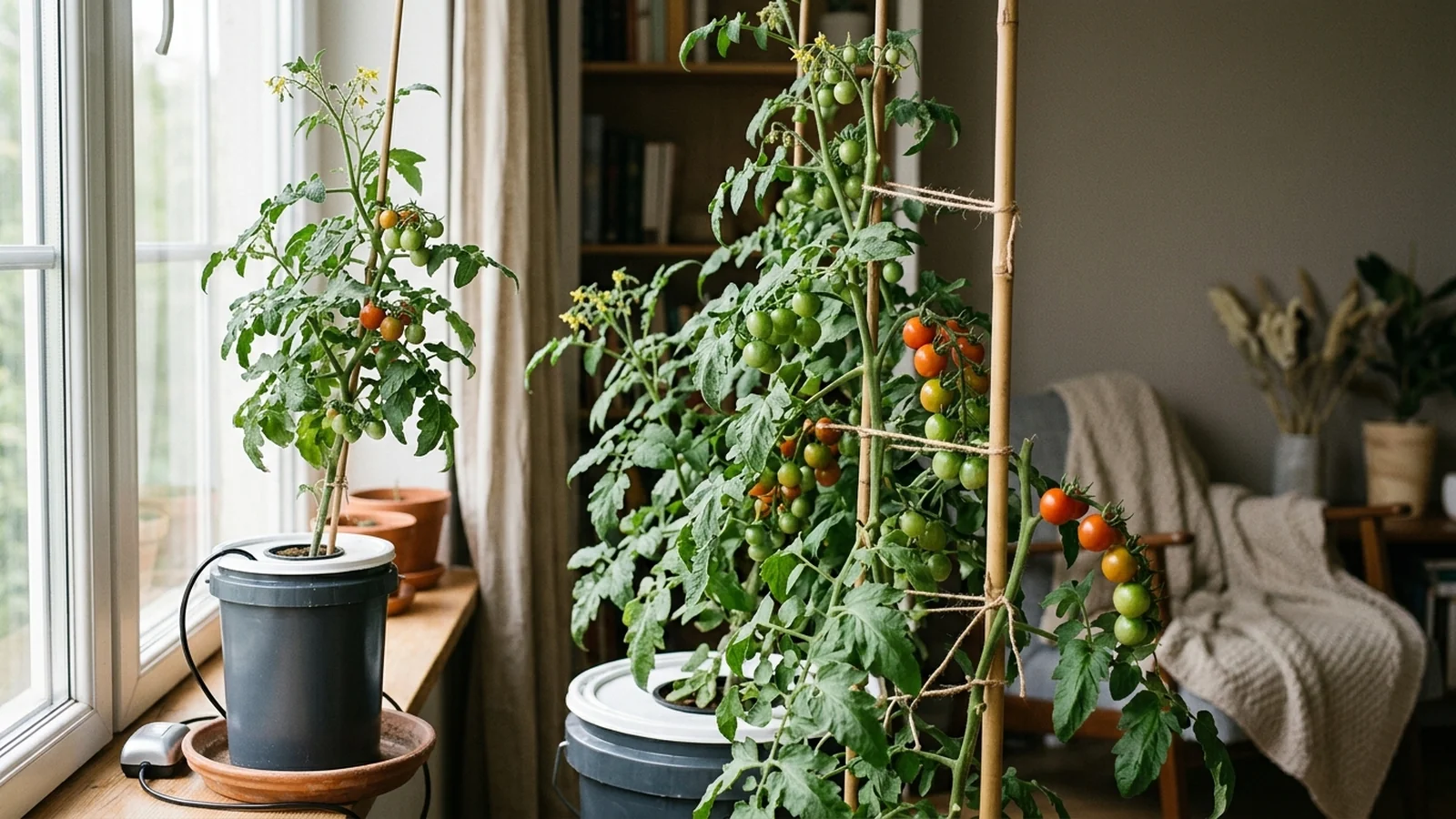
Growing hydroponic tomatoes indoors: system, EC, and light
Tomatoes are the first fruiting crop most hydroponic growers try indoors, and the jump from lettuce is bigger than it looks. Here is the system, the EC program, and what to expect.

Rockwool vs clay pebbles vs coco vs foam: which hydroponic medium fits
The four media most home growers choose between behave very differently: one needs a pH soak, one drains in seconds, one carries salt, one falls apart. Here is which fits which system.
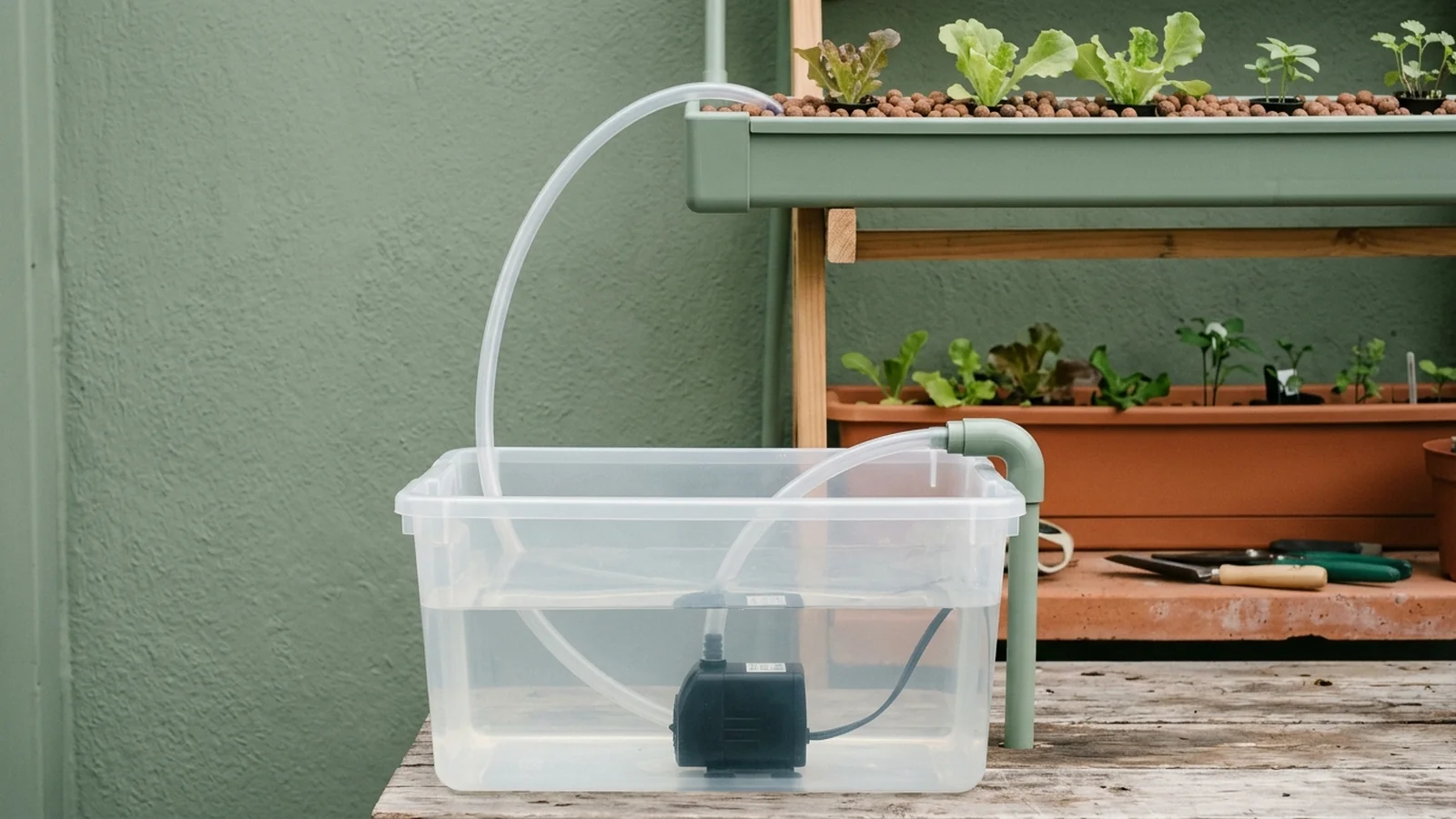
Why a pump's GPH rating falls as soon as it has to lift water
The GPH figure on a submersible pump's box is measured with no vertical lift at all. The moment that pump has to raise water, flow drops along a curve specific to that model, reaching zero at its maximum head.