Common organic fertilizer inputs, by release speed
| Release speed | Common inputs | Typical N-P-K |
|---|---|---|
| Rapid | Blood meal, fish meal | Blood meal about 12% N; fish meal about 6-12% N, 3-7% P₂O₅ |
| Moderate | Bone meal, kelp meal, compost | Bone meal 1-6% N, 11-30% P₂O₅; kelp meal about 1-1.5% N, 5-10% K₂O; compost about 1-3% N |
| Very slow | Sawdust, straw | Nutrient content is low and release depends on how long decomposition takes in the mix |
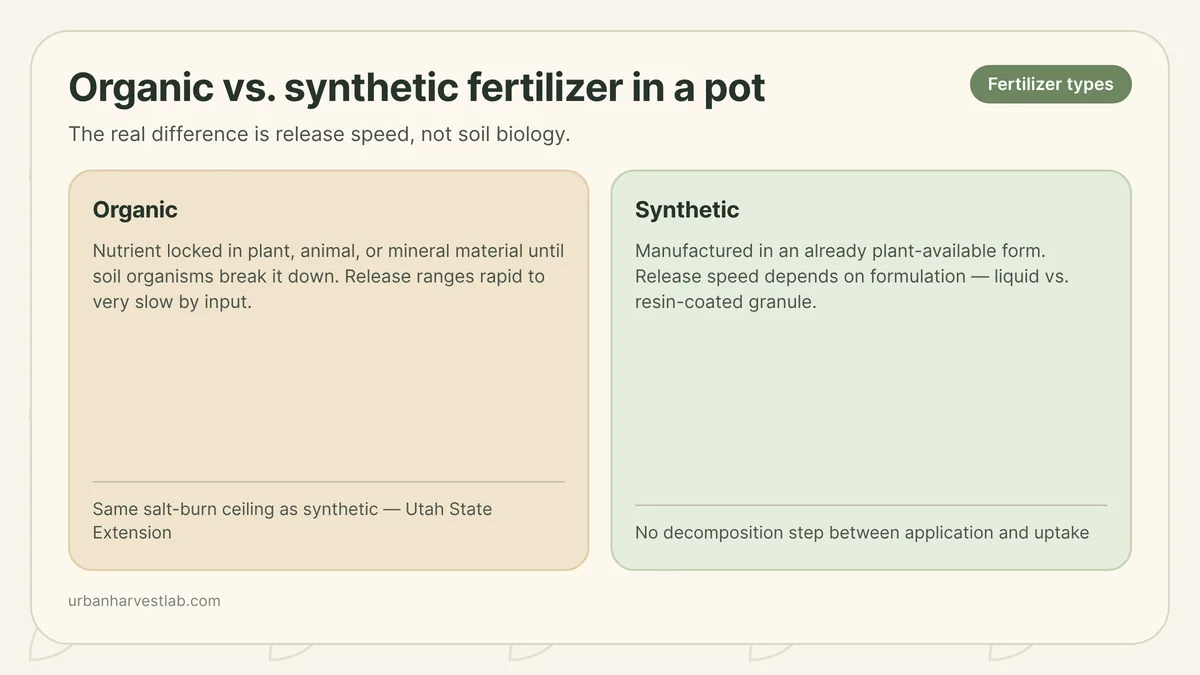
In a container, organic and synthetic fertilizer differ mainly in release speed, not in a soil-biology advantage for one over the other. Both carry the same salt-burn risk when overapplied, and the one soil benefit extension sources actually document for organic fertilizer is structural: more organic matter and better physical properties in the mix, not a nutrient-availability or yield advantage they claim to have measured. That is a narrower claim than most fertilizer marketing implies, and it is worth knowing before you pick a side.
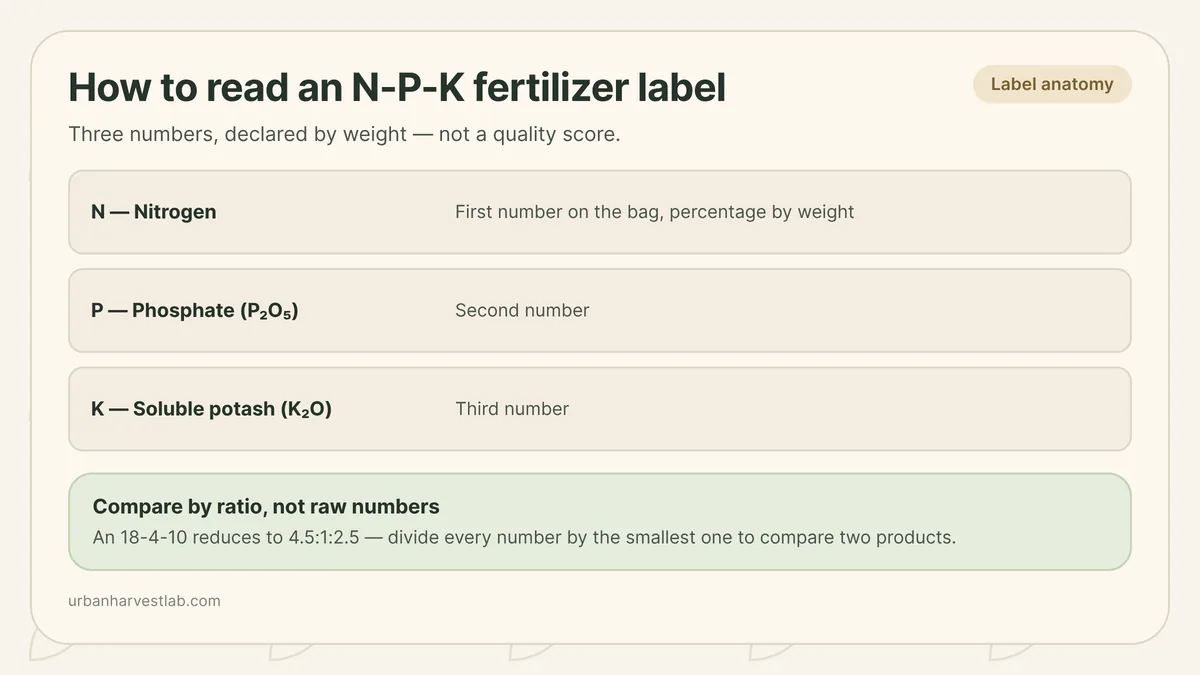
Start with what the three numbers on any fertilizer label actually mean, because that reading applies to organic and synthetic products equally. Everything below assumes you already know what N-P-K is telling you.
What “organic” and “synthetic” mean on a bag
Organic fertilizer is a plant, animal, or mineral-derived material — blood meal, fish meal, bone meal, kelp meal, compost, and similar inputs — that has to be broken down by soil organisms before its nutrient becomes available to a root. Synthetic fertilizer is manufactured to deliver nutrient in an already plant-available form, so there is no decomposition step standing between application and uptake.
That single distinction, not a purity or safety difference, is what drives most of what follows. An organic input’s nutrient is locked inside organic matter until something eats or breaks it down; a synthetic input’s nutrient is already unlocked.
The real technical difference: release speed, not release quality
Utah State University Extension sorts common organic fertilizer inputs into three release-speed categories, and the sorting is worth knowing input by input rather than treating “organic” as one behavior. Blood meal and fish meal release rapidly, at roughly 12% nitrogen for blood meal and 6-12% nitrogen with 3-7% phosphate for fish meal. Bone meal, kelp meal, and compost release moderately: bone meal runs 1-6% nitrogen and 11-30% phosphate, kelp meal about 1-1.5% nitrogen and 5-10% potash, and compost about 1-3% nitrogen. Sawdust and straw sit at the very slow end, where nutrient content is low to begin with and release depends on how long decomposition takes inside the mix.
That is a nutrient-timing framework, not a claim that organic nutrient becomes more available, or safer, than synthetic nutrient once it is released. University of Illinois Extension puts commercial fish emulsion at an N-P-K around 2-4-1, plus calcium, magnesium, sulfur, chlorine, and sodium, which behaves in a pot the way any liquid feed does once it is dissolved.
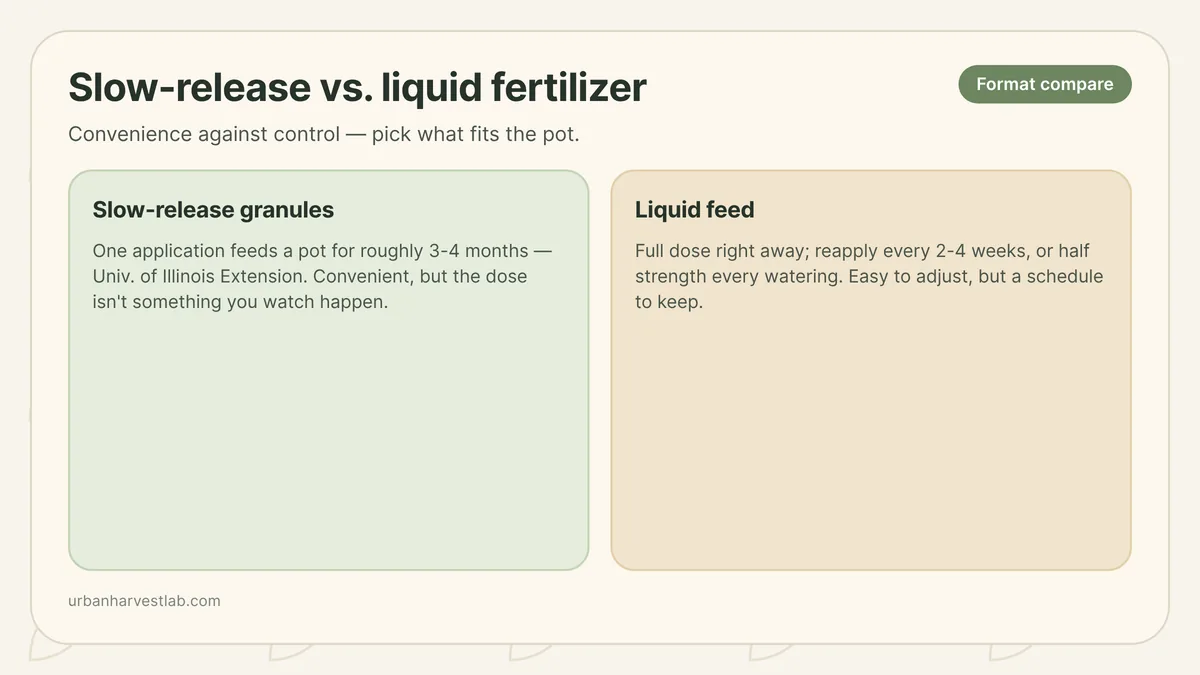
Synthetic fertilizer spans its own release-speed range, and it is the more useful axis for comparing the two categories directly. A resin-coated granular synthetic product releases slowly — University of Illinois Extension gives roughly three to four months, depending on moisture and temperature — while a synthetic liquid feed delivers its full dose immediately. Comparing slow-release and liquid fertilizer covers that mechanism directly — the practical question in front of you is release speed and application effort, not which category the bag is labeled with.
Salt burn is not a synthetic-only risk
Marketing built around “organic” often implies a gentler product, and on the specific question of burn risk, that implication does not hold. Many organic materials contain high levels of salts, and these salts will burn plants if organic materials are overapplied, per Utah State University Extension. The application ceiling the same source gives — no more than 1½ lb of nitrogen per 1,000 sq ft in a single application — is stated as applying to organic and synthetic products alike, not as an organic-specific safety margin.
In practice that means a heavy hand with blood meal or fish emulsion carries the same kind of risk as overdosing a synthetic liquid feed: scorched leaf tips, a crust on the surface of the mix, and stalled growth rather than the boost you were going for. Signs of overfertilizing herbs covers what that looks like before it gets bad enough to need a flush, and salt buildup in herb pots covers what to do once a crust has already formed. Neither guide changes based on which category of fertilizer caused the buildup.
What the extension sources actually claim for soil biology
Here is the part of the organic-versus-synthetic debate that gets the most airtime and the least support: the idea that organic fertilizer feeds soil life, unlocks more nutrient, or otherwise outperforms synthetic feed on some biological measure beyond the numbers on the bag.
Utah State University Extension’s own guidance goes this far and no further: regular use of organic fertilizers also increases soil organic matter levels, which improves soil physical properties. That is a structural claim — better aggregation, more water-holding capacity in a mix over repeated seasons — not a claim about nutrient availability or yield. It does not describe organic fertilizer as making nutrients more available, or soil microbial life more active, than a synthetic feed achieves.
That distinction matters in a container specifically. A commercial potting mix that already gets refreshed every season or two does not accumulate organic matter the way garden soil does over years, so the structural benefit organic fertilizer offers has less time to show up than it would in a bed you replace only once a decade.
Why containers make both of these matter more
A soilless potting mix, the kind most container growing uses, contains no clay or mineral particles at all — UConn Extension describes a soilless mix as containing no mineral particles, sand, silt, or clay, at all — it is built from peat, coir, bark, perlite, and similar materials instead. Garden soil’s clay fraction is what gives it a reserve capacity to hold onto dissolved nutrient between waterings; a soilless mix does not have that fraction, so there is comparatively little in the medium itself banking nutrient the way soil does.
That absence is why release speed and salt load land harder in a pot than they do in open ground. Nutrient that a slow organic input has not yet released is not doing anything, and nutrient that has already released — from either category — is either taken up, stuck to the mix loosely, or gone the next time the pot drains. University of Illinois Extension notes that frequent container watering leaches nutrients for exactly this reason, which is why a feeding plan for a pot needs a schedule rather than a single seasonal application. A container-vegetable fertilizer schedule sets that rhythm up crop by crop.
If the goal is specifically to build organic matter into a container mix over time, how much compost to add to potting mix and worm castings in a container mix are both moderate-to-slow organic inputs that deliver the structural benefit directly, alongside whatever nutrient they release.
Picking one for the pot in front of you
None of this requires choosing a side. A fast-growing, frequently harvested crop in active growth often responds well to a quick-release input, organic or synthetic, because the plant is using nutrient as fast as it becomes available. A container you check rarely is a better fit for a slow-release product, whether that is a resin-coated granule or a moderate-release organic input like bone meal or compost. What both categories require in the same way is respecting the label rate, tracking what is already in the pot, and not stacking a second feed on top of one that has not finished releasing yet.
The category on the bag tells you where an input’s nutrient came from and roughly how fast it will show up. It does not, on the evidence extension sources actually publish, tell you that one category is safer from burn or better for the plant once the nutrient is in the root zone.
Sources
- Utah State University Extension — Selecting and Using Organic Fertilizers
- University of Illinois Extension — Scale up your garden’s health with fish emulsion fertilizer
- Clemson Cooperative Extension, HGIC — Reading a Fertilizer Label
- UConn Extension, Home Garden Education Office — Potting Media
- University of Illinois Extension — Fertilizing (Container Gardens)
If you are choosing between organic and synthetic feed
These guides cover the label math, the release-speed choice, and what overfeeding looks like once you have picked a product.
Common questions
Is organic fertilizer better than synthetic fertilizer for potted plants?
Not in the way the marketing implies. Extension guidance sorts organic materials by how fast they release nutrient, not by a soil-biology or nutrient-availability advantage over synthetic feed. The one benefit that holds up is structural: regular organic fertilizer use raises soil organic matter and improves the mix's physical properties, which is a real reason to use it but a narrower one than most gardeners expect.
What is the actual difference between organic and synthetic fertilizer?
Organic fertilizer is a plant, animal, or mineral material such as blood meal, fish meal, bone meal, kelp meal, or compost that must break down before its nutrient becomes available, so release ranges from rapid to very slow depending on the material. Synthetic fertilizer is manufactured to a specific, already-available nutrient form, so its release speed depends on the product's formulation (liquid versus resin-coated granule) rather than on decomposition.
Can organic fertilizer burn plants the way synthetic fertilizer can?
Yes. Organic materials can carry high levels of salts, and applying too much of them burns plants the same way an overapplied synthetic product does. The application ceiling Utah State University Extension gives, no more than 1½ lb of nitrogen per 1,000 sq ft in a single application, is stated for organic and synthetic fertilizer alike, not as an organic-specific safety margin.
Does organic fertilizer improve soil biology more than synthetic fertilizer does?
Extension guidance used here supports a narrower claim than that. Regular organic fertilizer use increases soil organic matter, which improves the soil's physical properties over time. That guidance does not describe organic fertilizer as making nutrients more available, or soil microbial life more active, than a synthetic feed achieves.
Related guides
Slow-release vs. liquid fertilizer: which one fits your container
Granular slow-release and liquid fertilizer solve different problems in a pot. Here is how each one actually releases nutrient, and which situation calls for which.
How to read an NPK fertilizer label for herbs
The three numbers on a fertilizer bag tell you exactly what's inside by weight, nothing about whether your herbs need it. Here's how to read them and compare products correctly.
Best fertilizer for herbs in pots: a label-first guide
A practical, label-first guide to complete liquid and controlled-release fertilizers for potted herbs, with a decision table and a safer first application.