
Small aquaponics versus plain hydroponics at home
| Question | Aquaponics | Plain hydroponics |
|---|---|---|
| What feeds the plants | Nitrate from fish waste, plus added iron, potassium or calcium if they run short | A mixed nutrient solution |
| Before the first plant | A cycling period of 10 days to 3 weeks fishless or 4 to 6 weeks with fish | Plants can go in once the solution is mixed |
| What can go wrong fast | Ammonia or nitrite build-up, low oxygen, a chlorinated refill | Low oxygen, pH drift, algae |
| Pest control | Most chemical controls are off the table because they can harm the fish | More options |
| Extra reward | Fish, and a system that is a hobby in its own right | Simpler, cheaper to run |
A small aquaponics setup works, but only after a start-up period that New Mexico State University Extension puts at 10 days to 6 weeks, and it adds fish care to everything hydroponics already asks of you. Fish waste is converted by bacteria into nitrate that feeds the plants, and the plants clean the water for the fish. Choose it if the fish are part of the appeal. If you only want salad, plain hydroponics is simpler.
If you are still weighing soil against water-based growing, start with hydroponics versus soil. If you only want to pour old aquarium water on a pot, that is a separate and much lighter question, covered in using aquarium water on plants.
Is it worth setting up at home?
The Southern Regional Aquaculture Center (SRAC) publishes an extension fact sheet on small-scale aquaponics, written with Mississippi State, Virginia State and Texas A&M extension. It is plain about the limits: a small system “cannot provide all the food a family requires,” though it can be a healthy source of food and a worthwhile hobby. It also makes the point that decides most cases. Without a fish species you plan to harvest, SRAC says it is more economical to run a pure hydroponic system for the plants.
So the question is not whether aquaponics beats hydroponics at growing greens. It is whether you want fish. If you do, read on. If you do not, the hydroponic system comparison will get you growing sooner.
One caution about scale. SRAC’s “small-scale” tanks run under 500 gallons, with 300 gallons the average. A countertop tank is far smaller than that, so treat the fish and feed ratios below as the extension benchmark rather than a promise for a desktop unit.
How the nitrogen cycle feeds the plants
Fish excrete ammonia, mostly through their gills. New Mexico State University (NMSU) Extension describes what happens next: Nitrosomonas bacteria convert ammonia to nitrite, then Nitrobacter bacteria convert nitrite to nitrate. Both steps use oxygen and lower the pH. The nitrate is not toxic to fish and is what the plants take up.
The two steps in between are the danger. New Mexico State University Extension says un-ionized ammonia is extremely toxic to fish and that nitrite is toxic at 5 ppm, with tilapia kept at 1 ppm or below. NMSU also shows that the toxic share of ammonia depends on pH and temperature: at 82°F, about 2% at pH 7.5 but 18% at pH 8.5. A rising pH makes the same ammonia reading more dangerous.
Cycling: the wait before the first plant
NMSU is direct that cycling is the first step of any aquaponics setup, and that until a healthy community of nitrifying bacteria exists, growing plants is not possible. There are two routes.
With fish: 4 to 6 weeks, per New Mexico State University. Stock lightly and feed lightly so ammonia cannot build to a level that kills them. Test ammonia and nitrite daily. If nitrite climbs above 1 ppm, NMSU says to remove up to a third of the water and replace it with dechlorinated water at the same temperature and pH.
Without fish: 10 days to 3 weeks, per New Mexico State University. You feed the bacteria with a source of ammonia instead. NMSU lists liquid ammonia or ammonium chloride and warns that the ammonia must be pure, with no perfumes, soaps or additives, because those harm the system. Stop adding it once the fish arrive.
Either way, the system is ready when nitrate appears and ammonia and nitrite have both dropped to 0.5 ppm or lower. After that, NMSU says weekly testing is usually enough.
Choosing fish
SRAC builds its fact sheet around tilapia, which tolerate a broad range of water quality, but notes they grow slowly below 68°F, may start to die at 55°F to 45°F, and grow best near 85°F. Local rules may restrict them, so SRAC advises checking with your state fish regulator or Cooperative Extension office. NMSU groups goldfish with the warm-water species that prefer 65 to 85°F, and trout with the cold-water group at 55 to 65°F.
The practical rule from SRAC is to match fish and plants on temperature. A warm-water fish such as tilapia pairs with a warm-season crop such as basil. The Southern Regional Aquaculture Center puts the shared range for warm-water fish and warm-season plants at 72°F to 90°F, and 50°F to 68°F for winter crops with cool-water species.
For stocking, SRAC calls one pound of fish per 10 gallons a common final density at harvest for new growers. Start well below that, as NMSU advises for cycling. SRAC adds that fish should not be handled unless required, and that tanks need a cover to stop jumping, keep out birds and reduce algae, and to protect small children and pets from drowning.
What grows, and how it is set up
SRAC says culinary herbs and leafy greens perform well and suit beginners. Its examples are lettuce, basil, Swiss chard, pak choi and watercress, which have lower nutrient needs than fruiting crops such as peppers, cucumbers and tomatoes.
For a first system, SRAC calls the media bed easy and inexpensive to set up. The bed holds media that supports roots and doubles as a biofilter and solids filter. It lists river rock tested free of limestone, expanded clay pebbles and vermiculite among common media; limestone raises alkalinity and pH. The growing media comparison covers what each material does to roots. Two practical points from SRAC: transplant started seedlings, because direct seeding does not work well, and clean the media periodically or it clogs and develops oxygen-free zones.
Feed the fish, and the fish feed the plants. SRAC’s general guideline is 2 to 4 ounces of fish food per 10 square feet of plant area. Even so, iron, potassium and calcium may run short in a balanced system. NMSU supplements iron at 2 mg/L of chelated iron every 3 weeks or as needed, and SRAC lists chlorosis, tip burn and yellow leaves as the signs of a shortfall.
Water, oxygen and pH
Oxygen. SRAC wants dissolved oxygen above 5 ppm for fish, plants and bacteria, with supplemental aeration, and notes that oxygen dissolves less as water warms. The dissolved oxygen guide explains what warm water does and does not change.
pH. SRAC recommends 6.5 to 7.5, and often 6.8 to 7.2 as a compromise, because plants take up some nutrients better when slightly acidic while bacteria nitrify better in slightly alkaline water. Nitrification itself lowers pH, so SRAC notes many systems need a base added over time. That compromise sits above the pH range a plain hydroponic reservoir targets, so do not carry hydroponic numbers across.
Refilling. SRAC says small systems lose 1 to 5 percent of their water a day to evaporation, transpiration, plant uptake and splashing. Chlorine and chloramine can harm the organisms in the system. SRAC suggests letting chlorinated water stand, or using 500 milligrams of ascorbic acid per 50 gallons of reservoir water to remove chloramines quickly. The chlorine and chloramine guide explains why standing water does not clear chloramine.
Pests. SRAC says most chemical pest controls should not be used in aquaponic systems because they can harm the fish. Sticky cards and scouting under leaves are its starting points.
Winter. SRAC warns that tropical fish need warm water, and that temperate fish can be harmed by toxic nitrogen if they are fed without actively growing plants.
Food safety for crops you eat raw
This is where aquaponics differs most from a hydroponic reservoir, because the water has fish in it. The CDC states that tank water and items in tanks can be contaminated with germs. It advises washing hands after feeding fish or handling their supplies, wearing gloves when caring for a tank, and notes that children younger than 5, adults 65 or older, and people with weakened immune systems are more likely to get severe illness from germs fish can carry. For people with weakened immune systems, the CDC says to let others in the household care for the tank when possible. The aquarium water page draws the same conclusion for pots: skip raw salad crops, and in those households use tank water on ornamentals only. Aquaponics is consistent with that advice. It adds the CTAHR harvest protocol below, but washing does not eliminate bacteria (FDA), so the protocol lowers risk without removing it. For those higher-risk households, the cautious choice is plain hydroponics, or aquaponic crops that get cooked rather than eaten raw.
The University of Hawaii (CTAHR) extension publication on aquaponics food safety turns that into harvest habits:
- Use potable city or well water. Streams, reservoirs and rooftop rainwater can carry significant zoonotic pathogens from animals.
- Do not touch the raft, the roots or the water under them while harvesting, because that puts bacteria on your hands and then on the crop.
- Keep warm-blooded animals away, using netting and a raised tank, and cull plants soiled by droppings.
- Rinse the crop only in potable water, and not in aquaponic system water.
- Wear gloves when handling fish.
The University of Vermont Extension adds a general rule for hydroponic and aquaponic produce: prevent contact between production water and surfaces that touch food where possible, and clean and sanitize any that are touched. Washing is a reduction step, not a guarantee, as the FDA notes for produce in general.
Which to pick
- Aquaponics if you want fish, are happy to test water daily during start-up, and are growing leafy greens or herbs.
- Plain hydroponics if you want salad with the least fuss, or if the household includes children under 5, adults 65 or older or anyone with a weakened immune system, groups the CDC flags as higher risk. In those homes, grow crops you cook if you do keep fish.
- A pot and a watering can if the aim is to use up aquarium water: see the aquarium page above, not a new build.
Sources
- New Mexico State University Extension, Important Water Quality Parameters in Aquaponics Systems (Circular 680)
- SRAC Publication 5007, Principles of Small-Scale Aquaponics (Mississippi State, Virginia State, Texas A&M AgriLife Extension)
- CDC, Fish: Healthy Pets, Healthy People
- University of Hawai’i CTAHR, On-Farm Food Safety: Aquaponics (FST-38)
- University of Vermont Extension, Produce Safety in Hydroponic and Aquaponic Operations
- U.S. FDA, Selecting and Serving Produce Safely
Water, oxygen and system choices
Aquaponics borrows from hydroponics, so these pages cover the parts the two share.
Common questions
Does a small aquaponics system at home really work?
Yes, once the bacteria that convert fish waste to nitrate are established, which New Mexico State University puts at 4 to 6 weeks with fish or 10 days to 3 weeks without. It will not feed a household: the Southern Regional Aquaculture Center fact sheet says a small-scale system cannot provide all the food a family requires.
How long before I can plant in a new aquaponics system?
Until ammonia and nitrite have both fallen to 0.5 ppm or lower and nitrate shows up in tests. New Mexico State University gives 4 to 6 weeks when cycling with fish and 10 days to 3 weeks when cycling without fish.
What grows best in a small aquaponics system?
Leafy greens and culinary herbs. The Southern Regional Aquaculture Center lists lettuce, basil, Swiss chard, pak choi and watercress as good choices for beginners, with lower nutrient needs than fruiting crops such as peppers, cucumbers and tomatoes.
Is it safe to eat salad from an aquaponics system?
The CDC says tank water can be contaminated with germs, so treat aquaponic greens as higher-risk raw produce. University of Hawaii extension advises not touching the water or roots when harvesting and rinsing the crop only in potable water, and the FDA notes washing will not eliminate bacteria. The CDC names children under 5, adults 65 or older and people with weakened immune systems as more likely to get severe illness from germs fish carry; in those households the cautious choice is plain hydroponics, or aquaponic crops that are cooked rather than eaten raw.
Related guides

Rockwool vs clay pebbles vs coco vs foam: which hydroponic medium fits
The four media most home growers choose between behave very differently: one needs a pH soak, one drains in seconds, one carries salt, one falls apart. Here is which fits which system.
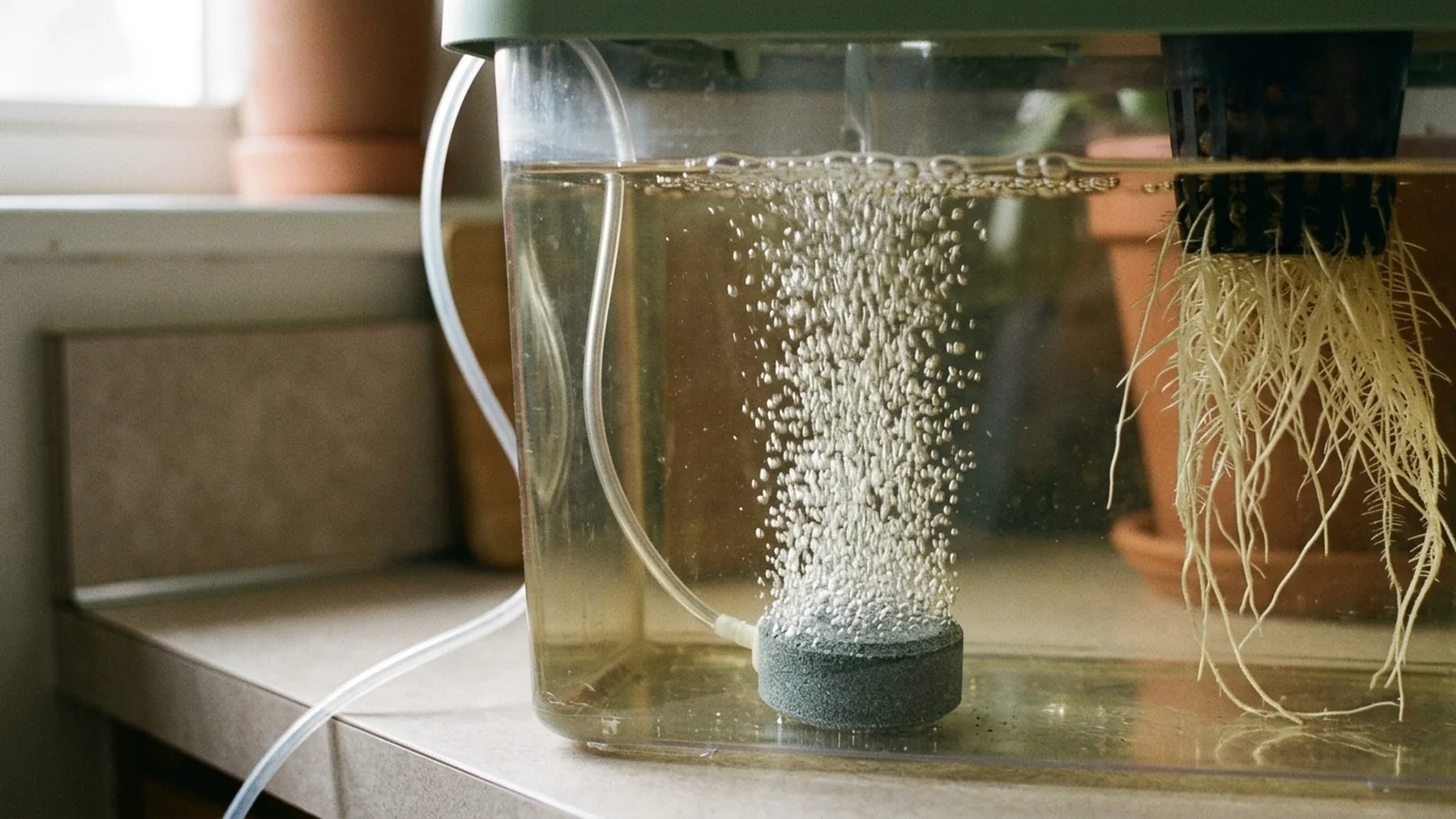
Dissolved oxygen in small hydroponic systems
Roots breathe oxygen dissolved in the water around them, not the air above it. Here are the actual targets, what temperature really does to that oxygen, and how to check yours without a lab meter.
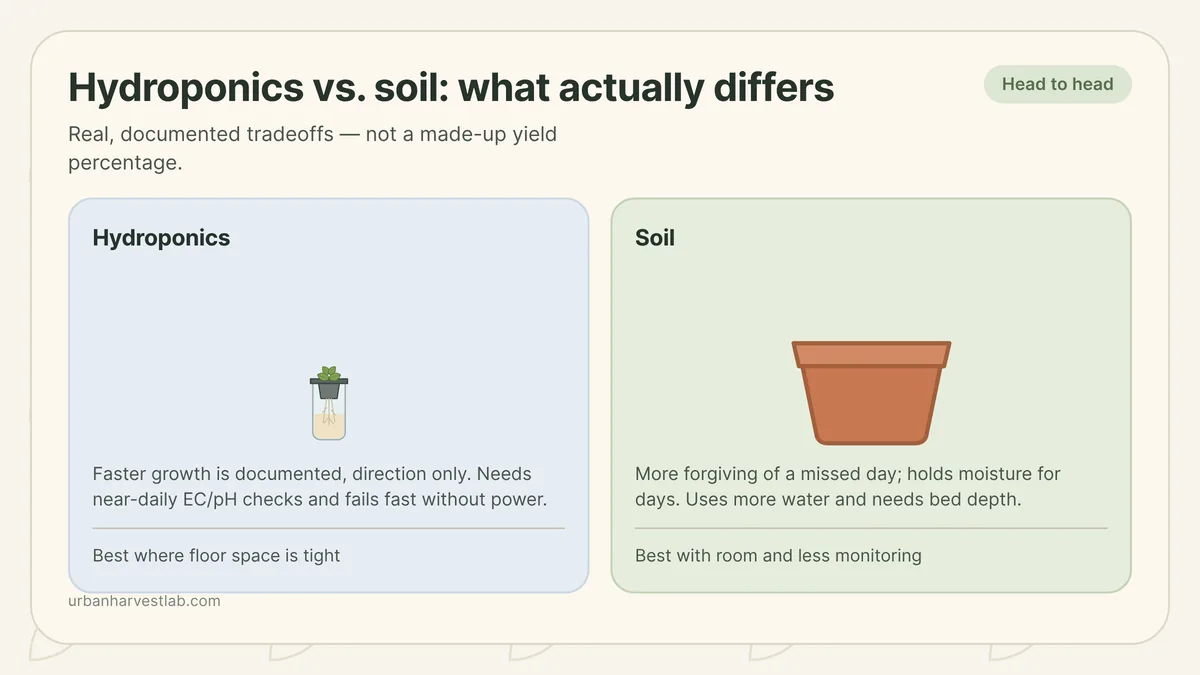
Hydroponics vs soil: what actually differs, with the evidence behind each claim
Hydroponics and soil differ in real, documented ways, but a single head-to-head yield percentage is not one of them. Here is what university extension research actually measured.