
Which tank water is worth using on plants
| Tank water | Use on plants? | Why |
|---|---|---|
| Established freshwater, no medication | Yes, on soil | Contains nitrate made from fish waste; a partial feed |
| New or still-cycling tank | Skip or use sparingly | Ammonia is not yet fully converted to nitrate, the step NMSU describes |
| Saltwater or brackish | No | Dissolved salts accumulate in the pot and scorch leaves |
| Freshwater with aquarium salt or other additives | Not on edibles | Salt adds to buildup; skip additives on edibles as a precaution |
| Recently medicated water or water with additives | No | Made for fish, not food crops; skip as a precaution |
Water from an established freshwater tank is a mild, incomplete feed that is fine on houseplants and ornamentals. It carries nitrate made from fish waste. Skip it if the tank is saltwater, if you have medicated the tank, or if the plant is a salad crop you will eat raw.
It sits in the same family as the other kitchen-adjacent feeds, and like them it works better as an occasional extra than as a plan. If you want a feed you can measure, start with a label-first guide to fertilizer for herbs in pots. For growing herbs on a small footprint in general, see the small-space herb gardening hub.
Nitrate from fish waste, and what is missing
Fish excrete ammonia. In a tank with a working filter, bacteria convert it to nitrite and then to nitrate. New Mexico State University’s aquaponics circular puts the last step plainly: “The non-toxic nitrate produced in this reaction serves as plant nutrients.” That is the real reason old tank water helps a plant. Nitrogen is the nutrient leafy growth runs on, and tank water delivers some of it in a form roots take up directly.
What it does not deliver is a full diet. The aquaponics fact sheet from Mississippi State, Oklahoma State, Virginia State and Texas A&M extension notes that “even in a balanced system some nutrients such as iron, potassium, and calcium may be deficient.” That sheet covers a system built to feed plants all day long, and it still runs short. A bucket of weekly water change is a smaller dose again. The deficiency symptoms it lists, chlorosis, tip burn and yellow leaves, are what you would expect on a plant leaning on tank water alone.
A home tank’s nitrate level swings with stocking, feeding and water-change timing. So there is no dose to calculate. Treat it as a light watering with a little feed in it.
For comparison, University of Illinois Extension describes a typical fish emulsion as roughly 2-4-1 in N-P-K. That is a product with a ratio you can read. Tank water has no label. The fish emulsion and seaweed page covers what a labelled fish-based feed does.
Which tanks to rule out
Saltwater and brackish tanks. Colorado State University Extension says potting-mix salts come from “the potting mix, fertilizers or high salts in the water used to irrigate the plants,” and lists “wilting, yellowing, and marginal and tip burn of leaves” as the symptoms. Seawater-strength water is the extreme case of high-salt water. Tip burn on a basil plant is the likely result, and the salt stays in the pot after the water drains.
Freshwater tanks dosed with aquarium salt. The same logic applies at a lower level. Salt you add to the tank ends up in the water you pour out.
Tanks with medication or additives. Aquarium medications are made and labelled for fish, not food crops, so keeping that water off anything you eat is a precaution rather than a tested rule. Pour medicated water down a drain rather than onto plants.
New or unstable tanks. A tank that is still cycling has not finished converting ammonia to nitrate, the step NMSU describes above. Use water from a tank that has run steadily.
Germs, hands and raw salad crops
The CDC states that “tank water and items in tanks can be contaminated with germs.” It advises wearing gloves when caring for an aquarium, especially with cuts on your hands, and washing your hands afterwards. It also suggests dumping tank water in a bathtub, laundry sink or outdoors rather than a kitchen sink, and disinfecting the sink afterwards.
For plants you eat, that points to a simple rule set:
- Pour at the base, onto the soil, and keep it off leaves and stems.
- Keep it for herbs and vegetables you cook, not for salad crops you eat raw, and skip tanks dosed with medication or additives.
- Wash your hands after, and wash the container you carried it in.
- Rinse the harvest as you would any other.
Those steps are common-sense hygiene built on the CDC’s tank-water guidance rather than a tested protocol for garden use. The CDC notes that children under 5, adults 65 or older and people with weakened immune systems are more likely to get severely ill from germs fish carry, so in those households use tank water on ornamentals only.
How to use it without causing a new problem
Because it contains some nutrient, count a tank-water watering as a light feeding. On the weeks you use it, skip or halve your regular fertilizer. Stacking both is how people end up with the signs of overfertilizing.
Pour until water runs from the drainage hole, then empty the saucer. Water that sits in a saucer wicks salts back up into the soil, which Colorado State names as one route to a surface crust. If a white crust forms anyway, Colorado State University Extension says to remove the visible crust first; University of Maryland Extension then says to “pour a lot of water — at least twice the volume of the pot” through and let it drain, and to leach routinely every four to six months. The salt buildup page walks through when to flush and when to repot.
Where it stacks up
Tank water is cheap and it saves a trip to the drain. It is not worth chasing. If a plant is yellowing or stunted, check watering, light and the age of the potting mix before blaming a missing pinch of nitrate, and use a measured feed for a real deficiency. The same holds for banana peel water: a pleasant reuse habit, not a program.
Sources
- New Mexico State University Extension, Important Water Quality Parameters in Aquaponics Systems
- SRAC Fact Sheet 5007, Principles of Small-Scale Aquaponics (Mississippi State, Oklahoma State, Virginia State, Texas A&M AgriLife Extension)
- CDC, Fish: Healthy Pets, Healthy People
- Colorado State University Extension, PlantTalk 1338: Whitish Crust on Potting Mixes
- Colorado State University Extension, PlantTalk 1339: Leaching Salts From Potting Mixes
- University of Maryland Extension, Watering Indoor Plants
- University of Illinois Extension, Fish emulsion fertilizer
Feeding potted herbs properly
Aquarium water is one of several kitchen-adjacent feeds, and these pages cover the measured alternatives.
Common questions
Is aquarium water good for plants?
Water from an established, unmedicated freshwater tank is usable on houseplants because fish waste is converted to nitrate, which plants take up. It is not a complete fertilizer, so treat it as a light supplement.
Can you use saltwater aquarium water on plants?
No. Salts in irrigation water accumulate in a pot and cause leaf scorch and wilting, according to Colorado State University Extension, and seawater is a far saltier water than most gardeners irrigate with.
Can I water vegetables and herbs with fish tank water?
Only from a freshwater tank that has had no medication or additives such as aquarium salt, poured onto the soil rather than the leaves, with hands washed afterwards. The CDC notes tank water can be contaminated with germs, so skip it on salad crops eaten raw; on herbs and cooked vegetables, pour it on the soil only.
How often can I water plants with aquarium water?
There is no set schedule: use the water from a regular water change in place of a normal watering, and skip or halve your usual fertilizer that week.
Related guides
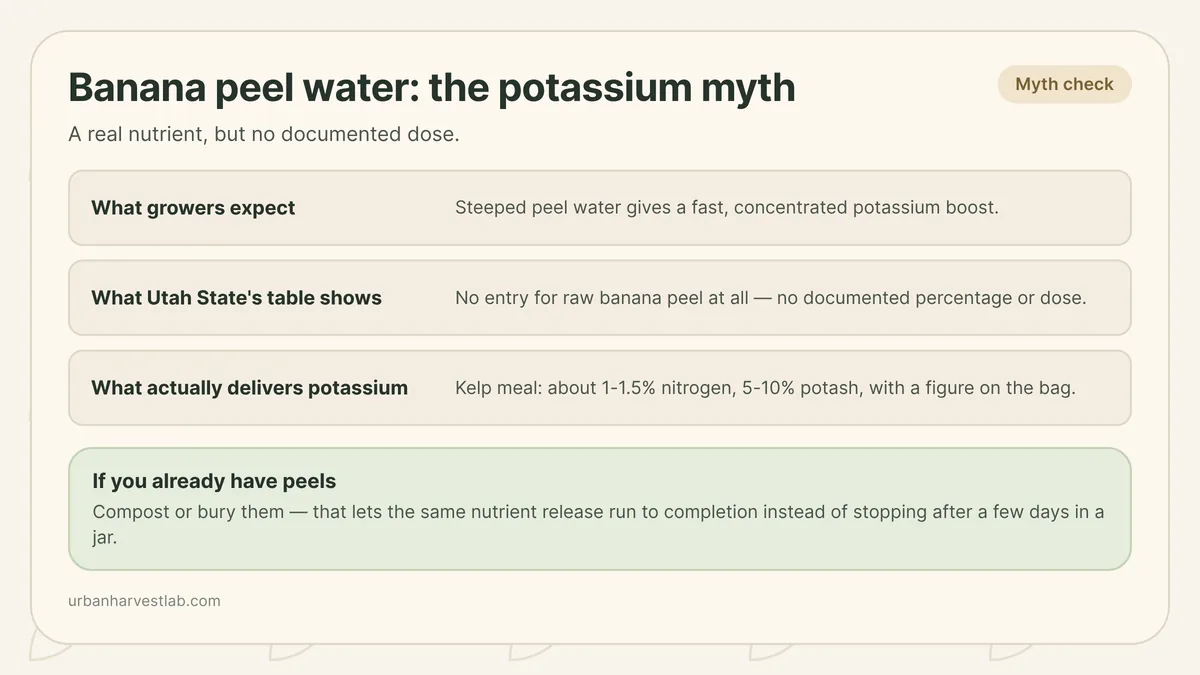
The banana peel water myth: what it actually feeds your plants
Soaking banana peels in water is a popular DIY feed, but Utah State's organic-fertilizer table has no entry for it, and the mechanism explains why the soak barely helps.
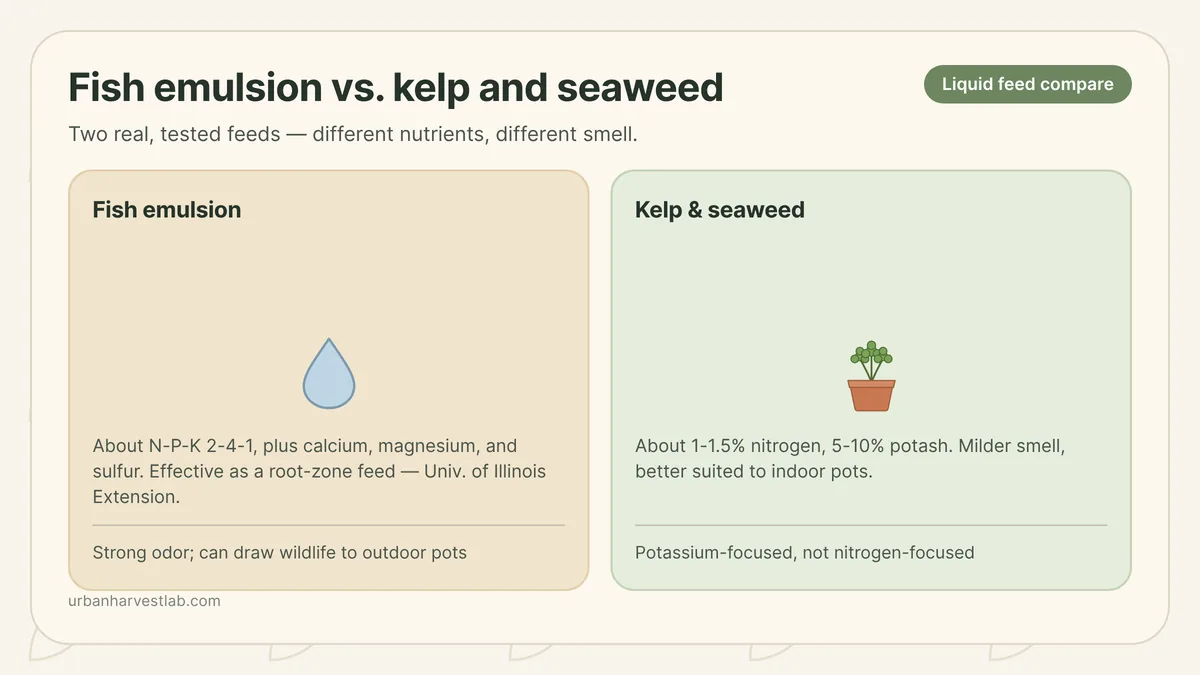
Fish emulsion and seaweed for herbs: what they actually do
Fish emulsion and seaweed products are genuine fertilizers with a documented N-P-K profile, but two of their most repeated claims do not hold up under testing, and the smell changes where you should use them.
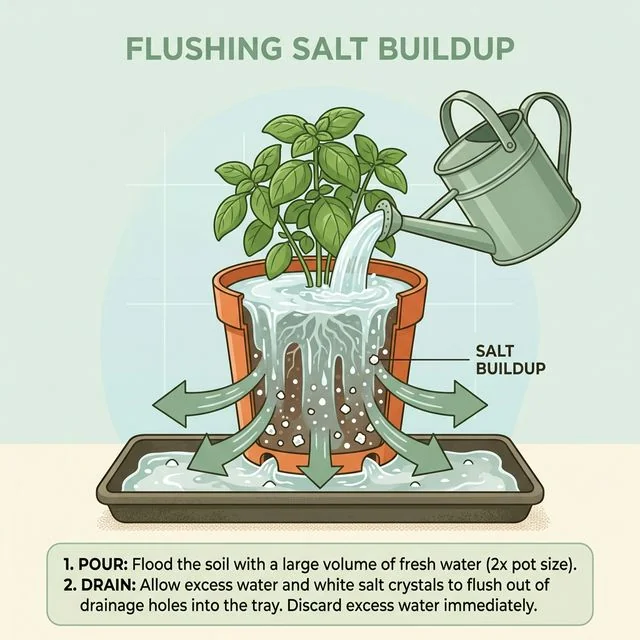
Salt buildup in herb pots: when to flush and when to repot
Every time you water your plants with liquid fertilizer, you are leaving heavy chemical salts behind. If you don't periodically wash them out, your herbs will suffer from chemical burn and nutrient lockout.