
Four common hydroponic media, as rated by UF/IFAS Extension
| Medium | Starting pH | Water-holding | Aeration | Reusable |
|---|---|---|---|---|
| Rockwool | Slightly basic (7 to 8.5) | High | Good to fair | No (Southern University describes heat treatment for reuse) |
| Expanded clay pebbles | Neutral | Low | Good | Yes, after washing and sterilising |
| Coco coir | Near-neutral to slightly acidic (5.5 to 6.8) | High | Good | No |
| Foam cubes | Neutral | High | Good | No |
Choose by how much water your system needs the medium to hold. Rockwool and foam cubes hold a lot and suit seed starting and slow-draining setups. Expanded clay pebbles hold very little, so they suit flood-and-drain beds and net cups where roots reach the water below. Coco coir holds plenty but brings salt and nutrient-binding quirks, and it does not belong in a recirculating reservoir.
The medium does three jobs: it anchors the plant, it holds a little water and air around the roots, and in a good hydroponic medium it stays out of the chemistry. UF/IFAS Extension describes the ideal as an “inert” material, one that is chemically inactive, so every nutrient comes from the solution you mix. How far each medium falls short of that ideal is the real comparison. Start with the system you run, covered in NFT vs DWC vs Kratky, because it narrows the field fast.
The three properties that separate them
UF/IFAS Extension lists pore space, water-holding capacity, aeration, cation exchange capacity (CEC) and pH as the properties that matter. Pore space is the gap between particles. More of it means more room for water and air; larger particles drain better but hold less water. Roots need both, so the best medium for a given system balances the two.
CEC is the ability to grab and release positively charged nutrient ions. In hydroponics, UF/IFAS says media with no or low CEC are desirable, because nutrients then go straight to the plant instead of binding to the medium. A medium with CEC can store nutrients or lock some away, and the feeding programme has to allow for it.
Starting pH matters because the medium can push the reservoir off target. UF/IFAS Extension notes that the pH of the media can influence the overall pH of the nutrient solution. If your reservoir keeps drifting, why hydroponic pH keeps rising is worth ruling out first.
Rockwool: high water-holding, needs a pH soak
Rockwool is spun from rock, heated until it forms fibres, then pressed into cubes and slabs. UF/IFAS Extension rates it high for water-holding capacity and good for aeration, with no CEC, so it stays out of the nutrient chemistry once it is conditioned.
The catch is pH. UF/IFAS gives rockwool a neutral to slightly basic pH of 7 to 8.5, and Southern University Extension puts typical cubes at about 8.0, which makes many nutrients unavailable. Southern University advises soaking cubes in pH-adjusted water to reach 5.5 to 6.5 before planting. UF/IFAS’s lettuce guide says most rockwool products need a prepared pH buffer soak to remove their natural alkalinity, and Cornell’s lettuce programme moistens its rockwool plugs with a nutrient solution at a relatively low pH such as 4.5 to remove pockets of high-pH contaminants. University of Kentucky pre-charges rockwool plugs with a balanced fertilizer at EC 1.0 mS/cm and pH 5.5 to 6.0 before seeding, and University of Minnesota Extension’s general rule for any substrate is to soak it in water for 24 hours and change the water before planting. The sources differ on the exact recipe, so follow the instructions on the cubes you bought.
Other points from the extension sources:
- UF/IFAS notes rockwool is sterile before use but can be prone to algal growth. If green growth shows up, algae in a reservoir covers the fix.
- Southern University advises wearing protective gear when handling it.
- UF/IFAS says rockwool is not biodegradable and that disposal is often considered a major issue. Plan for where used cubes will go.
On reuse the two extension sources disagree. UF/IFAS Extension states that rockwool cannot be reused. Southern University Extension advises heating cubes with boiling water or steam if you intend to reuse them over successive seasons. A small grower can treat that as a judgement call and decide whether the saving is worth the sanitation effort.
Expanded clay pebbles: low water-holding, reusable
Expanded clay (also sold as LECA or hydroton) is clay heated to a very high temperature. UF/IFAS’s lettuce guide describes the pellets as having a honeycomb structure inside, and UF/IFAS Extension’s media guide lists sizes from 1 to 18 mm. The size you pick sets how much air the bed holds.
UF/IFAS Extension rates its water-holding capacity as very low, so it may need more frequent watering cycles, and rates aeration as good. That is the reason clay suits ebb and flow, where the bed floods and drains on a schedule (ebb and flow for beginners), and net cups sitting just above a reservoir. It is a poor choice where a seedling needs to stay damp without a flood cycle.
Reuse is its strength. UF/IFAS says expanded clay can be washed, sterilised and reused, which it calls fairly sustainable, and adds that it is expensive enough to be used mostly by hobbyists rather than commercial producers. UF/IFAS’s summary table also rates its CEC as high, meaning it can store nutrients and salts, so rinse used pebbles before the next crop. University of Missouri Extension, by contrast, groups expanded clay with perlite, gravel, highly lignified coconut fibre and rockwool as inert media, where the reservoir’s own pH and EC apply directly at the root zone; the two sources disagree on clay, and rinsing used pebbles is sensible either way. For the cleaning routine itself, see how to clean a small hydroponic system.
Coco coir: high water-holding, with some CEC
Coco coir is the ground outer husk of coconuts. UF/IFAS Extension gives it a near-neutral to slightly acidic pH of 5.5 to 6.8 and high water-holding capacity with good aeration. Chunky grades drain and aerate more; fine grades hold more water.
Two things set it apart from rockwool and clay. First, it has CEC. UF/IFAS says it can hold on to nitrogen, potassium and phosphorus, which affects the fertilizer programme. Missouri Extension treats highly lignified coconut fibre as inert for pH and EC purposes, so how much coir interacts with the feed depends on the product. The lettuce guide from the same university adds that coir, like composted pine bark, can bind nitrogen and raise production costs. In general UF/IFAS explains that organic media with a carbon-to-nitrogen ratio above about 30:1 can compete with the plant for nitrogen as microbes break them down. Second, salt: UF/IFAS says coco coir should be washed or rinsed before use because of the high salt levels common where coconuts are grown. Washington State University Extension says modern processing has largely resolved coir’s old salt problem, but a rinse costs little and covers an unfamiliar batch.
Compressed blocks, pellets and bricks need soaking to expand before use, according to UF/IFAS’s lettuce guide. UF/IFAS also states that neither fine nor chunky coco should go into a recirculating system, because it can clog equipment. That limits coco to pots and bags that are watered from above or by drip, not DWC or NFT. If you came here from the potting-mix side, coco coir vs peat moss covers that comparison.
UF/IFAS lists coco coir as not reusable, and says organic media lose structure or degrade over time.
Foam cubes: rockwool-like, with an easier disposal story
Foam cubes, sometimes called grow foam, are made from a material similar to the foam used for flower arrangements. UF/IFAS Extension says they have properties similar to rockwool, with high pore space and good aeration, but drain slightly better and are less prone to waterlogging. Depending on the maker, they are biodegradable or partially biodegradable, which eases the disposal problem. UF/IFAS lists a neutral starting pH.
The weakness is durability. UF/IFAS says foam cubes tend to fall apart over time, so they are not ideal for slow-growing crops, and that they are not reusable. For a lettuce seedling, which University of Kentucky expects to be ready to transplant 14 to 21 days after seeding, that is fine. For a long-season fruiting plant, it is not.
Which one for which system
Match the medium to how water moves:
- Kratky and deep water culture. The roots end up in the solution, so the medium only has to hold the seedling in the net cup. A rockwool or foam cube for the first weeks, with clay pebbles packed around it if the plant needs steadying. See DWC for small spaces.
- NFT. Same logic, but the channel has pumps and narrow paths. UF/IFAS warns recirculating systems must consider the risk of clogging pumps and emitters and should not use fine or loose particle media. Keep the medium contained in the cube or cup.
- Ebb and flow. Clay’s fast drainage suits the flood-and-drain cycle.
- Pots or bags with drip or hand watering. Coco coir works here, with the rinsing and nitrogen caveats above.
- Seed starting. Rockwool or foam. The seed-sowing steps, including why surface sowing matters, are in how to germinate lettuce seeds for hydroponics.
One more consideration: UF/IFAS observes that media systems have a larger margin of error in a power outage, because the medium holds some water for some time. A medium with high water-holding capacity buys you more of that margin than clay does.
Perlite, one more option, is usually mixed with other media rather than used alone, according to UF/IFAS Extension. Whichever you pick, UF/IFAS warns that media can carry pathogens from one crop to the next, so start each planting clean, whether that means new material or properly sanitised reusable material.
Sources
- UF/IFAS Extension, Common Media Used in Hydroponics (EP623)
- UF/IFAS Extension, Growing Lettuce in Small Hydroponic Systems (HS1422)
- Southern University Agricultural Research and Extension Center, How to Use Rockwool Cubes for Germinating Seeds and Propagating New Cuttings
- University of Missouri Extension, Hydroponic Nutrient Solutions (G6984)
- University of Kentucky Center for Crop Diversification, Hydroponic Lettuce Production in Controlled Environments (CCD-CP-63)
- University of Minnesota Extension, Small-scale hydroponics
- Washington State University Extension, Kittitas County: Coconut Coir vs Peat Moss
- Cornell University CEA Program, Hydroponic Lettuce Handbook
Pick the system, then the medium
The medium has to suit how water moves through your system, so these pages cover the systems and the seed-starting stage.
Common questions
Is rockwool or clay pebbles better for hydroponics?
Neither wins outright, because they do different jobs. UF/IFAS Extension rates rockwool as high in water-holding capacity and expanded clay as low, so rockwool suits germinating seed and holding young plants steady, while clay pebbles suit flood-and-drain beds and net cups where you want fast drainage. You can combine them: a rockwool cube for the seedling, clay pebbles around it.
Do I need to adjust the pH of rockwool before using it?
Yes. UF/IFAS Extension gives rockwool a starting pH of 7 to 8.5, and Southern University Extension puts typical cubes at about 8.0 and advises bringing them down to 5.5 to 6.5 before use. Follow the soaking instructions that come with the cubes.
Can I reuse rockwool, clay pebbles or coco coir?
It depends on the medium and on the source. UF/IFAS Extension lists expanded clay as reusable after washing and sterilising, and coco coir and rockwool as not reusable. Southern University Extension says rockwool cubes can be reused across seasons if heated with boiling water or steam. Whatever you reuse, UF/IFAS warns that media can carry pathogens from the last crop.
Can I use coco coir in a DWC or NFT system?
Loose coco is a poor fit. UF/IFAS Extension says neither fine nor chunky coco coir should be used in recirculating hydroponic systems because it can clog the equipment. Coco suits pots and bags fed by drip or hand watering, not a circulating reservoir.
Related guides
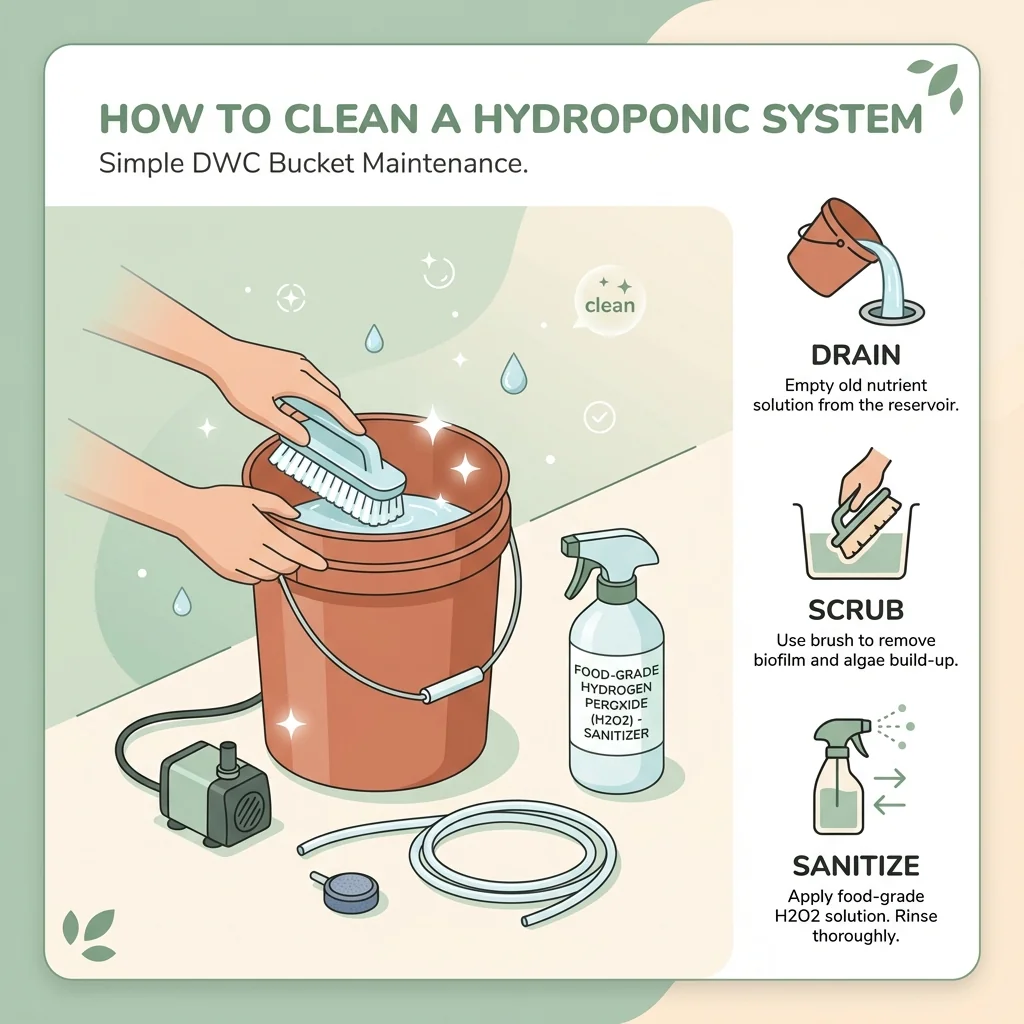
How to clean a small hydroponic system
A small hydroponic setup does not need constant chemical intervention. But between harvest cycles, a rigorous deep-clean is non-negotiable to prevent algae, mineral scaling, and deadly root rot spores from infecting your next crop. Here is the ultimate guide to system hygiene.
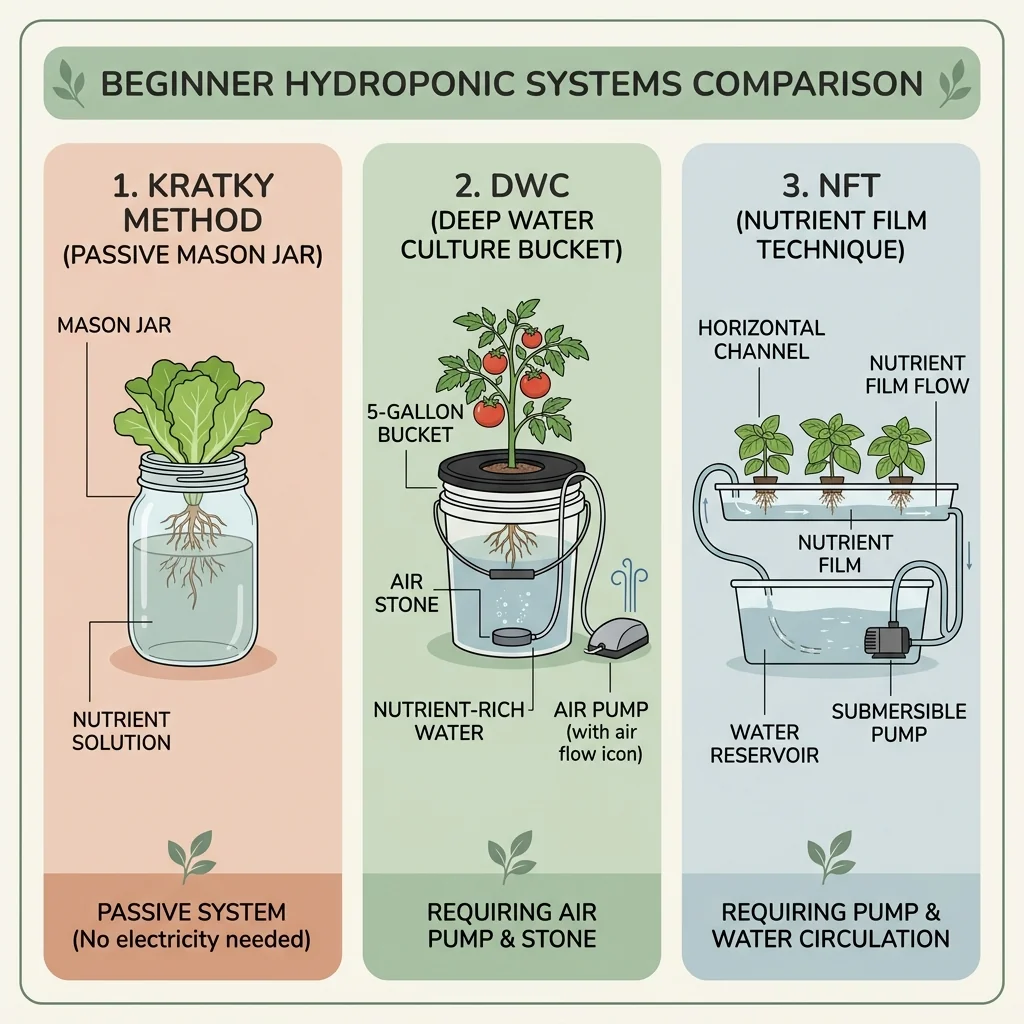
NFT vs DWC vs Kratky: which should a beginner pick?
Three systems dominate small-space hydroponics: Kratky, DWC, and NFT. This comparison shows how they differ and which one a beginner should actually start with.
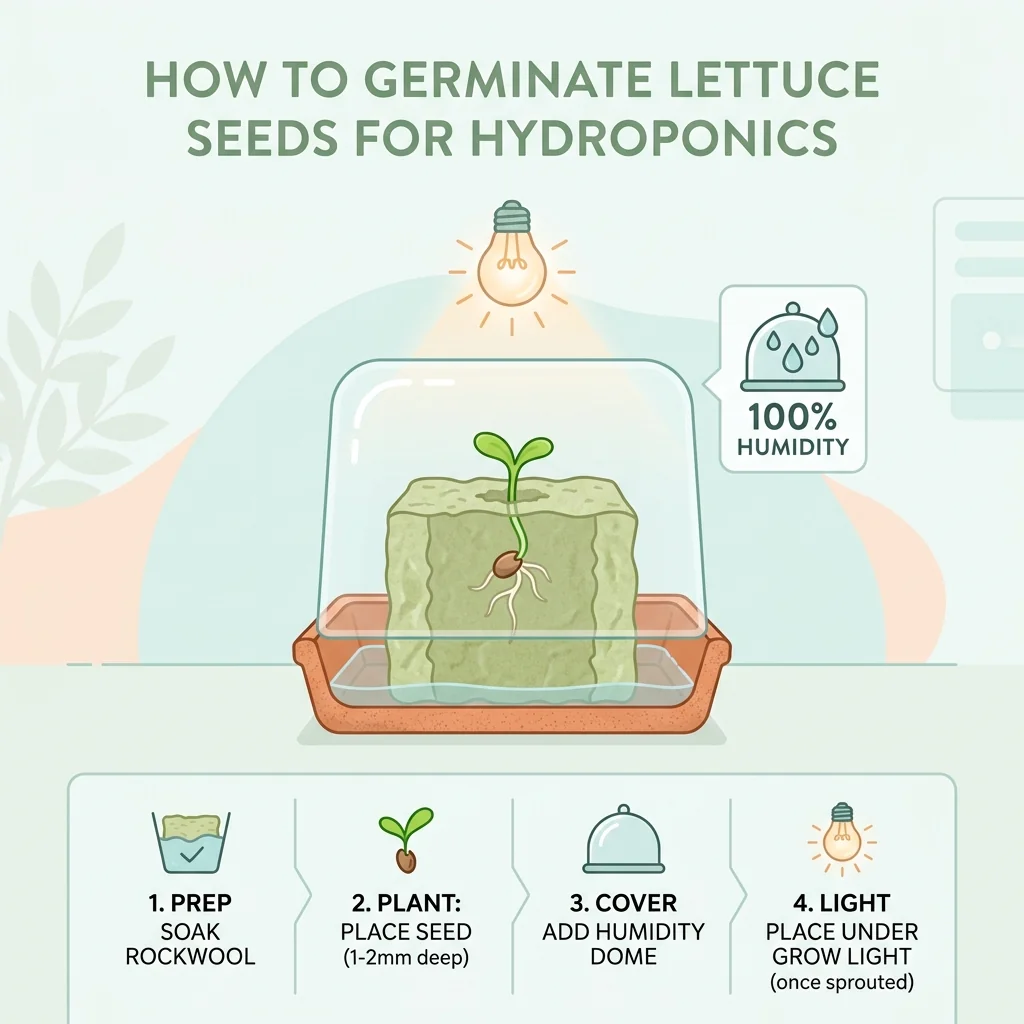
How to germinate lettuce seeds for hydroponics
You cannot start hydroponic seeds in potting soil. The dirt will wash off into your reservoir, clogging your pump and causing a massive bacterial bloom. Here is the sterile, foolproof method to start seeds for water-based growing.