
Troubleshoot the system before you change the inputs.
Symptoms
- Older leaves turn pale green or yellow while the newest leaves stay green, or older leaf margins develop dead spots
- New leaves come in yellow between the veins, distorted, or with dead tips while older leaves look normal
- Dark green foliage with burnt leaf margins and wilting despite adequate water, which points to excess salts rather than a shortage
- Growth slows even though the reservoir EC reads in the normal range
Possible causes
- pH too high for iron or magnesium to stay available, or too low for calcium
- A nutrient mix that has run down or been diluted so far that one or more elements are low
- One nutrient in excess crowding out another, such as potassium against nitrogen, calcium and magnesium
- Calcium that is in the solution but not reaching new leaves because of humidity, heat or low airflow
- Roots too damaged to absorb what is in the water
Quick fixes
- Measure pH first and correct it into the range for your crop before changing the nutrients
- Match the symptom to the leaf age it started on, then use the chart to pick the nutrient to investigate
- Check roots for brown, soft or slimy tissue before blaming the fertilizer
- Replace a run-down solution with a freshly mixed complete formulation rather than topping up one element
- Send leaf tissue or a solution sample to a laboratory when the pattern does not match one clean row of the chart
Hydroponic nutrient deficiency chart: where it starts and what it looks like
| Where it starts | Nutrient | What you see | Rule out first |
|---|---|---|---|
| Older leaves | Nitrogen | Lighter green plant, then uniform yellowing of the older leaves; growth slows | Low EC, excess potassium |
| Older leaves | Phosphorus | Short plants, chlorotic margins on older leaves, then dead spots | Low EC or a run-down solution (Penn State pairs phosphorus against zinc: excess phosphorus causes zinc deficiency, not the reverse) |
| Older leaves | Potassium | Small dead spots on old leaf margins that spread; leaves curl downward | Salt damage, excess sodium |
| Older to middle leaves | Magnesium | Yellowing between veins, then dead margins and spots | High pH, excess calcium or potassium |
| Newest growth | Calcium | Dead spots and brown margins on young leaves; growing tip can die | Tipburn from humidity, heat or low airflow |
| Newest growth | Iron | Yellowing between veins on new leaves | High pH |
| Newest growth | Sulfur | Even yellowing across the whole leaf blade, strongest on newer leaves | Nitrogen deficiency (starts on old leaves) |
| Newest growth | Boron | Distorted new leaves, cupping, crowded growing point | Excess calcium |
| Young leaves | Manganese | Yellowing between veins with a fine green network, then small dead spots | Iron deficiency, excess iron |
Look at which leaves show the problem first. Older, lower leaves point to nitrogen, phosphorus, potassium or magnesium; the youngest growth points to calcium, iron, sulfur, boron or manganese. Before you add anything, measure pH, because a nutrient the plant cannot take up looks exactly like a nutrient that is missing.
If the only thing you can see is a yellow lettuce, the yellow leaves diagnostic for hydroponic lettuce walks through pH, EC, roots and temperature in order.
Why leaf age tells you the nutrient
A plant moves some nutrients from old leaves to new ones when supply runs short, and cannot move others. The University of Missouri lists nitrogen, phosphorus, potassium and magnesium as mobile, with deficiency first expressed in older leaves. Zinc, iron, copper, manganese, boron, chlorine, nickel, calcium and sulfur are immobile, and their symptoms first show up in the younger leaves.
That sorting is the whole logic of the chart. A plant short of nitrogen shows it first on the older leaves. A plant short of iron shows it on the newest leaf, which comes in pale while the old ones stay green.
Sources agree on the rule but not on every detail inside it. Penn State calls calcium “a mobile nutrient” transported in the water-conducting tissues, while Missouri lists it as immobile; both still place the visible damage on new growth and fruit, and the chart follows that. Penn State describes the first signs of nitrogen deficiency as light green foliage and overall stunting, with no mention of leaf age. Cornell’s lettuce trial, which removed one nutrient at a time from a butterhead crop, saw lighter green plants followed by uniform yellowing of older leaves. Magnesium is placed on mature leaves by Cornell, older leaves by Missouri, and lower to middle leaves by Penn State. In practice that means “the lower half of the plant”, not one exact leaf.
Rule out pH before anything else
Hydroponic systems are less forgiving than soil, in Penn State’s words, and nutrient problems can produce plant symptoms quickly. That speed is why pH comes first.
Penn State states that the most common cause of iron deficiency is high pH in the media or irrigation water, and gives the same cause for magnesium deficiency. Calcium deficiency can come from low pH. Penn State gives 5.0 to 7.0 as the optimal range for growing vegetables hydroponically, which is wide on purpose. The narrower target for your crop is on the hydroponic lettuce EC and pH chart, and the lockout mechanism is explained in soil terms because the chemistry is the same.
If pH is high, bring it down using the method in how to raise and lower pH in hydroponics, then judge the result on new growth, not on old leaves. Penn State’s photograph of severely iron-deficient hydroponic basil shows the pattern: once iron was added to the water, the new growth was not affected.
Excess can look like shortage
Penn State is explicit that a reservoir can contain enough of a nutrient while the plant is deficient. When one nutrient is in excess, it can be taken up at the expense of another. Its worked example is a tomato recipe calling for 190 ppm nitrogen and 205 ppm potassium, mixed by mistake with 2,050 ppm potassium. The excess potassium produced a nitrogen deficiency even though the nitrogen was added correctly. Penn State’s antagonism table pairs potassium against nitrogen, calcium and magnesium, calcium against magnesium and boron, and iron against manganese. The practical lesson: if you see magnesium-type yellowing on lower leaves and you recently added a bloom or potassium booster, the cause may be the booster.
The University of Missouri adds that excess phosphorus can cause iron and zinc deficiencies, so a heavy phosphorus dose can show as iron-type yellowing on new leaves. Penn State’s tool for spotting soluble salts is EC, which tells you how strong the solution is but not how the nutrients are balanced, so even a good meter will not flag an antagonism.
Manganese: where the sources differ
Manganese is the entry in the chart with the least agreement on detail, and Cornell’s lettuce photographs do not help: they cover nitrogen, phosphorus, potassium, calcium, magnesium, sulfur, iron and boron.
On location, the extension pages that cover it agree. Iowa State says symptoms usually appear on young leaves. Missouri lists manganese among the immobile nutrients whose deficiency shows in younger leaves. Arizona describes yellowing between the veins of young leaves. They differ on how to separate it from iron, the obvious look-alike.
- Iowa State: manganese gives a fine, netted or checkered pattern in which even the smallest veins stay green, often followed by small dead spots. Iron lacks that fine network and the spotting.
- Arizona: the manganese pattern is not as distinct as with iron.
- Missouri: interveinal chlorosis of new leaves with some green next to the veins, later with grey or tan dead spots in the yellow areas.
If you are weighing the two, a fine green network and later spotting lean towards manganese, and a plainer yellowing between the veins leans towards iron. Penn State’s antagonism table pairs iron against manganese, so excess of one can mimic a shortage of the other. Iowa State’s advice is the safe one: because visual symptoms overlap, get a test to confirm.
Look-alikes that are not a deficiency
Calcium is the clearest case. Cornell grew lettuce without calcium and saw scattered dead spots on young leaves within the first week, marginal death and distortion of the youngest leaves, and a dead growing tip by the third week. That was much more dramatic than tipburn, which Cornell says typically occurs when the solution has enough calcium but conditions do not let it reach the new leaves. If you have edge browning on a lettuce head and a healthy crown, go to hydroponic lettuce tip burn.
Salt damage is another. Penn State lists dark green foliage, dead and burned leaf margins and root death, with wilting despite adequate water. Dark green leaves with burnt edges is the opposite of a starved plant. Roots are the third: the University of Missouri notes that damage to the root system by nematodes, insects or disease, or any other condition detrimental to root growth, can complicate a diagnosis. If roots are brown or soft, start at brown roots: staining or root rot.
What to do once you have a likely cause
Fix the cause the chart points to, in this order: pH, roots, then the solution itself.
Cornell notes that in many cases deficiencies are due to environmental causes rather than a lack of nutrients in the fertilizer solution, and recommends monitoring pH and EC daily. It also recommends periodic laboratory analysis of the nutrient solution, which can detect disorders earlier than visible symptoms. If a reservoir has simply run down, a fresh batch of complete nutrient is a cleaner fix than adding a single element, and when to change hydroponic nutrient solution covers the timing. A grow log of weekly pH and EC readings shows you which week things drifted.
Watch the new leaves, not the damaged ones: the evidence that a fix worked is clean new growth.
Sources
- Penn State Extension: Hydroponics systems and principles of plant nutrition: essential nutrients, function, deficiency, and excess
- Cornell University (e-GRO): Symptoms of common nutrient deficiencies in hydroponic lettuce, Mattson and Merrill, 2015
- University of Missouri Integrated Pest Management: Diagnosing nutrient deficiencies
- Iowa State University Extension: Identifying plant nutrient deficiencies, manganese
- University of Arizona Cooperative Extension: Guide to symptoms of plant nutrient deficiencies
Narrow down the cause
Yellow leaves, burnt edges and slow growth each have their own diagnostic route. These guides cover the neighbouring problems.
Common questions
How do I tell a nitrogen deficiency from an iron deficiency in hydroponics?
Check which leaves yellow first. Cornell found nitrogen deficiency in lettuce as lighter green colour turning into uniform yellowing of older leaves, while iron deficiency produced yellowing between the veins of new growth. Penn State adds that high pH is the most common cause of iron deficiency, so measure pH before you add iron.
Which hydroponic deficiencies show up on the new leaves?
Calcium, iron, sulfur, boron and manganese. The University of Missouri lists calcium, iron, sulfur, boron and manganese among the immobile nutrients whose symptoms first appear on the younger leaves. Cornell saw sulfur deficiency as uniform chlorosis most pronounced on recently mature leaves and newer growth.
Can I have a nutrient deficiency when the reservoir is full of fertilizer?
Yes. Penn State describes two ways: a pH outside the range where the nutrient dissolves and is taken up, and an excess of one nutrient that crowds out another. Its example is a potassium overdose causing a nitrogen deficiency even though the nitrogen was added correctly.
Do I need a lab test to confirm a hydroponic nutrient deficiency?
It is the only way to be sure. Cornell states that many nutrient disorders look similar and that laboratory analysis of leaves is necessary to verify symptoms, and it recommends periodic laboratory analysis of the nutrient solution to catch disorders before symptoms appear.
Related guides
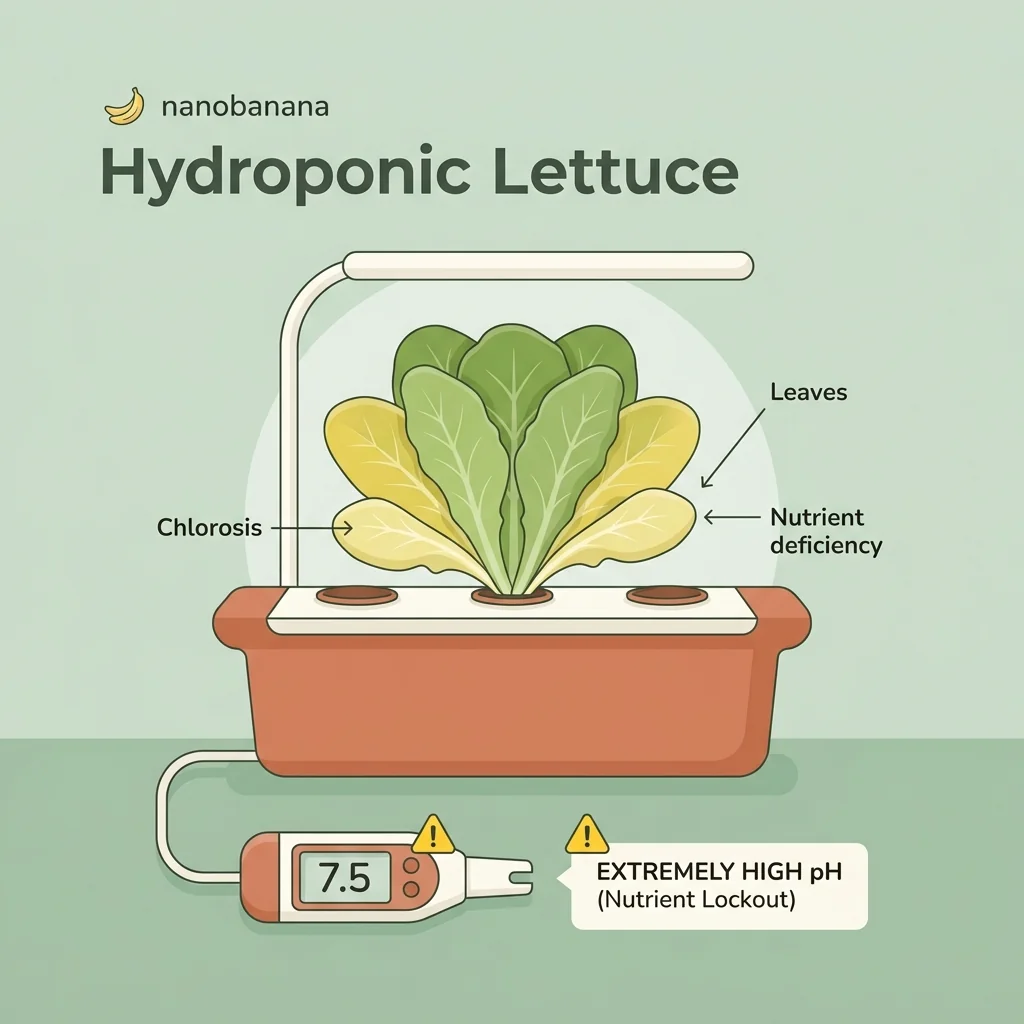
Hydroponic lettuce turning yellow? Here's how to fix it
A thriving hydroponic lettuce head should be a vibrant, deep green. If your entire crop is turning a sickly, pale yellow, the plants are starving. Here is a step-by-step diagnostic framework to find the exact cause and rescue the crop.
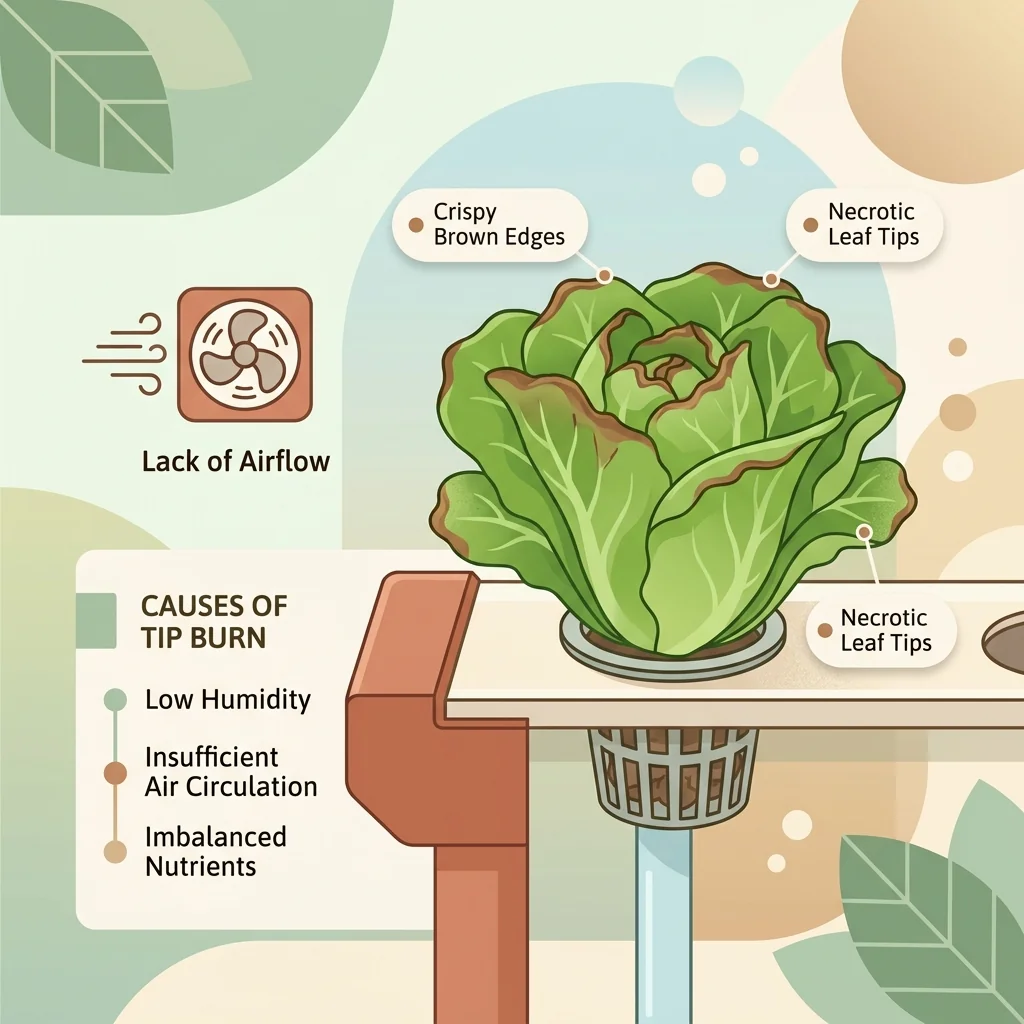
Hydroponic lettuce tip burn: causes, fixes, and what not to change
It is the most frustrating problem in indoor hydroponics: your lettuce looks perfect until the very edges of the youngest leaves turn brown and die. This is Tip Burn, and it is almost never caused by the nutrients in your reservoir.
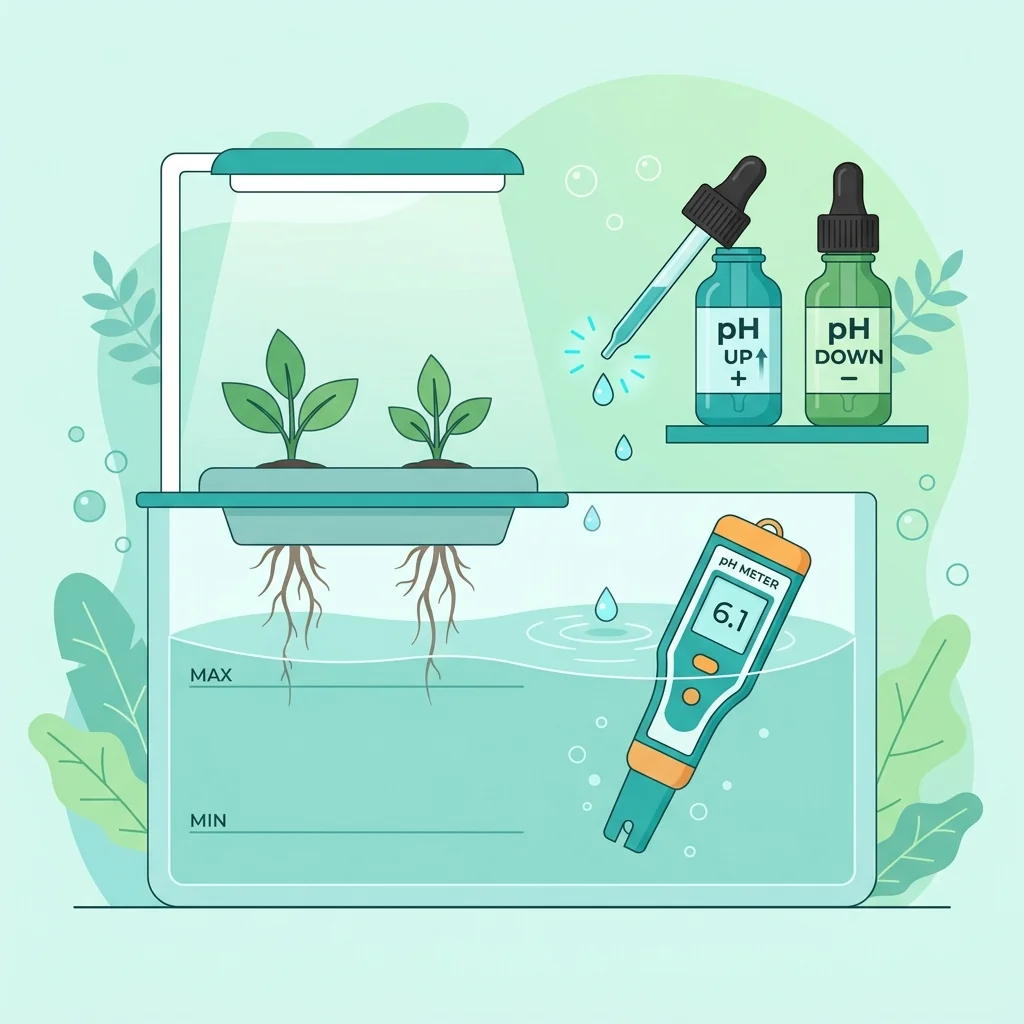
How to raise and lower pH in hydroponics (safely)
Adjusting hydroponic pH is simple once you know which product does what. Here is how to raise and lower pH safely, in small steps, without chasing the meter.