Troubleshoot the system before you change the inputs.
Symptoms
- The pH reading is lower every time you check, and corrections do not last.
- A fresh batch of nutrient solution starts at the right pH and slides within days.
Possible causes
- Ammonium in the fertilizer being taken up by the roots, which releases hydrogen ions.
- Low-alkalinity or low-mineral source water with little buffering.
- A pH meter that is out of calibration or a probe near the end of its life.
- Acid doses that do not account for the water alkalinity, which sets how much acid is needed.
- A reservoir that has changed as plants and microbes use water and nutrients over time.
Quick fixes
- Calibrate the meter with fresh pH 4 and pH 7 buffers and retest.
- Read the fertilizer label for the form of nitrogen and compare it with the water you use.
- Test the alkalinity of your source water.
- Inspect the roots and, if the reservoir will not hold, replace the solution.
A hydroponic reservoir whose pH keeps falling is usually being acidified by the plants themselves, through ammonium uptake, in water that has too little buffer to resist it. A meter that has drifted can fake the same pattern, so check that first. The mirror image, a pH that climbs, has its own causes in why hydroponic pH keeps rising. Here is how to find which one you have, in the order that costs the least.
Check the meter before you change anything
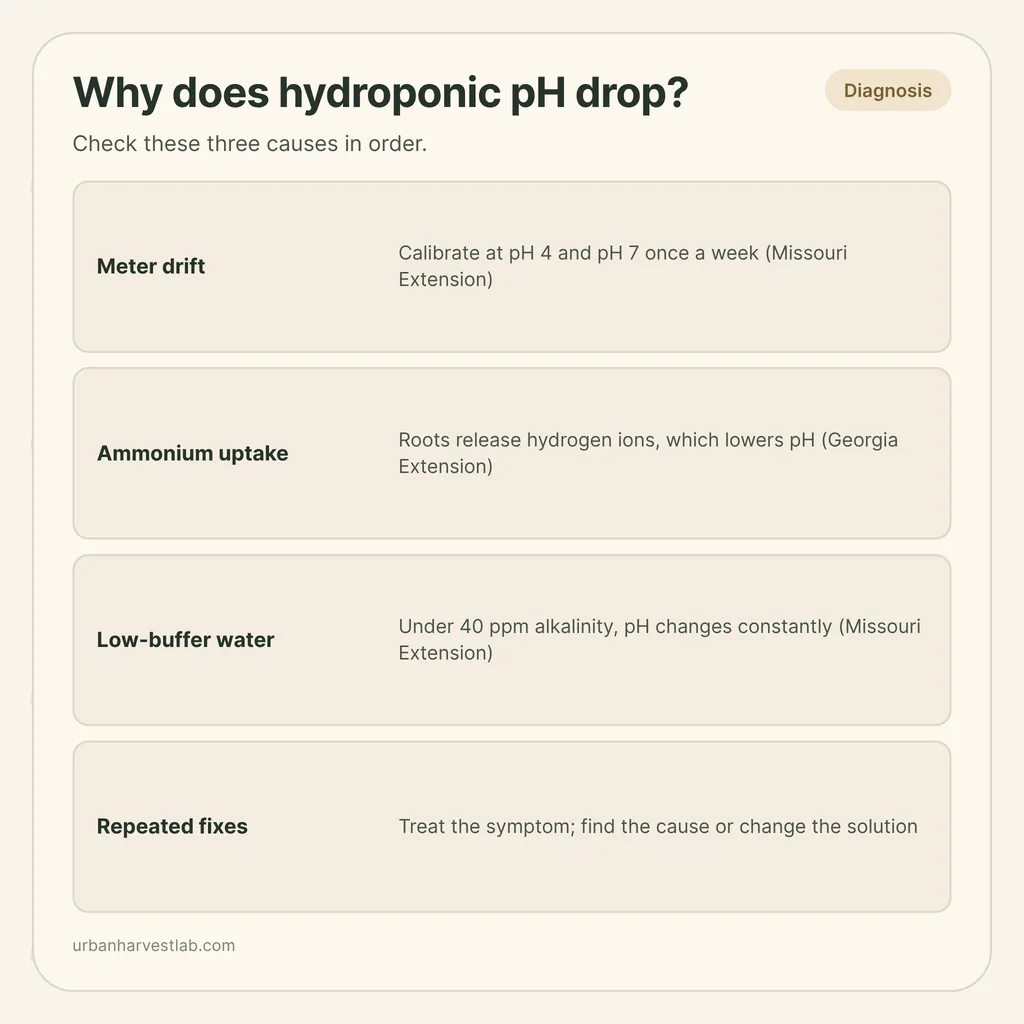
A falling number is only a problem if it is real. University of Missouri Extension says to calibrate the meter once a week at two points, pH 4 and pH 7. If the last calibration was longer ago than that, or the probe has been stored dry, recalibrate with fresh buffer and retest the same water (browse pH meters on Amazon). A second meter, or a fresh batch of buffer, settles it in a minute. Choosing and caring for one is covered in best pH and EC meters for hydroponics.
If the reading holds after calibration, the water really is getting more acidic. Work down the list below.
Cause 1: the plants are taking up ammonium
Nitrogen reaches roots as nitrate or as ammonium, and the two push pH in opposite directions. University of Georgia Extension explains that each time a nitrate ion moves into a root cell a hydroxyl ion is exported, which is why nitrate-fed plants raise pH. Ammonium is absorbed in exchange for a hydrogen ion, “thus adding an acidic component.” Ammonium-heavy feeding therefore pulls the reservoir down, nitrate-heavy feeding pushes it up. The rising case, where nitrate leads, is explained on the rising-pH page.
The same Georgia fact sheet gives a pointed example: ammonium nitrate looks neutral on paper, with equal parts ammonium and nitrate, but ammonium ions are taken up much faster than nitrate, so a significant acidic reaction builds. Penn State Extension adds that the plant uses ammonium immediately and does not store it, which suits summer and fast growth, and that too much of it causes toxicity, with yellowing and death of growing points.
Georgia wrote this for greenhouse potting substrate, where bacteria also convert ammonium to nitrate and release more hydrogen ions, and where cool weather slows that conversion. The part that carries into a reservoir is the exchange at the root surface.
What to do. Read the nitrogen breakdown on your fertilizer label. If it lists an ammonium or urea share, a steady downward slide is the expected result in soft water. The label shows the ammonium share, which is the figure to compare against the water you use. Do not add extra ammonium-containing products “to boost growth” while chasing a low reading.
Cause 2: the water cannot hold a pH
Alkalinity is the water’s capacity to neutralize acid. Penn State Extension states that when it is low, the water has low buffering capacity and its pH readily changes depending on what is added. University of Missouri Extension is specific: at low alkalinity, under 40 ppm calcium carbonate equivalent, pH changes constantly and needs constant monitoring and adjustment. Soft, low-mineral water, and any reverse-osmosis fill, can land in that band, so test it instead of guessing. The number to compare against, and how to get it, are in tap water alkalinity and pH drift, and the trade-offs of RO water are in do you need RO water for hydroponics.
Fertilizer chemistry matters here too. University of Missouri Extension notes that formulations with potential acidity help neutralize alkalinity above 160 ppm, while formulations with potential basicity can add alkalinity to water under 40 ppm. A feed designed to counter hard water is the wrong match for soft water, and the label may carry the potential acidity or basicity.
Cause 3: your own corrections
University of Missouri Extension says water under 40 ppm alkalinity needs constant monitoring and adjustment, so repeated corrections are a sign of the water, not a fix for it. Dosing, mixing time and retesting are covered in how to raise and lower pH in hydroponics. University of Missouri Extension also warns that the amount of acid needed depends on the water’s alkalinity, so the same dose does not suit every fill.
Cause 4: a reservoir that has changed over time
University of Missouri Extension notes that the pH and EC of a nutrient solution change as plants and microbes use water and nutrients over time. The reservoir is no longer the batch you mixed, so do not read the direction of the drift as a diagnosis.
Look at the roots instead. The signs of rot are described in hydroponic root rot: how to spot it early, and the staining that is not rot is explained in brown roots in hydroponics. If rot is present, correcting pH will not fix it.
A note for the curious: an Ohio State e-GRO Alert describes holding pH at 4.0 to 4.5 as a way to suppress Pythium in deep water culture and NFT leafy greens. It suppresses rather than eradicates, and lettuce in one trial showed toxicity symptoms within six days at pH 4.0. A low reading is not a treatment you can adopt by accident.
When to refresh instead of correcting
If you have confirmed the meter, matched the feed to the water, and the pH still will not hold, change the solution rather than keep patching it. The criteria are in when to change hydroponic nutrient solution, and the order of adding nutrients and adjusting pH is in how to mix hydroponic nutrients.
How low is too low depends on the crop. Cornell treats 5.8 as optimum for its lettuce system and 5.6 to 6.0 as acceptable, noting that nutrient deficiencies may occur above or below the acceptable range. For other crops, use the figures in the hydroponic lettuce EC and pH chart and the crop-specific pages rather than a single number.
Sources
- University of Georgia Extension — Essential pH management in greenhouse crops: pH and plant nutrition
- University of Missouri Extension — Hydroponic nutrient solutions (G6984)
- Penn State Extension — Hydroponics systems and principles of plant nutrition
- Penn State Extension — Hydroponics systems: nutrient solution programs and recipes
- Cornell University CEA — Hydroponic lettuce handbook
- Ohio State University, e-GRO Alert — Considerations for lowering pH to suppress root rot diseases in hydroponics
Keep pH steady
The upward drift, how to adjust pH, and how source water behaves.
Common questions
Why does the pH in my hydroponic reservoir keep dropping?
The usual causes are plants taking up ammonium from the fertilizer, which releases hydrogen ions into the water, and water with low alkalinity, which cannot resist the change. University of Georgia Extension describes the ammonium effect and University of Missouri Extension flags alkalinity under 40 ppm as the level where pH changes constantly. Check the meter first, because a drifting probe can look the same.
Is a falling pH a sign of root rot?
It can sit alongside root rot, but the pH direction alone does not diagnose it. University of Missouri Extension notes that solution pH changes as plants and microbes use water and nutrients. Look at the roots: roots showing the signs on the root-rot page point to rot whatever the meter says.
Does reverse osmosis water make pH unstable?
Low-mineral water can. Penn State Extension says that when total alkalinity is low the water has low buffering capacity and its pH readily changes with whatever you add. Test the alkalinity of your RO water rather than assuming it, and expect small additions to move the reading.
How low can the pH go before plants suffer?
It depends on the crop. Cornell treats 5.8 as optimum for its lettuce system and 5.6 to 6.0 as acceptable, with nutrient deficiencies possible outside that range. Look up your crop in a pH chart and act on the trend, not a single reading.
Related guides
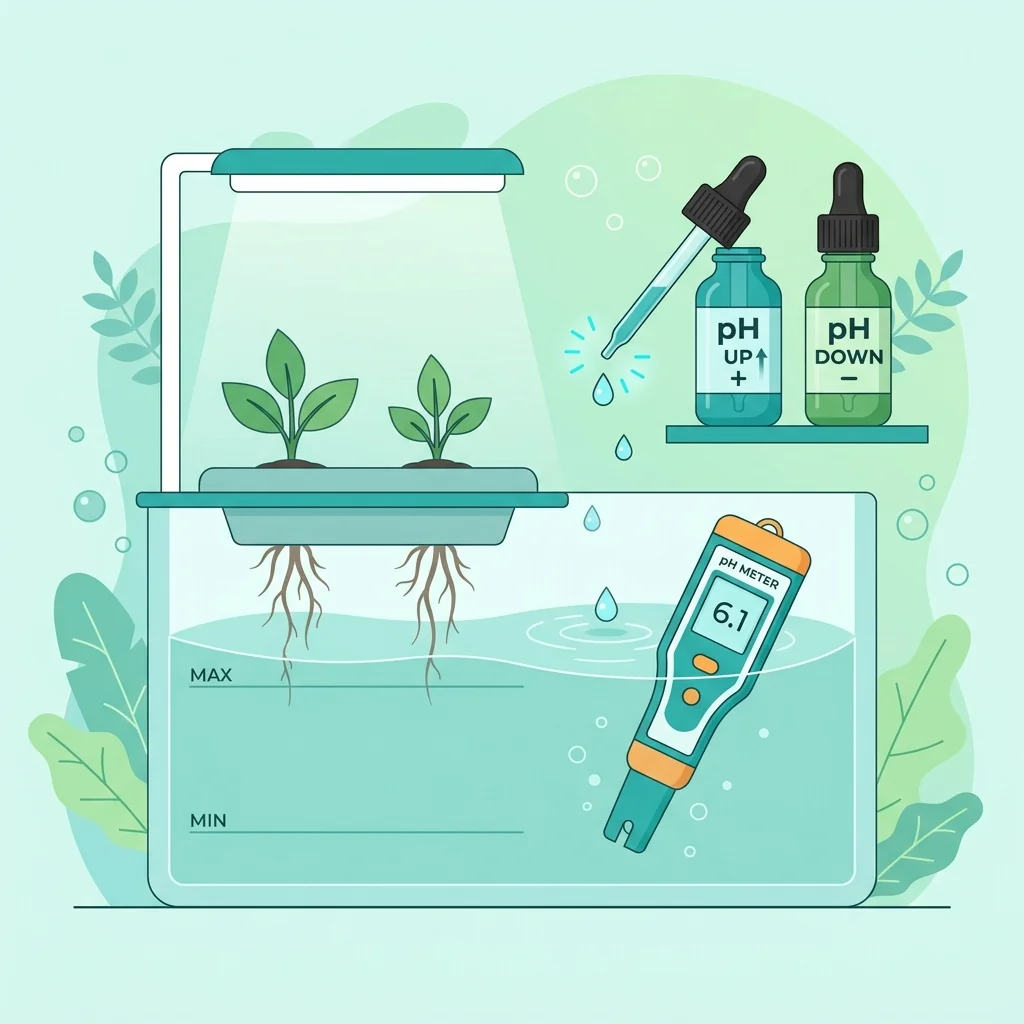
How to raise and lower pH in hydroponics (safely)
Adjusting hydroponic pH is simple once you know which product does what. Here is how to raise and lower pH safely, in small steps, without chasing the meter.

Tap water alkalinity: why hydroponic pH keeps drifting back up
Dosing pH down and watching the reading climb back up within a day usually means the water itself is buffered against the change. Here is what alkalinity measures, the range that keeps a reservoir stable, and how it differs from hardness.
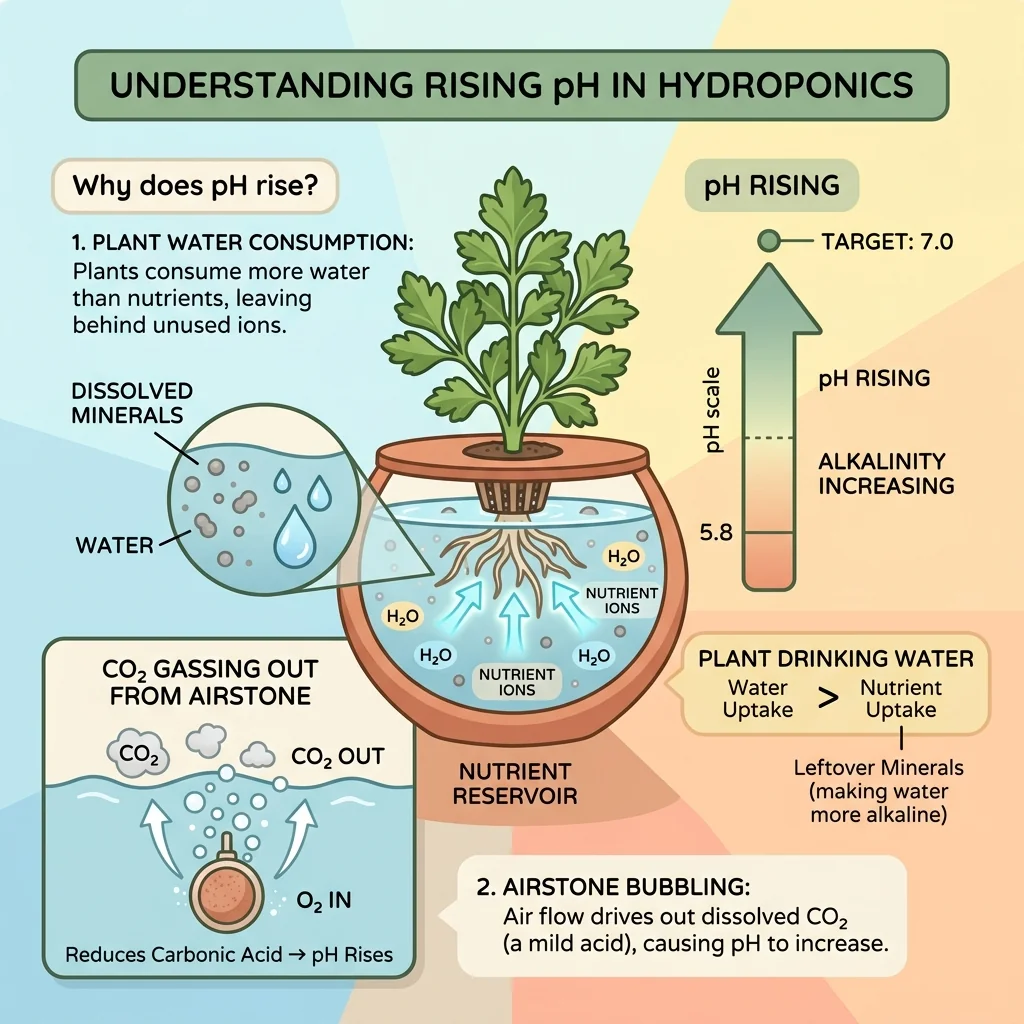
Why pH keeps rising in hydroponics (and how to stop it)
You balanced your hydroponic reservoir to a perfect 5.8 pH. Two days later, it has drifted back up to 6.8. This constant upward drift is the bane of hydroponic growers. Here is the chemistry behind why it happens and how to fix it.