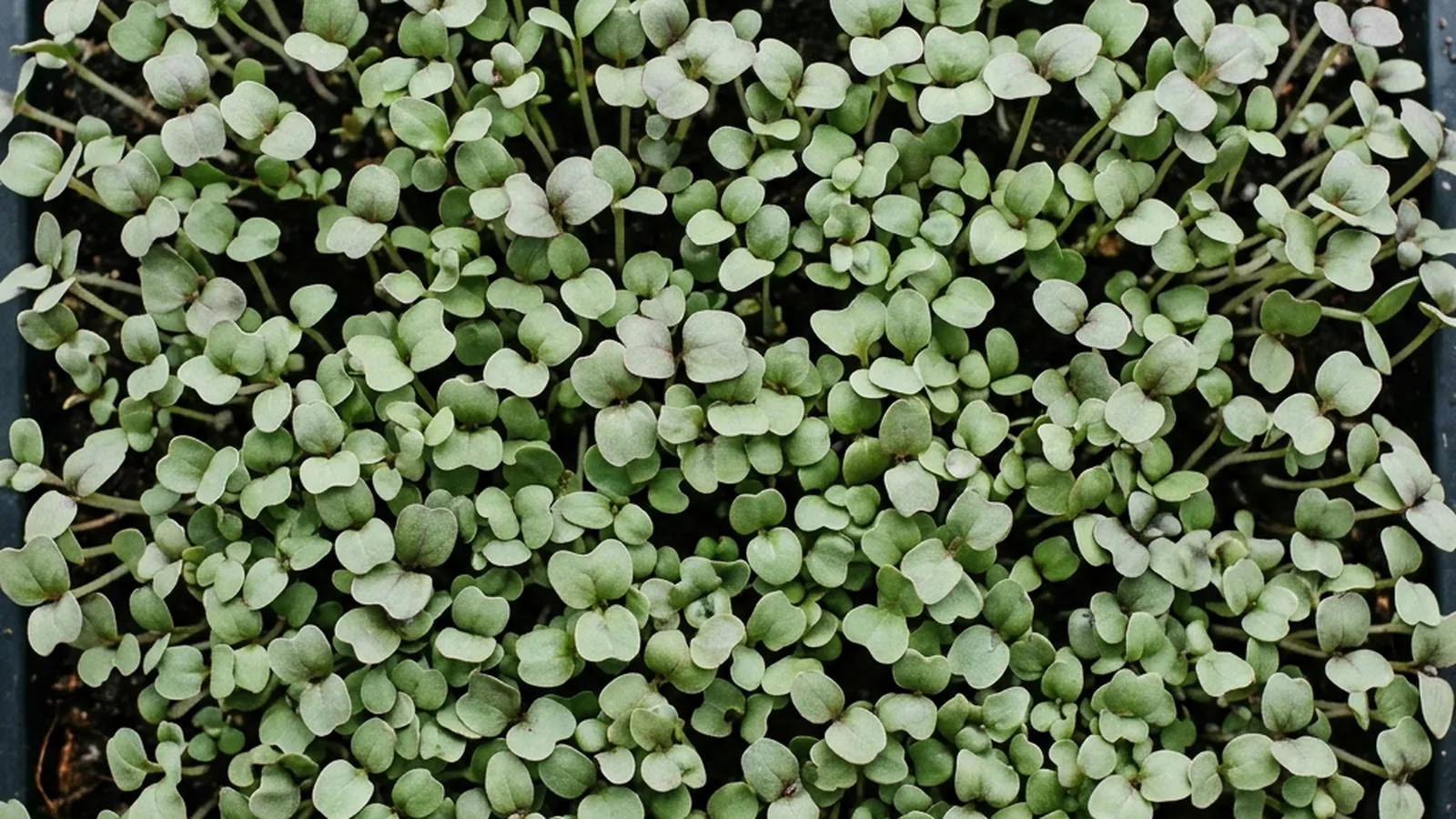
Basil microgreens start from a seed that turns to gel on contact with water instead of simply absorbing it, and the tray takes about twice as long as a fast brassica to reach harvest. That gel layer holds moisture against the seed coat and canopy for days longer than a bare brassica seed does, which is why a basil tray is the one in this group most likely to develop surface mold if watering and airflow are not managed deliberately.
Basil’s gel-forming seed and longer timeline are not the easiest combination to learn on. The beginner crop guide groups basil with chia and cress as seed that is harder to sow evenly and more prone to mold, and suggests trying it once a first tray of something faster — radish or broccoli, say — has made bottom watering and airflow into habits rather than new skills. The beginner microgreens method covers those basics for anyone starting from a first tray of any kind.
Why basil seed is not soaked
Presoaking speeds germination and is a legitimate step for crops with big, hard seed coats — the UC Master Gardener Program of Sonoma County gives a general 6 to 12 hour presoak for seed of that kind. Basil breaks that pattern. Its seed coat contains mucilage, and mucilage swells into a gel almost as soon as it contacts water. Instead of a normal soak that leaves you with plump, separate seeds ready to scatter, a soaked batch of basil seed turns into a sticky, semi-fused mass that is difficult to spread evenly across a tray.
The practical response is to skip the soak entirely. Sow basil seed dry, directly onto the moist growing medium, and let the gel form in place as the seed takes up water from the surface it is sitting on. Utah State University Extension sows basil at 28 g per 1020 tray (10 x 20 in.), the same rate it gives broccoli, kale and cilantro — see the seed density chart for how that scales to a different tray size. This is a handling consequence of the seed chemistry, not a general shortcut: the seed soaking guide covers which crops do benefit from a soak and for how long, and basil is the clearest exception in that comparison, not the rule.
Twelve to sixteen days, and most of it slow
Utah State University Extension puts basil at 12 to 16 days to harvest. That sits roughly in the middle of Penn State Extension’s general 7 to 21 day microgreens window, and it runs close to double the 7 to 8 days Penn State gives its fast brassica group — broccoli, radish, arugula, kale, and mustard. Basil is not the slowest microgreen you can grow; cilantro’s 21 to 28 days holds that spot. Basil is a mid-pack crop that simply takes about twice as long as the crop most beginner guides use as the default example.
Soil temperature for germination in Penn State Extension’s 60-75°F range, and air temperature around 60-70°F, apply to basil as they do to other microgreens, with no documented exception for this crop. On a 12-16 day tray, that means holding the room inside those bands from day one rather than correcting course around day 8 — the point at which a fast brassica would already be off the shelf and any drift would no longer matter to it. A room that runs cold or a windowsill with inconsistent light has more days here to compound the effect than it would on a tray that clears out in a week.
A longer timeline is not the same thing as a light crop. Penn State Extension’s greenhouse trial measured basil at 165 g per its 12 x 20 in. ten-row tray, above the 136 g average across the seventeen varieties in that trial. Those figures come from a 10 to 15 g seeding rate over multiple greenhouse cycles, not a windowsill promise, and that rate is not directly comparable to Utah State’s 28 g figure above — the two are measured on different tray areas, the arithmetic the seed density chart already works through — but they are real evidence against reading basil’s slow pace as a sign of a weak crop.
Penn State Extension and the UC Master Gardener Program of Sonoma County put harvest at 2 to 4 in. tall with true leaves just emerging for most crops except pea shoots, and University of Tennessee Extension gives 1 to 4 in. Basil falls in that general group rather than being called out separately, so cut on the tray’s appearance — true leaves just emerging — and treat 12-16 days as the planning figure rather than the trigger to harvest.
The covered stage runs longer than any brassica
Utah State University Extension covers basil for 4 to 7 days after sowing — the second-longest covered time in its table, behind only cilantro’s 7 to 14 days, and well past the 1 to 2 days it gives arugula, kale, radish and rutabaga, and the 2 to 4 days it gives broccoli. UC ANR Coastal Gardener’s general two-stage method runs a shorter stage one, 2 to 3 days, before flipping the cover for a stretch stage; the two sources diverge here, and both are worth knowing depending on which protocol you are timing a tray against. Either way, basil sits wet and dark longer than a brassica does, which is the direct reason bottom watering and airflow matter more on this tray than on a fast one. See microgreens blackout period by crop for how the covered stage is timed on the other common crops, and why pulling the cover at the right moment matters more for a slow, mold-prone seed than for a fast one.
A basil tray runs through the same stages as any other crop, just on its own schedule:
| Stage | When | What you do |
|---|---|---|
| Sow | Day 0, 28 g per Utah State’s 1020 tray | Scatter the gel-forming seed dry onto moist medium; do not presoak |
| Covered | Days 0-4 to 7 (Utah State); UC ANR’s general stage one runs 2-3 | Keep a solid, weighted cover on; check for the gel starting to form and the seed taking up water from below |
| Uncovered | Once sprouted, through day 12-16 | Move into light, switch to bottom watering, and add airflow to counter the gel’s extra surface moisture |
| Harvest | Day 12-16 (Utah State) | Cut once the tray shows 2-4 in. growth with true leaves emerging, not by the calendar alone |
The airflow and watering trade-off
The same gel that makes soaking impractical also changes the moisture profile at the surface of the tray. A wet, sticky seed coat holds water against itself and against the medium for days longer than a bare seed does over its own shorter covered stage, and that persistent surface moisture is exactly the kind of condition that favors mold and damping-off organisms.
This does not mean a basil tray is destined to fail. It means the two controls that matter for every microgreens tray matter more here. A bottom watering routine — pouring into the tray or a saucer underneath rather than over the canopy — keeps the gel layer and the hulls it is stuck to from staying wet longer than they need to. How to bottom-water microgreens covers the technique. Pair that with real airflow in the room once the cover comes off — stagnant, humid air sitting over a gel-coated seed bed is a worse combination than the same air moving over a dry brassica seed.
If you do see white growth in a basil tray, do not assume the worst from a glance. Mold vs. root hairs walks through the location, uniformity, and odor checks that separate ordinary root hair growth from a tray worth discarding, and basil’s gel coat makes that distinction more relevant than it is on a cleaner-germinating crop like radish.
It also helps to check the medium itself between waterings rather than watering on a fixed schedule. Because the gel layer sits on top and can look damp even after the medium underneath has started to dry, a quick check by touch or by lifting an edge of the tray tells you more than the surface appearance does. Water again once the medium underneath is drying out, not simply because the top looks matte.
Common mistakes with basil microgreens
- Soaking the seed the way you would a large, bare seed, and ending up with an unspreadable clump instead of a scatterable batch.
- Pouring water straight onto the tray surface, which sits directly on the gel layer and prolongs surface wetness.
- Judging basil against a fast brassica’s timeline and pulling it too early, before true leaves have formed.
- Pulling the cover on the same schedule as a fast brassica, well before basil’s longer covered stage is actually done.
- Leaving the tray under a solid cover past the point the crop needs light and airflow, because growth looks slower than expected.
Sources
- Utah State University Extension: Grow Your Own Microgreens — the 12-16 day harvest figure, the 28 g seeding rate, and the 4-7 day covered time.
- Penn State Extension: The ABCs of Microgreens
- Penn State Extension: Growing Microgreens — the 165 g measured yield and the 136 g trial average.
- Penn State Extension: A Step-By-Step Guide for Growing Microgreens at Home
- UC Master Gardener Program of Sonoma County: Growing Microgreens
- UC ANR Coastal Gardener: Your Indoor Winter Garden: Fresh Microgreens for Gloomy Days
- University of Tennessee Extension W1261: Regulatory Considerations for Marketing Sprouts, Microgreens and Baby Greens — the 1-4 in. harvest size.
Handle the crops that don't behave like brassicas
Basil's gel seed and longer covered time are not unique problems. Bottom watering, mold diagnosis, and per-crop blackout timing solve them.
Common questions
Should I soak basil seed before sowing?
No. Basil seed is mucilaginous and forms a gel coat in water almost immediately, which makes a normal presoak impractical and turns the seed into a sticky mass that is hard to spread. Sow it dry, directly onto the moist medium, instead.
How long do basil microgreens take to grow?
Utah State University Extension puts basil at 12 to 16 days to harvest — roughly the middle of Penn State Extension's general 7 to 21 day microgreens window, and close to double the 7 to 8 days Penn State gives its fast brassica group. Temperature and light shift it in either direction.
Why does my basil tray mold more easily than my broccoli tray?
Utah State University Extension covers basil for 4 to 7 days after sowing against 2 to 4 days for broccoli, and the gel layer around the seed holds surface moisture close to the seed coat and canopy that whole time. That combination favors mold and damping-off unless watering and airflow are managed deliberately.
Is basil a good first microgreen to grow?
Not usually. The beginner crop guide groups basil with chia and cress as gel-forming seed that is harder to sow evenly and more prone to mold, and suggests trying it after an easier first tray like radish or broccoli. It behaves differently from the watering routine that works for those easier crops.
Related guides
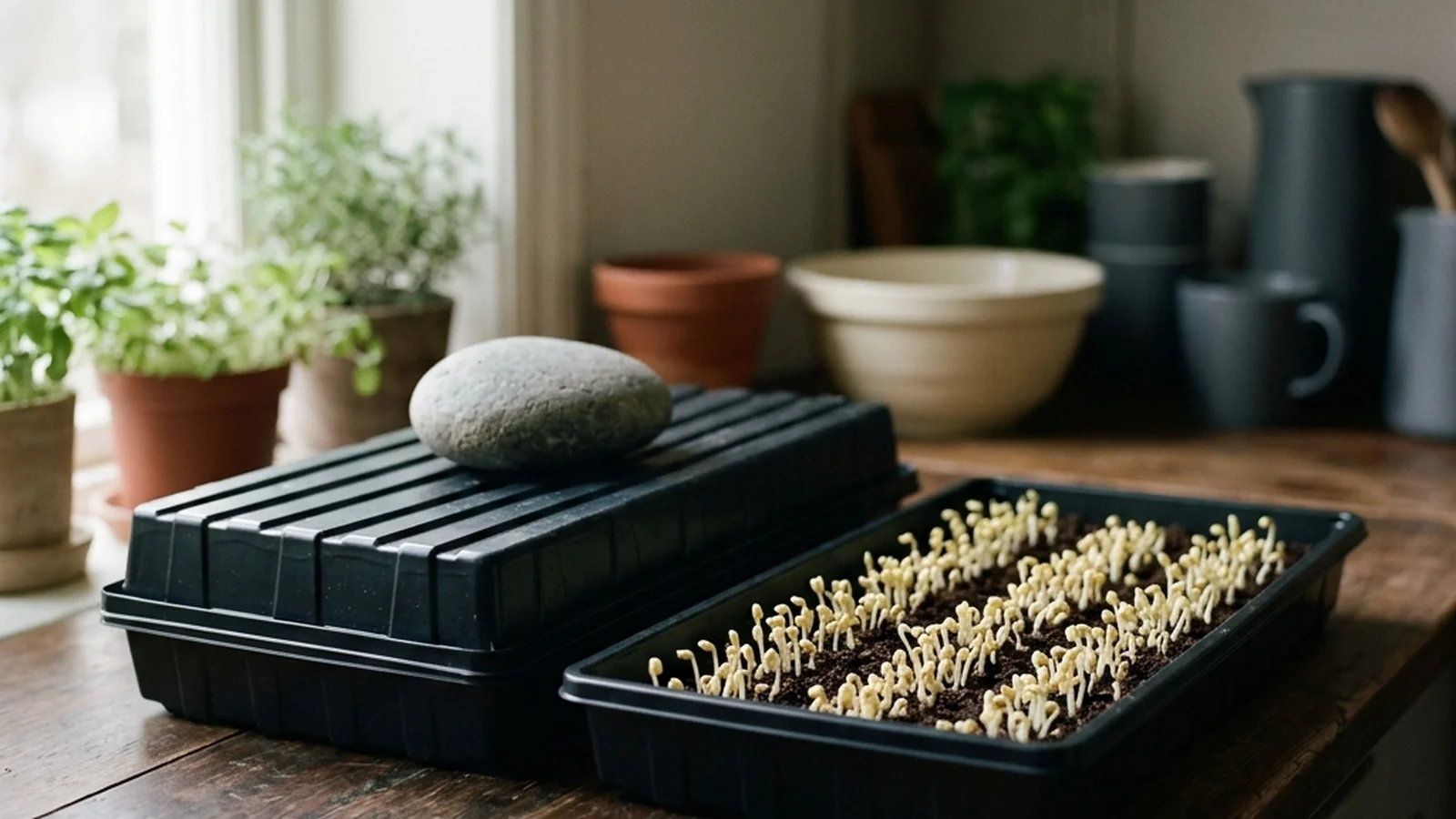
Microgreens blackout time by crop: what varies and why
Blackout time varies by crop — Utah State's table runs from 1-2 days for arugula to 7-14 for cilantro. Here is how that compares to the documented blackout methods, and how to judge readiness by the tray instead of the calendar.
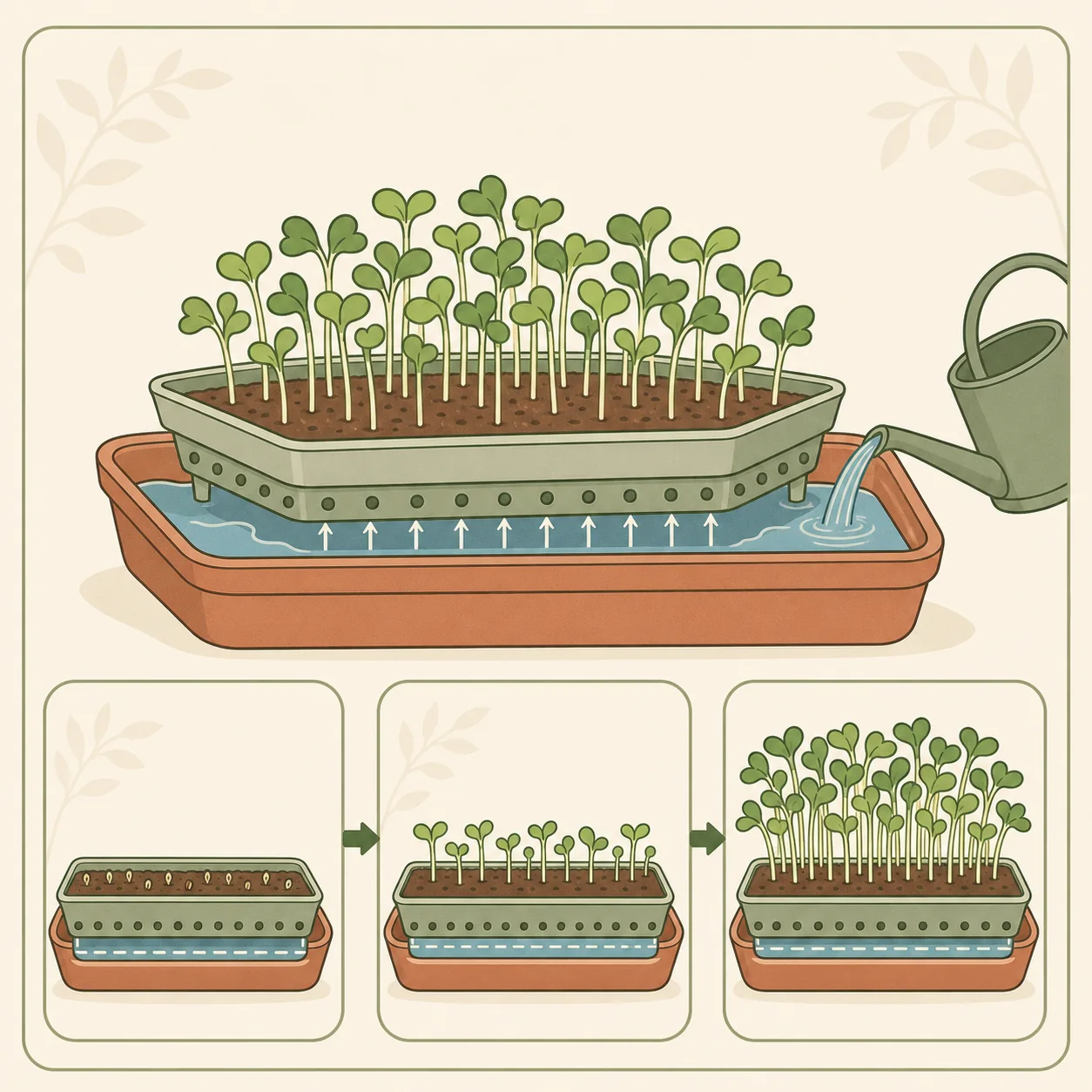
How to bottom-water microgreens without soaking the tray
Bottom watering is a controlled transfer, not permanent standing water. Add a measured amount, let the medium absorb it, and drain what remains.
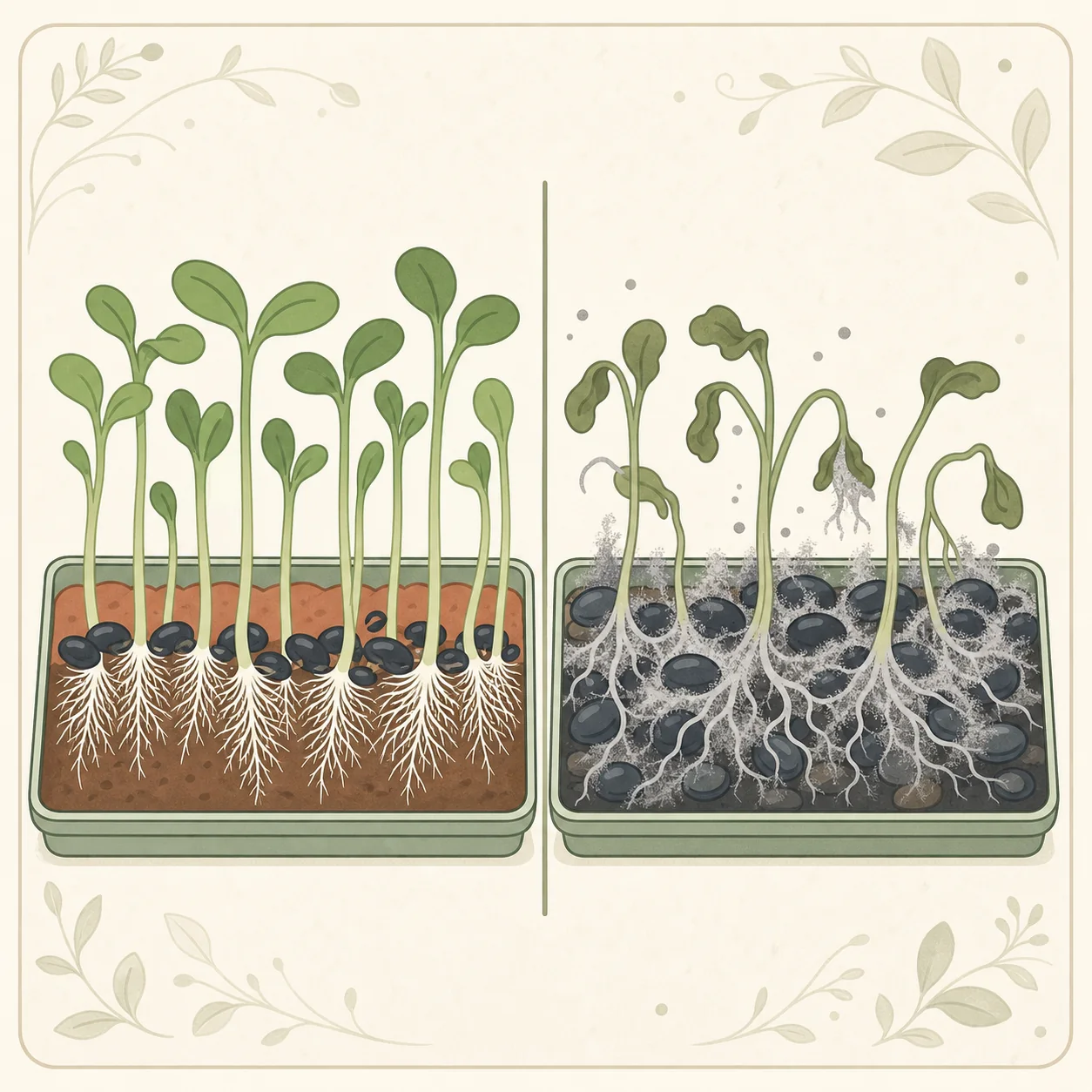
Microgreens mold or root hairs? How to tell safely
White fuzz around newly emerged roots is often normal root hair growth. Irregular spread, bad odor, slime, or collapsing stems changes the decision.