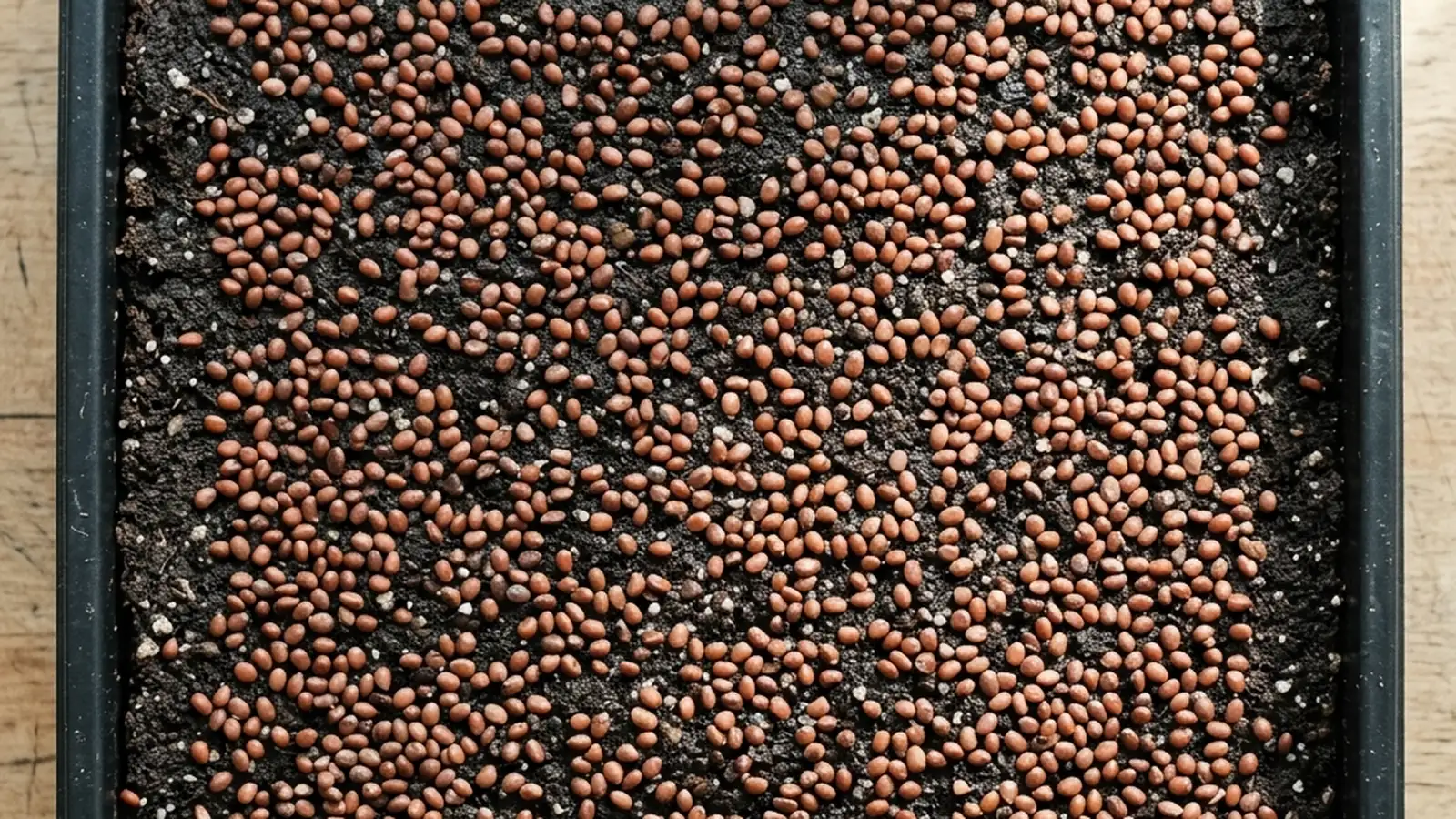
Why grams alone do not transfer between trays (90 seeds/g is a round number chosen to make the area arithmetic visible, not a figure for any crop)
| Tray | Area | 20 g of seed at 90 seeds/g | Resulting density |
|---|---|---|---|
| Windowsill tray, 6 × 12 in | 72 in² | 1,800 seeds | 25 seeds/in² |
| Half tray, 10 × 10 in | 100 in² | 1,800 seeds | 18 seeds/in² |
| Standard tray, 10 × 20 in | 200 in² | 1,800 seeds | 9 seeds/in² |
Seed density decides whether a tray comes up as an even carpet or a patchy mat with bare corners and a wet middle. The number that matters is seeds per unit of area, not grams — and you get it by taking the seeds-per-gram count for the seed in your hand and dividing across your tray’s area. How many grams that works out to depends on your tray and your seed lot, which is why the calculator below asks for both.
If you have not sown a tray yet, the beginner microgreens method covers the sowing, covering and watering steps that density sits inside.
Why a per-crop gram chart travels badly
Three extension sources publish density figures, and they are not in the same units. Illinois Extension and Penn State Extension publish the same per-area target independently — 6 to 8 large seeds per square inch, or 10 to 12 small seeds per square inch (Penn State relays it from Johnny’s Selected Seeds). That is the figure that survives a change of tray, which is why seeds per square inch is the number to work in, not grams. Penn State also gives 10 to 15 g of seed per standard 12 x 20 in ten-row tray — 240 square inches — while Utah State University Extension publishes a per-crop gram table for a different tray, the 1020, at 10 x 20 in — 200 square inches: arugula 10 g, radish 42 g, sunflower 48 g, pea 150 g, and 28 g for basil, broccoli, cilantro, kale, mesclun and rutabaga.
That table is worth having, and it is also the clearest illustration of why a gram figure does not travel on its own. Utah State can publish grams because it has fixed the tray: every row assumes a 1020. Change the tray and every number in the column is wrong by the ratio of the areas. And look at the spread inside it — arugula at 10 g against pea at 150 g is a fifteenfold difference driven by nothing but seed size. Penn State’s 10 to 15 g sits on a 240 square inch tray, forty square inches more than the 1020 — so even two extension sources do not agree on a gram figure until you fix the tray. A chart that quotes grams without naming the tray has silently fixed both variables and hoped yours match.
Two things move underneath any gram figure. The first is tray area. A 10 × 20 inch tray has nearly three times the area of a 6 × 12 inch windowsill tray, so the same weight of seed produces a completely different density — the table above works that through with a single 20 gram figure. The second is seed size — the same fifteenfold spread between Utah State’s 10 g of arugula and 150 g of pea above, driven by nothing but how much a seed weighs — and it varies not just between crops but between lots of the same crop.
So use Utah State’s figures as a starting point if you are sowing a 1020, Penn State’s 10 to 15 g — or Illinois and Penn State’s 6 to 8 large seeds and 10 to 12 small seeds per square inch — if you are sowing a 12 x 20 in tray, and the number on your own packet, or the one you count yourself, for anything else.
Calculate your own density
Live estimate
Enter the tray you are actually sowing and the seeds-per-gram figure for the seed you actually have. The last field works backwards: give it a density and it returns the weight to measure out.
Density you are sowing
—
Fill in the fields to calculate
- Tray area
- 200 in² · 1,290 cm²
- Seeds in the tray
- —
- To hit your target density
- —
Enter the seeds per gram from your packet and the weight you sowed.
The arithmetic is simple enough to do by hand, and worth knowing in case you are standing over a tray without a phone: multiply the tray’s length by its width for the area, multiply grams by seeds per gram for the total seed count, then divide the seeds by the area.
Finding your seeds-per-gram figure
Some suppliers print seeds per gram or seeds per ounce on the packet. Most do not.
If you do not have a scale, Illinois Extension gives a volume equivalent for a standard 10 x 20 in flat — 200 square inches: 2 to 2.5 tablespoons of large seed such as radish, or half a tablespoon to a tablespoon of small brassica seed. Rescale for other containers by working out their area as a percentage of that 200 square inches.
Counting it yourself takes one session and lasts the whole bag. Weigh out a gram on a kitchen scale precise to a tenth of a gram and count the seeds. For fine seed, weigh ten grams and divide by ten — the arithmetic is the same and a single mis-count matters ten times less. Write the number on the bag with a marker. That one figure turns every future sowing into a calculation rather than a guess.
Buy seed sold for sprouts and microgreens, which Penn State Extension notes is processed under food-safety standards for this use. That matters more than the density arithmetic, and it is covered alongside the rest of the kit in what you need to grow microgreens.
One thing that changes the count: presoaked seed weighs more, because it has taken up water. Weigh large seed such as sunflower or peas dry, before the soak, or the figure will drift. Which crops get soaked at all is covered in soaking microgreen seeds.
Reading a tray instead of a chart
The most valuable use of the calculator is backwards, and it is the opposite of how most people approach it.
Sow a tray, note the grams and the tray size, and see how it comes up. If the carpet was even and the crop cut cleanly, run the numbers and you have a density that works — in your room, with your seed, under your light. Write it down. That number is worth more than any recommendation, because it has already been tested in the only conditions that matter to you.
Two signals tell you which way to adjust:
- Bare patches and thin coverage. The tray needed more seed, or the seed was spread unevenly rather than sparsely. Even distribution matters as much as quantity — Penn State Extension describes sowing to create an even carpet without gaps or clumps.
- A mat that stays wet, smells sour, or collapses. That points at too much seed for the area. A crowded mat holds water against itself and dries slowly, which is exactly the condition that favours fungal problems. Penn State Extension recommends watering from the bottom and letting the tray drain to avoid persistent wetness, and density works with or against that.
If white growth appears and you are not sure what you are looking at, telling mould from root hairs covers the distinction, and damping-off covers the seedling disease that a dense wet tray invites.
Density and distribution are two different problems
A tray can carry exactly the right weight of seed and still come up badly, because the arithmetic says nothing about where the seed landed. Penn State Extension describes the goal as an even carpet across the surface, without gaps or clumps — and a clumped tray behaves like a dense one in the clumps and a sparse one everywhere else, so you get both failure modes at once.
Two habits fix most of it. Spread in two passes at right angles rather than one, which evens out the wrist movement that sends seed to one side. And sow onto a surface that is already moist and level, because dry or uneven medium lets seed roll into the low spots after you have spread it.
The practical test is to look down at the tray before you cover it. If you can see the seed distribution clearly, the density is probably about right; if the surface reads as a solid layer of seed, it is heavy for the area.
Density and the rest of the sowing decisions
Density does not sit on its own. It interacts with the two decisions either side of it.
Blackout comes next, and a denser tray under a weighted cover germinates in a more humid, less ventilated space than a sparse one. The durations and the two documented methods are in the blackout period by crop.
Watering comes after, and it is where a density mistake becomes a mould problem rather than just a thin tray. Bottom watering keeps hulls and foliage drier, which buys back some of the margin a dense sowing costs you.
Crops differ in how long they sit in the vulnerable wet stage. Penn State Extension groups the fast brassicas such as radish and broccoli at seven to eight days, so they spend fewer days in the wet stage where a dense mat causes trouble. That is not a licence to sow them heavier — it is why radish is the easiest crop to test a density on and see the result quickly. Radish is the usual benchmark for that reason.
Sources
- Utah State University Extension, Grow Your Own Microgreens — the per-crop seeding rates in grams per 1020 tray.
- Illinois Extension, Growing Microgreens — 6 to 8 large / 10 to 12 small seeds per square inch, the volume rates per 10 x 20 in flat (2 to 2.5 tablespoons large seed, 0.5 to 1 tablespoon small brassica seed), and the instruction to rescale by area percentage for other containers.
- Penn State Extension, Growing Microgreens — the 10 to 15 g per 12 x 20 in tray seeding rate and the 6 to 8 / 10 to 12 seeds per square inch target relayed from Johnny’s Selected Seeds.
- Penn State Extension, A Step-By-Step Guide for Growing Microgreens at Home — even-carpet sowing and bottom watering to avoid excess moisture.
- Penn State Extension, The ABCs of Microgreens — crop groups and days to harvest, and seed sold for sprout and microgreen use.
Sow, cover and water the tray
Density interacts with blackout timing, watering method and the mould risk that follows a mat that stays wet.
Common questions
How many grams of seed should I use per tray?
For a 1020 tray, Utah State University Extension publishes per-crop rates — arugula 10 g, radish 42 g, sunflower 48 g, pea 150 g, and 28 g for basil, broccoli, cilantro, kale, mesclun and rutabaga. Those numbers hold for that tray and that seed size; on any other tray, scale by area, and on any seed lot, check the seeds per gram. A seed-density calculator does that arithmetic.
How do I find out how many seeds are in a gram?
Some suppliers print it. If yours does not, weigh out one gram on a kitchen scale that reads to 0.1 g and count it, or count ten grams and divide by ten for a steadier figure. Seed size moves this figure enormously: Utah State University Extension needs 10 g of arugula but 150 g of pea for the same tray, which is why counting your own is the only reliable route.
What happens if I sow too densely?
A dense mat holds water against itself and dries slowly, which is the condition that favours mould and damping-off. Penn State Extension recommends watering from the bottom and allowing drainage specifically to avoid that persistent wetness, and a crowded tray works against it.
Does the calculator work in centimetres?
Yes. Switch the unit selector and enter the tray in centimetres. Results are given in seeds per square inch and per square centimetre, because suppliers and growers quote both.
Related guides

Soaking microgreen seeds: which crops need it, and for how long
Soaking is not a step every crop needs. Two extension sources cover it — one general rule and one per-crop protocol — and they agree with each other.
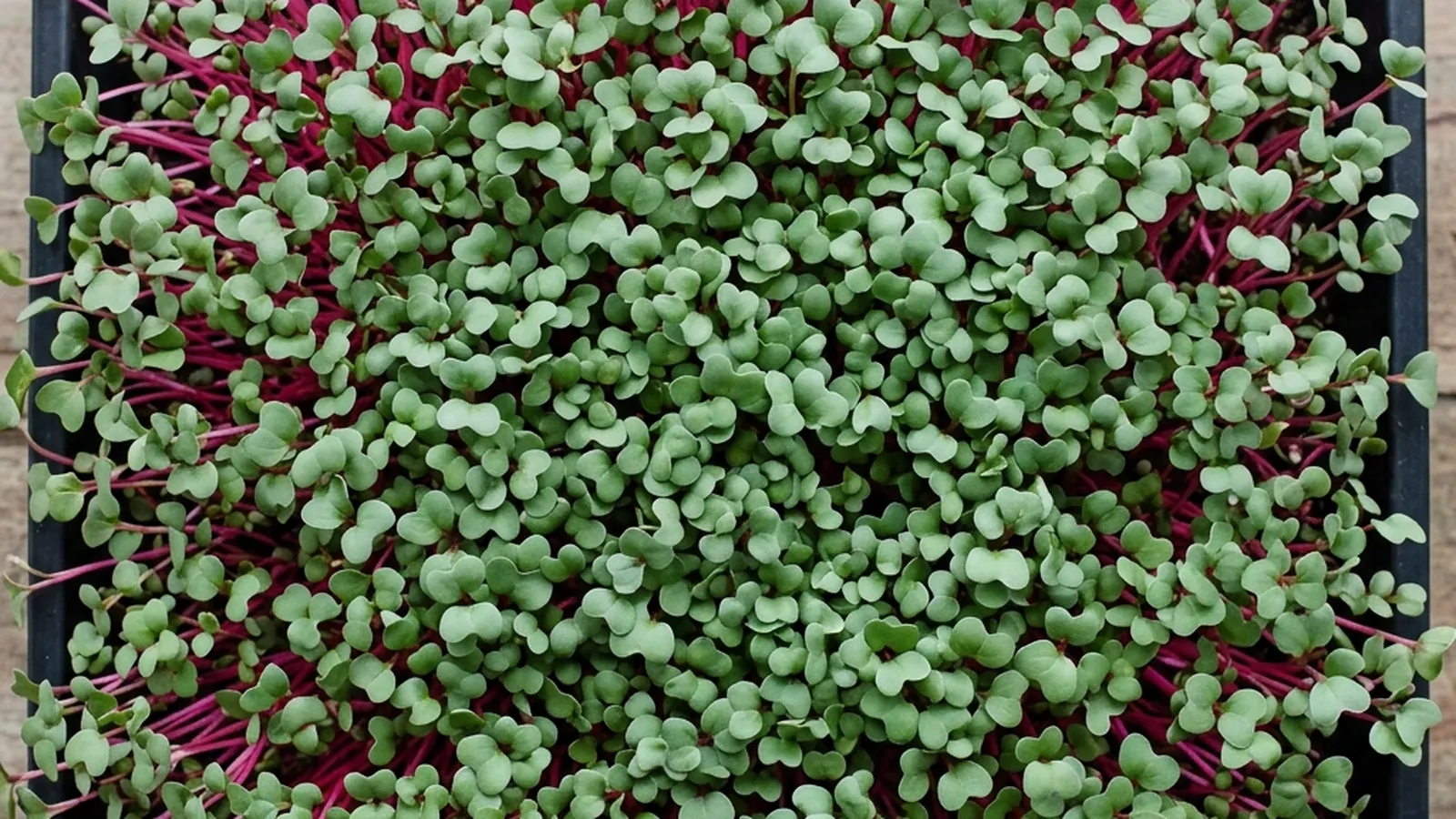
Radish microgreens grow log: a day-by-day timeline
Radish is one of the fastest common microgreens, which is why it works as the benchmark crop for beginners. Here is the realistic week it takes, stage by stage.
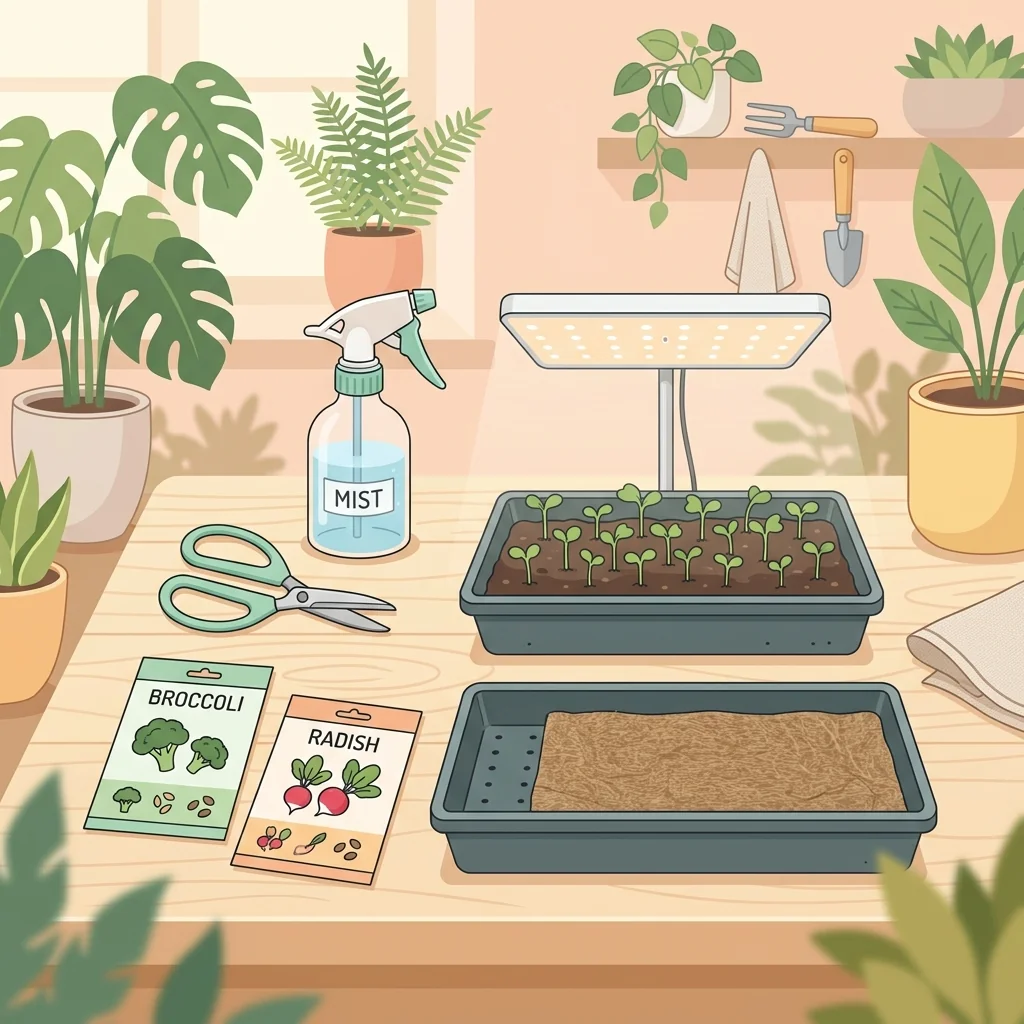
What do you need to grow microgreens? A short list
The microgreens supply list is short: tray, medium, seeds, spray bottle, light, scissors. Here is exactly what to get for your first setup and what not to waste money on.