
Beet microgreens are a slow crop grown from an unusual seed, and both facts trace back to the same source: what you sow is not a single seed but a hard, multi-seeded fruit. That structure is why beet benefits from a presoak that faster crops skip, why germination looks clumpy and uneven instead of tidy rows of single sprouts, and why the whole tray takes longer to reach harvest than a fast brassica does. None of that is a problem to fix. It is simply what beet is.
The method is the same as any other tray. What changes is how long it runs and what it looks like on the way.
Why beet seed needs a soak
What gets sold and sown as a single beet seed is not one seed. It is a dried, hardened fruit, and that fruit case — the pericarp — can contain more than one true seed fused inside it. That structure is tougher than the seed coat on a crop like radish or broccoli, and it is the reason beet responds well to presoaking before it goes into the tray.
UC Master Gardener Sonoma gives 6 to 12 hours for large or hard-coated seed, and beet’s fruit is exactly that case: the soak softens the pericarp and speeds germination. Use that window rather than a shorter guess, and do not treat a longer soak as automatically better — the point is softening the case, not saturating it. For the broader logic of which crops benefit from a soak and which do not, the general seed soaking guide covers the comparison across crops so you are not building a separate rule for every seed type in your tray rotation.
After soaking, drain the seed well before sowing. A soaked, hard fruit sitting in standing water on top of the growing medium is more likely to encourage the same surface moisture problems that show up on any overwatered tray, and beet’s slower pace gives those problems more days to develop before harvest.
Clumpy, uneven emergence is normal
Beet’s germination pattern is the part most people misread. Because each beet fruit can contain multiple seeds, sowing what looks like an even, single-seed spread does not produce an even, single-sprout result. Two or three seedlings commonly come up from what was one fruit, while other spots on the tray stay bare longer or show only one sprout. The result is a patchier, clumpier germination pattern than you would see on a tray of true single seeds like radish or broccoli.
That patchiness reads as a failure if you are used to the dense, even carpet a fast brassica produces. On beet it is just the seed structure showing through. If your tray shows clusters of seedlings in some spots and gaps in others a few days after sowing, that is consistent with normal beet behavior, not evidence of bad seed, wrong depth, or a watering mistake. If you are still unsure whether what you are seeing is normal unevenness or an actual germination problem, the guide to microgreens that are not germinating walks through the checks that separate the two.
Resist the urge to resow into the gaps once the tray is already growing. Mixing a fresh, un-germinated soak into an established tray just adds a second, out-of-sync timeline to a tray that is already running longer than most of your other crops.
Slower than a brassica, with no day count attached
Penn State Extension puts beet in a named list of crops that run longer than the fast brassicas — Swiss chard, spinach, amaranth, lettuce, celery and beet — and gives no day count for any of them. Set against Penn State’s general seed-to-harvest range of 7 to 21 days, that places beet toward the far end rather than the 7 to 8 days broccoli, radish, arugula, kale and mustard take.
So “how many days for beet” is a range, not a number. Plan closer to the slow end of that window rather than the week a radish tray takes.
Penn State Extension gives 60-75°F soil temperature for germination and 60-70°F air temperature, and beet sits inside those figures like every other crop. What is different is the dwell time: a longer run means more days for a cool corner, a dry afternoon or a missed watering to compound before you get to cut anything. If you have not grown a tray of anything yet, start with the beginner microgreens method — the basic four-step process is the same, beet just takes longer to run through it.
Color, watering, and blackout
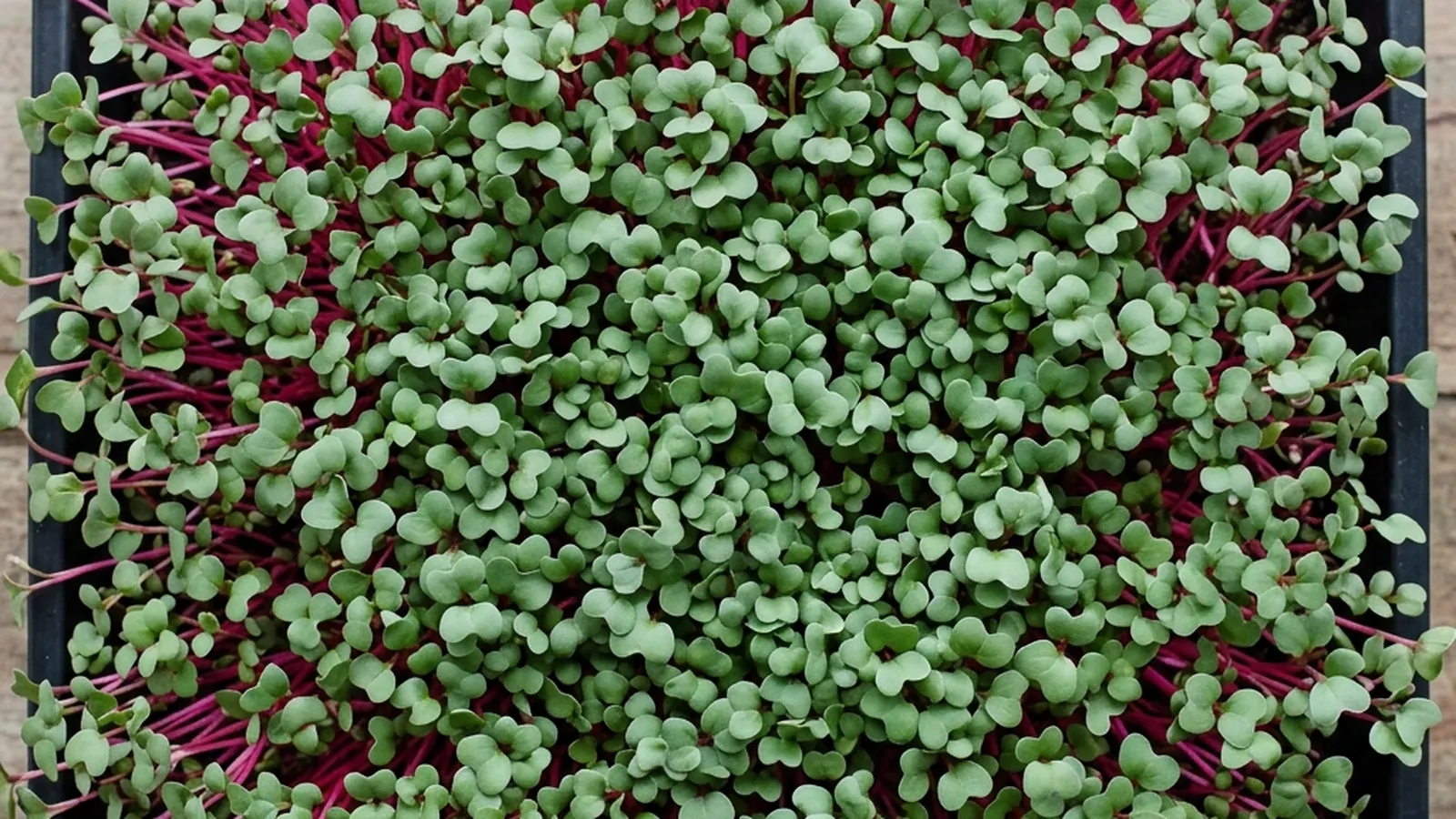
Extension sources do not describe stem colour, but growers consistently report beet microgreens running deep red to magenta, considerably darker than the pink tint some radish varieties show. Colour varies by variety and is not a sign of whether the tray is healthy.
Watering follows the same logic as any other microgreens tray: keep the surface moist with a spray bottle through germination, then move to bottom watering once the cover comes off, so the developing canopy and hulls stay drier than the roots. Because beet spends more days in the tray than a fast brassica, small watering inconsistencies have more time to show up as mold or uneven growth, so it is worth being more deliberate here than habit might otherwise push you to be.
Utah State Extension publishes a covered time for eleven varieties, and beet is not one of them, so there is no beet figure to time a cover against — which makes getting the cover off at the right moment, rather than by the calendar, matter more on a slow crop than on a week-long radish tray. The blackout period by crop guide carries Utah State’s per-variety covered times and the two documented blackout methods.
One fruit, several sprouts: beet against a single-seed crop
Putting beet side by side with a crop like radish or broccoli makes the practical differences concrete.
| Trait | Beet | Fast brassica (broccoli, radish) |
|---|---|---|
| Seed structure | Hard, multi-seeded fruit | Single true seed |
| Germination pattern | Clumpy and uneven, several sprouts per fruit | Even, one sprout per seed |
| Speed | Named among the slower crops; absent from Utah State’s days-to-harvest table | 7-8 days |
Beet is not harder to grow than radish. It is a crop whose normal looks like another crop’s failure, which is why the useful preparation is knowing what to expect before the tray does it.
Cut on size, not on a day count
Penn State and UC Sonoma both put harvest at 2 to 4 inches with true leaves just emerging, and beet is cut on the same benchmark. Go by what the tray looks like rather than a day number.
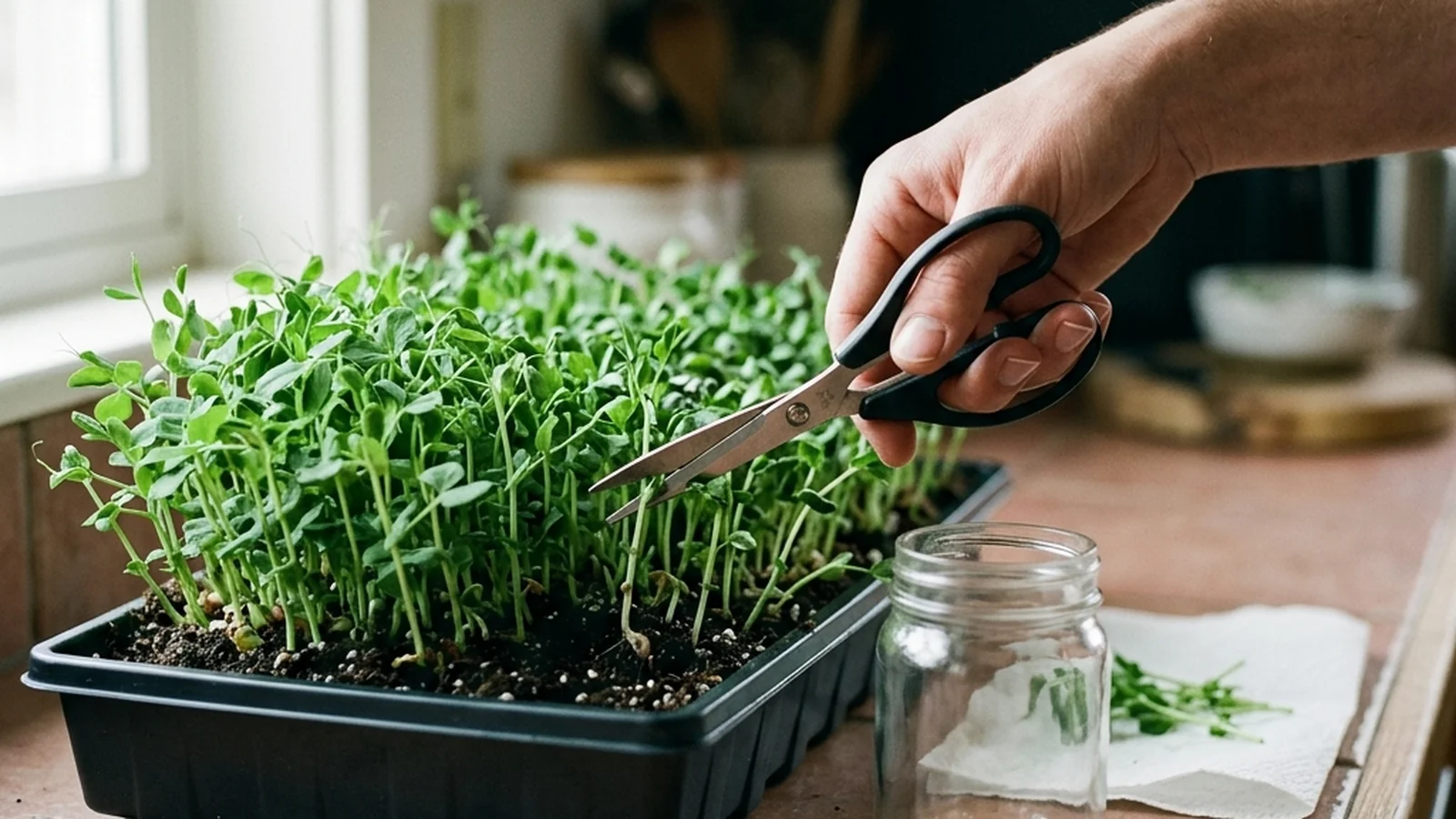
Cut at the base, just above the growing medium. Like most microgreens other than pea shoots, beet does not regrow a useful second harvest once the growing point is removed, so treat each tray as a single-cut crop. For handling after the cut — bagging, refrigeration, and washing timing — how to harvest and store microgreens covers the general practice that applies here as it does to any other crop in the cluster.
Common mistakes with beet microgreens
- Skipping the presoak because it feels unnecessary for something called a “seed,” when beet’s hard, multi-seeded fruit is exactly the case UC Master Gardener Sonoma’s 6-12 hour soak is meant for.
- Judging a beet tray’s germination against a fast brassica’s tidy, even carpet and assuming a clumpy tray has failed.
- Resowing into apparent gaps a few days in, which just adds a second, unsynced timeline to an already slower crop.
- Expecting a 7-to-8-day harvest because that is what a broccoli or radish tray takes, then pulling beet too early, before true leaves have formed.
- Oversoaking the fruit for far longer than the 12-hour upper end UC Master Gardener Sonoma gives, on the assumption that more time softens it better, which mainly raises the risk of surface moisture problems once it is sown.
Sources
- Penn State Extension: The ABCs of Microgreens — fast brassica group timing (7-8 days) and beet named among the slower crops.
- Penn State Extension: Growing Microgreens — general seed-to-harvest range, temperature ranges, and harvest height.
- UC Master Gardener Program of Sonoma County: Growing Microgreens — presoak duration for large or hard seed, sowing depth, and light guidance.
Handle the slow, hard-seeded crops correctly
Beet's soaking need and clumpy sprouting are not unique problems. The general soaking rules, germination troubleshooting, and watering method solve them.
Common questions
Do I need to soak beet seed before sowing?
Yes. Beet "seed" is actually a hard, multi-seeded fruit, and the general presoak of 6-12 hours documented for large or hard seed gives that pericarp time to soften before it goes onto the tray. Beet is not one of the crops in Utah State Extension's per-crop soak table, so the general figure is the one to use.
Why did more than one seedling come up from what looked like a single beet seed?
Because it was not a single seed. What gardeners call a beet seed is a dried fruit that can contain several true seeds fused together, so it is normal for two or three seedlings to emerge from one spot instead of one clean sprout per seed.
How long do beet microgreens take to grow?
Longer than the fast brassica group. Beet is named specifically as one of the crops that takes longer than broccoli, radish, arugula, kale, and mustard, which are usually ready in 7-8 days. Beet falls toward the slow end of the general 7 to 21 day microgreens window instead, and beet is absent from Utah State's per-crop days-to-harvest table, so no tighter figure is available for it.
Is uneven, clumpy germination a sign something went wrong with my beet tray?
Not on its own. Because each beet fruit can hold multiple seeds, germination naturally looks clumpier and less uniform than a crop like radish that germinates from a single true seed. Treat even coverage as a bonus, not the standard you should expect from beet.
Related guides

Soaking microgreen seeds: which crops need it, and for how long
Soaking is not a step every crop needs. Two extension sources cover it — one general rule and one per-crop protocol — and they agree with each other.
How to harvest and store microgreens safely
The cut and the fridge decide how long a tray lasts. Here is when to harvest, why you should not wash before storing, and what the shelf-life data actually shows.
Radish microgreens grow log: a day-by-day timeline
Radish is one of the fastest common microgreens, which is why it works as the benchmark crop for beginners. Here is the realistic week it takes, stage by stage.