
Chia microgreens are grown from dry, unsoaked seed scattered thinly over a moist surface, then watered gently from below. The seed coat releases a gel within minutes of getting wet, so the usual soak-then-sow routine turns the seed into one sticky mass.
That makes chia the opposite case to the crops covered in soaking microgreen seeds, where a presoak speeds things up. It is also why the beginner crop guide puts chia on the list to try after a first tray of something easier.
What the gel does
Researchers at the University of Kentucky report that chia mucilage “begins to emerge from the ruptured pericarp within minutes of exposure to water” and reaches its final size after about 1.5 hours, by which point it accounts for 92% of the water the seed has taken up.
The gel is not a nuisance to engineer around. In the University of Kentucky germination trials (Geneve and colleagues, Crop Science), seeds with the mucilage removed germinated more slowly, with 63% germination after 26 hours against 97% for intact seeds. Final germination was the same under optimal lab conditions. Seeds with their gel also germinated better and faster after cycles of wetting and drying, and the authors suggest it may act as a buffer that supplies water if conditions dry after the seed is first wet.
The same study’s greenhouse test points the same way: it reports that “mucilage-producing seeds [had] greater emergence at lower substrate moisture levels.”
For a grower, that means a fast start from intact seed, and a tolerance for a surface that dries briefly. It does not mean a wetter tray is better.
Sowing
- Do not soak. Sow dry, straight onto the moist medium. The gel forms in place.
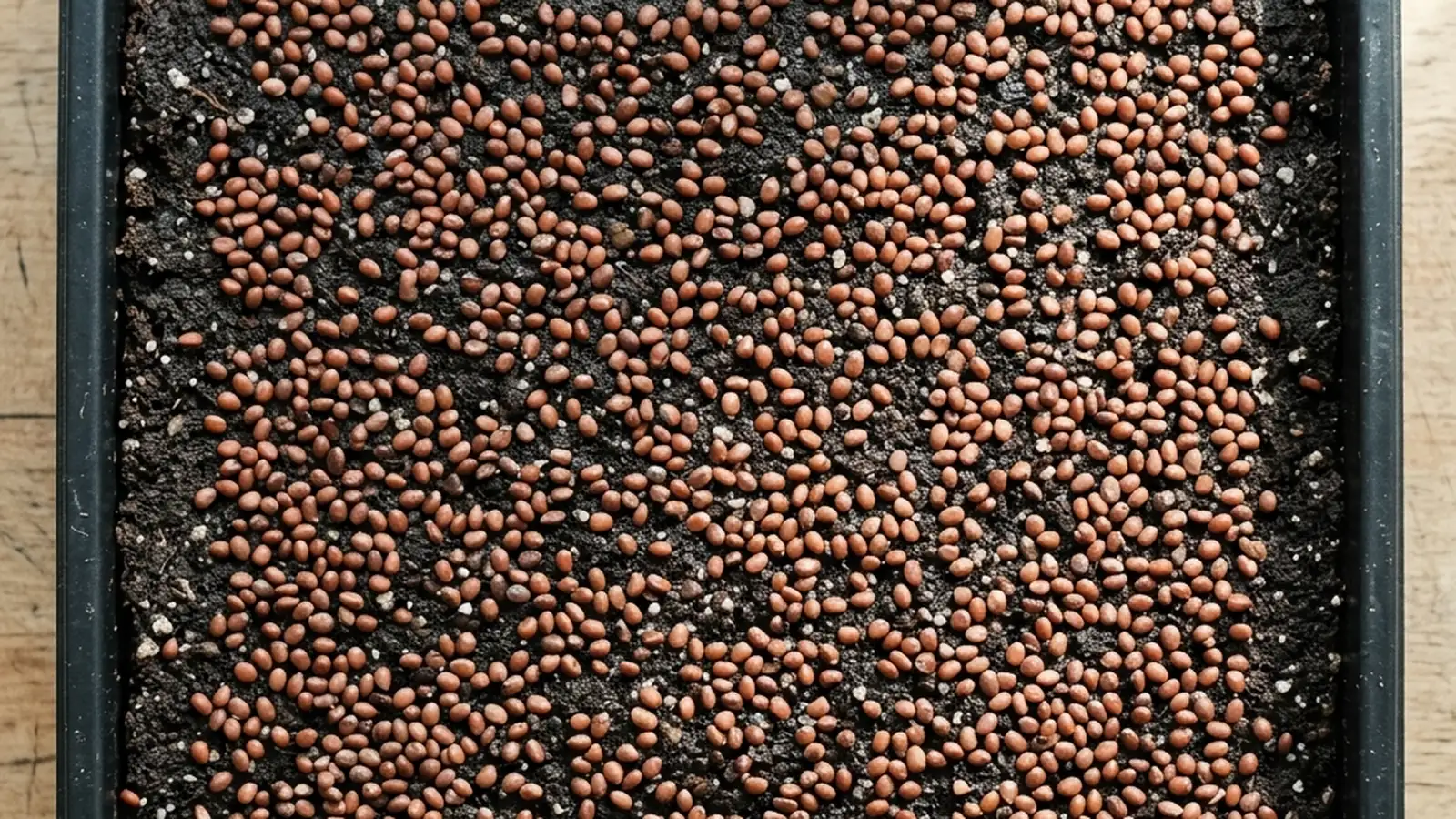
- Go thin. Gel glues neighbouring seeds together, so a heavy scatter becomes clumps that hold water. Chia is not in Utah State’s seeding-rate table, so use the seed density chart to scale a rate for your tray and err on the light side.
- Wet the surface first, then scatter. Sowing onto a dry surface and watering over the top washes seed into piles.
- Cover for germination. Illinois Extension covers seed with a moistened paper towel or cloth, or a dome, and removes it once the seedlings begin to push it up. Match that cue rather than a day count. The blackout guide has the published day figures for other crops.
- Keep it warm, not hot. Penn State Extension gives 60-75 °F for the growing medium. A chia sprout study from the Estonian University of Life Sciences found 25 °C (77 °F) optimal for germination, in a lab test of 100 seeds per sample, a little above that range.
Water: the part that goes wrong
The Estonian study found that the amount of water had the greatest influence on chia sprouts, and that an insufficient or excessive amount had a negative effect on germination. Chia punishes both extremes. Illinois Extension’s cue is to wait until the medium starts to dry out a little, which shows first around the outer edge of the container.
Penn State Extension advises watering from the bottom and allowing drainage to prevent mold. Bottom-watering lets the tray draw what it needs without flooding the gel layer. Between waterings, lift an edge or press the medium rather than judging by the surface.
Mold or root hairs
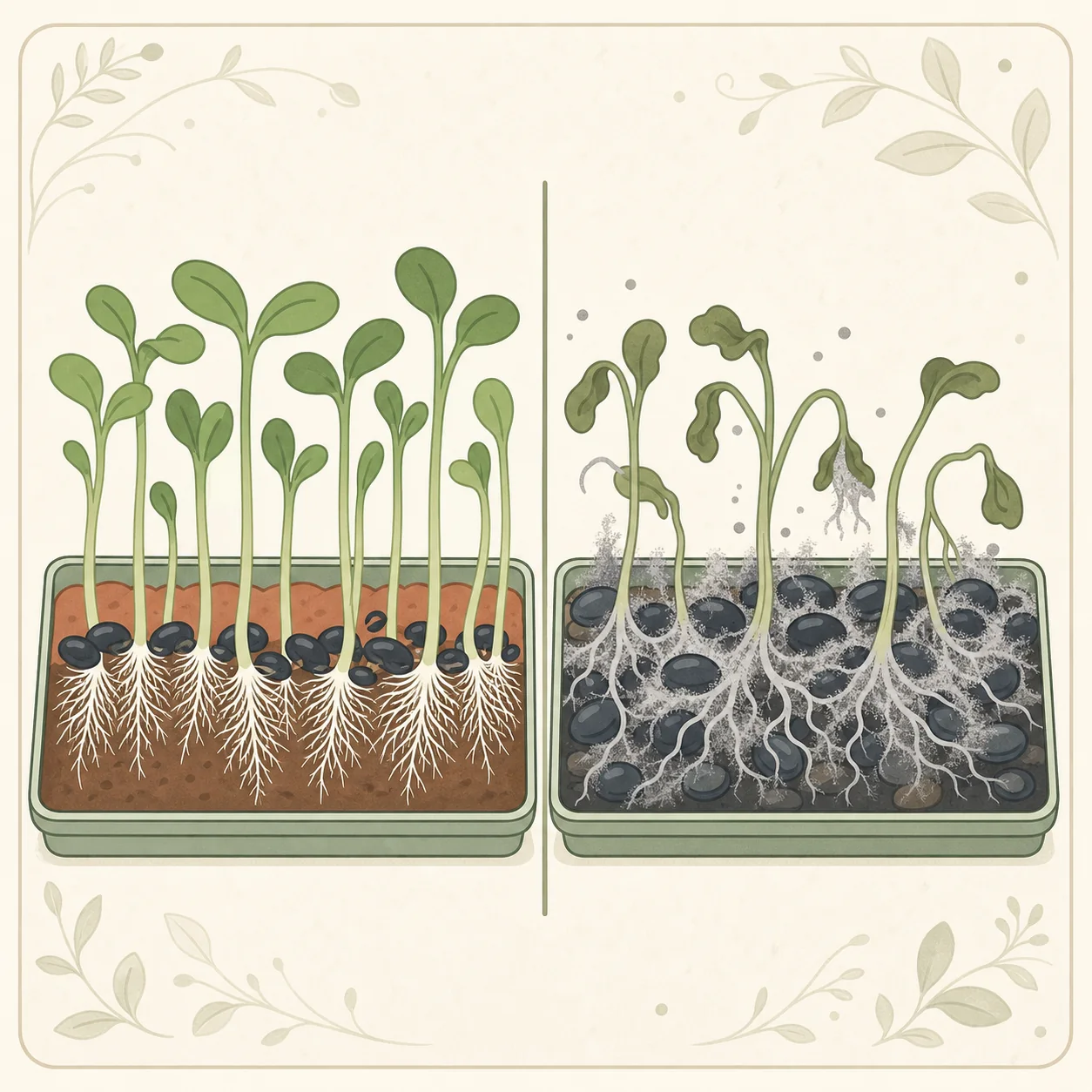
Fine white fuzz is common on any microgreen tray, and a gel-coated seed bed is where people most often panic. Purdue notes that root hairs emerging from the seed are normal, whereas mold is not. The checks in mold versus root hairs apply here unchanged. Penn State Extension also describes damping-off as whitish growth on collapsing seedlings, so look at the stem base before deciding.
Basil is the other crop in this group with gel seed; basil microgreens shows the same watering logic with Utah State’s published figures.
Harvest
Purdue and Penn State give the general rule: cut when the plant is 2 to 4 inches tall and any true leaves are just emerging. Utah State’s table and Penn State’s measured yield table do not list chia, so there is no extension day count or tray yield to quote. Judge by the tray, and expect most microgreens to stay cut rather than regrow.
| Step | Chia | Fast brassica such as radish |
|---|---|---|
| Soak | No, it gels | No presoak for radish in Utah State’s table |
| Watering | Bottom, light, check by touch | Bottom |
Sources
- University of Kentucky: Stress influences seed germination in mucilage-producing chia (Crop Science)
- AGRIS: Seed germination and mucilage production in chia (Salvia hispanica)
- Estonian University of Life Sciences: Investigation of various factors on the germination of chia seeds sprouts (Agronomy Research)
- Penn State Extension: Growing Microgreens
- Penn State Extension: A Step-By-Step Guide for Growing Microgreens at Home
- Illinois Extension: Growing Microgreens
- Purdue Extension: Grow Microgreens at Home
- Utah State University Extension: Grow Your Own Microgreens
Handle gel-forming seed
Soaking rules, mold checks and watering technique for crops that behave differently from a brassica.
Common questions
How do you grow chia microgreens?
Sow the seed dry, in a thin even layer, onto a moist growing medium or pad. Do not soak it, because the seed coat turns to gel within minutes of getting wet. Cover the tray for germination, water from below, and cut when the seedlings are 2 to 4 inches tall with true leaves just emerging, the general harvest size Purdue and Penn State give.
Should I soak chia seeds before sowing?
No. University of Kentucky researchers report that chia mucilage emerges within minutes of contact with water and reaches full size after about 1.5 hours. Soaked seed becomes a sticky mass that cannot be spread evenly.
Why does my chia tray get moldy?
The gel coat holds water at the seed, and Penn State Extension advises watering from below and letting the tray drain specifically to prevent mold. Give the tray airflow, and check whether the white growth is fuzzy mold or fine root hairs before discarding the tray.
How long do chia microgreens take?
Utah State and Penn State do not list chia in their per-crop tables, so there is no extension day count to quote. Cut by appearance, at 2 to 4 inches with true leaves just emerging, rather than by the calendar.
Related guides
Microgreens seed density: how to work out grams per tray
Seed density is the one variable that decides whether a tray comes up as an even carpet or a patchy, mould-prone mat. Here is how to calculate it from your own seed.

Soaking microgreen seeds: which crops need it, and for how long
Soaking is not a step every crop needs. Two extension sources cover it — one general rule and one per-crop protocol — and they agree with each other.
Microgreens mold or root hairs? How to tell safely
White fuzz around newly emerged roots is often normal root hair growth. Irregular spread, bad odor, slime, or collapsing stems changes the decision.