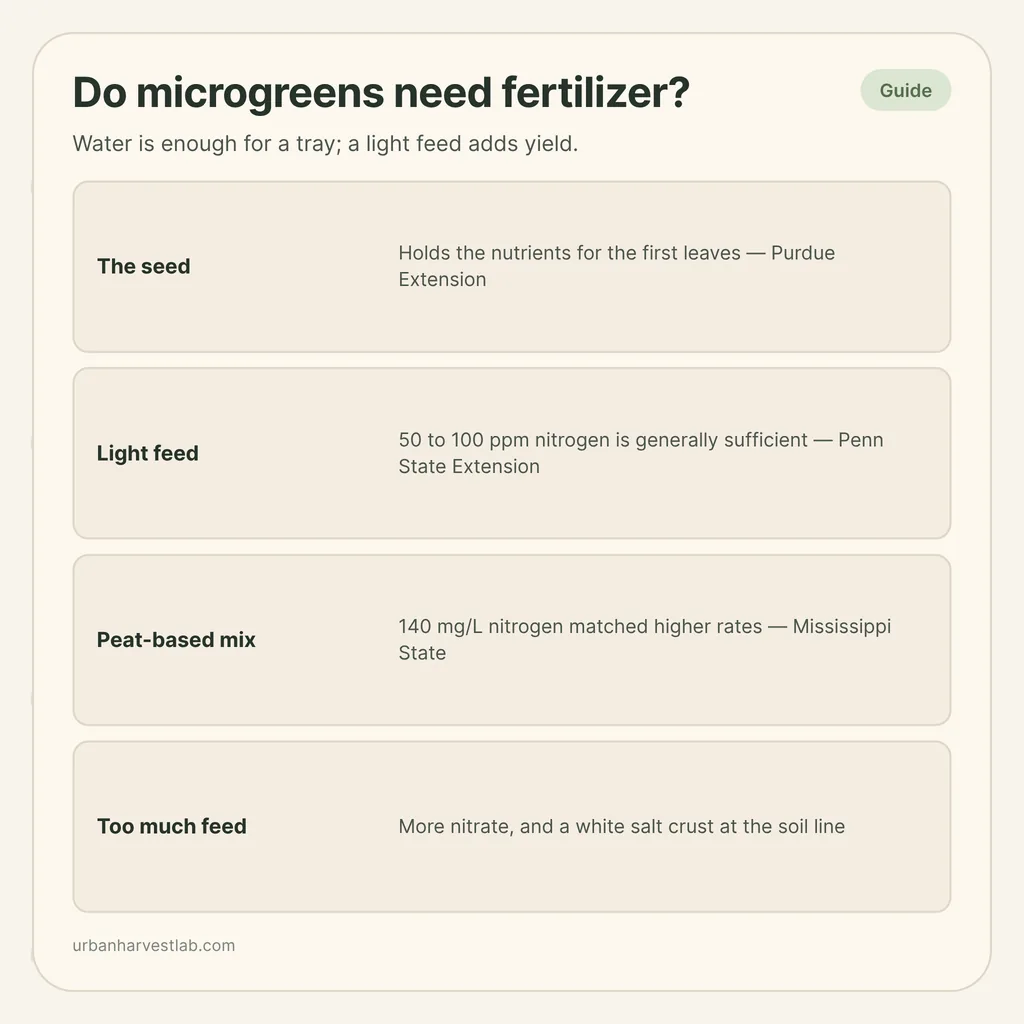
Microgreens do not need fertilizer to produce a tray. The seed carries the crop to its first leaves, and extension programs treat water as enough. Greenhouse trials show a light feed adds yield on a peat-based mix, and nitrogen beyond that adds nitrate and risks salt build-up.
What the seed already holds
Purdue Extension is direct: “Fertilization is not needed to successfully grow MGs as the seed itself is a storehouse for all of the nutrients needed to produce the first, seed leaves (cotyledons) and emerging true leaves.” Penn State Extension agrees from its own course trays: little or no fertilizer is needed, because the seedlings are not grown for very long before harvesting.
Illinois Extension builds the same idea into the medium. It asks for a basic potting soil with a little fertility mixed in, and says any potting soil that will get normal plants through their first few weeks without supplemental fertilizer will do fine. If your mix already clears that bar, the feeding question is mostly closed. Which mixes qualify is a medium question, covered in microgreens growing media compared.
When a light feed pays: the trials
The strongest evidence for feeding comes from Mississippi State University. Li, Arthur and Bi grew broccoli, cabbage, kale, daikon radish, Rambo radish and pea microgreens in a greenhouse on a peat-based soilless substrate, at 25.6 °C by day and 23.9 °C at night. Starting four days after sowing, each Mississippi State tray got 120 mL of fertilizer solution daily for five consecutive days, at 0, 70, 140, 210 or 280 mg/L nitrogen from a general-purpose 20-20-20 fertilizer.
The Mississippi State result: 140, 210 and 280 mg/L nitrogen gave similar fresh and dry shoot weights in both experiments, and all three were higher than the unfed control. The authors concluded that 140 mg/L nitrogen should be sufficient. Nothing was gained by going higher, and in the December run the 280 mg/L trays scored lower on visual quality (4.39) than the 0, 70 and 140 mg/L trays. The same trial found that the fertigation rate changed macronutrient concentrations in the shoots but not micronutrients such as iron, manganese or zinc.
A second Mississippi State trial, on hydroponic pads, found the same direction: one post-emergent fertilization generally increased shoot height, fresh and dry shoot weights, and macronutrient concentrations. The hemp mat gave the tallest, heaviest shoots of the four pad types.
Penn State’s range is lower than Mississippi State’s: 50 to 100 ppm nitrogen, with 100 ppm made from 20-10-20 fertilizer in its Hydroponics and Aquaponics class. Penn State also grew trays on clear water and reports they worked, but that they “have sometimes shown iron deficiency symptoms.” Treat the two figures as bracketing a range for a peat-based mix, not as competing answers. They come from different media, crops and schedules.
Strength matters on the other side too. An Italian trial (Palmitessa and colleagues) fed three Brassica microgreens on polyethylene terephthalate fibre pads with a Hoagland-type solution at half, quarter and eighth strength. In that trial, half strength gave both a high yield (0.23 g per cm²) and a desirable seedling height. Seedlings fed the eighth-strength solution were 17% shorter than those on quarter strength and 25% shorter than those on half strength, and broccoli raab yield fell 40% against half strength.
What feeding costs
Nitrate. Di Gioia and colleagues grew seventeen species on natural fibre mats with a half-strength Hoagland solution. They saw very high nitrate accumulation, especially in the Brassicaceae and in basil, and concluded that the nitrogen supplied exceeded the requirement and could be reduced for most species. A separate trial by Kyriacou and colleagues grew lettuce, mustard and rocket on peat to day 18 and replaced a quarter-strength Hoagland solution with water for the last 0, 6 or 12 days. Cutting the feed lowered nitrate, and the effective duration differed between species. Yield fell 5.6% going from 0 to 6 days without feed, and a further 11.8% from 6 to 12 days. The authors say that brief periods of six days or less cut nitrate with moderate or no impact on mineral composition. That trial used a controlled climate chamber and a specific solution, so it shows direction rather than a schedule for a kitchen tray.
Salts. Maryland Extension, writing about indoor plants in general rather than microgreens, ties high soluble salts to excessive or frequent fertilizer and to concentrate used wrongly. Its listed signs include a white crust on the media surface, “especially if bottom watered,” with stem collapse at the soil line. If you bottom water, read how to bottom-water microgreens before you add feed to the water.
Mold. Penn State describes damping-off as favoured by warm, humid conditions. Penn State does not tie it to feeding, so cutting fertilizer is not the lever. Damping-off in microgreens covers the diagnosis.
Decide by setup
| Your tray | Water only? | What the sources support |
|---|---|---|
| Potting mix with some fertility | Yes | Illinois: a mix that carries ordinary plants for a few weeks needs no supplemental feed. |
| Peat-based mix, you want more bulk | Optional light feed | Mississippi State: gains up to 140 mg/L nitrogen, none above it. Penn State: 50 to 100 ppm. |
| Fibre mat or pad in a tray | Works, with a caveat | Penn State grew trays on clear water, with occasional iron deficiency symptoms. Mississippi State found gains from one feeding on pads, and the Italian trials fed every pad. |
| Greens you will eat within days, nitrate a concern | Yes, or stop feeding before harvest | Kyriacou: replacing the feed with water lowered nitrate, with 5.6% lower fresh yield at six days. |
If you do feed, you need a balanced water-soluble fertilizer and a number from its label. Penn State’s course used a 20-10-20 formula, and browse water-soluble 20-10-20 fertilizer on Amazon if you want that exact analysis. The fertilizer dilution calculator converts a label rate into millilitres per litre. The trials above quote nitrogen in mg/L or ppm of nitrogen, not of product, so match the units to the label before you mix.
On a bare pad the seed reserve does all the work; growing microgreens without soil covers that method. If shoots look pale, check microgreens turning yellow before reaching for feed.
Sources
- Purdue Extension, Grow Microgreens at Home
- Penn State Extension, Growing Microgreens
- Illinois Extension, Growing Microgreens (PDF)
- University of Maryland Extension, Fertilizer Toxicity or High Soluble Salts in Indoor Plants
- Li, Arthur and Bi (Mississippi State), Shoot Yield and Mineral Nutrient Concentrations of Six Microgreens in the Brassicaceae Family Affected by Fertigation Rate, Horticulturae 2023
- Li, Lalk, Arthur, Johnson and Bi (Mississippi State), Shoot Production and Mineral Nutrients of Five Microgreens as Affected by Hydroponic Substrate Type and Post-Emergent Fertilization, Horticulturae 2021
- Palmitessa et al., Yield and Quality Characteristics of Brassica Microgreens as Affected by the NH4:NO3 Molar Ratio and Strength of the Nutrient Solution, Foods 2020
- Di Gioia et al., Yield performance, mineral profile, and nitrate content in a selection of seventeen microgreen species, Frontiers in Plant Science 2023
- Kyriacou et al., Preharvest Nutrient Deprivation Reconfigures Nitrate, Mineral, and Phytochemical Content of Microgreens, Foods 2021
Set up the tray before you decide on feed
The medium decides how much feeding matters, and a calculator turns a label rate into a usable dilution.
Common questions
Do microgreens need fertilizer?
Not to produce a tray. Purdue Extension says the seed is a storehouse for all of the nutrients needed to produce the first seed leaves and the emerging true leaves. A Mississippi State trial on a peat-based mix did find higher yield with a light feed than with none, so fertilizer is an option for more bulk, not a requirement.
How much fertilizer should I give microgreens?
Penn State Extension says a solution with 50 to 100 ppm nitrogen is generally sufficient, and its course uses 100 ppm nitrogen from a 20-10-20 fertilizer. In the Mississippi State trial, 140 mg/L nitrogen was enough to match higher rates on a peat-based mix. Those are different setups, and the label tells you how to dilute a given product to either number.
Can fertilizer make microgreens moldy?
Penn State Extension describes damping-off as favoured by warm, humid conditions, not by feeding. What fertilizer does add is salt. Maryland Extension says fertilizer salts can build up as a white crust on the surface of potting media, especially when bottom watered, and cause stem collapse at the soil line.
Why are my microgreens pale or yellow?
Pale shoots under a blackout cover are normal. Separately, Penn State Extension reports that its trays grown on clear water have sometimes shown iron deficiency symptoms, which is one reason a light feed is on the table.
Related guides
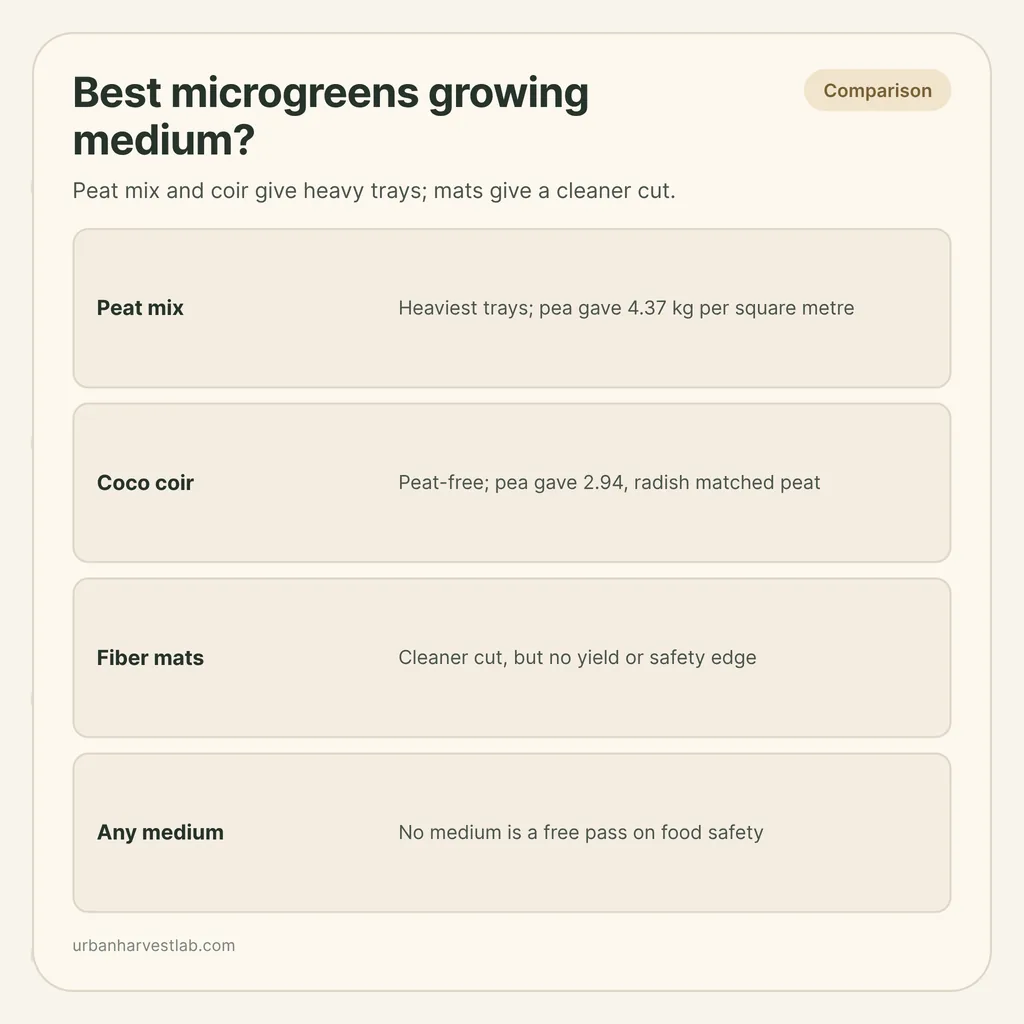
Microgreens growing media compared: peat mix, coco coir, hemp and jute mats
Peat mix and coir give the heaviest trays, mats give the cleanest cut, and the food-safety data does not favor mats. What the trials measured and which medium suits your kitchen.

Microgreens turning yellow: normal etiolation or a real problem?
Pale, yellow, leggy microgreens right after you lift the cover are usually fine. Here is how to tell that from a light problem, a crowded wet tray, or disease.
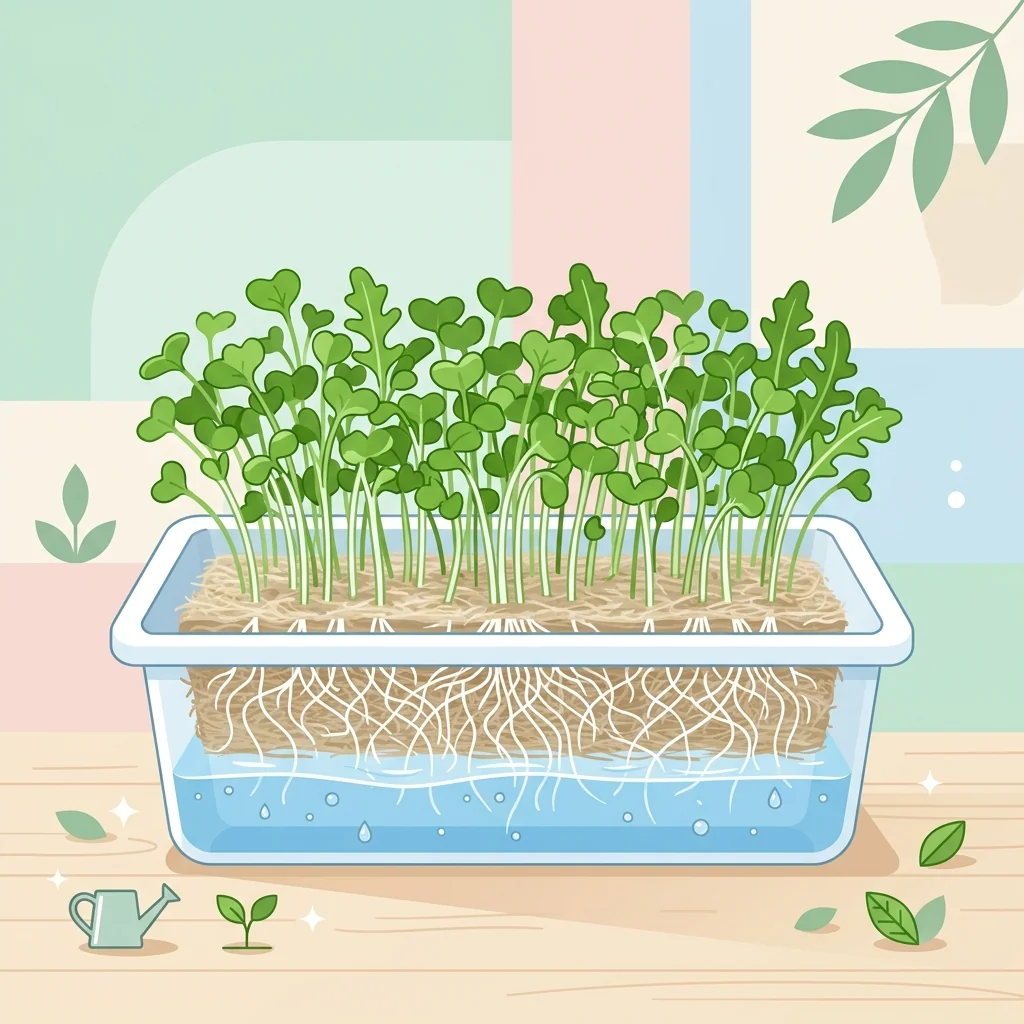
How to grow microgreens without soil (hydroponic)
No soil, no mess. Grow microgreens hydroponically on a grow mat or pad for clean, tidy trays indoors. Here is how the soil-free method works and where it shines.