
Troubleshoot the system before you change the inputs.
Symptoms
- Seedlings are tall, thin, pale, and leaning toward one side of the tray, but the stems feel firm when touched.
- A section or the whole tray has gone flat, with stems bent or lying over but not pinched or discolored at the base.
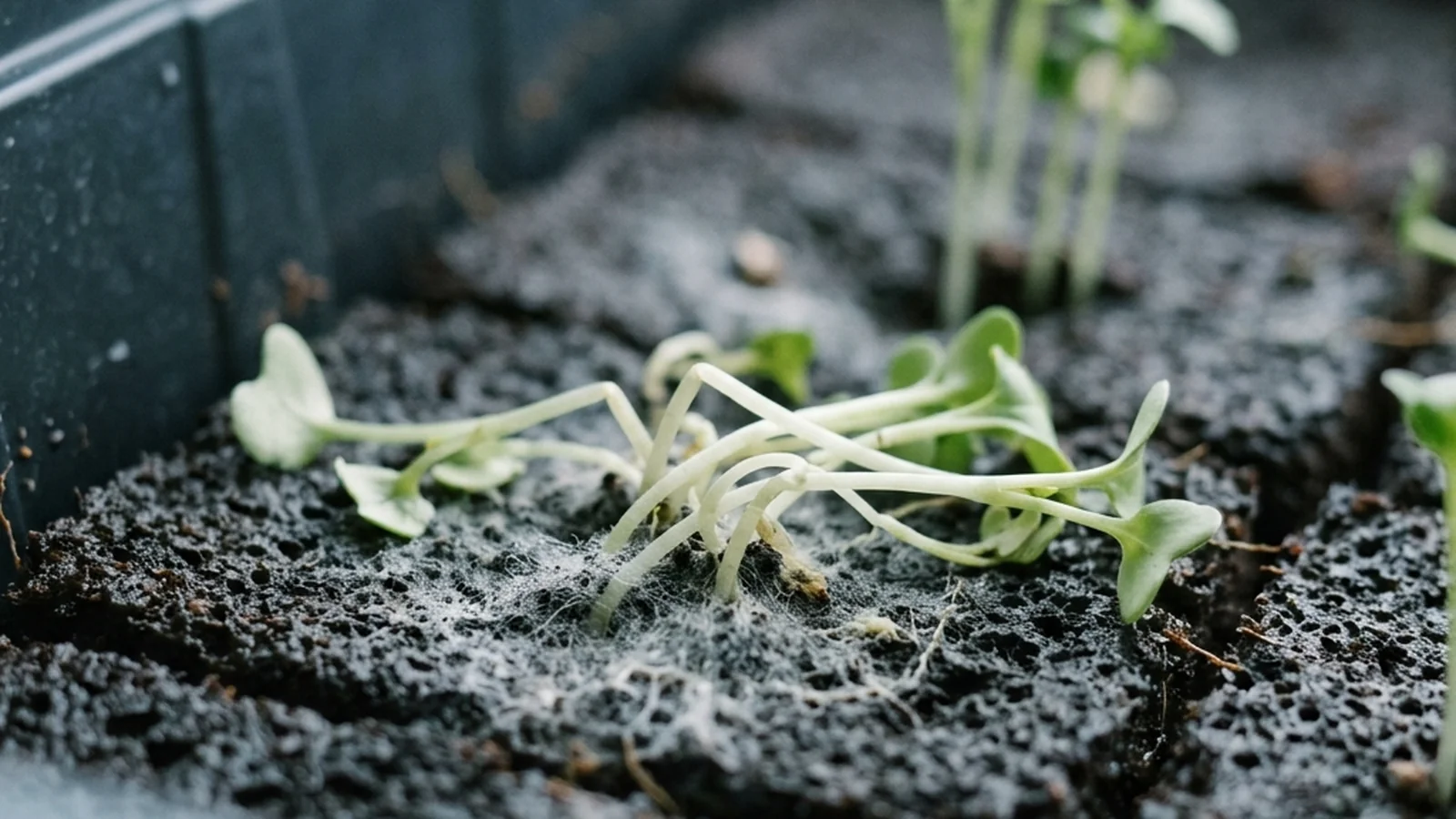
- Seedlings are collapsing with a pinched or water-soaked stem right at the growing-medium line, along with patchy emergence or root decay.
Possible causes
- Not enough light reached the tray once the cover came off, so stems stretched upward searching for it.
- Water was poured over the top of the tray, or the canopy stayed saturated, and the weight or force knocked seedlings down.
- A dense stand of top growth outgrew what its stems could support before harvest.
- Pythium, or less commonly Rhizoctonia, Fusarium, or Phytophthora, has infected the roots and stem base.
Quick fixes
- Press a few stems gently at the medium line: firm and springy means light or mechanics; pinched or mushy means disease.
- For leggy stretch, move the tray to the 6-8 hours of light a day UC Master Gardener Sonoma gives once sprouts appear; new growth comes in shorter, but the stems that already stretched stay long.
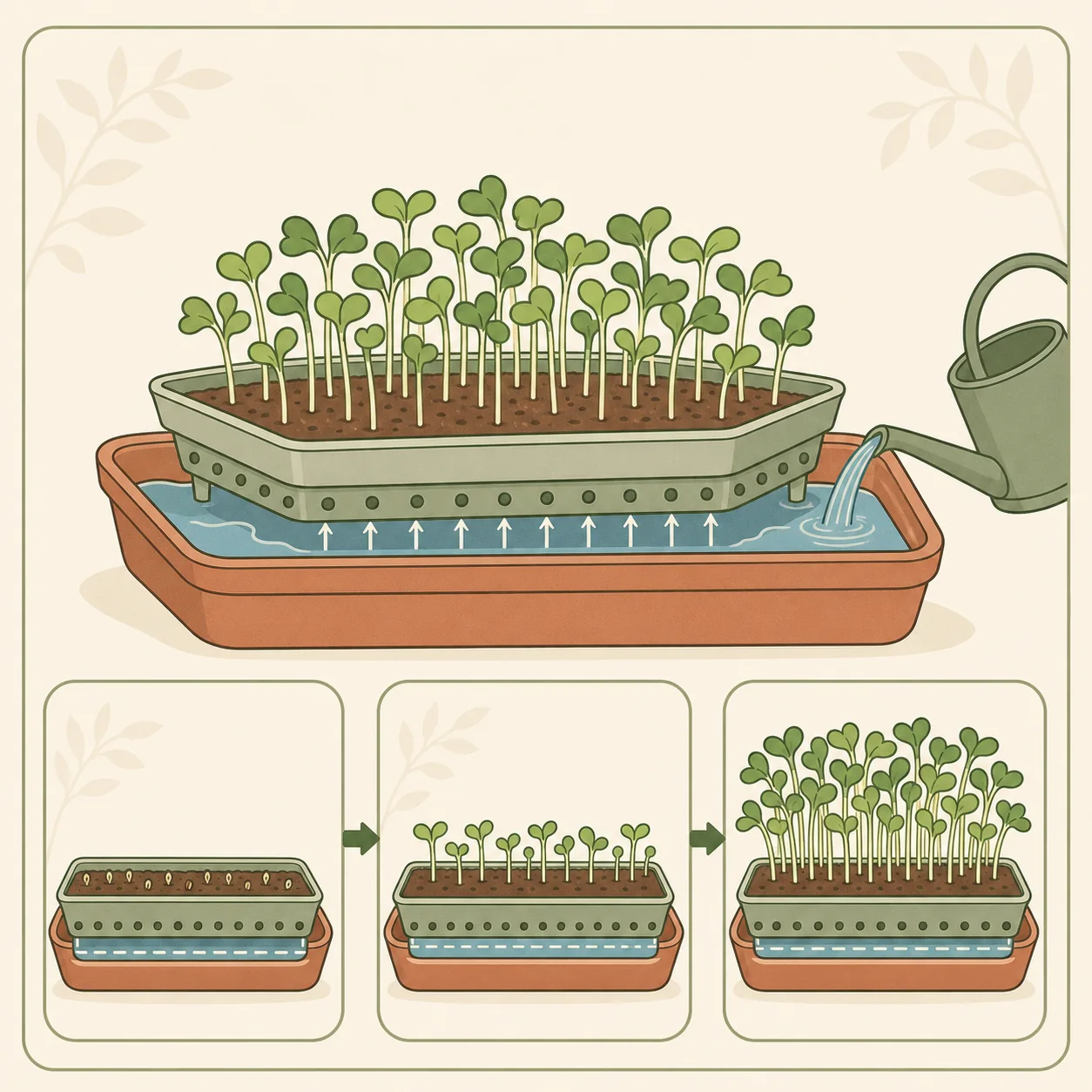
- For water and weight issues, switch to bottom watering and let the tray drain fully between waterings.
- For disease signs, do not try to save the tray - discard it and sanitize before the next sowing.
Three reasons a tray falls over
| Sign | Leggy stretch | Water and weight | Damping-off |
|---|---|---|---|
| Stem at medium line | Firm, thin, tall | Firm, may be bent flat | Pinched or water-soaked |
| Color | Pale, yellow-white | Normal green | Cotyledons wilting, discolored |
| Pattern | Leaning toward light source | Flattened mat, often whole tray | Patchy, spreading collapse |
| Action | Move to more usable light | Bottom water, improve drainage | Discard and sanitize |
Press a stem where it meets the growing medium. If it is firm, the tray is stretching for light or was knocked down by watering; if it is pinched or water-soaked, it is damping-off and the tray goes in the bin. A microgreens tray falling over is not one problem. It can be a tray stretching toward light with every stem still intact, a tray knocked flat by watering habits or its own top weight, or a tray genuinely diseased at the stem base. The three look similar from across the room and call for three different responses, so treating all of them the same way either wastes a rescuable tray or delays discarding one that needs to go.
Light, watering, tray choice and timing are what make a tray less likely to fall over in the first place - the beginner microgreens method covers those settings.
Start with the stem, not the symptom
The fastest way to sort a falling-over tray is to look at the stem right at the growing-medium line, not at how dramatic the collapse looks from above. Gently press or pinch a few stems near the base.
A stem that feels firm and springy, even if the seedling above it is pale, thin, or lying flat, points toward a light problem or a watering and weight issue. A stem that feels pinched, thread-thin, or water-soaked right at that spot - especially alongside bare patches where seed failed to emerge, or roots that look brown and decayed rather than white and firm - points toward disease. That single check does more work than anything else here, because the three branches below share almost no other reliable tell from a distance.
Branch 1: leggy stretch toward the light
Tall, thin, pale stems leaning hard toward a window or leaning away from the darkest side of the room are classic signs of insufficient light. The seedling is spending its stored energy reaching for light instead of building a short, sturdy stem, and it will keep stretching as long as the light stays inadequate.
Pale, leaning growth in the first day or two after the cover comes off is normal etiolation, not a light fault - microgreens turning yellow covers how long to wait before treating it as a problem. What matters for a falling-over tray is that those stems are still firm; if they are, the tray has not failed at anything yet.
The UC Master Gardener Program of Sonoma County puts natural light at 6-8 hours a day once sprouts appear. If the tray sits far from a window, gets shaded part of the day, or is lit by a fixture that does not reach the canopy evenly, stems keep stretching past the point where they would otherwise level off. Setting up a fixture correctly - height above the canopy, hours on a timer - is its own topic with its own numbers, covered in microgreens light setup; use that guide rather than guessing at a distance or duration here.
The stems in this branch stay intact. Nothing is pinched, mushy, or rotting. This tray is still edible, and moving it into better, more consistent light for the next few days is usually enough to see the growth firm up, even if the existing stretched section stays somewhat longer than it would have with light from day one.
Branch 2: water and weight mechanics
The second branch has nothing to do with light or disease. It is what happens when water lands on top of a tray with enough force or volume to knock delicate seedlings down, or when a canopy stays saturated long enough that its own weight, combined with softened stems, is enough to flatten it.
Watering directly over the top of a tray - pouring, a heavy stream from a watering can, or a strong spray after the germination stage - can physically push seedlings flat, especially once they are tall enough to have real leverage but not yet sturdy enough to resist it. A tray left sitting in standing water, or one that drains poorly, keeps the base of every stem softer and less able to hold the plant upright, even without any pathogen involved.
A dense, top-heavy tray adds a related but separate mechanism: if a crop was sown thickly and grows a full, heavy canopy in a short window, the stems can simply run out of the strength needed to hold that much leaf and cotyledon weight upright late in the cycle, particularly if watering has kept them soft. That is not a rescue situation for the tray in front of you - it is a sowing-density decision to adjust the next time you fill that tray, since seed density set the ratio of stem strength to top growth a week earlier.
The tell here is the same firm-stem check from above, with no pinching or tissue damage at the medium line. Penn State Extension’s home microgreens guide says to water from the bottom and let the tray drain rather than watering over the top, and that applies whether the immediate cause was a heavy pour or a mat that stayed saturated. See how to bottom water microgreens for the method itself.
Branch 3: damping-off
The third branch is disease, and it is the one that should stop a rescue attempt rather than prompt one. Damping-off shows up as poor or patchy emergence, root decay, and - the sign that matters most here - a pinched or water-soaked stem right at the medium line. Cotyledons wilt and the seedling topples because the stem and root system have actually failed, not because the plant is reaching for light or was pushed over by water.
This is a different failure mode from the first two branches, and it is not something a light adjustment or a gentler watering can undo once the stem tissue itself is compromised. Damping-off in microgreens covers the full picture - what causes it, how pre-emergence and post-emergence stages differ, and the sanitation steps that actually control it - and is the place to go once the pinched-stem check above points this way. The short version: remove or discard the affected tray rather than trying to save it, and sanitize trays and medium before the next sowing.
Related symptoms
Pale or yellowing seedlings that are otherwise upright and not falling over are a related but distinct symptom, covered in microgreens turning yellow rather than here. Surface fuzz on hulls or medium that has nothing to do with stems bending or collapsing is a mold-versus-root-hairs question, not a falling-over question - see microgreens mold or root hairs if that is what is actually in front of you.
Common mistakes
- Assuming every collapsed tray is disease and discarding a tray that only needed more light or gentler watering.
- Assuming pale, leaning growth right after blackout is already a light failure, when a short adjustment period is normal.
- Watering harder or more often on a flattened tray, which worsens both the water-mechanics branch and any disease already present.
- Skipping the stem-at-the-medium-line check and diagnosing from a photo of the whole tray instead.
- Sowing at the same density again after a top-heavy collapse without treating it as a density decision for the next tray.
Prevent the next tray from falling over
Set up light correctly once sprouts emerge, rather than after stretching has already started - see microgreens light setup for fixture placement and timing. Water from the bottom by default, since pouring over the top is both a mold risk and a direct cause of physical knock-down. Get light and watering right and two of the three branches stop happening; the third is a sanitation question, not a growing one.
Sources
- Penn State Extension: A Step-By-Step Guide for Growing Microgreens at Home covers watering from the bottom and blackout handling.
- UC Master Gardener Program of Sonoma County: Growing Microgreens gives the 6-8 hours of natural light once sprouts appear.
- UC ANR Coastal Gardener: Your Indoor Winter Garden describes the blackout stages that precede normal post-blackout paleness.
- University of Minnesota Extension: How to prevent seedling damping off describes the stem and root symptoms that separate disease from the other two branches.
- UC IPM Pest Notes: Damping-Off Diseases in the Garden lists the pathogens most commonly responsible for damping-off.
Fix the cause, not just the symptom
Once you know which branch you are dealing with, these guides cover the actual fix.
Common questions
Can a leggy microgreens tray still be eaten?
Yes. Leggy, pale, stretched growth from too little light is a light problem, not a food-safety problem. The stems are intact and the crop is still edible, though shorter and sturdier growth is more pleasant to harvest and eat.
How do I tell leggy stretch from damping-off without a lab test?
Press gently at the stem near the growing medium. A firm, springy stem that simply leans or looks pale points to light or mechanics. A pinched, thread-thin, or water-soaked stem at that exact spot, especially paired with patchy emergence or root decay, points to damping-off.
My tray looks fine but then collapsed flat overnight - what happened?
Check first for a watering or weight cause: water poured over the top, a tray left sitting in standing water, or a dense mat of top growth that got too heavy for its stems. If the stems are firm and unpinched at the base, this is a watering or density issue rather than disease.
Related guides
Damping-off in microgreens: symptoms and control
Damping-off attacks the seedling itself, not the tray surface. Here is how to recognize pre- and post-emergence stages and control outbreaks with sanitation, not fungicide.

Microgreens turning yellow: normal etiolation or a real problem?
Pale, yellow, leggy microgreens right after you lift the cover are usually fine. Here is how to tell that from a light problem, a crowded wet tray, or disease.
How to bottom-water microgreens without soaking the tray
Bottom watering is a controlled transfer, not permanent standing water. Add a measured amount, let the medium absorb it, and drain what remains.