Troubleshoot the system before you change the inputs.
Symptoms
- A thin green film or slimy layer on the surface of the potting soil.
- Flat, glossy, lobed green patches pressed against the soil, sometimes with tiny cups or umbrella-like stalks.
- A green or dark crust that sheds water instead of soaking it in.
- Small flies hovering over the pot alongside the green growth.
Possible causes
- Algae growing on a surface that stays moist, which University of Maryland Extension describes as usually not detrimental to plants.
- Liverwort, which Penn State Extension says thrives in overwatered, densely shaded containers with compacted media.
- Watering too often, or a dense mix and a crowded shelf that keep the top layer from drying.
- Excess fertilizer, which Washington State University Hortsense links to liverwort growth.
Quick fixes
- Let the surface dry between waterings and keep air moving between pots.
- Break up the mat with a fork, or remove and discard the top layer of mix with the mat in it.
- Do not over-fertilize, and consider a coarse, quick-drying material on the surface.
- If water runs off the crust instead of soaking in, remove it before the next watering.
Green on the soil: algae or liverwort?
| Sign | Algae | Liverwort |
|---|---|---|
| Look | Thin greenish film or slimy layer | Flat, glossy, lobed or ribbon-like green patches |
| Structure | Single or multicelled aquatic plants | Non-flowering relative of mosses, attached by hair-like rhizoids |
| Where it thrives | Moist surface of the growing media | Overwatered, densely shaded containers with compacted media |
| Harm | Usually none; a thick mat can dry into a crust | Dense mats can impede water infiltration and gas exchange |
| Fix | Dry the surface, add airflow, break up or remove the top layer | Same, plus coarser mix, more spacing, and a coarse surface layer |
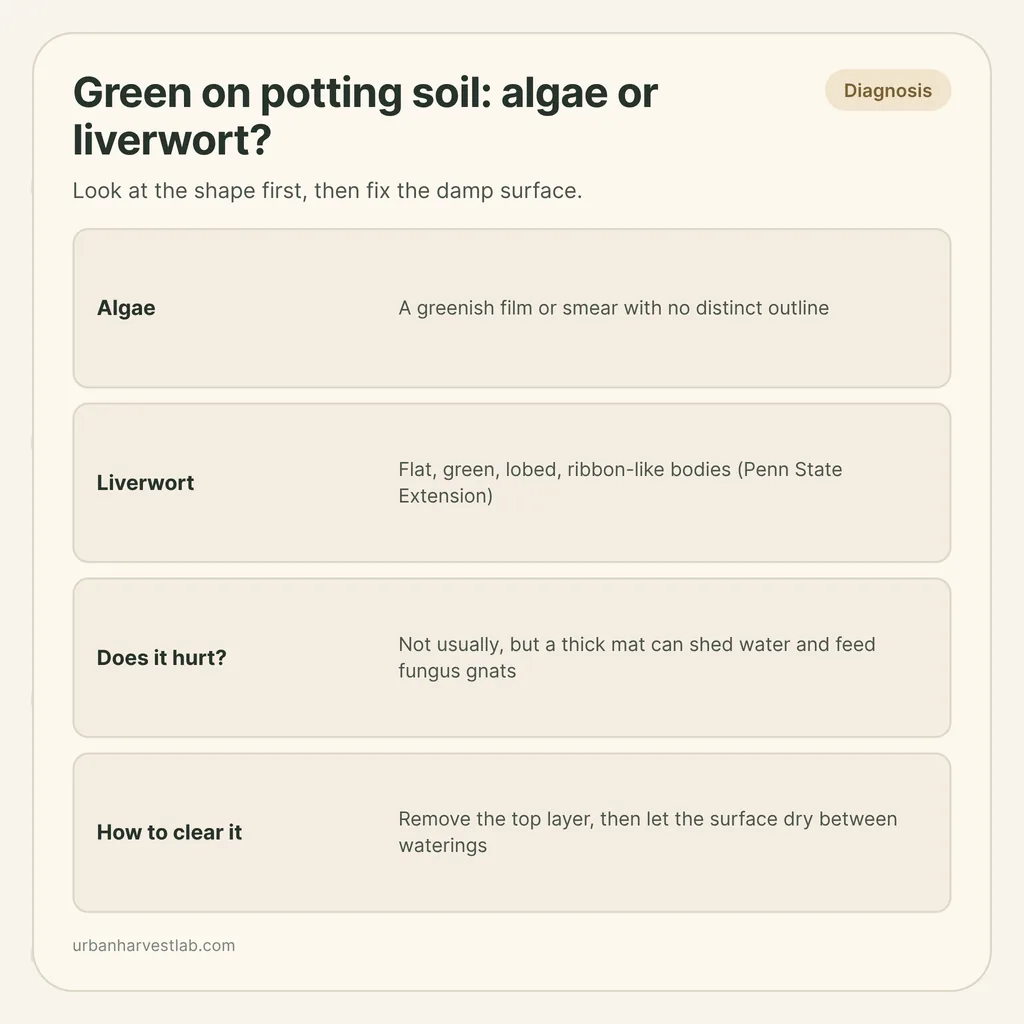
Green stuff on top of potting soil is usually algae: a thin film that appears where the surface stays damp, and one that University of Maryland Extension says is not usually detrimental to plants. If the green is in flat, lobed, glossy patches, it is more likely a liverwort. Either way the message is the same: the top layer of your mix does not get the chance to dry. Fix that, and the green stops spreading.
Is it algae, liverwort, or something else?
Look at the shape first.
Algae show up as a greenish layer on the surface of the growing media. University of Maryland Extension calls them single to multicelled aquatic plants that grow under moist conditions. Expect a film or smear with no distinct outline.
Liverwort is a different organism that looks like moss to most people. Washington State University’s Hortsense calls liverworts low-growing, non-flowering relatives of mosses. Penn State Extension describes the common one as having flat, green, lobed, ribbon-like bodies that adhere closely to moist surfaces. If you can see separate lobes, it is probably liverwort.
White or grayish growth is not algae. University of Maryland says fungi form a white to grayish layer and can grow alongside algae or on their own. The fuzzy kind has its own page: white mold on plant soil. If what you see has a stalk and a cap, that is a mushroom.
Does it hurt the plant?
Mostly no. University of Maryland says algae growth isn’t usually detrimental to plants. The trouble starts when the layer gets thick.
- A crust that sheds water. A thick mat can dry out and interfere with water absorption and infiltration into the mix, according to University of Maryland. Water runs down the side of the pot instead of wetting the roots.
- Gnat food. The same extension notes the mat can feed fungus gnats and shore flies, whose larvae feed on plant roots and can cause wilting and stunting. If you already have little flies, read why fungus gnats keep coming back in herb pots.
- Liverwort mats. Penn State says dense liverwort mats can impede irrigation and reduce gas exchange at the soil surface, and that they compete with seedlings for space, light and nutrients. A seedling tray with a green carpet is worth acting on early.
Why it is growing there
Moisture at the surface. University of Maryland’s prevention advice is to let the surface dry between waterings and keep humidity low with good air circulation between pots, which tells you what feeds it.
Liverwort adds a few more conditions. Penn State says it thrives in overwatered, densely shaded containers with compacted media, and Washington State adds that it thrives in high-nutrient environments, so heavy feeding helps it along.
If you are not sure you are overwatering, overwatered vs underwatered shows how to check below the surface instead of guessing from the top inch.
How to clear it
- Remove it. University of Maryland offers two options: break up the mat with a small cultivation tool such as a fork, or remove and discard the upper layer of mix along with the algae.
- Replace what you took. Top up with fresh, dry mix from the bag.
- Let the surface dry between waterings. Both University of Maryland and Washington State put this first. Water when the top of the mix has dried, not on a schedule.
- Move air. Space pots so air can pass between them. Penn State lists more plant spacing among its cultural controls for liverwort.
- Check the mix. Penn State recommends coarse-textured potting media for drainage and avoiding constant saturation.
- Consider a coarse top layer. Washington State suggests mulch that drains well and dries quickly at the surface, such as crushed shell or hazelnut shells. Penn State reports rice hulls work in nursery containers. For what a surface layer does and does not do in a pot, see mulch for potted plants.
Sprays are a poor fit. Penn State says chemical control is challenging because few herbicides are labeled for liverworts, and that regrowth is likely if conditions stay favorable. For a pot of herbs, the cultural fixes above are the plan.
Why scraping alone does not work
Penn State warns that liverworts propagate readily through vegetative fragments, so physical removal is often ineffective unless underlying environmental conditions are changed. Scrape without changing the watering and Penn State says reestablishment is likely. Cultural control, Penn State says, is the most effective strategy.
Check new plants too. Penn State notes liverworts often reach home gardens through nursery containers, and advises looking at the container surface before you buy.
When the green is not the real problem
If the plant is also drooping, yellowing, or the pot feels heavy days after watering, the green layer is a symptom of the same cause rather than the cause itself. Start with the roots and the watering pattern, not the surface. Green growth on the water in a soilless setup is a separate case: see algae in a hydroponic reservoir.
Sources
Other things that grow on top of soil
White fuzz, mushrooms, and tiny flying insects often show up on the same damp surface. These guides tell them apart.
Common questions
Is the green stuff on my soil harmful to the plant?
Usually not. University of Maryland Extension says algae and fungal growth on the surface of potting media is not usually detrimental to plants. It becomes a problem when it thickens into a mat that dries into a crust, interferes with water absorption and attracts fungus gnats and shore flies.
How do I get rid of green algae on potting soil?
Let the surface dry between waterings and keep air moving around the pot. University of Maryland Extension then suggests either breaking the mat up with a fork or small cultivation tool, or removing and discarding the top layer of mix along with it.
Is it algae, moss, or liverwort?
Algae form a thin greenish film. Liverwort, a relative of mosses, has flat, green, lobed, ribbon-like bodies pressed against the surface, according to Penn State Extension. If the green patches have a defined shape rather than a smear, think liverwort.
Will green growth come back after I scrape it off?
It can. Penn State Extension notes that physical removal is often ineffective unless the conditions that fed the growth change, so the surface still needs to dry between waterings and the pot needs airflow and a mix that drains.
Related guides
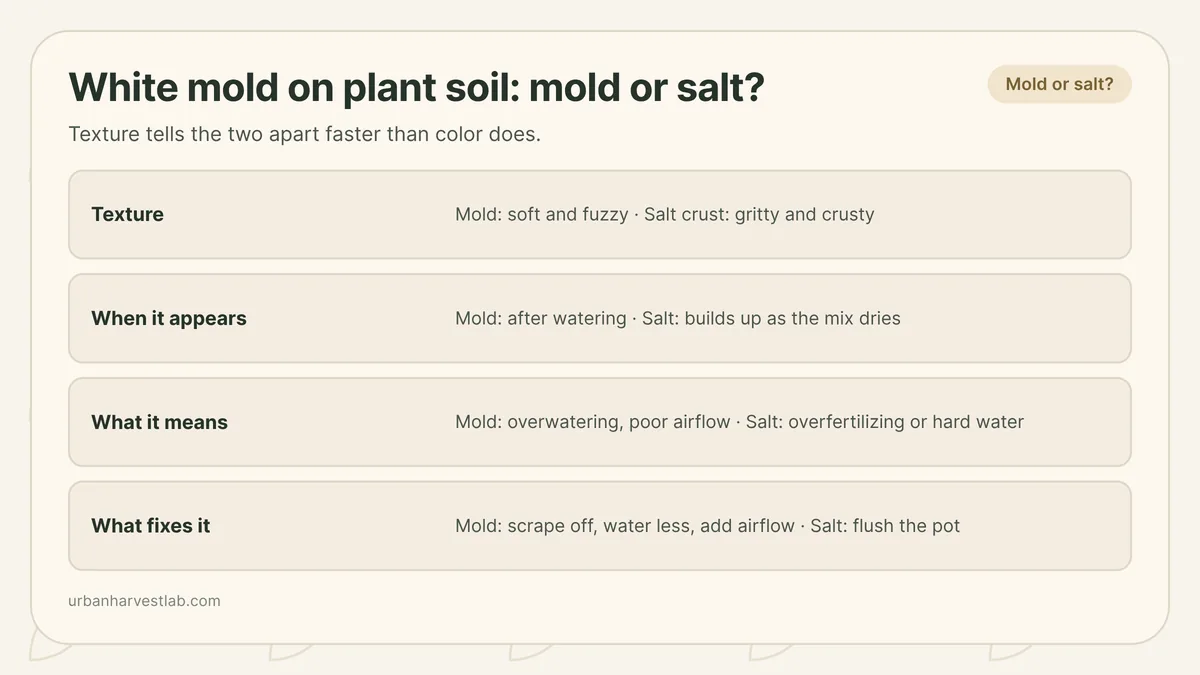
White mold on plant soil: what it means and what to do
A white, fuzzy patch spreading across the soil surface looks alarming, but it is usually a cosmetic fungus feeding on the mix, not the plant.
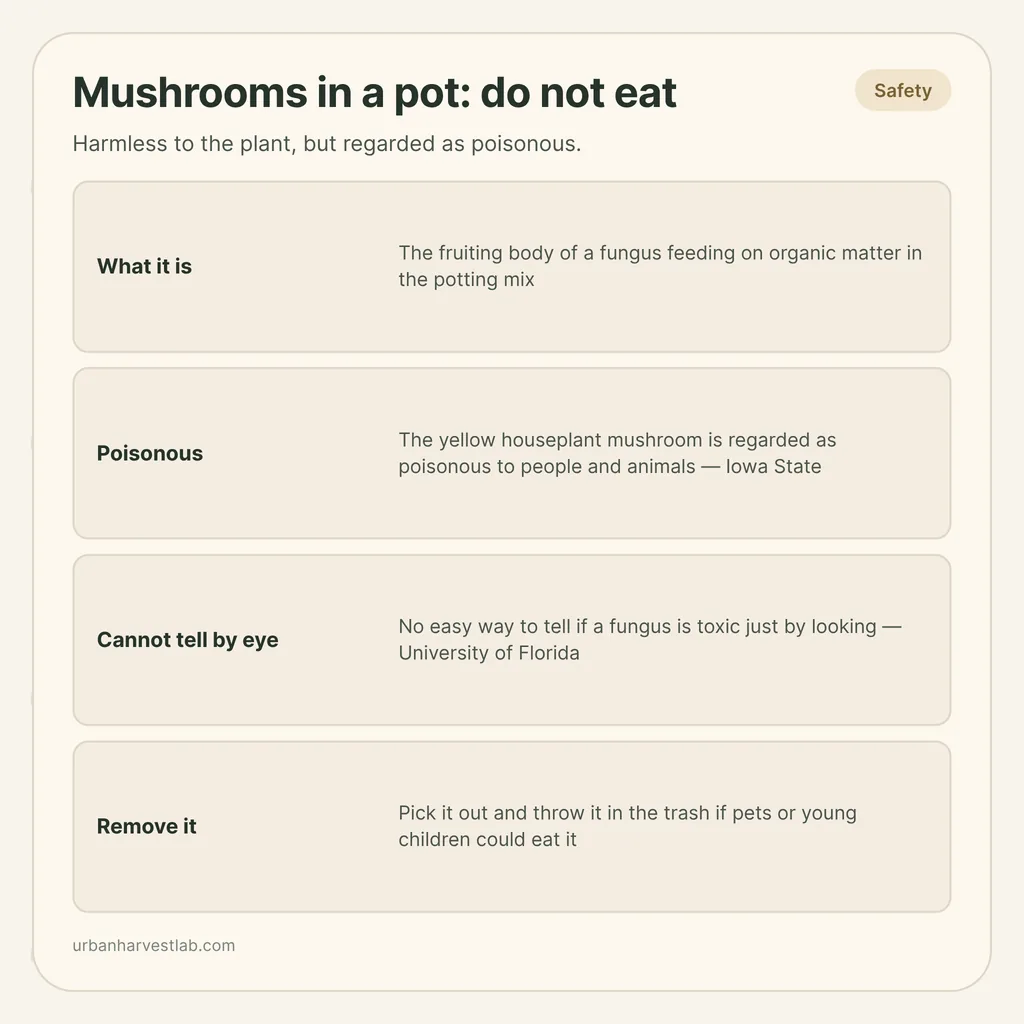
Mushrooms growing in a potted plant: harmless to the plant, not to eat
Mushrooms in a pot are the fruiting bodies of a fungus living on the organic matter in your mix. They rarely hurt the plant, but some are poisonous if eaten.
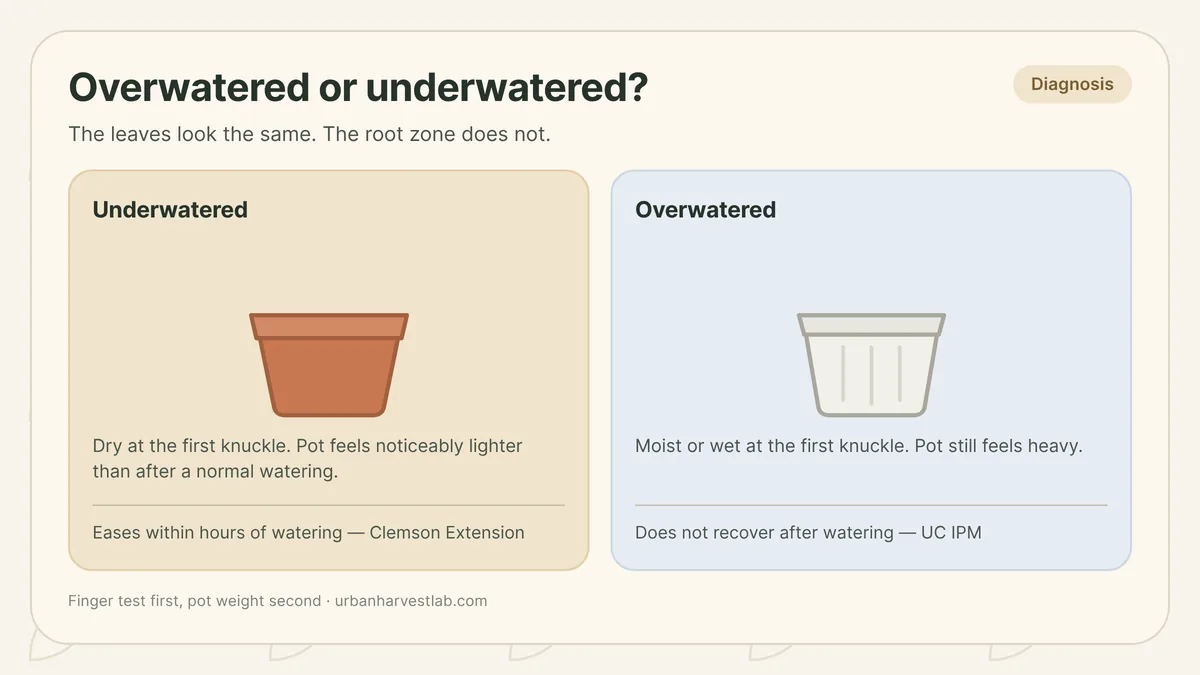
Overwatered vs underwatered: how to tell which one you have
Reading the root zone directly, with a finger test, pot weight, and how the plant responds to being watered, settles what the leaves alone cannot.