Troubleshoot the system before you change the inputs.
Symptoms
- Small mushrooms, often lemon yellow or white, pushing up from the soil surface.
- Mushrooms that come and go in flushes, singly or in clusters.
- A yellowish-white or cord-like network of threads on or just under the soil surface.
- Water running straight through the pot or pooling on a dense, matted soil surface.
Possible causes
- A saprotrophic fungus feeding on bark, wood chips, peat or other organic matter in the potting mix, brought in with the mix or arriving as airborne spores.
- Conditions that favour fruiting: high humidity, low light, warm temperatures and overwatering, according to the University of Florida.
- A dense hydrophobic fungal mat in the pot that stops water and nutrients reaching the roots, which the University of Florida links to plant decline.
Quick fixes
- Pick the mushrooms out by hand and bin them, away from pets and children.
- Rake or loosen the top of the soil so the surface dries between waterings.
- Move the pot to a cooler, less humid spot and water at the base of the plant.
- If the soil is matted through, repot into fresh mix rather than reaching for a fungicide.
Mushroom-shaped or mushroom-like things in a pot
| What you see | Likely identity | University of Florida's toxicity note |
|---|---|---|
| Sulfur-yellow, thin stalk, ring, striped cap, in clusters | Yellow houseplant mushroom (Leucocoprinus birnbaumii) | Considered poisonous |
| Tiny brown or grey cups holding egg-like beads | Bird's nest fungus | Not pathogenic nor toxic |
| Bright yellow, scrambled-egg blob with no stalk | Dog vomit slime mold (not a true fungus) | Harmless, not toxic to people or pets |
| Large white-to-brown cap with scales, white gills turning green | Green-spored parasol (Chlorophyllum molybdites) | Poisonous to people and pets |
| Grey or off-white caps that melt into black liquid | Inky cap group | Not given for the group; do not eat |
| Small stalked mushroom with a ring and a scaly cap, sometimes staining pink when bruised | Possibly Lepiota or Conocybe | Some species contain amatoxins and are poisonous |
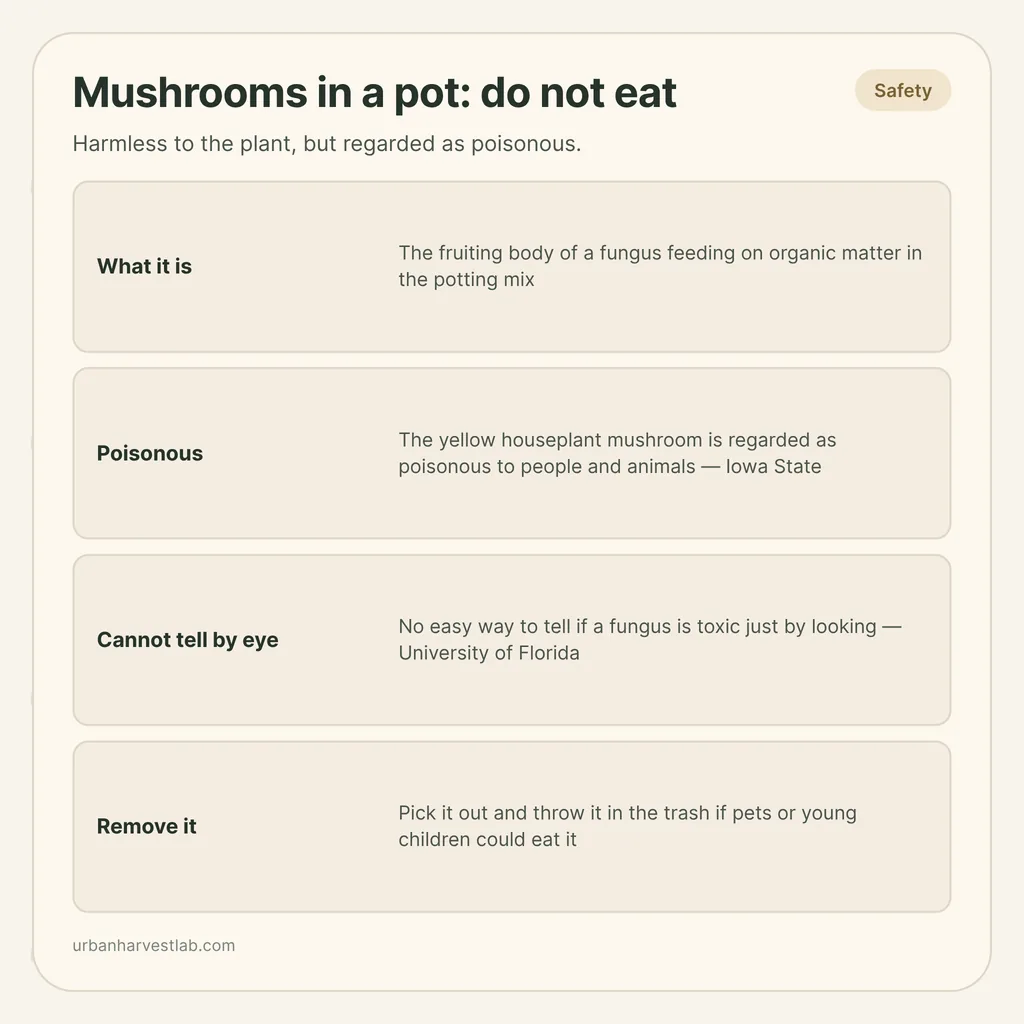
Mushrooms in a potted plant are the fruiting bodies of a fungus that lives on the organic matter in your potting mix. The common yellow one does not harm the plant, but it is regarded as poisonous, so do not eat it and pick it off if pets or children can reach the pot.
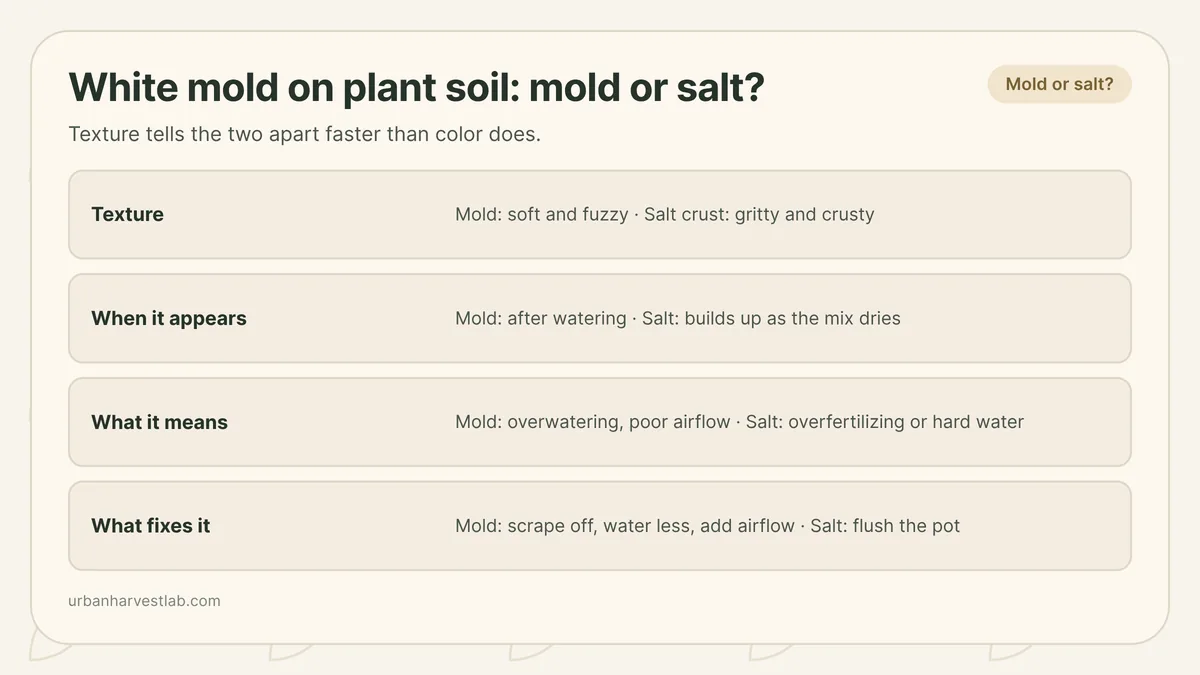
If what you see is fuzzy white growth with no stalks or caps, that is a different thing: see white mold on plant soil.
What a mushroom in a pot actually is
A mushroom is the reproductive structure of a fungus. The fungus itself spends most of its life as a network of fine threads, a mycelium, in the soil or debris, and usually you cannot see it. Iowa State Extension says that thread-like body may have come in with the potting mix, or a spore may have floated through the air and landed in the pot.
The University of Florida explains why pots suit these fungi. Many are saprotrophic: they feed on the organic matter in the potting soil itself, which often contains tree bark, wood chips, pine straw, moss or leaves. Some potting blends hold a large share of woody material, which is an ideal substrate for many mushroom-forming fungi. Spores can also come in with components such as peat moss.
So the mushroom is not a sign that your plant is infected. It is a sign that the mix is food and the conditions are right.
Which mushroom is it?
The most common one indoors is the yellow houseplant mushroom, Leucocoprinus birnbaumii. The University of Florida calls it the most common mushroom on indoor potting soils and describes the whole mushroom as sulfur yellow, growing alone or in clusters, with a raised centre and fine vertical stripes on the cap, and a thin stalk with a ring. Iowa State Extension puts them at about 1 to 3 inches tall with caps of 1 to 2 inches, oval or bell-shaped. The University of Florida adds that it can fruit year-round in indoor potting soil, and that it can form a dense yellowish-white mycelium on the surface.
Not everything yellow or odd-looking in a pot is that mushroom. The University of Florida describes several other mushrooms and mushroom-like growths turning up in potted plants. Two points matter most:
- Bird’s nest fungi and the yellow slime mold are harmless to people and pets, according to the University of Florida. The slime mold is not a true fungus; the bright yellow, scrambled-egg-like blob needs no treatment, and it dries to a crusty, pale patch.
- Some look-alikes are dangerous. A large scaly cap with gills that turn green points to the green-spored parasol, which the University of Florida says is poisonous to humans and pets. Small ringed mushrooms in the Lepiota and Conocybe groups include species with amatoxins.
You cannot sort these out by eye with certainty. The University of Florida states that there is no easy way to determine whether a fungus is toxic just by looking at it. That is the reason for the simple household rule: nothing from a pot goes in your mouth, however much it resembles a supermarket mushroom.
Is it poisonous?
Treat every mushroom in a pot as inedible. Iowa State Extension says the yellow houseplant mushroom is regarded as poisonous to people and animals. The University of Florida lists it, the green-spored parasol and some Conocybe and Lepiota species as common potting-soil mushrooms that can be toxic when consumed.
Handling is a different matter. The University of Florida says touching and handling mushrooms is not dangerous, so you can pick them out with your fingers and wash your hands afterwards. It also says the fruiting bodies can be picked out of the pot and thrown in the trash if pets or young children could eat them.
If someone has swallowed one, contact poison control. The University of Florida gives the number for Florida Poison Control, 800-222-1222; outside the US, use your local poison centre. For a pet, phone a vet. If you can, keep a fresh specimen, since the University of Florida notes that identification works best from fresh material with photos of the cap, the full stalk and the gills.
Does it hurt the plant?
Mostly no. Iowa State Extension says the yellow houseplant mushroom fungus breaks down dead organic matter in the potting soil, does not harm living plants, and the mushrooms do not need to be removed for the plant’s sake. The University of Florida adds that most mushroom-forming fungi are not pathogens of potted plants.
There are two exceptions to watch for.
A water-repelling mat. The University of Florida notes that some fungal mycelium forms a dense hydrophobic mat that stops water and nutrients being absorbed, so the plant may decline even though the fungus is not attacking the roots. If water beads on the surface or runs straight out of the bottom while the plant droops, loosen the soil, and repot into fresh mix if the whole root ball is matted.
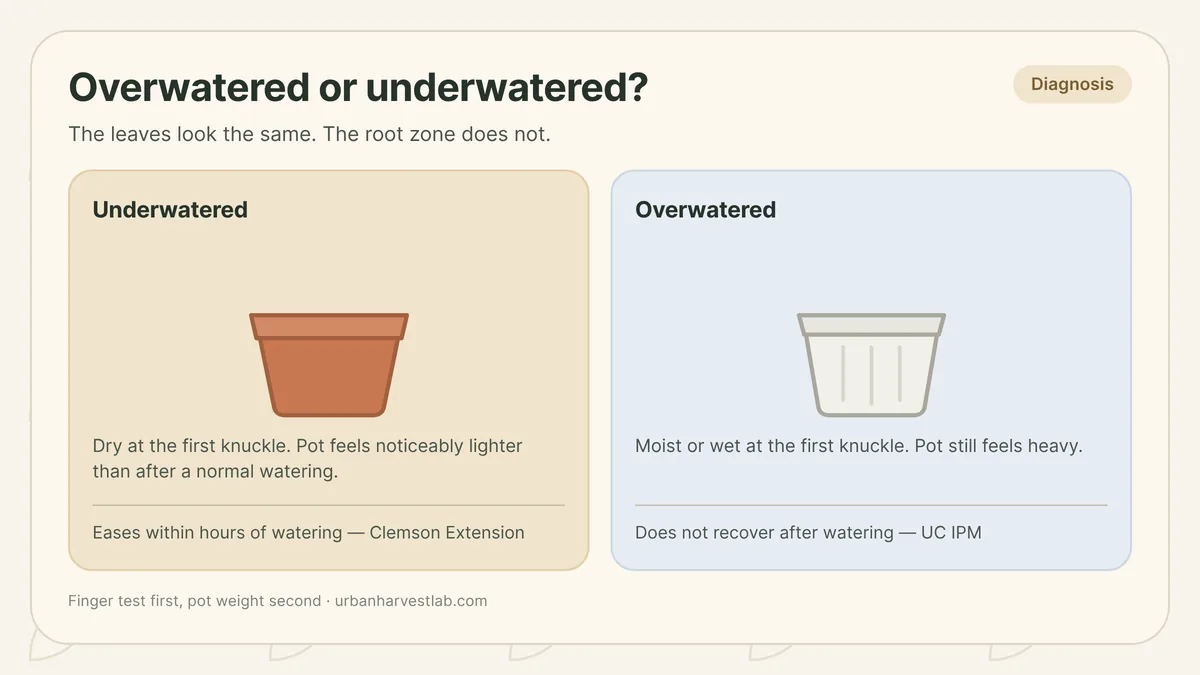
The conditions, not the fungus. The University of Florida also warns that overly hot and wet conditions favour fungi and bacteria that do cause root and stem rots. A pot that keeps growing mushrooms is a pot that is staying wet. If the plant is also yellowing or wilting, work through overwatered vs underwatered before blaming the mushrooms.
Why they showed up now
The University of Florida says mushroom growth in potting soil generally follows high humidity, low light and warm temperatures, and that overwatering may encourage fungal growth and stimulate fruiting. The fungus can sit in the mix as threads until conditions suit it, so a humid spell, a pot moved to a dim corner or a run of heavy watering can be what tips it into fruiting.
Potting mix can carry the fungus in, since the University of Florida says spores can come from soil components. Mixes with a large share of bark or wood chips give the fungus more to eat. If mushrooms keep returning across several pots, the mix is the common factor; see choosing a potting mix for what goes into a blend.
How to get rid of them
Start with what the University of Florida recommends.
- Pick them off by hand and bin them. Do not leave them where a pet could eat them.
- Rake or loosen the top of the soil. The University of Florida says this aerates and dries the surface, which helps stop new mushrooms forming.
- Water at the base, not over the top. Cut back the watering that kept the mix wet.
- Change the pot’s location. Indoors, the University of Florida suggests a place with less humidity or a cooler temperature.
- Replace heavily colonised mix. The University of Florida says that where mulch is completely colonised by mycelium it should be removed and the soil replaced. For a pot, that means repotting into fresh mix.
Skip the fungicide. Iowa State Extension says fungicide treatments are generally not effective against mushrooms, and the University of Florida tells homeowners to consult their county Extension office before applying any chemical, and to change cultural practices alongside any product.
Expect another flush or two. Picking the mushroom removes the fruit, not the threads, so the fungus can fruit again whenever the mix is wet and warm enough.
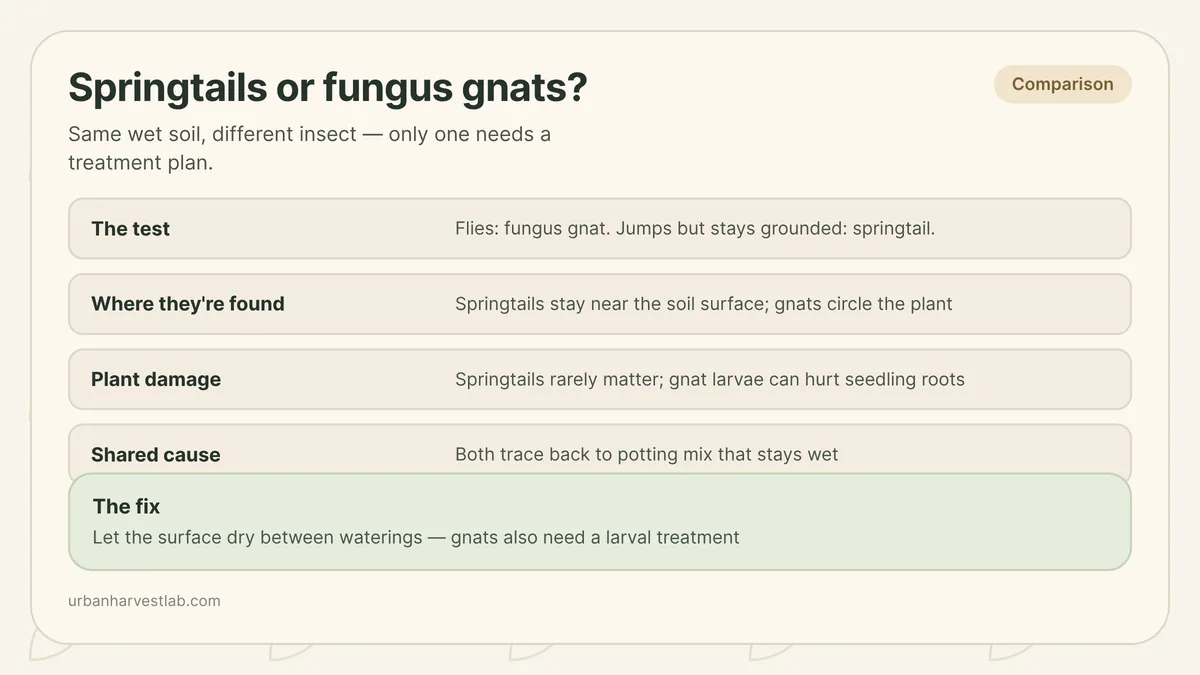
Tiny flies or jumping specks around the same soil are a separate question; springtails vs fungus gnats tells them apart. And if what you actually want is mushrooms to eat, that is a job for a purpose-made kit, covered in growing oyster mushrooms at home.
Sources
Other things that show up in pot soil
Fuzzy mold, tiny insects and soggy mix often travel with mushrooms. These pages sort out each one.
Common questions
Are mushrooms in my houseplant pot harmful to the plant?
Usually not. Iowa State Extension says the small yellow mushroom common in pots breaks down dead organic matter in the potting soil and does not harm living plants. The University of Florida adds that most mushroom-forming fungi in pots are not pathogens, though the wet conditions that favour them can also favour root rot.
Are the yellow mushrooms in my plant pot poisonous?
Yes, treat them as poisonous. Iowa State Extension says the yellow houseplant mushroom is regarded as poisonous to people and animals, and the University of Florida lists it among common potting-soil mushrooms that can be toxic when consumed. Touching them is not dangerous, but do not eat them, and pick them off if pets or young children can reach the pot.
Will fungicide get rid of mushrooms in my plant?
Iowa State Extension says fungicide treatments are generally not effective against mushrooms. The University of Florida recommends checking with your local county Extension office before applying any chemical product, and pairing any treatment with changes in watering and placement.
Why did mushrooms appear in a pot that was fine before?
The fungus was probably already in the mix as threads or spores. The University of Florida says high humidity, low light, warm temperatures and overwatering favour mushroom growth, so a wetter, warmer or darker spell can trigger fruiting.
Related guides
White mold on plant soil: what it means and what to do
A white, fuzzy patch spreading across the soil surface looks alarming, but it is usually a cosmetic fungus feeding on the mix, not the plant.
Tiny bugs in plant soil: springtails or fungus gnats?
If the bugs in your potting soil jump but stay grounded, they are springtails. If they lift off and buzz around the plant, they are fungus gnats. Both are pointing at the same watering habit.
Overwatered vs underwatered: how to tell which one you have
Reading the root zone directly, with a finger test, pot weight, and how the plant responds to being watered, settles what the leaves alone cannot.