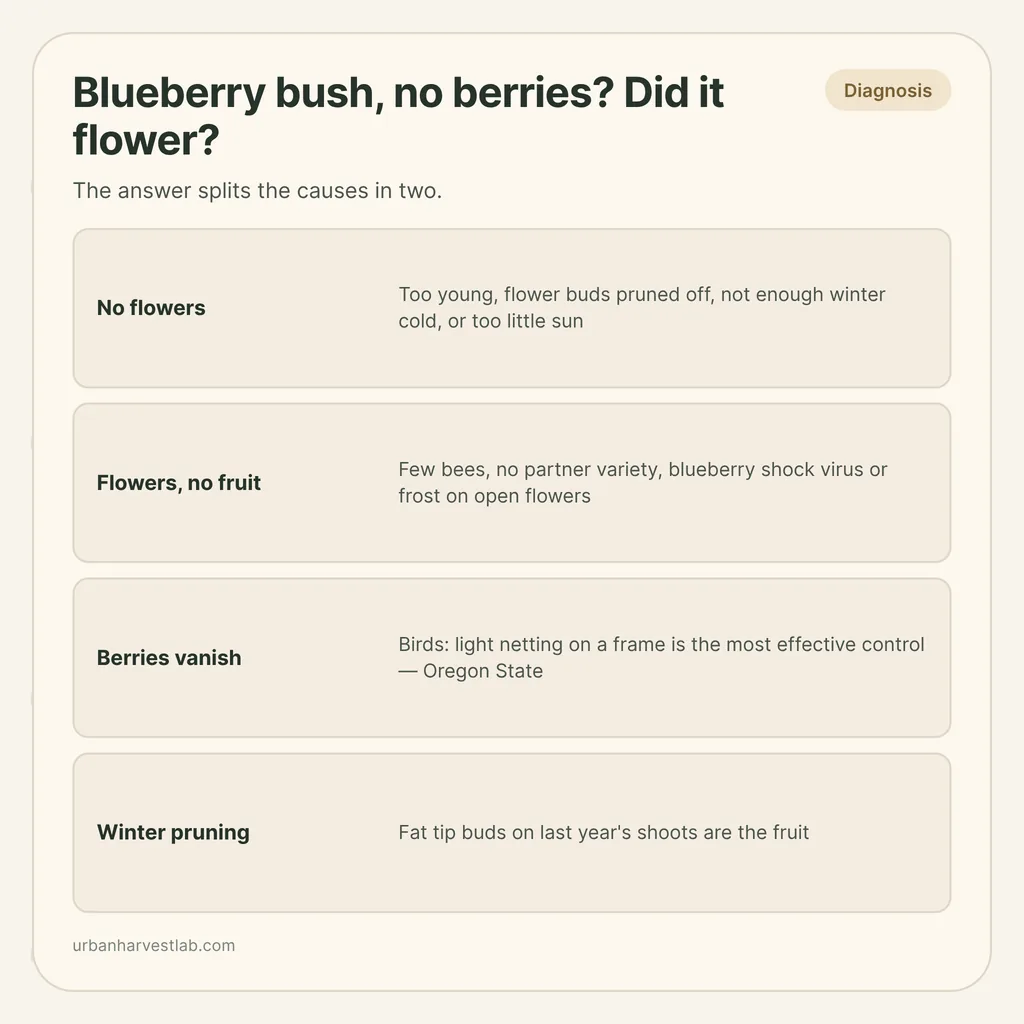
Troubleshoot the system before you change the inputs.
Symptoms
- The bush grows leaves but does not open any flowers.
- The bush flowers, but the flowers drop and no berries form.
- Berries form but are gone before they ripen.
- The bush bore well for years and now carries far fewer berries.
Possible causes
- The plant is too young to bear a real crop.
- Winter or spring pruning removed the flower buds.
- The variety needs more winter chill than your climate gives, or blooms so early that frost takes the flowers.
- Cold, damp weather kept bees from the flowers, or there are too few bees near the pot.
- Blueberry shock virus, a pollen-borne virus that makes the plant drop its flowers for a season.
- Birds are taking the berries as they colour.
- Too much shade, or a mix pH above the blueberry range.
Quick fixes
- Look at last year's shoots in winter: fat buds at the tips are flower buds. Stop cutting them off.
- Prune once a year, while the plant is dormant, removing the oldest canes at the base.
- Check the variety label against your winters, and shelter a low-chill type from frost at bloom.
- Put a second variety that blooms at the same time in another pot, and grow flowers bees can reach nearby.
- Cover ripening berries with small-mesh netting pinned down at the base.
- Test the mix pH, and move the pot to full sun.
Ask one question first: did the bush flower? If it did not, the cause is usually age, pruning, winter cold or shade. If it flowered and set no berries, look at pollination, a virus or birds. The set-up that prevents most of this is in the guide to growing blueberries in pots. If the problem is the foliage rather than the fruit, the yellow and red leaves page covers it.
No flowers at all
The plant is young
Oregon State Extension says a new northern highbush produces fruit for the first time one or two years after planting, and that the yield per plant in the ground climbs from 0.5 to 1.5 pounds in year two to 9 to 15 pounds at maturity. Maryland Extension, writing about pots, says a full crop takes about five years. A bush bought as a small plant last spring is on schedule if it has not fruited.
Some of the missing fruit is deliberate. Maryland Extension tells growers to pick the flowers off one-year-old plants in spring so the plant puts its energy into roots, and Oregon State warns that plants that put energy into fruit too young may not recover and keep yielding less than a well-pruned bush. If you or the nursery did this, there is nothing to fix.
The flower buds were pruned off
Oregon State Extension says blueberry flowers and fruit grow on one-year-old wood, and that in winter the flower buds are the fat buds at the tip of last year’s growth. Each one makes a flower cluster and no leaves. The small, scale-like buds lower on the shoot make leaves only.
So a tidy trim of the shoot tips in winter takes off the berries. Maine Extension, answering a grower whose mature bushes fruited poorly, points the other way as well: unpruned bushes become overgrown with old canes, and the fix is to remove the oldest canes at the base each year and keep the strongest shoots. Oregon State adds that pruning too severely lowers yield. The middle path is to cut out old and twiggy canes in winter, leave the good fruiting shoots alone, and look at the buds before you cut.
Repotting costs a crop too. Oregon State says to transplant blueberries of any age in late winter before bud break, and to remove another 25 to 30 percent of the flower buds to offset transplant shock. A plant moved into a bigger pot this year will fruit lightly.
The winter did not suit the variety
A dormant blueberry needs a stretch of cold to flower normally. Oregon State Extension gives the range as roughly 32 to 45 °F and puts the requirement at 200 to 300 hours for southern highbush and more than 800 hours for northern highbush. The University of Georgia gives about 800 to 1,000 chill units for northern highbush, 200 to 600 for southern highbush and 300 to 600 for rabbiteye. University of California Cooperative Extension warns that figures like these were mostly worked out in the eastern US and are only a rough guide for California, where some varieties do better than their numbers predict.
The mismatch runs both ways:
- A high-chill type in a mild climate. Northern highbush that falls short of its hours may flower poorly.
- A low-chill type in a cold climate. Oregon State says southern highbush blooms in late winter and its flowers are frequently damaged by frost, so it does not recommend them for the Pacific Northwest. Its home-garden guide says most or all of the flowers can be lost to frost in the Willamette Valley.
If you suspect frost took the buds, Oregon State suggests slicing flower buds lengthwise a few weeks after a cold event and looking for brown or dead tissue. The plant label or the nursery listing should say which type you have; if it does not, treat that as the first thing to find out.
Too little sun, or the wrong pH
Oregon State Extension says full sun is ideal and that blueberries tolerate partial shade, but yield and fruit quality may be lower. Maine Extension lists soil pH among the causes of poor fruit set, saying a pH that creeps too high will impact the plant’s health and productivity. Oregon State gives the range as 4.5 to 5.5. Pot mixes are covered in the container soil pH guide.
Flowers, but no berries
Bees did not reach the flowers
Maine Extension says blueberries are pollinated by bumblebees and honey bees, and that too few of them around the plants gives poor pollination. Its pointer for telling this apart: the same number of flowers as usual, but poor fruit set.
Weather matters. Michigan State University Extension says honey bees prefer warm, sunny conditions to forage, while bumble bees, especially native species, do not mind working under cloudy, cold or windy conditions. A cold, damp week at bloom can leave flowers unvisited. Oregon State says this does not commonly happen in Oregon, where many home gardens have enough bees, so it is worth weighing against your own bloom weather.
The pollinator guide for balconies covers what to plant to bring bees closer.
There is no partner variety
Most highbush types set some fruit alone, but not all, and partners improve it. Oregon State says northern highbush will fruit with self-pollination but cross-pollination improves berry size and quantity, and that half-high cultivars do not produce much fruit alone. University of Wisconsin Extension names St. Cloud and Polaris as the exceptions that do need another cultivar. Maryland Extension says the second variety can live in a separate container, and it should bloom at the same time. Oregon State adds that highbush cultivars ripen at different times but all bloom together, so any two will cross-pollinate.
Blueberry shock virus
Oregon State Extension describes blueberry shock as a pollen-borne virus, common in its region and carried from plant to plant by bees. An infected plant drops all its flowers the following season, and there is no fruit on the plant, or on the affected part of it, in the shock year. There is no control for the virus, but Oregon State says plants come back into full production after the shock year, and to prune hard the following winter because the plant will have produced a lot more growth than usual. A bush that bore well, dropped its flowers and then grew vigorously is a likely match, not a diagnosis.
Frost on open flowers
A frost after the flowers open can cost the crop, which is the risk Oregon State describes for early-blooming types. A pot can be moved on frost nights during bloom; the cold snap protection guide lists ways to do that.
Berries form, then vanish
Oregon State Extension says many species of birds feed on blueberries and can eat an entire crop if not controlled, either pecking at fruit before it is ripe or taking whole berries. Scare devices have limited effectiveness because birds adapt. The most effective control, it says, is light plastic overhead netting with a small mesh, on a frame, pinned to the soil so birds cannot find a way in. Maryland Extension suggests bird netting or floating row cover for containers. If you want to buy one, you can browse bird netting on Amazon.
Berries that die while still white are a different problem. Maine Extension points growers who see that to Penn State Extension’s page on mummy berry, a somewhat common blueberry disease.
What to check, in order
- Did it flower? No: go to steps 2 to 5. Yes: go to step 6.
- How old is it? Under two or three years from planting, or recently repotted, patience is the answer.
- Look at last year’s shoots in winter. Fat tip buds are fruit. Do not cut them off.
- Check the variety against your winters. The label should say northern highbush, southern highbush, half-high or rabbiteye.
- Move the pot to full sun and test the mix pH (a soil pH test kit on Amazon works).
- Check the bloom week. Cold and wet, no bees, a single plant, or a frost after flowers opened each have a different fix.
- Net the ripening fruit.
Sources
- Growing blueberries in your home garden (EC 1304), Oregon State University Extension
- Blueberry cultivars for the Pacific Northwest (PNW 656), Oregon State University Extension
- Why are my mature highbush blueberry plants not producing berries?, University of Maine Cooperative Extension
- Blueberry production (Circular 1278), University of Georgia Extension
- Blueberries, University of California Cooperative Extension, Ventura County
- West central Michigan small fruit update, May 28, 2019, Michigan State University Extension
- Growing blueberries in containers, University of Maryland Extension
- Growing blueberries in containers, University of Wisconsin-Madison Division of Extension
Blueberries in pots
The set-up, the leaf problems and the pollinators behind a fruiting container blueberry.
Common questions
Why is my blueberry bush not producing berries?
Work out whether it flowered. If it did not, the usual causes are a plant that is too young (Oregon State Extension says first fruit comes one or two years after planting), flower buds pruned off, a variety that does not match your winters, or too little sun. If it flowered but set no fruit, think poor pollination in cold or damp weather, blueberry shock virus, or birds taking the berries.
How long does a potted blueberry take to fruit?
Oregon State Extension says a new northern highbush produces for the first time one or two years after planting, with 0.5 to 1.5 pounds per plant in year two for plants in the ground. Maryland Extension says a container plant takes about five years to reach a full crop, and to remove flowers in the first spring so the plant builds roots. Expect a small harvest early.
Do I need two blueberry bushes to get berries?
Not always. Oregon State Extension says northern highbush cultivars produce fruit with their own pollen, but a second cultivar improves berry size and quantity, and half-high types do not produce much fruit alone. Wisconsin Extension lists St. Cloud and Polaris as exceptions that do need a partner. Maryland Extension says the second variety can sit in a separate container if it blooms at the same time.
Can pruning stop a blueberry from fruiting?
Yes. Oregon State Extension says the fat buds at the tip of last year's growth produce only a flower cluster, so cutting those tips removes the berries. It also says plants pruned too severely give a lower yield. Maine Extension adds that bushes left unpruned become overgrown with old canes and fruit productivity suffers.
Related guides
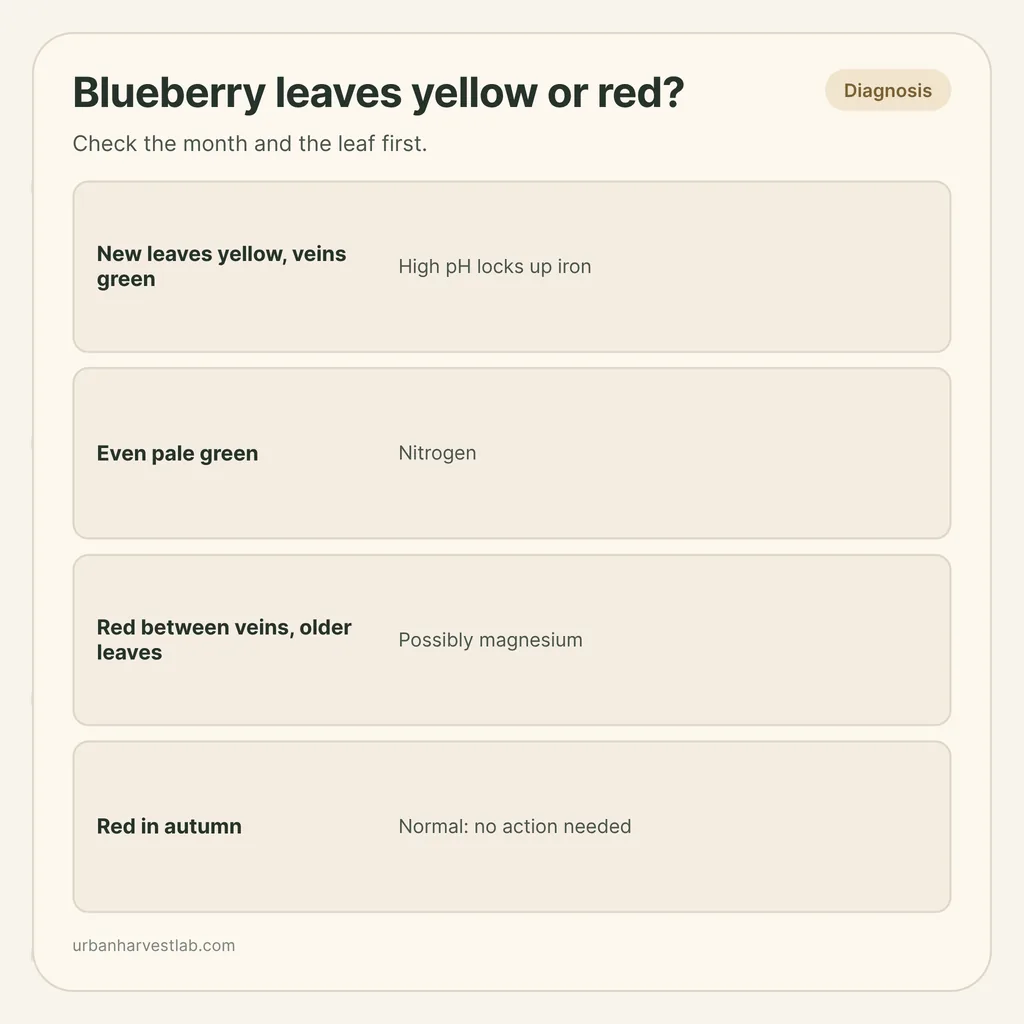
Blueberry leaves turning yellow or red in a pot: pH, iron or just autumn
Yellow, green-veined new leaves usually mean the pot's pH or your tap water is too high for blueberries. Red leaves can be perfectly normal, depending on the month.

Strawberry plants not fruiting in pots: type, age, light, and heat
A strawberry pot with leaves and no berries is rarely sick. The variety type, the plant's age, the sun, the heat and an early frost explain most of it.

How to grow blueberries in pots: acidic mix, a second variety and the right water
Blueberries are fussy about acidity, not about space. Here is the pot size, the mix, the pollination partner and the watering that keep a container bush fruiting.