Troubleshoot the system before you change the inputs.
Symptoms
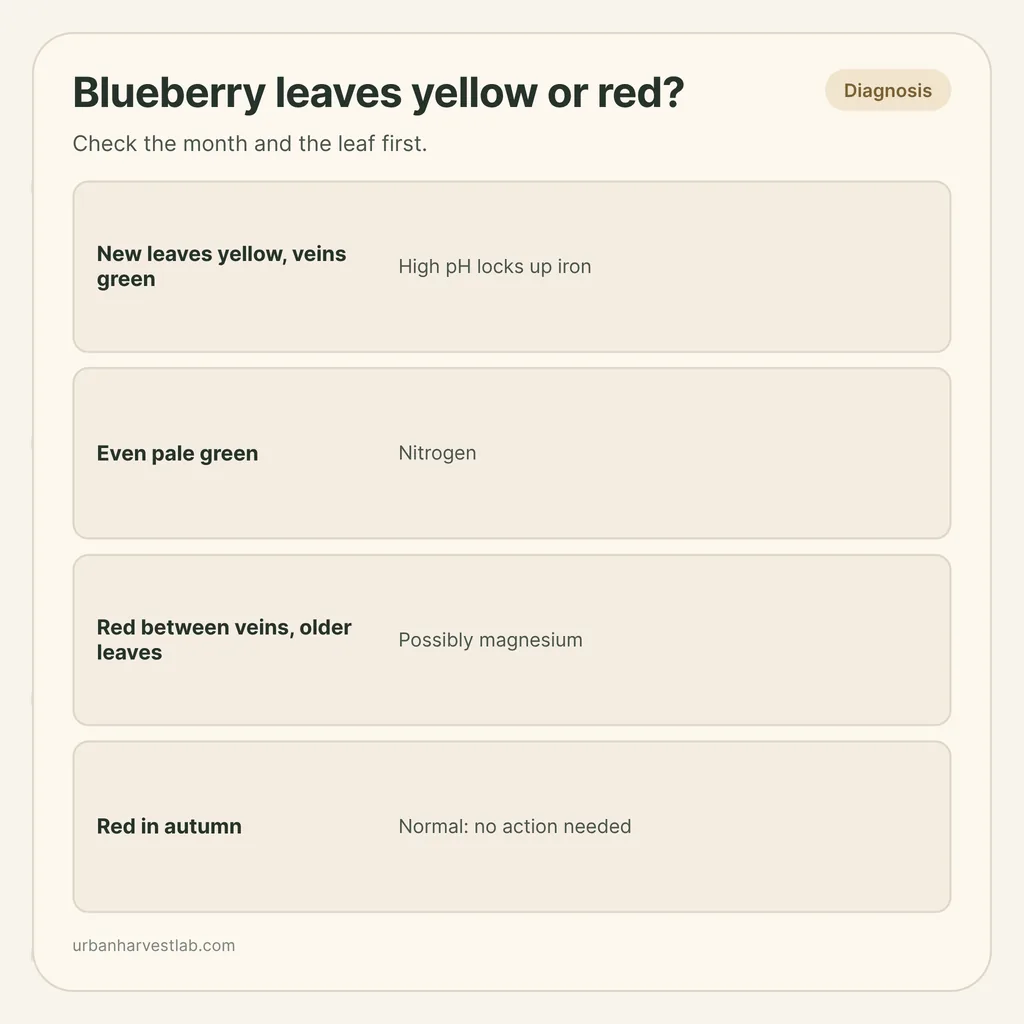
- The newest leaves are pale yellow while the veins stay dark green.
- Leaves turn red between the veins on older leaves near the base of young shoots.
- The whole plant is pale green and the leaves turn red and drop early.
- Leaves turn red or maroon in autumn as nights cool.
Possible causes
- Mix pH is above the blueberry range, so iron is present but unavailable.
- Hard tap water has pushed the pot pH back up over several months.
- Nitrogen is short, which can bring early reddening and leaf drop.
- Magnesium is short, which gives red colour between the veins.
- Wet roots, drought or fertilizer salts are stressing the plant.
- It is autumn, and the colour change is the plant preparing for winter.
Quick fixes
- Check the calendar and which leaves are affected before changing anything.
- Test the mix pH with a lab test or a reliable kit, and check your water report.
- Switch to rainwater where you can, and use an acid-type blueberry fertilizer.
- Lower the pH with sulfur only after the test, using a published rate.
- Check that the pot drains and the mix is moist but not soggy.
Yellow leaves with dark green veins on the newest growth mean the plant cannot reach its iron, and in a pot that usually means the mix pH has risen above the blueberry range. Red leaves are a different question, and the answer is mostly the calendar. In autumn they are normal. In summer they are stress, and the pattern tells you which kind.
Start with two observations: which leaves, and which month. The set-up that prevents most of this is in the guide to growing blueberries in pots.
Yellow with green veins on new leaves: high pH and iron
Cornell’s berry diagnostic guide says interveinal yellowing in blueberry is caused by iron deficiency but is symptomatic of high soil pH. It puts the point at which the plant loses the ability to use iron at above pH 5.2, and says the symptoms develop first in young leaves. Oregon State Extension describes the same sign: yellow, green-veined leaves, especially on younger leaves. A 2000 newsletter from Missouri State University’s Fruit Experiment Station adds that the tissue ranges from light yellow to bronze, with the midrib and smaller veins staying dark green.
The iron is usually in the mix. The same Missouri source calls it a problem of iron availability rather than a lack of iron in the soil. That is why a general fertilizer does not fix it. The plant is not short of food; the pH has locked the food up. The nutrient lockout guide explains the mechanism for other crops.
Oregon State Extension gives the target as pH 4.5 to 5.5. A pot that began in that range can leave it in two ways. Lime or a lot of compost in the mix raises pH, according to Oregon State, and Maryland Extension singles out animal manure compost. And the water you pour on every few days does the rest.
Cornell’s 5.2 sits inside Oregon State’s range, which these sources do not reconcile further. If new leaves are yellowing, aim for the lower half of it.
The water is often the reason
Maryland Extension says the pH of municipal water in its region is typically 7.5 to 7.8, with high salts and bicarbonate, and warns that irrigation water can drive up soil pH. The University of Georgia suggests acidifying blueberry irrigation water at pH 6.0 or above and lists bicarbonate above 92 ppm as a level that calls for action. Those are commercial-grower thresholds, but the chemistry is the same in a barrel on a balcony.
A pot gives the water far less buffering to work against than open ground does, which is the point of the container soil pH guide. University of Wisconsin Extension calls collected rainwater ideal for blueberries because it is typically not as hard and does not have as high a pH as well water. If you cannot collect rain, look up the alkalinity on your utility’s report; why alkalinity matters more than pH is covered separately.
Red leaves: first check the month
Autumn. Cornell says blueberry leaves develop a maroon colour in autumn as a normal response to lowering temperatures. University of Maine Extension adds that blueberries are deciduous, so reddening and dropping of leaves is no cause for alarm in itself. If it is October and the whole plant is colouring up, leave it alone.
Cold spring. Cornell notes that a reddish-purple hue can appear in spring if the weather is cold, and that it disappears when warmer weather arrives.
Early or out of season. University of Maine Extension answered a grower whose red and yellow leaves started in early summer: it is a little early for that, which means the plant is probably stressed. Three causes are worth separating.
Nitrogen
Cornell says nitrogen-deficient leaves are a uniform light green with no pattern, and may develop early fall colour and drop. The Missouri newsletter says nitrogen-deficient leaves often turn reddish, can be mistaken for early fall colour, and drop prematurely in late August and early September. If the whole plant is pale and thin and the reddening is general rather than between veins, nitrogen is the first suspect.
Blueberries take nitrogen as ammonium. Oregon State Extension says many all-purpose fertilizers such as 16-16-16 contain mainly nitrate, which is not suited to blueberry, and Maryland Extension says to avoid nitrate or chloride fertilizers and use an acid-based one. Follow the label rate: University of Wisconsin Extension warns that blueberry roots are sensitive to fertilizer salt injury, and Cornell lists overfertilization as a cause of marginal leaf burn.
Magnesium
Cornell says magnesium deficiency, common in acid soils, causes red colour between the veins, beginning as yellowing and progressing to bright red, on leaves at the bases of young shoots first. Young leaves at the tips are seldom affected. That is the opposite of iron, which hits the tips first. Missouri’s newsletter cautions that several suspected magnesium cases turned out to be nitrogen when the leaves were analysed, so treat a magnesium diagnosis as a guess until a test supports it. Use a product made for blueberries and follow its label.
Phosphorus
Cornell says phosphorus deficiency causes purple coloration but is rarely observed in the field, since blueberries have a low phosphorus requirement. It adds that if the pH is too high for phosphorus uptake, other nutrients will likely be unavailable too. Another reason to test the pH first.
Wet roots, thirst and salts
University of Maine Extension suggests that poor drainage in a wet season can stress blueberries and alter the pH and nutrient content of the soil. Oregon State Extension describes a shallow, fibrous root system that is susceptible to drought injury, and Wisconsin asks for a medium that is moist but not wet or soggy. Both extremes show up in leaf colour. Check that the drainage holes work and that the mix is damp a couple of inches down before you blame the pH. The overwatered vs underwatered guide covers how to tell them apart.
What to do, in order
- Check the calendar. Red in autumn needs nothing.
- Read the pattern. New leaves yellow with green veins: pH and iron. Even pale green: nitrogen. Red between veins on older leaves: possibly magnesium.
- Test the mix. University of Maine Extension would not recommend acidifying without knowing the starting point, and Maryland Extension says pH probes sold to gardeners are generally inaccurate, so a lab test is safer than a cheap probe.
- Correct the pH. For a 15-gallon container, Maryland Extension gives 3 tablespoons of sulfur mixed into the top few inches of mix to lower the pH by one unit; retest afterwards. Sulfur is slow.
- Bridge the gap. The Missouri newsletter calls an iron foliar spray or soluble iron a good short-term remedy, and says the long-term answer is an acid pH. Follow the product label.
- Fix the water. Switch to rainwater or address the alkalinity, or the pH will creep back.
Yellowing that does not match any of these may not be a blueberry problem at all; the yellow leaves cause finder starts from the leaf pattern. The same green-veined pattern on a lemon tree has its own page: citrus leaves yellow indoors.
Sources
- Blueberries: Leaves are unusually colored, spotted or necrotic, Cornell Berry Diagnostic Tool
- Why are the leaves on my blueberry plants falling off?, University of Maine Cooperative Extension
- Signs of Chlorosis, Fruit Experiment Station newsletter, Missouri State University (2000)
- Growing blueberries in your home garden (EC 1304), Oregon State University Extension
- Blueberry success is all in the soil, Maryland Grows, University of Maryland Extension
- Blueberry Irrigation Water Quality (Circular 1105), University of Georgia Extension
- Growing Blueberries in Containers, University of Wisconsin-Madison Division of Extension
Blueberries and pH in pots
The set-up, the pH and the water behind a healthy container blueberry.
Common questions
Why are my blueberry leaves turning yellow?
The most common cause in pots is a mix pH that has crept above the blueberry range, which shows as pale yellow new leaves with dark green veins. Cornell says iron deficiency in blueberry is symptomatic of high soil pH, and puts the threshold at above 5.2. Oregon State Extension gives the target as pH 4.5 to 5.5. Uniform pale green on all leaves points to nitrogen instead.
Are red blueberry leaves normal?
In autumn, yes. Cornell says blueberry leaves develop a maroon colour as a normal response to lowering temperatures, and University of Maine Extension notes that blueberries are deciduous. Red leaves in early summer are a sign of stress: nitrogen or magnesium shortage, poor drainage, drought or high pH.
How do I lower the pH of a blueberry in a pot?
Test first. Maryland Extension gives 3 tablespoons of sulfur mixed into the top few inches of mix for a 15-gallon container to lower pH by one unit, then retest. Sulfur acts slowly, and Missouri State University suggests a foliar iron spray or soluble iron as a short-term remedy while the pH comes down.
Can tap water make blueberry leaves yellow?
Yes, indirectly. Maryland Extension says irrigation water can drive up soil pH, and puts typical municipal water in its region at pH 7.5 to 7.8 with high bicarbonate. Georgia Extension suggests acidifying irrigation water at pH 6.0 or above. Rainwater is the easy alternative; check your water utility report for alkalinity.
Related guides

Citrus leaves turning yellow indoors: iron, nitrogen, water or winter light
Where the yellow starts and whether the veins stay green separate nitrogen, iron, magnesium and wet roots on a potted lemon, lime or orange.
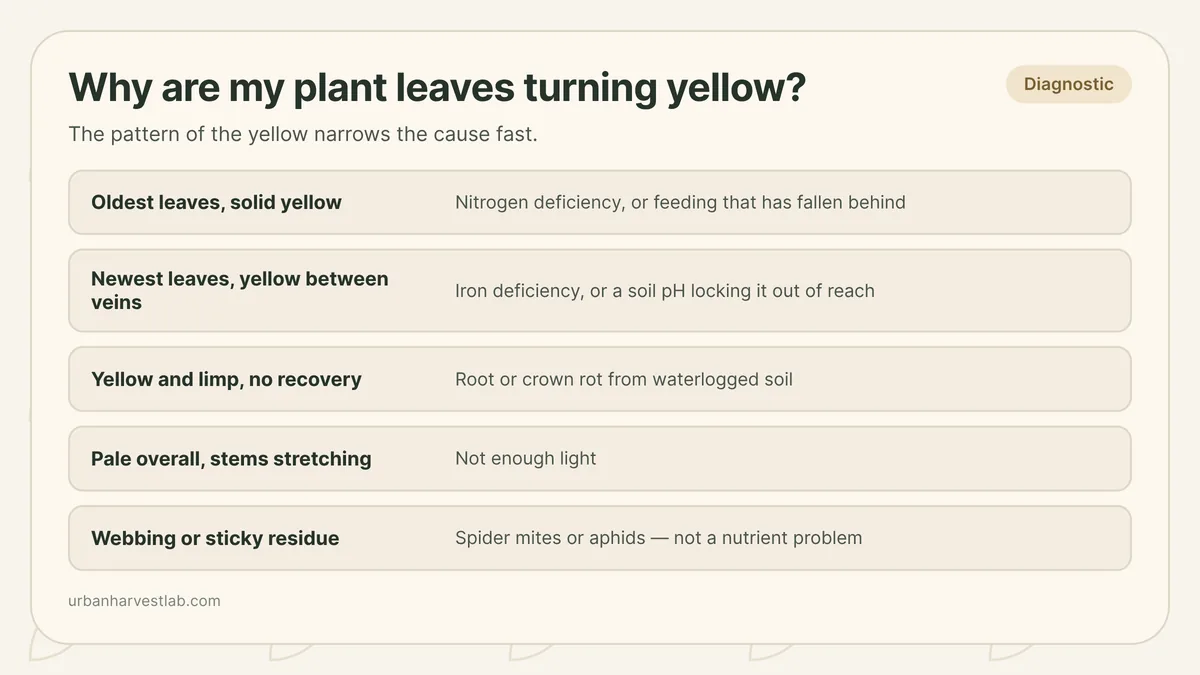
Why are my plant leaves turning yellow? Find the likely cause
Yellow leaves have a short list of real causes, and the pattern of the yellowing narrows it fast, once you know what to look for.

How to grow blueberries in pots: acidic mix, a second variety and the right water
Blueberries are fussy about acidity, not about space. Here is the pot size, the mix, the pollination partner and the watering that keep a container bush fruiting.