
Thinning in stages: what to do and when
| Stage | What to do | Source |
|---|---|---|
| First true leaf | Thin to about one-half to one inch apart and drop the weakest | WSU Extension |
| About two weeks later | Weaker plants are now obvious; remove them | WSU Extension |
| 1 to 2 inches tall or two sets of true leaves | Remove crowded plants, with the packet spacing in mind | UF/IFAS Extension |
| First three sets of true leaves, growing well | Thin to the final spacing on the packet | WSU Extension |
Thin seedlings when they are about 1 to 2 inches tall or have two sets of true leaves, by snipping the extras off at the soil line and keeping the stockiest plant in each spot. That is the timing UF/IFAS Extension gives, and the cutting method comes from UGA Extension. Do it on moist mix, in two or three rounds, and stop at the spacing on your seed packet.
You sow more seed than you need because some will not come up. When all of it does, a pot of carrots or beets turns into a mat, and the plants compete for water, nutrients and light, as UF/IFAS Extension puts it. Thinning is the correction. The final count that a pot can carry is a separate question, answered in the guide to how many plants fit in a container. Here the question is how to get there without losing the plants you want.
When to thin
UF/IFAS Extension says the moment is when plants are about 1 to 2 inches tall or have two sets of true leaves. True leaves are the ones that come after the first pair, the seed leaves.
Earlier is easier. Ohio State University Extension says it is best to thin when seedlings are very small, so the root system of the plant you keep is not disrupted. A pot left until the seedlings are large is the hard case: Ohio State says that once plants have grown so large the roots have intertwined, you need scissors, because removing one plant moves its neighbours.
Not every crop needs it. WSU Extension says peas and bush beans do not need thinning. Other beans, including pole varieties, do.
One pass or three
You do not have to reach final spacing in a single sitting. WSU Extension suggests sowing extra seed and thinning in three gradual steps over three to five weeks, because some seedlings thin themselves in the first week through damping-off or insects.
The schedule in the table above follows WSU’s steps. At the first true leaf, thin to about one-half to one inch apart. WSU says that by the end of two weeks the hardier seedlings are evident and the weaker ones can go. Once plants have their first three sets of true leaves and are growing well, take them to the final spacing.
How to cut
- Moisten the mix first. Ohio State University Extension suggests thinning after bottom watering, or wetting the surface with a spray bottle, so very small plants slide out easily if you pull. WSU Extension says to water about an hour beforehand if the soil is dry, and to thin when the soil is damp but not excessively wet.
- Pick the keeper. Ohio State University Extension says the strongest seedling is not necessarily the tallest, but typically the stockiest one, closest to the center of the pot.
- Cut the rest at the soil line. UGA Extension says to snip extra seedlings at the soil line with scissors rather than pulling, because tugging disturbs the roots of the plants you are keeping. UConn Extension gives the same instruction for a seed tray. UF/IFAS Extension lists pulling with fingers or forceps as an option too.
- Clip rather than lift where roots tangle. WSU Extension prefers clipping pole beans at the soil level so the entwining roots do not disturb neighbouring plants. The same logic applies to any crowded pot.
Ohio State University Extension describes this as scissor thinning: cutting the stem flush to the soil. It says it becomes necessary when seedlings are growing so close together, or have grown so large, that the roots have intertwined.
How far apart
Seed packets give the final spacing, and both UGA Extension and WSU Extension tell you to follow them. UF/IFAS Extension notes that it will initially look as if there is lots of room between seedlings, but plants grow quickly to use all available space. Resist the urge to leave a few extra.
Spacing varies by crop and by the pot, so the numbers live with the crop. For carrots, UF/IFAS Extension thins to 2 to 3 inches between plants, and the carrot container depth guide covers the pot. For roots with clustered seed, see beets in containers and radishes in containers. WSU Extension notes that Swiss chard and beet “seeds” are actually clusters containing several seeds, so a single sown seed ball comes up as several plants.
What to do with the thinnings
Do not bin them yet.
- Eat them. WSU Extension says thinnings of lettuce, spinach, Swiss chard and beet greens can go in salads.
- Replant them. WSU Extension says seedlings can be lifted with a spoon, held by the seed leaves rather than the stem because stems bruise easily, and moved on a cool, cloudy day with a good watering afterwards. Ohio State University Extension says thinned seedlings can be carefully transplanted into new pots if space allows. WSU picks a cool, cloudy day to give the seedlings time to adjust, and treats these as a bonus if they take and a failed experiment if they do not.
- Compost the rest.
If you plan to move seedlings outdoors after thinning, the hardening-off schedule covers that step. To avoid thinning a whole pot at once, sow smaller batches more often, as in the succession planting guide. Seedlings that stretch and flop before you get to them are covered in leggy seedlings.
Sources
- UF/IFAS Extension Escambia County: Thinning Vegetable Seedlings
- WSU Extension (Skagit County Master Gardeners): Thinning Vegetables in the June Garden
- Ohio State University Extension: Module 8, Thinning of Indoor and Outdoor Plants
- UGA Extension: Get Growing Early, A Guide to Seed Starting
- UConn Home and Garden Education Center: Seed Starting, Simplified
Sowing, spacing and staggering
What happens before and after thinning, from how many plants fit a pot to keeping the harvest going.
Common questions
When should I thin seedlings?
UF/IFAS Extension says to thin crowded plants when they are about 1 to 2 inches tall or have two sets of true leaves. WSU Extension starts earlier and spreads the work out: thin to about one-half to one inch apart at the first true leaf, then to final spacing once the plants have their first three sets of true leaves.
Should I pull seedlings out or cut them?
Cutting is the safer default: UGA Extension says to snip extras at the soil line rather than pull, because tugging disturbs the roots of the plants you are keeping. Pulling works while seedlings are very small and the mix is moist, which is how Ohio State University Extension and UF/IFAS Extension describe it; once roots have intertwined, Ohio State says to switch to scissors.
How far apart should I thin seedlings?
Use the spacing on the seed packet for the crop, which UGA Extension and WSU Extension both recommend. One sourced figure: UF/IFAS Extension thins carrots to 2 to 3 inches between plants. For other crops in a pot, the spacing guide on this site lists the container figures.
Can I replant or eat the seedlings I remove?
Often yes. WSU Extension says thinnings of lettuce, spinach, Swiss chard and beet greens can go in salads, and that seedlings can be lifted with a spoon and transplanted on a cool, cloudy day. Ohio State University Extension says thinned seedlings can be discarded or carefully transplanted into new pots if space allows.
Related guides

How to grow radishes in pots: depth, spacing and why you get only leaves
Radishes are one of the fastest crops you can grow in a pot, and the one that most often goes wrong in the same way: big leaves, no root. Here is what to change.
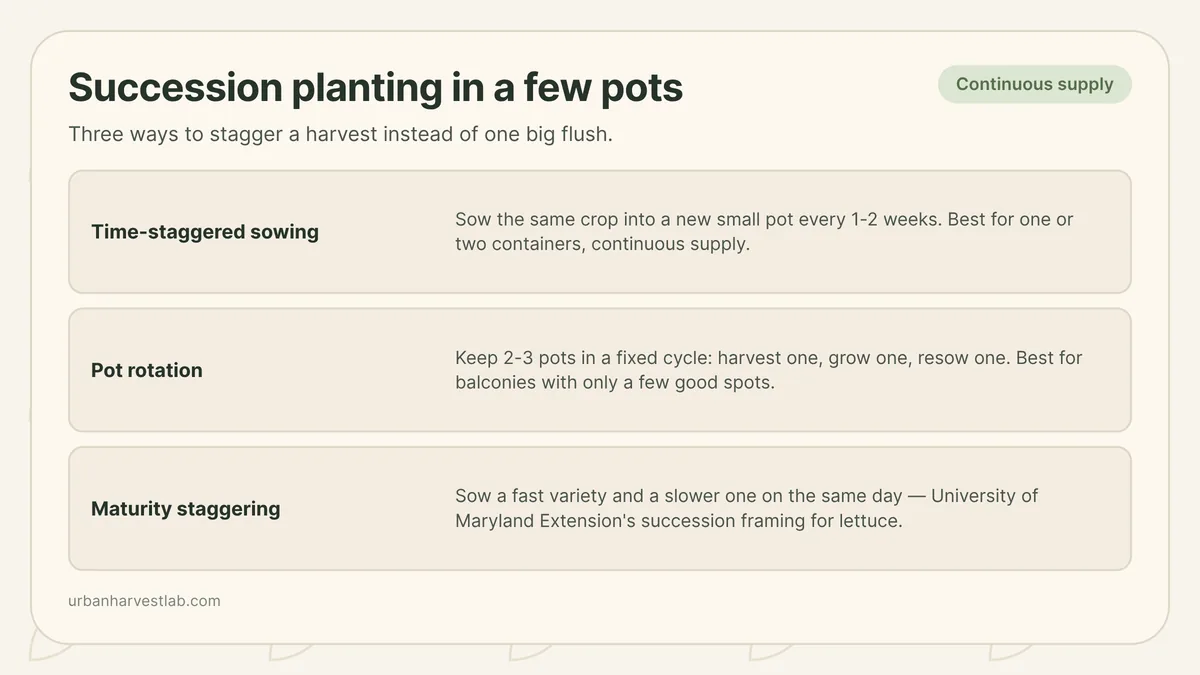
Succession planting in containers: how to stagger a harvest from a few pots
Succession planting in containers is a sowing rhythm: a few pots restarted on a schedule keep producing, where one large planting ripens together and then quits together.

How to grow beets in containers: sow, thin, and harvest roots and greens
A beet seed is really a cluster of seeds, so a pot sown once comes up crowded. Thinning on time, and watering evenly, is what turns that crowd into round roots.