Troubleshoot the system before you change the inputs.
Symptoms
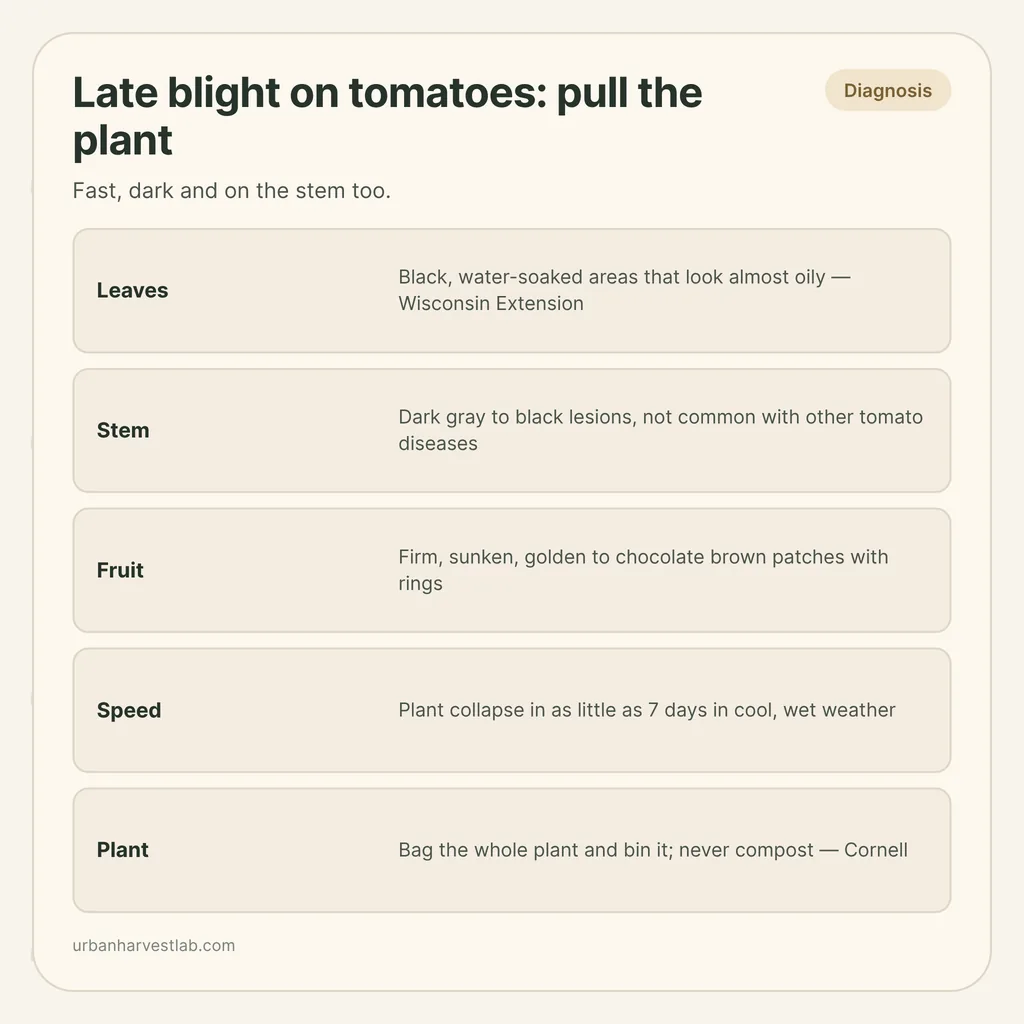
- Water-soaked grey-green patches on leaves that turn dark brown to black within days.
- Dark grey to black lesions on stems.
- White fuzzy growth under leaves on a damp morning.
- Firm, brown, wrinkled-looking patches on green fruit.
Possible causes
- Late blight, favoured by cool, wet weather and by wet foliage.
- Early blight or septoria, if the spread is slow and the stem is clean.
Quick fixes
- Pick fruit that has no lesions and check it daily.
- Pull the whole plant, bag it, leave the bag in the sun for a few days, then bin it.
- Keep the fruit and plant debris out of the pot's mix, and do not compost any of it.
Late blight compared with the leaf spots it is mistaken for
| Sign | Late blight | Early blight or septoria |
|---|---|---|
| Leaf spots | Quickly enlarge into black, water-soaked, almost oily areas | Brown spots with rings, or small grey spots with dark borders |
| Speed | Collapse in as little as 7 days in cool, wet weather | Spreads over weeks, usually upward from the lowest leaves |
| Stems | Dark grey to black lesions | Uncommon (Wisconsin); early blight can reach the stem |
| Fruit | Firm brown patches, often on the upper part | Early blight: sunken spots near the stem. Septoria: fruit not infected |
| Under the leaf in damp weather | White fuzzy growth | No white fuzz |
If dark, water-soaked patches took over your tomato leaves in a few days and the stem is marked too, it is probably late blight. Bag the whole plant and put it in the trash, because late blight spreads on the wind and removing leaves rarely stops it.
Slow, ringed brown spots on the lowest leaves are a different problem, covered in brown spots on tomato leaves. A plant that droops while the leaves look fine is a wilting question. This is the fast one.
What late blight looks like
Wisconsin Extension names three clues: how fast the disease moves, lesions on the stem, and lesions on the fruit. On leaves, it says the lesions quickly enlarge to black, water-soaked areas that look almost oily. Washington State describes the first marks as gray-green, water-soaked spots that quickly enlarge into dark blotches.
Wisconsin Extension adds that in cool, wet conditions the disease can cause plant collapse and death in as little as 7 days. A plant that looked fine on Monday and half-black by the weekend is the pattern.
Check the stem. Wisconsin says stem lesions are dark gray to black, can form on younger and older stems, and are not at all common with the other tomato diseases. A clean stem with spotty leaves points back toward early blight or septoria, although early blight can also mark stems later on, as brown spots on tomato leaves explains.
Fruit gives a third clue. Wisconsin describes large, usually sunken but still firm lesions, golden to chocolate brown, with relatively distinct rings. Washington State says the blotches are firm, look corrugated or wrinkled, and usually start on the upper part of the fruit. A pale, dry, one-sided patch is more likely sunscald.
Then wait for damp air. Cornell describes white fuzzy growth, especially under the leaves, once it is moist. Gray spores instead are Botrytis, not late blight.
Why a balcony is not safe
Cornell says the disease likes cool, wet weather. It needs moisture to infect, and infection can happen without rain when relative humidity is 90 percent or more. Washington State adds that it can be more severe under sprinkler irrigation. Cornell says to water the soil, not the foliage, and Washington State suggests growing tomatoes where they are protected from rain, such as under a balcony overhang.
It also moves between gardens. Cornell’s plant pathologist Meg McGrath calls it a community disease: the longer a sick plant stays, the more spores it sends on the wind to other gardens and farm fields. Other tomato-family plants carry it too. Cornell lists hairy and bittersweet nightshade, petunias and tomatillos.
What to do, in order
- Harvest fruit that is clean. Maine Extension says non-infected fruit is usable even when the plant is diseased. Wisconsin says to use it quickly, since lesions can still appear. Check it every day.
- Do not eat or preserve fruit with lesions. Wisconsin says such fruit should not be eaten or preserved, and should not be canned.
- Pull the whole plant. Cornell says it is rarely possible to control late blight just by removing affected tissue, and the longer you wait, the more spores leave your garden.
- Seal it. Cornell advises sealing the plants in garbage bags and leaving them in the sun for a few days before they go in the trash. Maine says to discard the bag without opening it. Washington State also lists burying deeply, two feet or more.
- Keep it out of the compost. Maine, Washington State and Wisconsin Extension all say not to compost diseased plants. Cornell’s 2010 advice also allows burying the sealed bags underground or deep in a compost pile once the plants are dead, but a balcony bin is not a deep pile, so the trash is the safer route here.
Fungicides are a weaker option. Cornell says that if you wait until symptoms appear, it might be too late to rescue plants, and that fungicides need a regular preventive spray schedule and thorough coverage. Washington State says copper products offer limited control and their use alone is not recommended. On anything you will eat, the label decides what is allowed; choosing a pest treatment for edible plants covers how to read it.
The pot afterwards
Cornell’s greenhouse work found the pathogen can survive for several weeks in affected tomato fruit and can infect seedlings that grow from it. The seedlings could be a source of infection where the time between crops is less than about three months. Seed taken out of affected fruit did not produce symptoms in the same work.
So tip out every fruit, leaf and root fragment before the pot is used again. How to refresh mix and when to replace it is in reusing potting mix, and rotating families through containers is in crop rotation in containers.
Growing again
Cornell’s Long Island trials found tomatoes bred with the Ph2 and Ph3 genes, including Defiant PhR, Iron Lady, Mountain Merit and Mountain Magic, showed excellent resistance to the dominant strain, with few symptoms on leaves and fruit. The same trials found that Legend and New Yorker were as severely affected as a susceptible comparison, because the genes in those varieties do not act against the current strain. Cornell also says resistance does not mean full immunity. Late blight does not travel on tomato seed, so starting your own plants avoids a bought-in infection, Cornell adds.
Sources
Other tomato problems
Rule out the slower leaf diseases and the wilting causes before you decide.
Common questions
How do I know it is late blight and not early blight?
Look at the speed and the stem. Wisconsin Extension says late blight leaf lesions quickly enlarge into black, water-soaked areas that look almost oily, and that stem lesions are not at all common with the other tomato diseases. Early blight makes slower, ringed brown spots on older leaves, though it can reach the stem later.
Can I eat tomatoes from a plant with late blight?
Wisconsin Extension says fruit with lesions should not be eaten or preserved, and tomatoes with lesions should not be canned. It says non-infected fruit can be eaten but should be used quickly because lesions can still develop. Maine Extension also calls non-infected fruit usable.
Can I compost a tomato plant with late blight?
No. Maine Extension says not to put the diseased plant into a compost pile or leave it in the garden, and Washington State and Wisconsin say not to compost diseased material. Cornell's 2010 advice allows a deep compost pile once sealed plants are dead, but a balcony bin is not one. Seal it in a bag, leave the bag in the sun for a few days as Cornell and Wisconsin advise, then put it in the trash.
Will the pathogen survive in my pot until next year?
Cornell found the pathogen survives for several weeks in rotted tomato fruit and can infect seedlings that sprout from it, so time between crops under about three months is a risk. Remove all fruit and plant debris from the pot.
Related guides

Brown spots on tomato leaves: early blight, septoria or bacterial spot
Three common diseases cause brown spots on tomato leaves, and each leaves a different mark. Read the spot, then pick the response that fits.

Tomato plant wilting even though you water it: heat, roots, or disease
Midday droop that clears by evening is usually heat. Wilt that stays after watering points to rotting roots or a vascular disease, and a cut stem tells you which.
Choosing a pest treatment for plants you are going to eat
Once you know which pest you have, the next question is what you can treat it with without compromising the food. The answer is a ladder of methods, and the label on any product you buy sets the legal limits of the top rung.