Troubleshoot the system before you change the inputs.
Symptoms
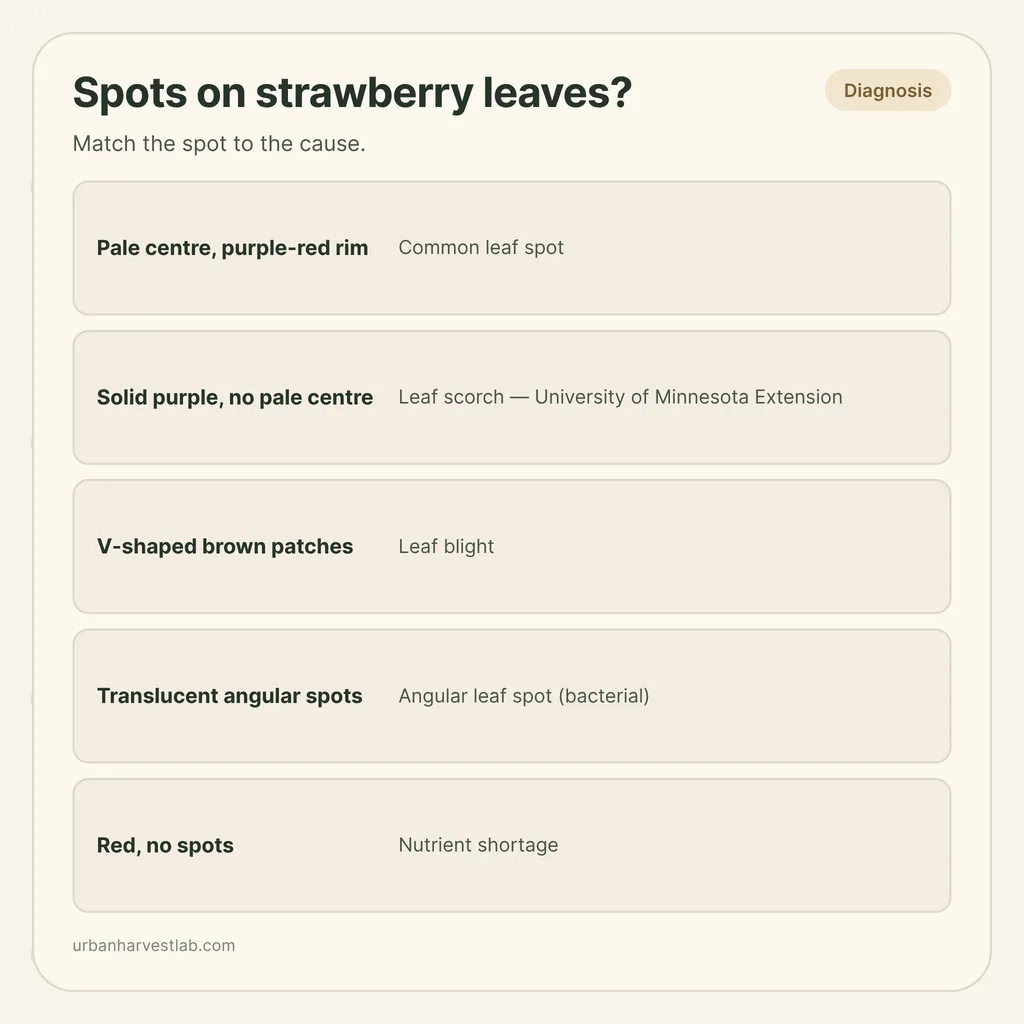
- Small round spots with a white or tan centre and a purple or reddish rim, scattered over the leaf.
- Solid purple spots with no pale centre that merge until the leaf looks reddish-brown, dries and curls.
- V-shaped brown patches that follow the main veins.
- Tiny angular water-soaked spots on the underside of the leaf that look translucent against the light.
- Leaves reddening evenly or at the edges with no distinct spots.
Possible causes
- Common leaf spot, a fungus that overwinters on old leaves and spreads in rain splash.
- Leaf scorch, a related fungus favoured by warm, wet weather.
- Leaf blight, which makes V-shaped lesions along the veins.
- Angular leaf spot, a bacterial disease favoured by cool, wet weather.
- A nitrogen or phosphorus shortage, which can turn leaves purplish or reddish without any spotting.
Quick fixes
- Pick off the worst leaves and old dead foliage, and take them away from the pot.
- Water at the soil surface in the morning so leaves dry quickly.
- Keep to about 3-4 plants in a 12-inch pot so air moves through the canopy.
- Check the pot's pH and feeding if the leaves are red but not spotted.
- Replace container strawberries each spring instead of carrying infected plants over.
Red, purple or brown spots on strawberry leaves are usually common leaf spot or leaf scorch, two fungal diseases that look alarming and seldom hurt the crop. Match the spot to the table below, remove the old and spotted leaves, water at the soil in the morning, and plan to replace the plants next spring. If you are still setting up the pot, growing strawberries in containers covers spacing and sun.
Match the spot to the cause
| What you see | Likely cause | Detail from the extension sources |
|---|---|---|
| Small round spots with a white or tan centre and a purple-red rim | Common leaf spot | University of Minnesota Extension gives 1/10 to 1/3 of an inch. Washington State says the pale centres sometimes fall out and leave a hole |
| Solid purple spots, no pale centre, that merge until the leaf looks reddish-brown | Leaf scorch | UConn IPM says leaves eventually dry up and curl at the edges so they look scorched |
| V-shaped brown patches running along the main veins | Leaf blight | UConn IPM says the V is light brown inside with dark brown edges |
| Tiny angular spots on the underside, translucent against the light | Angular leaf spot (bacterial) | UConn IPM calls the sticky fluid and varnish-like film on the underside diagnostic |
| Red or purple tint with no distinct spots | Nutrient shortage | Cornell names nitrogen and phosphorus |
Hold a leaf up to the light before deciding. Translucent angular spots on the underside rule out the fungal group.
Why it is usually not a crisis
UConn IPM says the three fungal leaf spots “do not generally cause severe damage, but may weaken plants enough to cause overwintering problems,” and that yield is not usually affected. That weakening is the practical cost, and it is small for a pot you intend to replace anyway: Iowa State University Extension says strawberries grown in containers are best treated as annuals.
The diseases are tied to weather. UConn IPM puts common leaf spot at 68 to 77 °F and leaf scorch at 68 to 86 °F, both with wet foliage. Washington State says the leaf spot fungus overwinters on old infected leaves, rain splashes the spores onto healthy tissue, and infection is most severe in spring and fall. A rainy week on a balcony is therefore the usual trigger.
What to do in a pot
Clear the old leaves. UConn says to remove old tissue at the end of the season, and Washington State says removing foliage after harvest reduces spore counts. In a pot that means picking off dead and badly spotted leaves by hand and taking them away from the pot. Keep green, healthy leaves; they are feeding the plant.
Water the soil, not the leaves. UConn IPM prefers drip irrigation, and says to water in the morning so leaves can dry quickly if overhead watering is used. For a pot, that translates to a spout at the soil surface early in the day. Iowa State advises watering when the soil surface is dry, which also avoids a permanently damp canopy. If you suspect the opposite problem, overwatered or underwatered plants look different from this.
Give the leaves room. UConn recommends well-spaced plants to keep the canopy dry. Iowa State suggests plants about 8 inches apart, with 3 or 4 in a 12-inch container, and at least 6 hours of direct sun.
Do not work wet plants. UConn says to avoid working among strawberries when the plants are wet, which spreads the angular leaf spot bacterium in particular. Pruning and picking can wait for a dry afternoon.
Pick resistant types next time. UConn IPM says resistant varieties are available for leaf spot and leaf scorch. UConn’s Home & Garden fact sheet lists the everbearing Fort Laramie as resistant to leaf spot. Washington State names Olympus and Shuksan as the most susceptible to common leaf spot.
Sprays are a separate question. Washington State says leaf spot can still be a problem after renovation without chemical protection, but product choice and rates depend on your country and the label. Your local extension office can tell you what is permitted on a crop you will eat. No product or dose is given here.
Renovation, and why pots mostly skip it
Gardeners with strawberry beds renovate after harvest. Washington State removes the leaves of June-bearing plants 1/2 inch above the crown and does not mow other types. UConn’s Home & Garden fact sheet mows or clips 8 to 10 days after picking ends, to 1 1/2 inches above the crown, and warns that leaving it later removes the buds for next year’s crop. The two heights differ, and both describe a planting kept for several years.
For a pot the question is mostly moot. Iowa State treats container strawberries as annuals, so the clean fix for a badly spotted plant is fresh potting mix and new plants in spring rather than a haircut. The reasoning is covered in strawberry plants not fruiting, and leaf spot is one more reason not to carry an infected pot over.
When the leaves are red but not spotted
Cornell’s berry diagnostic page lists two likely causes of red or purple strawberry leaves, leaf scorch and nutrient deficiencies. It says nitrogen or phosphorus shortages cause purplish to reddish leaves, and that phosphorus deficiency is most common when the pH is too low (below 5.5) or too high (above 7.0). A pot that has not been fed can fit. Check the mix against container soil pH and feed on a schedule; Iowa State suggests a water-soluble, all-purpose fertiliser 2 to 3 times through the season.
If the problem is the fruit, not the leaves
Spots and discolouration on leaves do not explain berries that are missing or lumpy. Missing fruit has its own causes in why strawberry plants do not fruit in pots, and lopsided berries are covered in small, lumpy strawberries. Dark marks on herbs rather than strawberries follow the same fungal-versus-bacterial logic in black spots on herb leaves.
Sources
- University of Minnesota Extension — Strawberry, spots on leaves
- UConn IPM — Leaf Diseases of Strawberry
- UConn Home & Garden Education Center — Strawberries
- Washington State University Hortsense — Strawberry: Common leaf spot
- Cornell Berry Diagnostic Tool — Strawberries: Leaves are red or purple
- Iowa State University Extension — How to Grow Strawberries in Containers
Strawberry problems in pots
Setup, fruiting and fruit-shape guides for container strawberries.
Common questions
What are the red spots on my strawberry leaves?
Most often common leaf spot or leaf scorch, both fungal. University of Minnesota Extension describes leaf spot as small round spots, 1/10 to 1/3 of an inch, with dark purple to reddish edges and a light tan to white centre, and leaf scorch as small solid purple spots with no pale centre.
Will leaf spot kill my strawberry plant?
Not usually. UConn IPM says the fungal leaf spots do not generally cause severe damage and yield is not usually affected, though they may weaken plants enough to cause overwintering problems. That matters little for pots Iowa State University Extension treats as annuals.
Should I cut off spotted strawberry leaves?
Yes, the worst ones and any old dead foliage, because Washington State University says the fungus overwinters on old infected leaves and spreads by rain splash. After harvest, WSU removes the leaves of June-bearing plants 1/2 inch above the crown, while UConn trims to 1 1/2 inches; both treat this as a bed practice.
Can red strawberry leaves be something other than disease?
Yes. Cornell lists leaf scorch and nutrient deficiencies as the two likely causes of red or purple leaves, and says nitrogen or phosphorus shortages can give purplish to reddish leaves. Spots point to disease; an even colour change points to nutrition.
Related guides

Strawberry plants not fruiting in pots: type, age, light, and heat
A strawberry pot with leaves and no berries is rarely sick. The variety type, the plant's age, the sun, the heat and an early frost explain most of it.
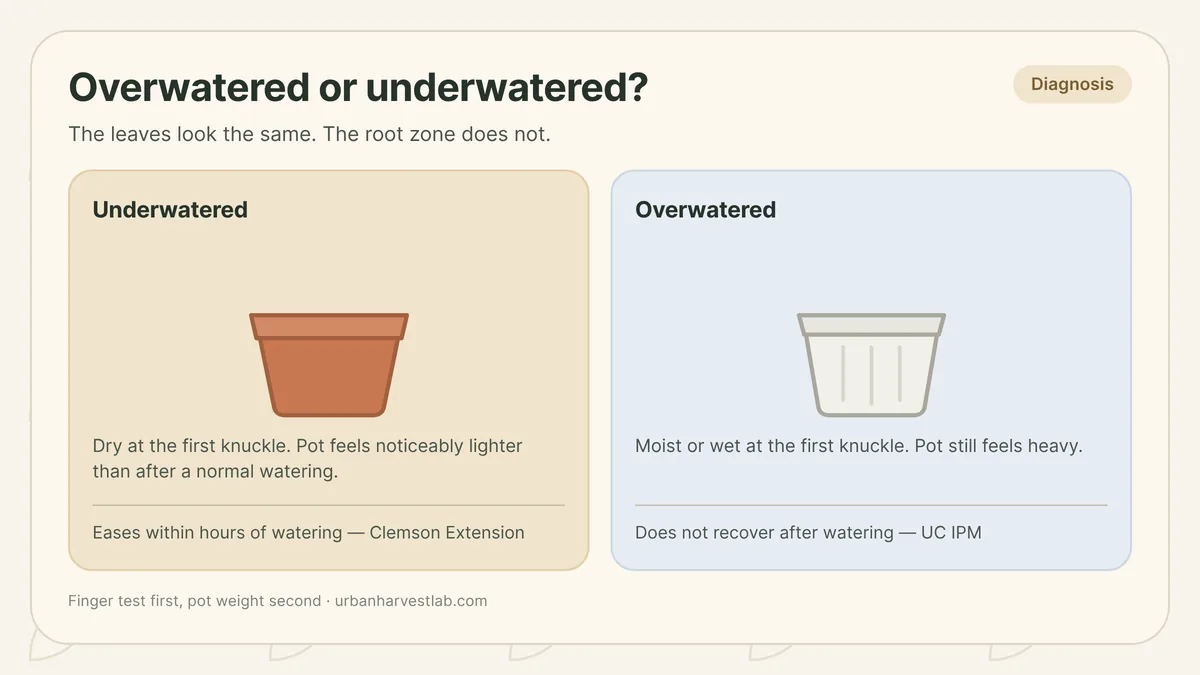
Overwatered vs underwatered: how to tell which one you have
Reading the root zone directly, with a finger test, pot weight, and how the plant responds to being watered, settles what the leaves alone cannot.
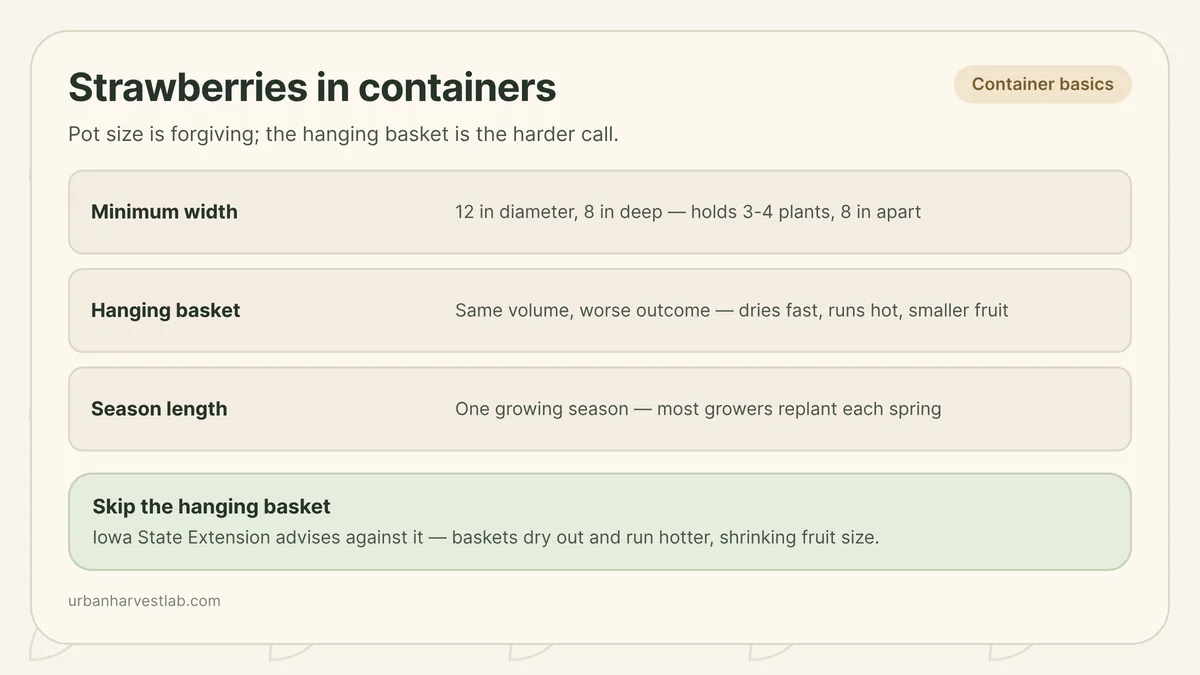
Strawberries in containers: pot size, hanging baskets, and annual replanting
Container strawberries behave differently from garden strawberries: the pot size is forgiving, hanging baskets are the harder option, and most growers treat the planting as a one-season crop.