Troubleshoot the system before you change the inputs.
Symptoms
- Berries are lumpy, lopsided, or have a hard seedy tip or several tips.
- Berries ripen normally but stay small, or later berries are smaller than the first ones.
- Seeds on the berry surface are different sizes, or are all the same size and clustered on a dull, hard patch.
Possible causes
- Incomplete pollination, often from few bee visits, rain or cold at bloom, or a row cover left on during flowering.
- Cold or frost damage to open flowers, which harms some of the seeds on the berry.
- Tarnished plant bug nymphs and adults feeding on flowers and young berries.
- Hot, dry or heated pots, an old planting, or the normal drop in size across successive sets of fruit.
Quick fixes
- Look closely at the seeds on the surface of a few deformed berries to see whether they vary in size or are uniform.
- Take any row cover off once flowers open so bees can reach them.
- Cover open flowers on frost nights and uncover them in the morning.
- Shake the flowering stems over a white sheet or plate to check for small green, fast-moving bugs.
- Keep the pot evenly moist and replace plants after their second or third crop.
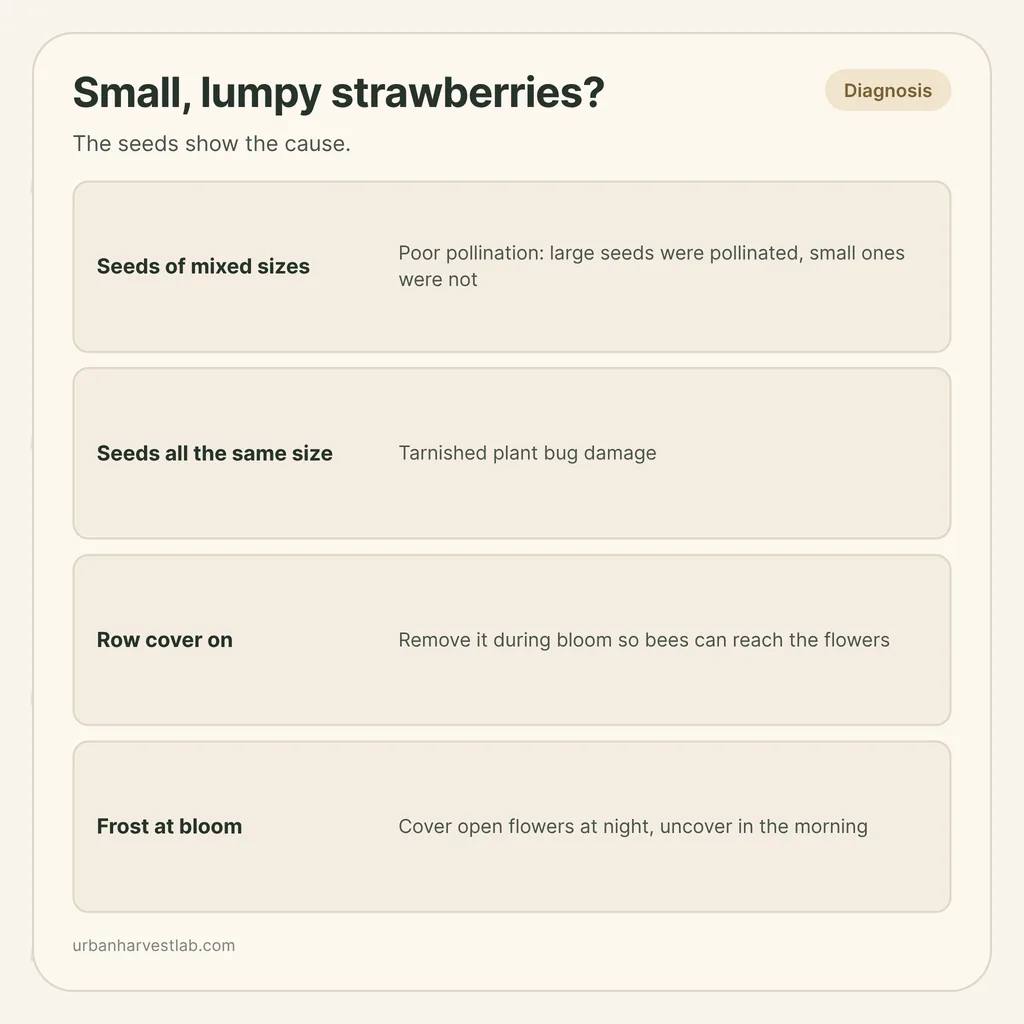
Small, lumpy or lopsided strawberries are most often a pollination problem, a cold-damaged flower or tarnished plant bug feeding, and the seeds on the surface show which. Seeds of mixed sizes mean the flower was pollinated unevenly; seeds that are all the same size, usually bunched at a hard tip, mean a bug. If your plant is giving no berries at all, that is a different question, covered in strawberry plants not fruiting.
Read the seeds first
What looks like a seed on a strawberry is a separate fruit, an achene. University of Delaware Extension says the receptacle may carry up to 500 ovules per berry, and that each one has to be pollinated for the flesh around it to swell. Skip some and the berry grows unevenly around them.
That is why the seeds are the clue. Delaware says poor pollination shows as variable seed size: large seeds were pollinated and small seeds were not. NC State Extension draws the same line from the other side, with uniform seed size on fruit damaged by tarnished plant bugs. Hold a bad berry up to the light and compare it with a good one before you change anything.
Patchy pollination
A strawberry flower has both male and female parts and can pollinate itself. Delaware says wind and rain can move pollen within the flower, but that this usually does not pollinate every ovule, and that bees are usually necessary for complete pollination. It gives 16-25 bee visits per flower as the recommended amount, and says this matters most for the king berry, the first flower to open on a truss.
Delaware lists the situations where it goes wrong: plants under row covers during bloom, and bloom periods that are rainy, stormy or cold. NC State Extension adds that poor pollination is very common in the first picking of spring-fruiting strawberries in the southeast, when the weather is often less suitable for bee activity.
For a pot, that gives you three things to check.
- Covers. Wisconsin Extension says to remove a floating row cover during bloom so pollinators can reach the flowers. A frost cover goes on at night and comes off in the morning.
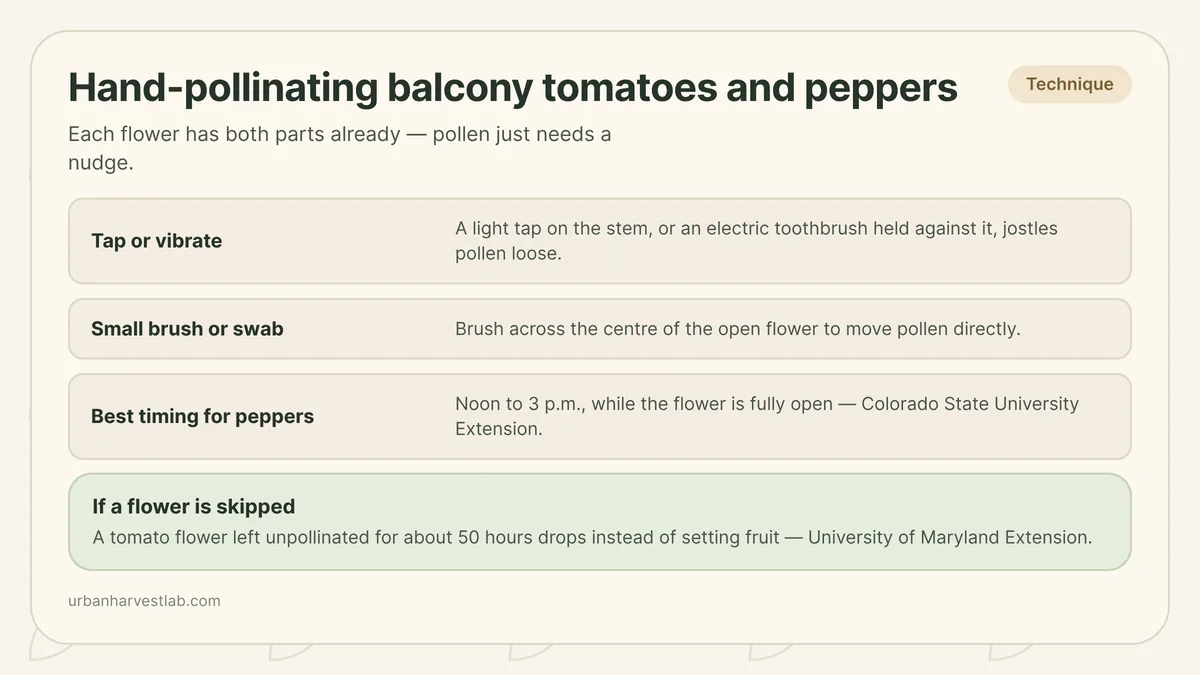
- Access. A pot on a high or sheltered balcony may see few bees. The routine for moving pollen by hand is written for tomatoes and peppers in hand-pollinating on a balcony; strawberry flowers are a different shape, so use it as a picture of the problem rather than a method.
- Sprays. Minnesota Extension notes that bees are working the flowers at bloom and that even a certified organic spray is not automatically bee-friendly. Keep sprays off open blossoms.
Cold on the flowers
Strawberries flower early, and a late cold night can catch open blossoms. Delaware says frost commonly kills the whole flower, and that cold damage short of that still causes deformities because some achenes are damaged. It also says cold injury can cause fruit with multiple tips. The sign in the flower is the pistils in the centre turning black or brown.
NC State Extension puts numbers on it: with the flower completely open, 30 °F at plant level can cause some damage and 28 °F considerable damage. A berry that formed from a damaged flower stays deformed; protect the next flush rather than hoping the shape corrects itself. The steps for a cold night are in emergency cold snap protection.
Tarnished plant bugs
NC State Extension describes the adult as oval, flattened, about 6 mm (¼ inch) long and mottled brown, green and reddish-bronze. The nymphs are smaller and pale green, and the early ones look like green aphids but move faster. Wisconsin Extension points to a yellow V-shaped marking just behind the head to tell the adult from beneficial bugs.
Both stages feed on the flowers and young fruit. NC State says feeding on the developing seeds stops growth under them, leaving fruit that is small, knobby or unevenly developed, and in severe cases a hard, seedy tip with little flesh beneath. Wisconsin says the damage tends to sit at the tip, and that hollowed-out seeds are very characteristic. NC State also says the earliest feeding, at petal fall or before, causes the worst malformation. The common name for the result is catfacing; the tomato version has a different cause and is covered in catfacing tomatoes.
To check, Alabama Extension suggests laying a white cloth or sheet under the plant and shaking the plant onto it, where the insects are easy to see. Do it during bloom, before the damaged fruit appears.
What helps in a pot is mostly tidiness. Alabama Extension calls managing weeds in and around plantings one of the most effective cultural practices, since the bugs feed on many weed species, and NC State says they overwinter as adults in leaf litter and dead weeds. Clear litter and weeds around the pots. Wisconsin adds that earlier-flowering varieties may escape the worst of it. Damaged berries are still edible: Minnesota Extension says the fruit is less appealing for fresh eating but still edible.
Small berries that are not deformed
Not every small berry is a problem.
- Later sets are smaller. University of Maryland Extension says the first fruits are the largest and each succeeding set will be smaller.
- Heat and dry mix. Iowa State University Extension says container strawberries need consistent moisture because they have shallow roots and do not tolerate dry, hot conditions, and that fruit size tends to get smaller as soil temperature rises, especially for day-neutral varieties. Shade the pot rather than the plant; the options are in the heatwave guide.
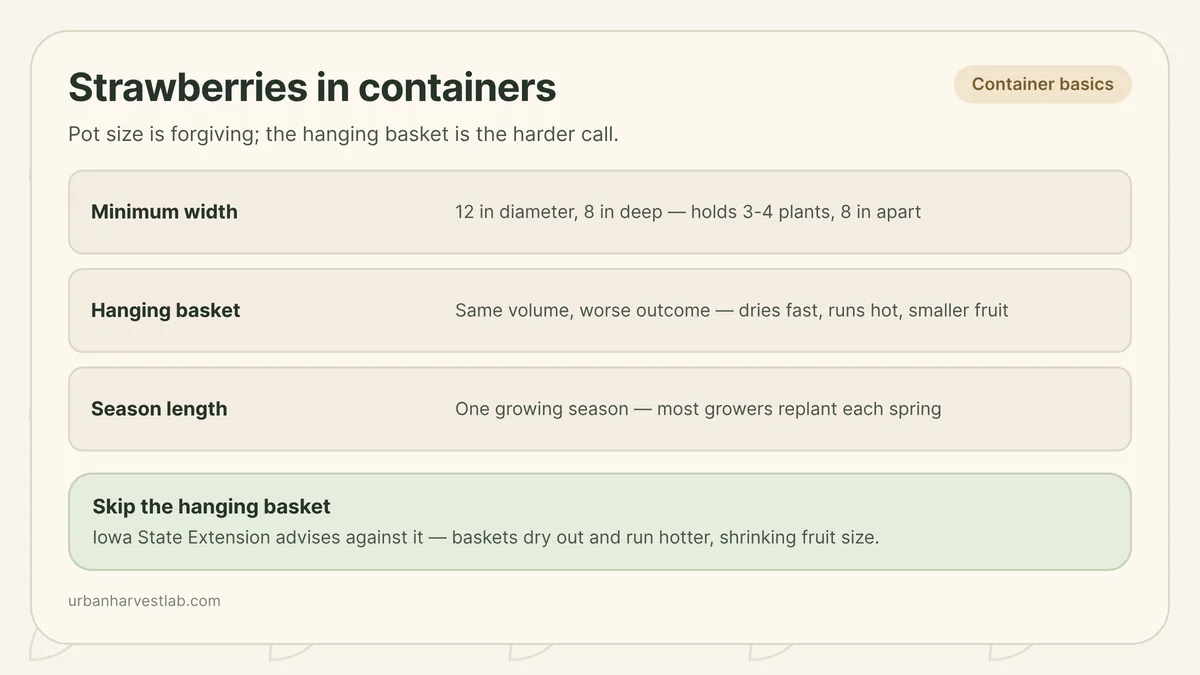
- Age. NC State Extension says yield and berry size decrease after the first year and recommends replacing a planting after its second or third crop. Iowa State treats container plants as annuals, as set out in strawberries in containers.
A short check
- Compare the seeds on a bad berry with a good one: mixed sizes or uniform.
- Remove any cover during the day while flowers are open.
- Look at the flower centres after a cold night for black pistils.
- Shake the flowering stems over a white sheet for small, fast green nymphs.
- Clear weeds and leaf litter near the pots.
- Keep the mix evenly moist and the pot out of the hottest afternoon sun.
Sources
- University of Delaware Cooperative Extension, “Misshapen Strawberry Fruits, Cold Damage and Frost Injury”
- NC State Extension, “Tarnished Plant Bug in Strawberries”
- Alabama Cooperative Extension System, “Tarnished Plant Bug Damage in Strawberries”
- University of Wisconsin-Madison Extension, “Tarnished plant bug - a strawberry menace”
- University of Minnesota Extension, “Tarnished plant bug in strawberries”
- University of Maryland Extension, “Growing Strawberries in a Home Garden”
- NC State Extension Gardener Handbook, “Small Fruits”
- Iowa State University Extension, “How to Grow Strawberries in Containers”
Strawberries in pots
Fruiting, container setup and protection for a strawberry planting that crops well.
Common questions
Why are my strawberries small and deformed?
The usual causes are incomplete pollination, cold damage to the flowers, and tarnished plant bug feeding. University of Delaware Extension says incomplete pollination often results in smaller or misshapen berries, and that cold damage can leave deformities when some seeds are harmed. NC State Extension says tarnished plant bug feeding produces small, knobby, unevenly developed fruit. Seeds of mixed sizes point to pollination; uniform seeds point to the bug.
How do I tell poor pollination from bug damage?
Look at the seeds. NC State Extension says seeds on fruit deformed by poor pollination vary in size, while those on fruit damaged by tarnished plant bugs are uniform in size. University of Wisconsin-Madison Extension adds that bug damage tends to sit at the tip of the berry and that hollowed-out seeds are very characteristic of it.
Are deformed strawberries safe to eat?
University of Minnesota Extension says tarnished plant bug damage makes the fruit less appealing for fresh eating but still edible. A berry that is also soft, mouldy or rotting is a different matter and should be thrown out.
Why are my strawberries getting smaller as the season goes on?
That is normal to a degree. University of Maryland Extension says the first fruits are the largest and each succeeding set of berries will be smaller. Iowa State University Extension adds that fruit size tends to get smaller as soil temperatures rise, especially for day-neutral varieties, and NC State Extension says berry size decreases after the first year of a planting.
Related guides

Strawberry plants not fruiting in pots: type, age, light, and heat
A strawberry pot with leaves and no berries is rarely sick. The variety type, the plant's age, the sun, the heat and an early frost explain most of it.
Strawberries in containers: pot size, hanging baskets, and annual replanting
Container strawberries behave differently from garden strawberries: the pot size is forgiving, hanging baskets are the harder option, and most growers treat the planting as a one-season crop.
How to hand-pollinate tomatoes and peppers on a balcony
A tomato or pepper flower already carries both male and female parts, but nothing on a balcony reliably moves the pollen between them. This is the tap, brush, or vibrate technique that stands in for a bee.