Troubleshoot the system before you change the inputs.
Symptoms
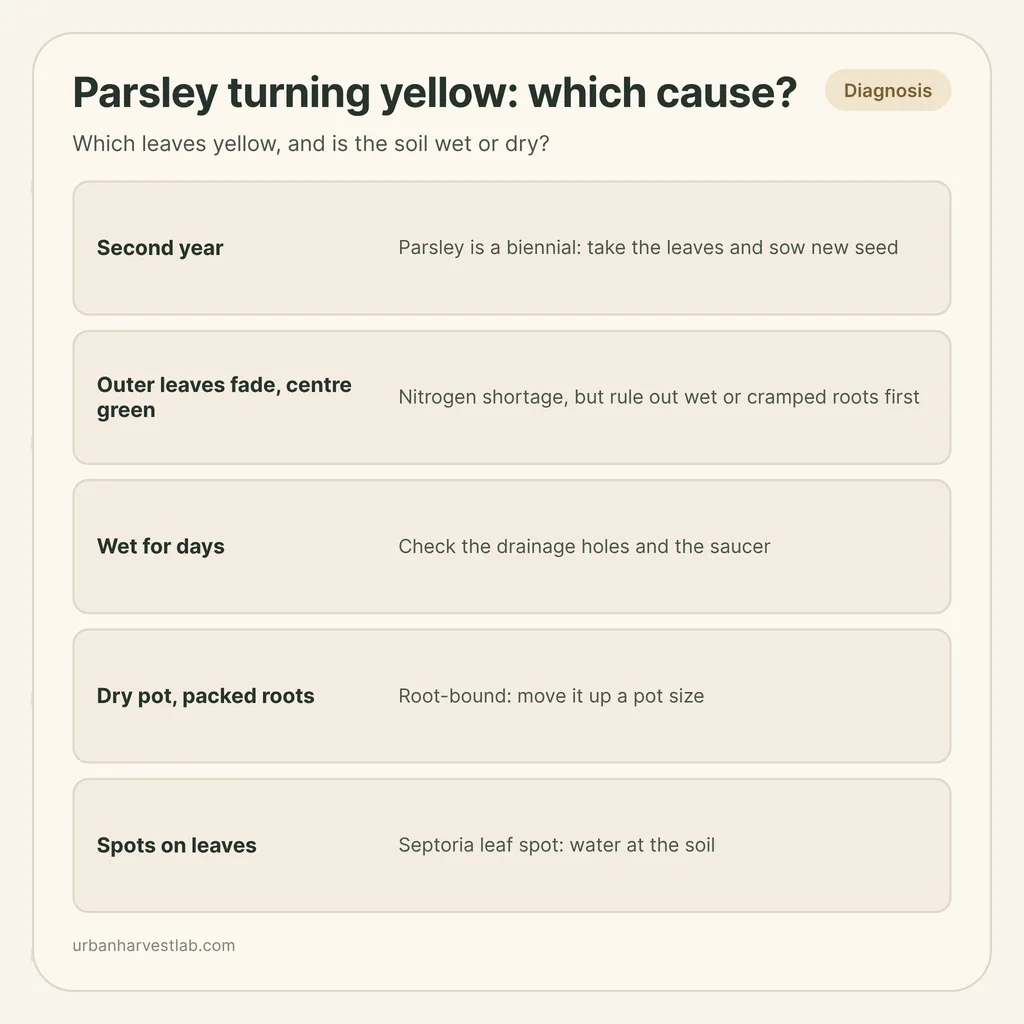
- Outer or lower leaves fade to an even pale yellow while the centre of the plant stays green.
- Leaves yellow and growth stays stunted while the soil stays wet for days.
- The pot dries out fast, the plant wilts soon after watering, and leaves yellow and droop.
- Small grayish-brown spots appear on leaves and leaf stalks, sometimes with tiny dark specks.
- A second-year plant sends up a flower stalk and its leaves yellow and thin out.
Possible causes
- Second-year biennial growth: the plant is finishing its life cycle.
- Nitrogen is short, so the oldest leaves fade first as the plant moves it to new growth.
- Waterlogged soil cuts off oxygen to the roots.
- The taproot has filled the pot, or the mix dries out between waterings.
- Aphids are feeding on leaves and stems.
- Septoria leaf spot, a fungus spread by splashing water.
Quick fixes
- Check the plant's age first: if it has overwintered and is sending up a stalk, plan a replacement sowing.
- Push a finger into the mix to the first joint and check drainage holes before changing anything else.
- Slide the rootball out and look for roots packed around the outside; move up to a deeper pot if so.
- If the roots and moisture are right and the pattern fits nitrogen, feed at a diluted rate and judge success on new growth.
- Look under leaves and along stems for aphids, and remove spotted leaves while keeping water off the foliage.
Yellow parsley: pattern, likely cause, first check
| What you see | Likely cause | First check |
|---|---|---|
| Flower stalk forming, leaves thinning, plant came through winter | Second-year biennial | Note the plant's age; sow a replacement |
| Older leaves evenly pale, new growth small and sparse | Nitrogen short | Rule out wet or cramped roots, then feed lightly |
| Yellowing and stunting with soil wet for days | Overwatering or poor drainage | Finger test and drainage holes |
| Pot dries fast, wilts soon after watering | Root-bound taproot | Slide the rootball out |
| Distorted or sticky growth, small insects on stems | Aphids | Check leaf undersides and stem tips |
| Small grayish-brown angular spots, tiny dark specks | Septoria leaf spot | Remove spotted leaves; stop wetting foliage |
Yellow parsley is usually one of five things: a plant in its second year, a nitrogen shortage, soil that stays too wet, roots that have filled the pot, or leaf spot (and, less often, aphids). Which leaves yellow, and whether the soil is wet or dry when you check, separates them. If the yellowing arrived together with a stall rather than a fade, why parsley grows slowly covers that side. For yellowing across a mixed shelf of plants, the yellow leaves cause finder starts from the pattern instead of the plant.
Start with the plant’s age
Clemson Cooperative Extension describes parsley as a biennial, “producing leaves the first year and flowers the next.” A plant that overwintered and is now sending up a stalk is doing exactly that, and no change to watering or feeding will turn it back into a leaf producer. Take the leaves while they are usable and sow new seed. Clemson notes that parsley seed is slow to germinate, so sow before the old plant gives out rather than after.
A first-year plant has no such excuse. Move on to the cause that fits the pattern.
Outer leaves fading, centre still green
UC Integrated Pest Management says that with nitrogen deficiency “older leaves or needles become uniformly pale green to yellowish,” while new growth “is sparse and undersized but is usually green.” Nitrogen moves from old leaves to new ones, so the outer ring of parsley fades while the centre holds its colour.
Do not reach for fertilizer yet. The same UC IPM page warns that “deficiency symptoms commonly result from adverse soil conditions and anything that makes roots unhealthy.” A parsley plant with drowned or cramped roots looks hungry whether or not the mix has nitrogen in it. Rule out the next two causes, then feed lightly. Best fertilizer for herbs in pots covers what to use. Clemson adds that very fertile soil tends to give lush leaves that lack flavour, so more is not better.
Fully yellowed old leaves rarely green up again, so judge the fix by the next leaves.
Wet for days and not growing
Missouri Botanical Garden lists “stunted slow growth with yellowing leaves” as a symptom of overwatering. Roots in waterlogged soil cannot get oxygen, and “the longer the air is cut off, the greater the root damage.” Damaged roots stop supplying water and nutrients, which is why the leaves can show a hunger pattern in soil that is full of food.
Clemson Cooperative Extension’s test is to push a finger into the mix up to the first joint. If it is wet days after watering, check that the drainage holes are open and the pot is not sitting in a full saucer. Water again only once the mix is dry at your fingertip. The routine that suits parsley is in how often to water parsley, and overwatered vs underwatered explains why the two look so alike.
Dry pot, quick wilt, yellow leaves: cramped roots or drought
Yellowing also follows drought. Clemson says lower leaves yellow when plants “are allowed to become too dry for an extended time,” and gives the root-bound signs as roots in “a solid mass around the rootball,” roots growing out of the drainage hole, or a plant that “requires frequent watering or wilts shortly after watering.”
Parsley has a long taproot. Slide the plant out of the pot and look. If the roots are packed around the outside, move it up. Clemson suggests a pot “1 or 2 inches larger in diameter” and says to repot only in spring and summer while the plant is actively growing, and not to repot a plant that is dormant or beginning to flower, so a second-year parsley sending up a stalk is a replacement case, not a repotting one. Parsley pot size covers the depth the taproot wants, signs your potted herb is root bound has the full list, and repotting herbs without shock covers the move.
Insects and spots
Aphids. UC IPM says “large populations can turn leaves yellow and stunt shoots.” Look at stem tips and leaf undersides. If you find them, aphids on indoor herbs covers identification and control, and the choice of treatment on a plant you will eat matters.
Septoria leaf spot. This is spots, not an overall fade. The Pacific Northwest Pest Management Handbooks, from Oregon State University, describe leaf spots that “start as small, grayish-brown, somewhat angular spots,” with small oval spots on the leaf stalks and tiny dark specks on the upper surface. The fungus can be seedborne, and it spreads under moist conditions: “wind-driven rain, dew drips, irrigation.” The cultural advice from the same source is to “minimize leaf wetness periods,” so water at the soil and avoid splashing the foliage. Remove spotted leaves. Handbook chemical controls are written for commercial crops, and for a pot on a balcony the label of any product decides whether it can go on a herb you eat.
Common mistakes
Feeding first. Roots that are too wet or too cramped produce the same pale leaves, and fertilizer on top of a root problem adds salts to a plant that cannot use them.
Watering on a timer. Check the mix with a finger; the pot’s weight and the weather change between waterings.
Watering over the foliage when spots are present. Septoria spreads in splashing water, so pour at the soil.
Sources
- Clemson Cooperative Extension, “Herbs”
- Clemson Cooperative Extension, “Indoor Plants – Transplanting & Repotting”
- Clemson Cooperative Extension, “Indoor Plants – Watering”
- Clemson Cooperative Extension, “Houseplant Diseases & Disorders”
- UC IPM, “Common Nutrient Deficiency Symptoms”
- UC IPM Pest Notes 7404, “Aphids”
- Missouri Botanical Garden, “Overwatering”
- Pacific Northwest Pest Management Handbooks, “Parsley (Petroselinum crispum)-Septoria Leaf Spot”
Get the parsley setup right
Pot depth and watering rhythm sit behind most yellow-parsley cases. These cover both.
Common questions
Why is my parsley turning yellow?
The usual causes are a second-year plant reaching the end of its leafy phase, a nitrogen shortage, soil that stays wet, roots that have outgrown the pot, aphids, and Septoria leaf spot. Look at which leaves are yellow, whether the soil is wet or dry, and whether the yellow is an even fade or spots. Those three observations separate most cases.
Is yellow parsley dying?
Not necessarily. Clemson Cooperative Extension describes parsley as a biennial that produces leaves the first year and flowers the next, so a second-year plant is on its normal schedule. A first-year plant with yellow outer leaves and a healthy centre can often be corrected by fixing water, roots or feeding.
Should I cut off yellow parsley leaves?
Yes, pinch off leaves that are fully yellow. They rarely come back, and removing them lets you see what the next leaves do. Judge any fix by the new growth, not by whether the old yellow leaves green up.
Does yellow parsley mean it needs fertilizer?
Only if the pattern fits. UC IPM describes nitrogen deficiency as older leaves turning uniformly pale green to yellowish with sparse, undersized new growth. UC IPM also notes that deficiency symptoms commonly result from adverse soil conditions and anything that makes roots unhealthy, so check watering and roots before feeding.
Related guides
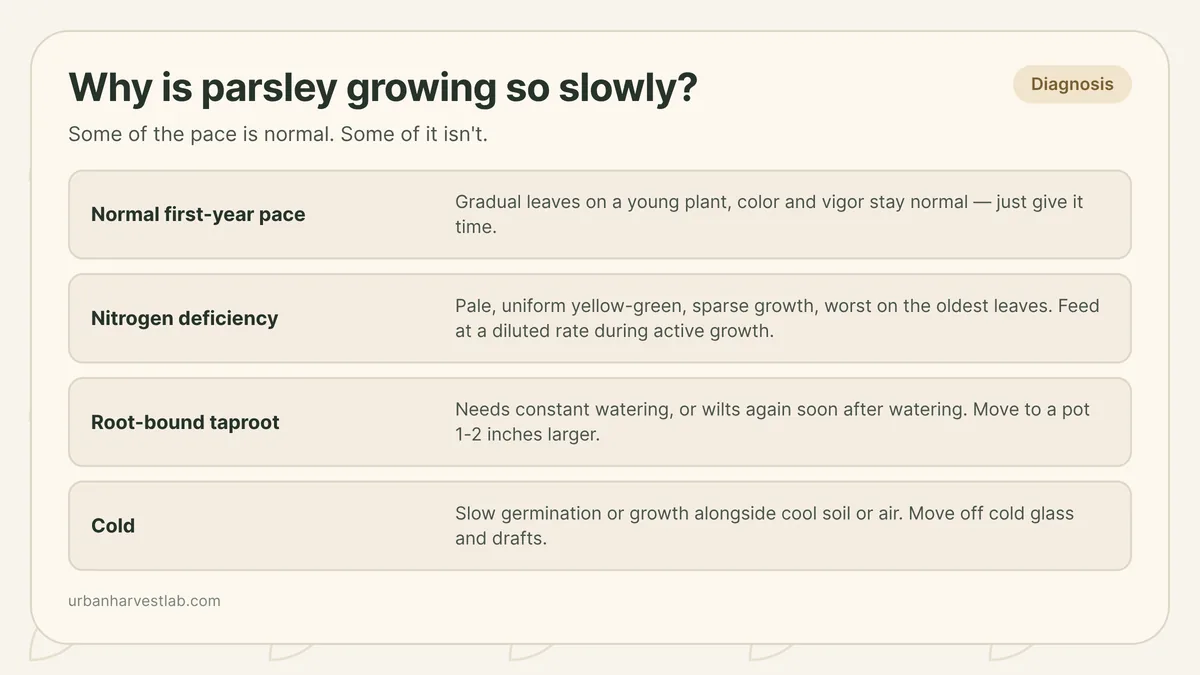
Why is parsley growing so slowly?
Some of parsley's slow pace is just how the plant works. Here is how to tell normal first-year growth apart from nitrogen deficiency, a cramped taproot, and cold.
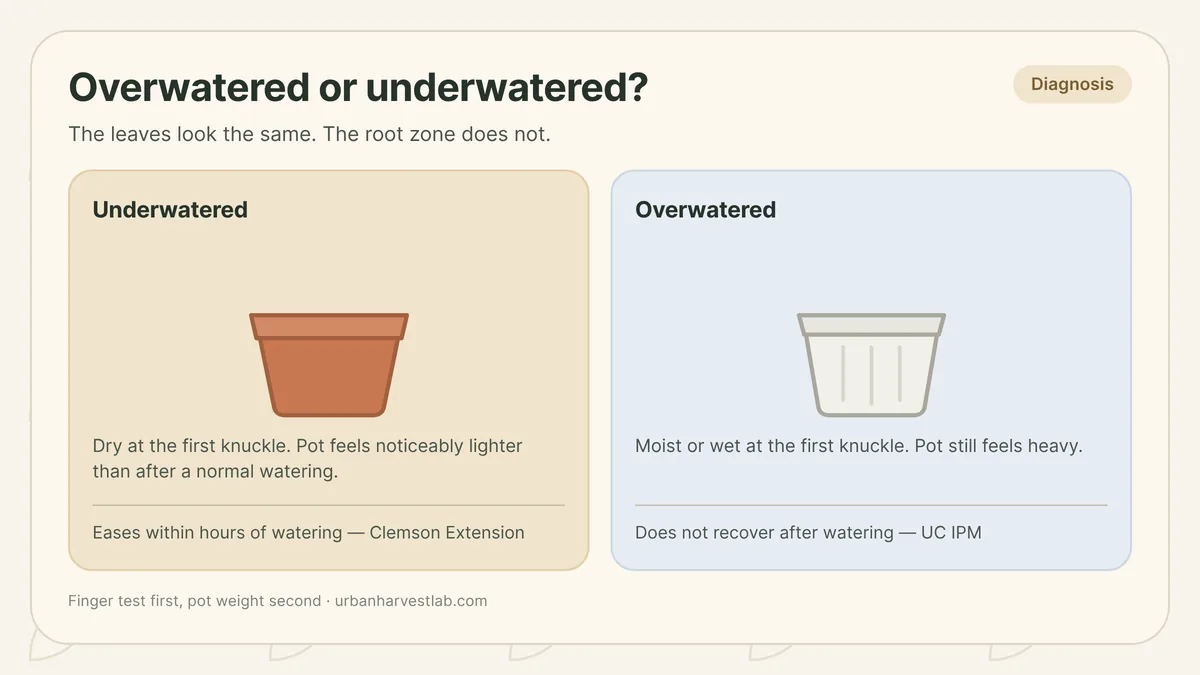
Overwatered vs underwatered: how to tell which one you have
Reading the root zone directly, with a finger test, pot weight, and how the plant responds to being watered, settles what the leaves alone cannot.
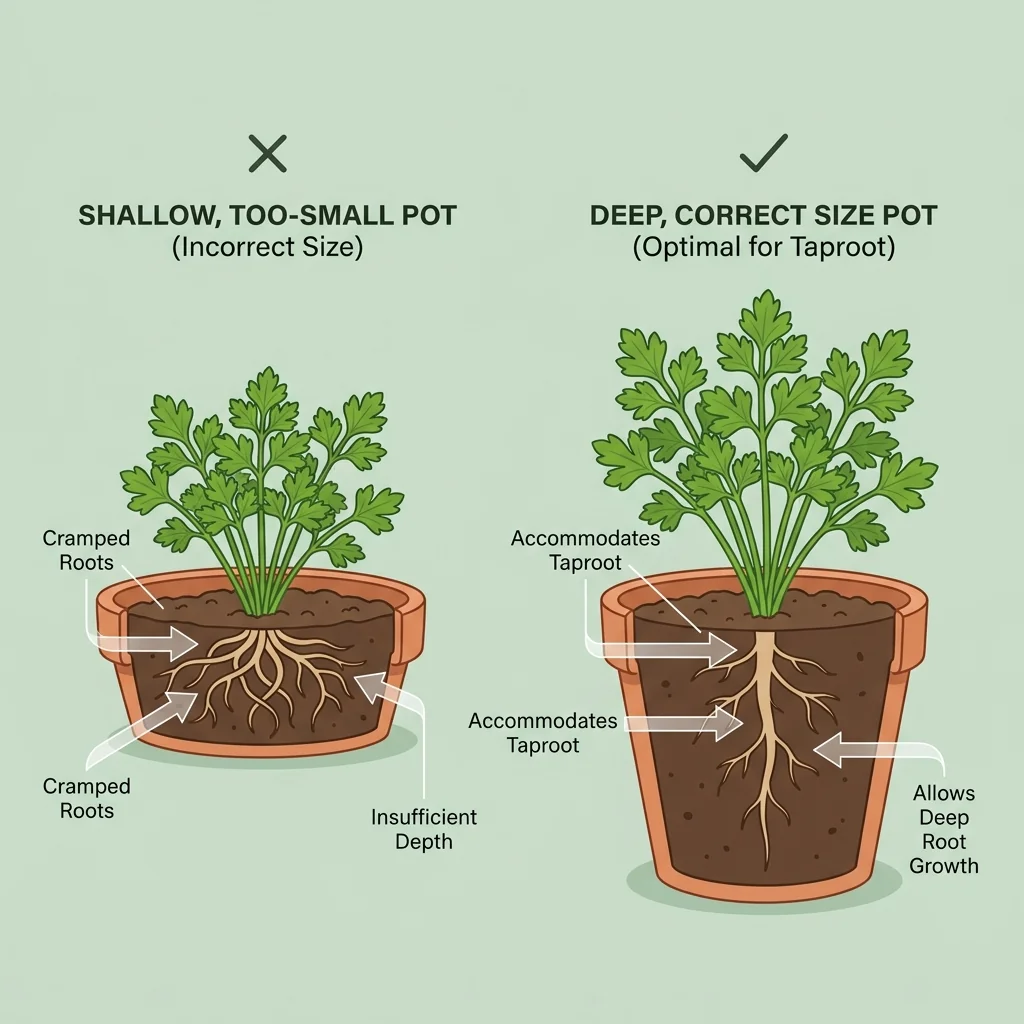
What size pot does parsley need? Depth and diameter guide
Parsley has a deeper taproot than most kitchen herbs, so pot depth matters more than width. This guide gives the exact size range, spacing, and drainage to get it right.