Troubleshoot the system before you change the inputs.
Symptoms
- New spring leaves on a peach or nectarine are thickened, puckered and reddish, then turn yellowish and grey-white with a velvety bloom.
- The distortion appears within a couple of weeks of the leaves coming out of the buds, not later in summer.
- Young shoots may be thickened and stunted, and affected leaves drop in spring.
Possible causes
- The fungus Taphrina deformans, which survives on the bark and buds and infects leaves as they open in cool, wet weather.
- Aphid feeding, which can also curl leaves, but with live insects on the growing tip and without the red, blistered thickening.
- A dry root zone, which makes leaves droop and curl without thickening or colour change.
Quick fixes
- Do not spray the tree in spring. Leave the leaves on until they drop, and expect a replacement flush.
- Keep new growth dry: move the pot under cover and water the soil, not the foliage.
- Mark your calendar for the dormant season, and read the label of any fungicide legal for fruit in your country before you buy it.
Peach leaf curl compared with other causes of curled leaves
| Clue | Peach leaf curl | Aphids | Dry root zone |
|---|---|---|---|
| Leaf texture | Thick, blistered, puckered | Curled or twisted, not blistered | Thin and limp |
| Colour | Red or pink, then grey-white bloom | Green, sometimes sticky | Wilted; lower leaves may yellow |
| Where to look | Whole new flush, in spring | Growing tips and undersides | Whole plant, with dry mix |
| Fix | Dormant-season prevention | Remove or treat the insects | Water the pot properly |
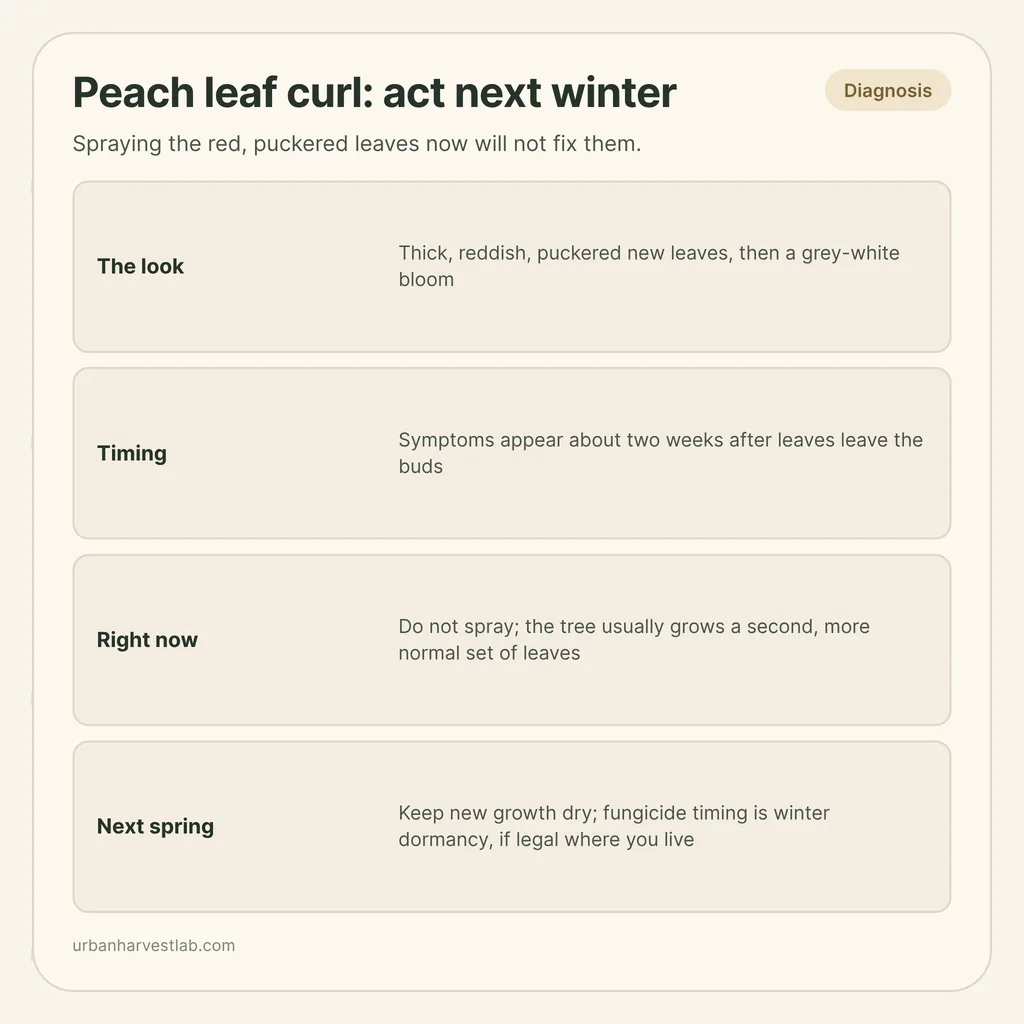
Thick, red, puckered leaves on a peach or nectarine in spring are almost certainly peach leaf curl, a fungal disease. The infection happened as the buds opened, so spraying the curled leaves will not undo it. What you can do now is look after the tree, and what you can do before next spring is keep the buds from getting wet, or treat the tree while it is dormant if your local rules allow it.
If the curl is on a tomato, see tomato leaves curling; on a pepper, pepper leaves curling. This disease belongs to peach, nectarine, almond and a few relatives.
How to tell it is peach leaf curl
UC IPM describes the first sign as reddish areas on developing leaves in spring. They thicken and pucker, and the leaf curls and distorts. The thick patches then turn yellowish, then grey-white as velvety spores form on the surface. The RHS lists the same picture: crumpled, thickened leaves, often red, with a white bloom of spores.
Timing is a good clue. UC IPM says leaf symptoms appear about two weeks after the leaves emerge from the buds. A peach whose leaves were fine in May and then curled in July has another problem.
The disease is caused by the fungus Taphrina deformans. It affects peach and nectarine, and the RHS adds almond and, occasionally, apricot. Young green shoots can be infected too: UC IPM says affected shoots become thickened, stunted and distorted and often die. Fruit symptoms are rare, and when they appear they are reddish, wrinkled areas that later turn corky and crack.
| Check | What it tells you |
|---|---|
| Is it a peach, nectarine, almond or apricot? | If not, this is a different problem |
| Are the leaves thick and blistered, not just rolled? | Points to the fungus |
| Did it start as the leaves unfolded? | Fits the infection window |
| Are there live insects on the shoot tips? | Look at aphids as well, or instead |
What to do this spring
Leave the spray alone. UC IPM says treating after symptoms appear won’t be effective, and that fungicides applied during the growing season won’t be effective and may harm foliage.
Then expect recovery. UC IPM says affected leaves are replaced by a second set that develops more normally unless wet weather continues, and the RHS says the second flush is not reinfected. UC IPM puts the end of the disease at dry, warmer weather of 79 to 87°F.
A few practical points:
- Pick off leaves early, if you want to. The RHS says prompt removal of infected leaves before the white bloom appears helps reduce the fungus carried over to the next year. UC IPM says removing diseased leaves or pruning infected shoots has not been shown to improve control. The two sources disagree, so treat it as optional housekeeping, not a cure.
- Protect bare branches. UC IPM warns that defoliation in spring may expose branches to sunburn.
- Thin the fruit if the tree is badly hit. UC IPM says a severely affected tree can be stunted and suggests thinning fruit later in the season.
- Water the soil, not the leaves. UC IPM says the spores move by splashing water from rain or irrigation.
Why spring weather decides it
The fungus survives the summer on the tree’s surfaces and builds up through cool, wet autumn and winter weather, according to UC IPM. Infection needs wet leaves. UC IPM gives the threshold as wetness from rain, dew or irrigation for more than 12.5 hours at temperatures below 61°F, and says periods of cool, wet weather as leaves first open favour the disease. The RHS also notes that wet conditions are needed for spring infection.
This is why the same tree can be clean one year and covered the next. It is also why a potted tree has an edge over one planted in a lawn.
Prevent it next year
Keep the new growth dry
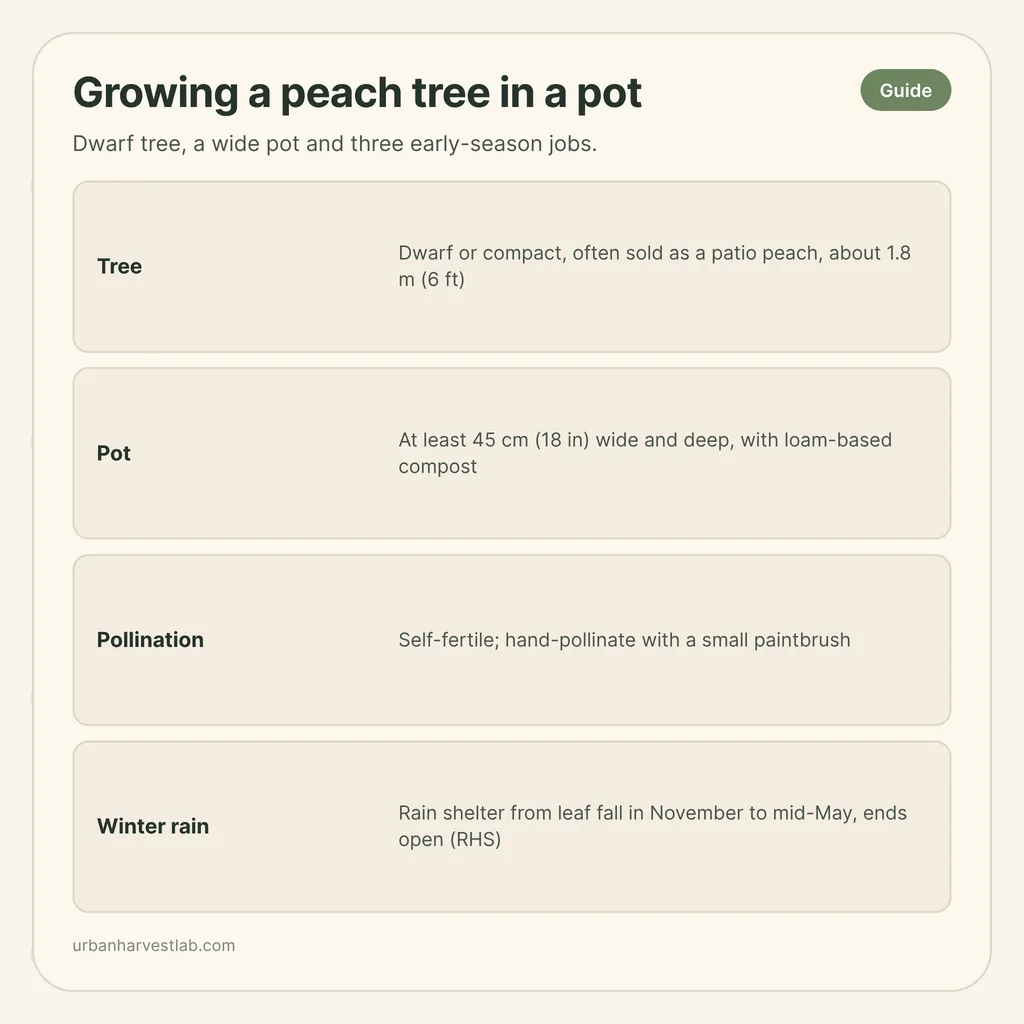
The RHS describes a plastic rain shelter as very effective at preventing infection for peaches trained against a fence or wall. It covers the top of the tree and the front to within 30 cm (1 ft) of the ground, with the ends open so pollinating insects can reach the flowers. It goes up after leaf fall in November and stays until mid-May. The RHS adds that keeping emerging shoots dry also gives useful frost protection.
On a balcony or patio you can do the same job with the pot itself. Stand the tree under a roof or deep overhang through the same months, with open sides for air and pollinators. How a peach is overwintered in a pot, including cold protection for the roots, is covered in overwintering perennials in pots. Choosing the tree in the first place is covered in growing a peach tree in a pot.
Consider resistant varieties
UC IPM lists Frost, Indian Free, Muir and Q-1-8 among resistant varieties, adds that Redhaven and most cultivars derived from it are tolerant, and says Frost must still receive fungicide in its first two to three years. The RHS names Avalon Pride, Red Haven, Harken, Dixired, Redwing, Advance, Hylands, Robin Red Breast and Rochester as having some claimed resistance. Availability depends on your country, so check what a nursery near you stocks.
If you use a fungicide, let the label lead
Fungicide rules differ by country, and so do the products. The RHS says no fungicides are available to amateur gardeners for peach leaf curl in the UK. UC IPM names copper-based products and chlorothalonil as the backyard options in California, and says to treat susceptible trees every year after leaves fall but before new buds develop in spring. That is a dormant-season window, not a spring one.
Rates, mixing, wetting the branches, protective gear and whether the product is allowed on a tree that bears food are all on the label, and UC IPM says to read and follow it. UC IPM also warns that repeated copper use can build up in the soil and put waterways at risk, which matters if your pot drains onto a balcony, yard or street. The general ladder for edible plants is in choosing a pest treatment for plants you are going to eat.
When to worry
One bad spring costs you some leaves and growth. UC IPM says a tree that is left uncontrolled while infection builds up for several years may decline and need to be removed. If the same tree curls two springs running, change something before the third: cover, variety or a label-compliant dormant treatment.
If the leaves are curled but not red and thick, compare them with curling tomato leaves or curling herb leaves to see whether you have a different cause.
Sources
Related fruit-tree and leaf problems
Curled leaves have many causes. These pages cover growing a peach in a container, winter care, and how to choose a treatment for plants you eat.
Common questions
Will my peach tree die from leaf curl?
One bad spring usually does not kill the tree. UC IPM says the tree grows a second set of more normal leaves, but that if infection builds up and is left uncontrolled for several years, the tree may decline and need to be removed.
Can I spray something now to cure the curled leaves?
UC IPM says treating after symptoms appear will not be effective, and that fungicides applied during the growing season will not work and may harm the foliage. The useful sprays, where they are permitted, belong to the dormant season. Read the product label first.
Is it safe to eat fruit from a tree with leaf curl?
The disease is a plant fungus. UC IPM describes fruit symptoms as rare: reddish, wrinkled areas that later turn corky and crack. Whether fruit is safe after any spray depends on that product label and its stated waiting period, so check it before you pick.
Do I need a rain cover for a potted peach?
The RHS describes a plastic rain shelter as very effective for peaches grown against a wall, kept on from leaf fall until mid-May. A pot has an advantage: you can move the whole tree under a roof or overhang during the same months.
Related guides

Tomato leaves curling: heat, water swings, herbicide, pests, or virus
Most curling tomato leaves are a harmless response to heat or uneven watering. Twisted new growth, bronzing, or stunting points elsewhere.
Choosing a pest treatment for plants you are going to eat
Once you know which pest you have, the next question is what you can treat it with without compromising the food. The answer is a ladder of methods, and the label on any product you buy sets the legal limits of the top rung.
Growing a peach tree in a pot: dwarf trees, hand pollination and a winter roof
Peaches and nectarines suit a sunny patio or balcony when you choose a genuinely compact tree and handle three jobs: flowering-time frost, hand pollination and a rain cover in winter.