Peach or nectarine in a pot: what the RHS advises
| Question | Guidance |
|---|---|
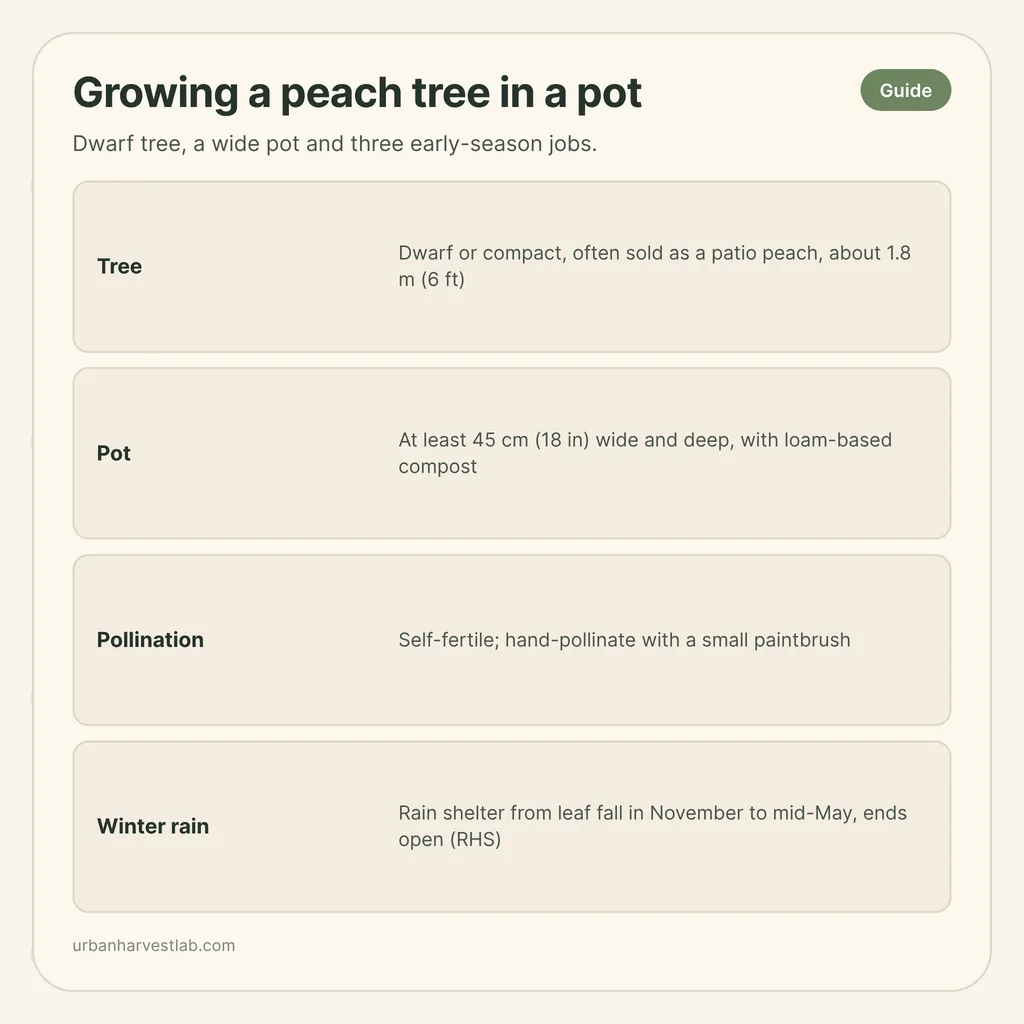
| Tree type | Dwarf or compact, often sold as a patio peach, about 1.8 m (6 ft) |
| Pot | At least 45 cm (18 in) wide and deep; 45-50 cm (18-20 in) for most container fruit |
| Compost | Good loam-based compost, or multi-purpose mixed with one-third grit or perlite |
| Pollination | Self-fertile; hand-pollinate with a small paintbrush over several dry, sunny days |
| Frost at flowering | Fleece overnight, or move the pot into a greenhouse, porch or other frost-free spot |
| Winter rain | Rain shelter from leaf fall in November to mid-May, ends open |
| Thinning | Fruitlets about 20 cm (8 in) apart, at hazelnut to walnut size |
| Repotting | Every year or alternate years after leaf fall |
A peach or nectarine will crop in a pot if the tree is a dwarf or compact type, the pot is at least 45 cm (18 in) wide and deep, and you handle three early-season jobs: shelter the blossom from frost, hand-pollinate it, and keep winter and spring rain off the buds. Most of that advice comes from the Royal Horticultural Society, which writes for a cool, wet climate. The same logic holds anywhere that has a late frost in flowering time or a wet spring.
Peaches and nectarines are the same species, and the RHS treats their care as near-identical. Other tree fruit in pots has different rules: a columnar apple usually needs a second variety flowering at the same time, and a fig in a container sets fruit without pollination.
Buy a dwarf tree, not a small one
A young peach in a nursery pot looks small whatever it will become. What matters is how it is bred and grafted. The RHS says peaches bred for container growing are often sold as “patio peaches”, reaching only about 1.8 m (6 ft) tall and needing little pruning. For nectarines it likewise says compact varieties are bred specifically for pots.
Read the tag or catalogue entry for the words “dwarf”, “compact” or “patio”, and ask the seller if it says nothing. The RHS says that if you want a peach in a container, you should choose a dwarf variety.
Grafted trees add a second control. The RHS says the rootstock helps control vigour and makes a fruit tree more suitable for a container, and for peach and nectarine it lists Pixy or St Julien A for trees sold in the UK. Nurseries elsewhere may use other rootstocks, so ask whether the tree is on a dwarfing one.
Pot, compost and position
The RHS says containers for peaches should be at least 45 cm (18 in) wide and deep, filled with a good quality loam-based compost. Its general fruit-in-pots advice is 45-50 cm (18-20 in) across for most fruit. If you mix your own, the RHS suggests multi-purpose compost with one-third by volume grit or perlite. Clay pots are heavy and stable, it says, while plastic is lighter and easier to move. If you are buying one, check the listed width and depth against the 45 cm (18 in) minimum (browse 18-inch planters on Amazon). A tree you plan to carry under cover each winter is easier in plastic, and a full pot of wet compost adds real weight, so check it against your balcony weight limit. Roots in a pot are more exposed to winter cold than roots in the ground; how to judge and protect them is in overwintering perennials in pots.
Put the pot somewhere sunny and sheltered. The RHS names a patio or courtyard as often ideal, and says peaches need a warm, sheltered location with plenty of sun to ripen fruit well. If your balcony is exposed to wind, see windproofing a balcony garden.
Drainage matters more than people expect. The RHS warns that roots rot in cold, soggy compost, especially in winter, so check that water keeps draining freely as the tree grows.
Pollination: self-fertile, but still give it a hand
You need one tree. The RHS says all peach varieties are self-fertile, and all nectarines too. The catch is timing. Peaches flower early in the year, usually early spring but sometimes as early as February, when few pollinating insects are around.
So the RHS suggests hand-pollinating. Over several dry, sunny days, dab a small paintbrush gently into the centre of every flower in turn. If the tree is in a greenhouse, the RHS says to do this every time. A pot that you have carried under cover to protect the flowers has the same problem, because no insects can reach it.
Frost at flowering: the advantage of a pot
Frost is the other threat in that early-flowering window. The RHS says peach blossom is susceptible to frost damage, which can reduce the crop. If frost is forecast, cover the tree overnight with fleece, burlap (hessian) or an old bedsheet supported on canes so it does not touch the flowers, and uncover it by day to let in light and insects. It says heavier fleece gives about 2°C (about 4°F) of protection, which is not much against a hard freeze.
A pot gives you a better option. The RHS says potted peaches can be moved into a greenhouse, porch or other frost-free spot during flowering, and pollinated by hand. Check the forecast for your area; frost dates for a balcony explains how to find yours.
The winter roof that stops leaf curl
Peach leaf curl is a fungal disease of peaches, nectarines and almonds. The RHS says a rain shelter of plastic sheeting is very effective at preventing it, should go up after leaf fall in November, and should stay until mid-May, with the ends open so pollinating insects can reach the flowers. Its container-fruit advice says the same in shorter form: peaches and apricots can be covered with a lean-to shelter from autumn to late winter to protect them from rain-splash.
With a pot, the cover can be a roof or overhang that you move the tree under. The RHS says wet conditions are needed for the spring infections to occur, so the roof only has to keep rain off; the pot still needs drainage. What the disease looks like and what to do after leaves have curled is in peach leaf curl.
Water, feed and thin
The RHS says trees in pots need a steady supply of moisture through the growing season, with particular importance in early to mid-summer while the fruits swell. It links uneven watering to fruit that develops poorly or drops unripe, and overwatering or wet weather during ripening to split fruit.
For feeding, the RHS says container peaches benefit from regular feeding: an organic high-potassium liquid fertiliser every two weeks during the growing season, or an organic granular general-purpose fertiliser sprinkled onto the compost.
Thin the fruitlets. The RHS says to remove some young peaches so the rest sit about 20 cm (8 in) apart, when they are between hazelnut and walnut size. Snip them off, starting with awkwardly placed, distorted or noticeably small ones. If they are bunched together, it says you can cut selected fruitlets in half with pruners (secateurs) so they drop without damaging the shoot.
Harvest, birds, pruning and repotting
Peaches are ready, the RHS says, once they are fully coloured and the flesh near the stalk feels soft. Cup the fruit in your palm and lift gently; ripe fruit comes away easily. Ripening is staggered, so check regularly. Before the fruit colours, birds and squirrels may take it; the RHS suggests sleeves or taut, secure netting, or moving potted trees into a greenhouse or other enclosed space.
Prune lightly. The RHS says some naturally compact varieties need little or no pruning, and that peach trees should only be pruned in spring or summer to reduce the risk of silver leaf and bacterial canker. Prune on a dry day.
To keep roots from binding, the RHS says to repot every year or alternate years after leaf fall. Once the tree is in its final pot, it can be root-pruned every other year with 30 per cent of the compost refreshed, and the top layer replaced in the years between.
Sources
More fruit trees for pots
Other tree fruit for containers, the winter plan for potted perennials, and the leaf disease that peaches and nectarines catch.
Common questions
Can you grow a peach tree in a pot?
Yes. The RHS says compact peach varieties grow and crop well in containers if the pot is at least 45 cm (18 in) wide and deep, filled with a good loam-based compost, and stands somewhere sunny and sheltered such as a patio or courtyard. Water steadily and feed regularly.
Do I need two peach trees to get fruit?
No. The RHS says all peach varieties are self-fertile, so you only need one tree for a good crop, and the same for nectarines. Because the flowers open when few insects are flying, it recommends hand-pollinating with a small paintbrush over several dry, sunny days.
How big does a potted peach tree get?
The RHS says varieties bred for container growing, often sold as patio peaches, reach only about 1.8 m (6 ft) tall and need little pruning. A tree that is not sold as dwarf or compact is not suited to a pot.
How do I stop peach leaf curl on a potted tree?
The RHS says a plastic rain shelter is very effective at preventing infection and should stay up from leaf fall in November until mid-May, with the ends open for pollinating insects. For trees in pots it also says you can move them to keep them out of the rain.
Related guides
Columnar apple trees in pots: pollination, thinning and pruning
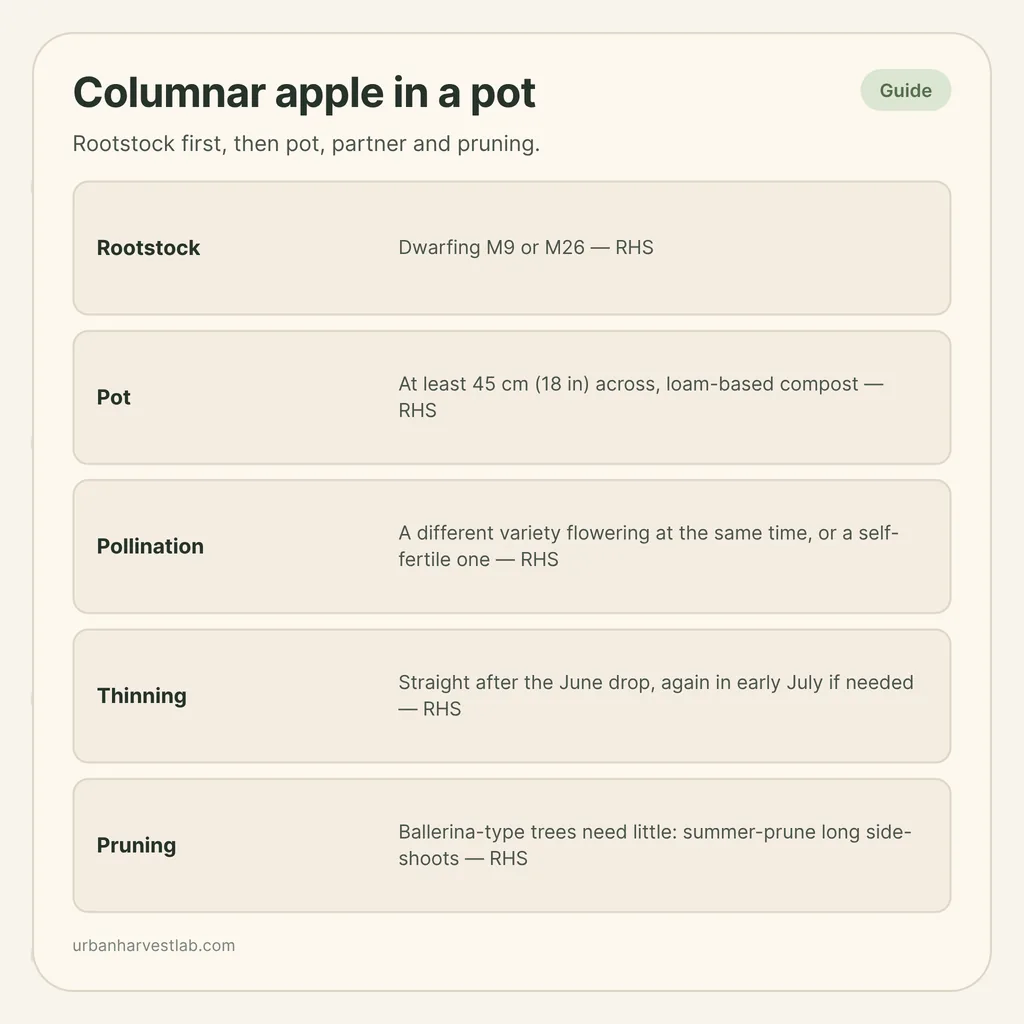
A columnar apple suits a pot if the rootstock is dwarfing, the pot is wide and a second tree flowers at the same time. Here is how to pollinate, thin and prune it.

How to grow a fig tree in a pot: size, pruning and winter
A fig in a container needs a big pot, strong sun, regular water and a dormant winter in an unheated, frost-free spot. Here is how to size, prune and overwinter it.
Overwintering perennials in pots: the two-zone rule for herbs and fruit
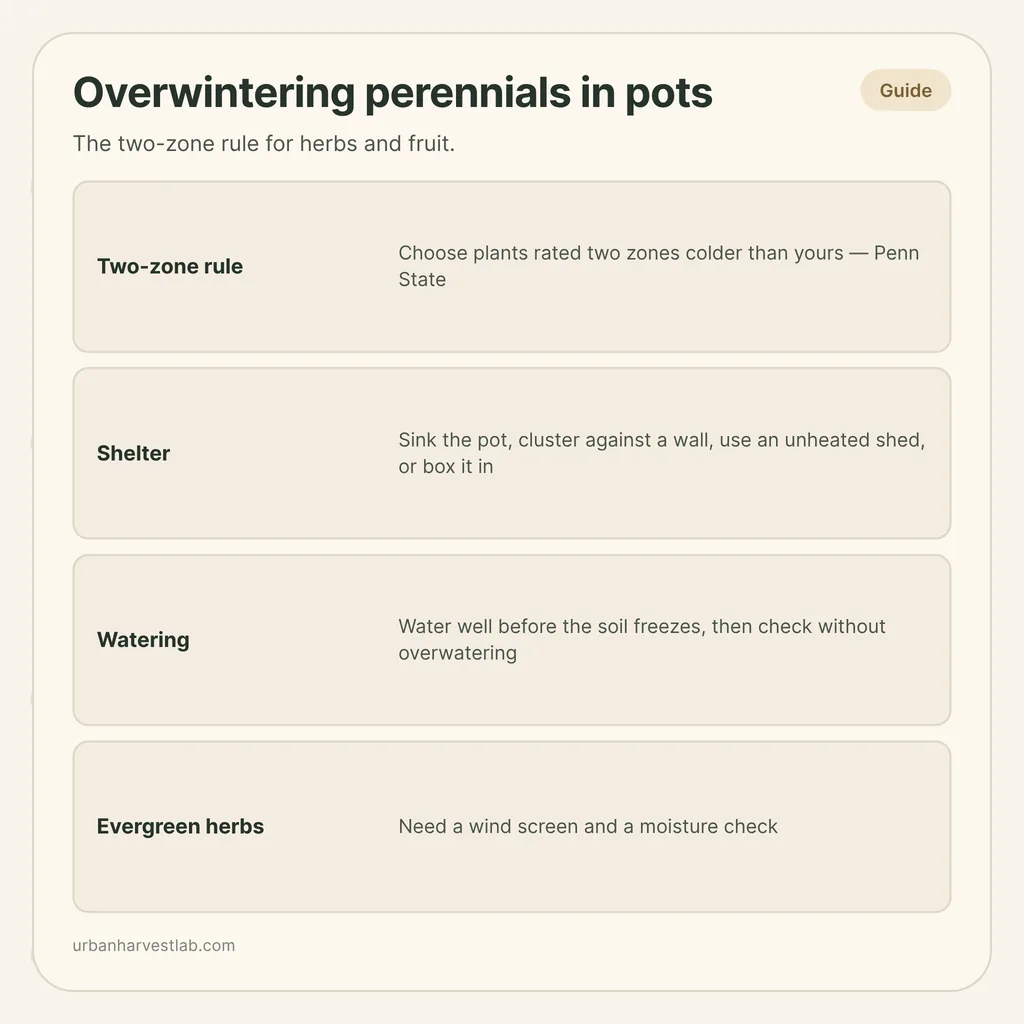
The hardiness zone on a plant tag assumes the roots are in the ground. In a pot they are not, so the rule, the shelter and the winter watering all change.