Troubleshoot the system before you change the inputs.
Symptoms
- Seedlings alive and green but the same size for a week or more
- No new leaves forming after the first true pair
- A tray past week 6 that has stopped gaining size
- Mix that stays dark and wet, or a lamp far above the tray
Possible causes
- Fertilizer in the mix used up
- Mix saturated, roots short of oxygen, or fungus gnat larvae feeding on roots
- Roots filled the cell and the seedling is overdue for a bigger pot
- Light too weak or too short in duration
Quick fixes
- Water only when the top of the mix is nearly dry
- Feed with a dilute water-soluble fertilizer if the tray is past 6 weeks and the roots are healthy
- Pot up into a larger container
- Lower the lamp to 2 to 6 inches and run it 14 to 16 hours
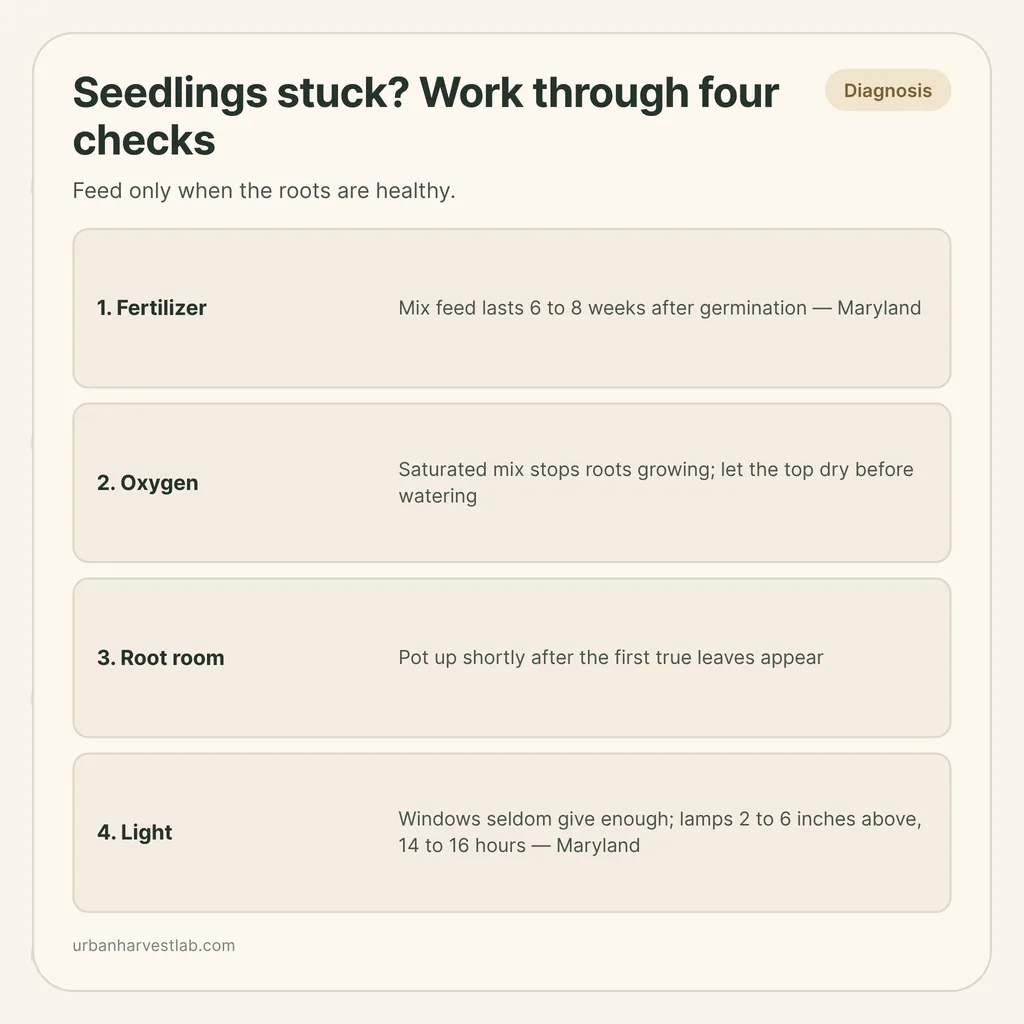
Seedlings that sit still after their first true leaves are usually short of one of four things: fertilizer, oxygen at the roots, room for the roots, or light. Work through them in that order, and feed only when the roots are healthy, because feeding a waterlogged tray makes things worse.
Three look-alikes belong to other pages. Tall, thin, floppy seedlings are leggy. Purple stems and leaf undersides are a separate cold-root question. Seedlings that collapse at the soil line are damping-off, not stunting. Here the plants are alive, upright and green, and simply not getting bigger.
First, rule out “slow on purpose”
Seedlings are meant to grow more slowly once they are up. Iowa State Extension says the best growing temperature after germination is about 10°F cooler than the best germination temperature. University of Maryland Extension gives 55 to 60°F at night and 65 to 70°F by day for seedlings that have germinated. A tray in a cool room will move slowly without anything being wrong.
Count the weeks since sowing as well. University of Maryland Extension’s indoor growing times differ widely by crop: it lists 5 to 6 weeks for tomato and 8 to 10 for pepper, eggplant and onion. A pepper that looks small at week 4 may simply be early.
Check 1: has the fertilizer run out?
Seed-starting mixes are not built to feed for long. University of Maryland Extension says soilless growing media “often contains a small amount of fertilizer, enough to support plants for 6 to 8 weeks after germination.” In another passage the same service says most potting mixes can grow a seedling for at least 6 weeks without more nutrients.
So a seedling that stalls in week 2 or 3 is unlikely to be hungry, while one that stalls in week 6 or later quite possibly is. The difference between seed-starting and potting mix is covered on its own page.
When the tray is past that point and the roots look healthy, feed lightly:
- Iowa State Extension advises regular feeding with a dilute (1/4-strength) water-soluble fertilizer, and says it produces stockier transplants provided enough light is available.
- For mixes without slow-release fertilizer, Iowa State says a dilute solution once every two weeks should be sufficient.
- Maryland points to the label dose for indoor plants or transplants, and warns that young seedlings are easily damaged by too much fertilizer, especially if their roots are drying out.
Feeding does nothing for a seedling whose roots are failing. Check water next.
Check 2: are the roots getting air?
Overwatering is the commonest quiet cause. Maryland says common seedling problems are related to root moisture, and that roots stop growing and die from lack of oxygen when the media is saturated. Illinois Extension describes the trap: waterlogged mix causes root dieback, the plants wilt, and “many people” respond by watering more. The same page points out that small seedlings have small root systems and don’t take up much water.
Maryland’s rule is to wait until the top of the media is nearly dry before watering, and Illinois says to keep it moist but not wet.
Two signs point to a mix that is too wet:
- Illinois Extension lists fungus gnats and algae on the surface as signs the growing media is too wet.
- UC IPM adds that fungus gnat larvae, when numerous, “can damage roots and stunt plant growth, particularly in seedlings and young plants,” and advises letting the surface of container soil dry between waterings.
If you see gnats, drying the surface is the first move, and the fungus gnat guide covers the rest.
Check 3: is the cell too small?
Maryland names leaving seedlings in the flat too long as one of the most common seedling mistakes, and recommends potting up shortly after the first true leaves appear. Iowa State likewise says to move seedlings to cell packs at the first true leaves or once they can be handled. A seedling kept past that point in a tiny cell has little left to grow into.
Maryland also gives per-cell volumes:
| Crop group | Cell size per plant |
|---|---|
| Lettuce, beets, spinach, kale and other greens | 3 to 6 square inches |
| Squash, cucumber, broccoli, cabbage | 4 to 9 square inches |
| Tomato, eggplant, pepper | 9 to 16 square inches |
Sowing too early adds to the squeeze: Maryland describes the result as tall, root-bound plants that perform poorly in the garden.
To check, tip one seedling out. If you see roots wound around the outside of the mix, pot it up; when and how to pot up seedlings has the depth and technique.
Check 4: is the light enough?
Maryland says natural light from a window is seldom enough for strong seedling growth, and Illinois Extension makes the same point for its own region, noting that windowsills often fail on both duration and intensity. Under a lamp the figures vary by source:
- Maryland: fixtures 2 to 6 inches above the plants, lit 14 to 16 hours a day on a timer.
- Iowa State: 12 to 16 hours of light a day, with the light source 4 to 6 inches above the plants.
Maryland specifies an outlet timer for the hours. Raise it as the plants grow. If you are choosing a lamp, you can browse LED grow lights on Amazon and check the fixture’s own instructions for height.
Quick reference
| What you see | Most likely cause | First move |
|---|---|---|
| Stalled tray past week 6, roots healthy | Mix fertilizer used up | Dilute feed per label |
| Dark, heavy, wet mix; wilting; gnats | Roots short of oxygen | Let the top dry before watering |
| Roots wound around the cell | Cell too small | Pot up |
| Seedlings on a sill or far below a lamp | Weak light | Add or lower a lamp, 14 to 16 hours |
If all four checks come back clean, the plant may be one of the slow ones, or the problem is wider than seedlings; a potted plant that is not growing starts from the roots and container.
Sources
Raising sturdy seedlings
The neighbouring problems and the fixes that go with them.
Common questions
Why have my seedlings stopped growing after the true leaves came?
Four causes cover most trays. The mix has run out of fertilizer (University of Maryland Extension puts the supply in many mixes at 6 to 8 weeks after germination), the mix is too wet for the roots to breathe, the roots have no room left in the cell, or the light is too weak. Check them in that order.
How much should I feed a stalled seedling?
Iowa State Extension gives a dilute, 1/4-strength water-soluble fertilizer, and every two weeks for mixes without slow-release fertilizer. Maryland says to follow the label dose for indoor plants or transplants, and warns that young seedlings are easily damaged by too much, especially with drying roots.
Can overwatering stop seedling growth without killing them?
Yes. University of Maryland Extension says roots stop growing and die when the media is saturated, and Illinois Extension notes that the resulting wilt leads many people to water more. Let the top of the mix get nearly dry before the next watering.
How big should the cells be for tomato and pepper seedlings?
University of Maryland Extension recommends 9 to 16 square inches per cell for tomato, eggplant and pepper, 4 to 9 for squash, cucumber, broccoli and cabbage, and 3 to 6 for lettuce, beets, spinach and kale. A seedling that has outgrown its cell needs a bigger pot.
Related guides

Seedlings turning purple: cold roots, phosphorus, and when it is normal
Purple stems and leaf undersides on seedlings are a stress response, and cold roots are one of the commonest triggers. Often it is a short-lived stress rather than a mix that needs fertilizer. A few checks separate the harmless cases from the ones that need action.

Why are my seedlings leggy? Light, heat, crowding, and what to save
A tall, thin, floppy seedling is telling you it is short of light, too warm, crowded, or started too early. Find which, fix the setup, and bury the stems that can take it.
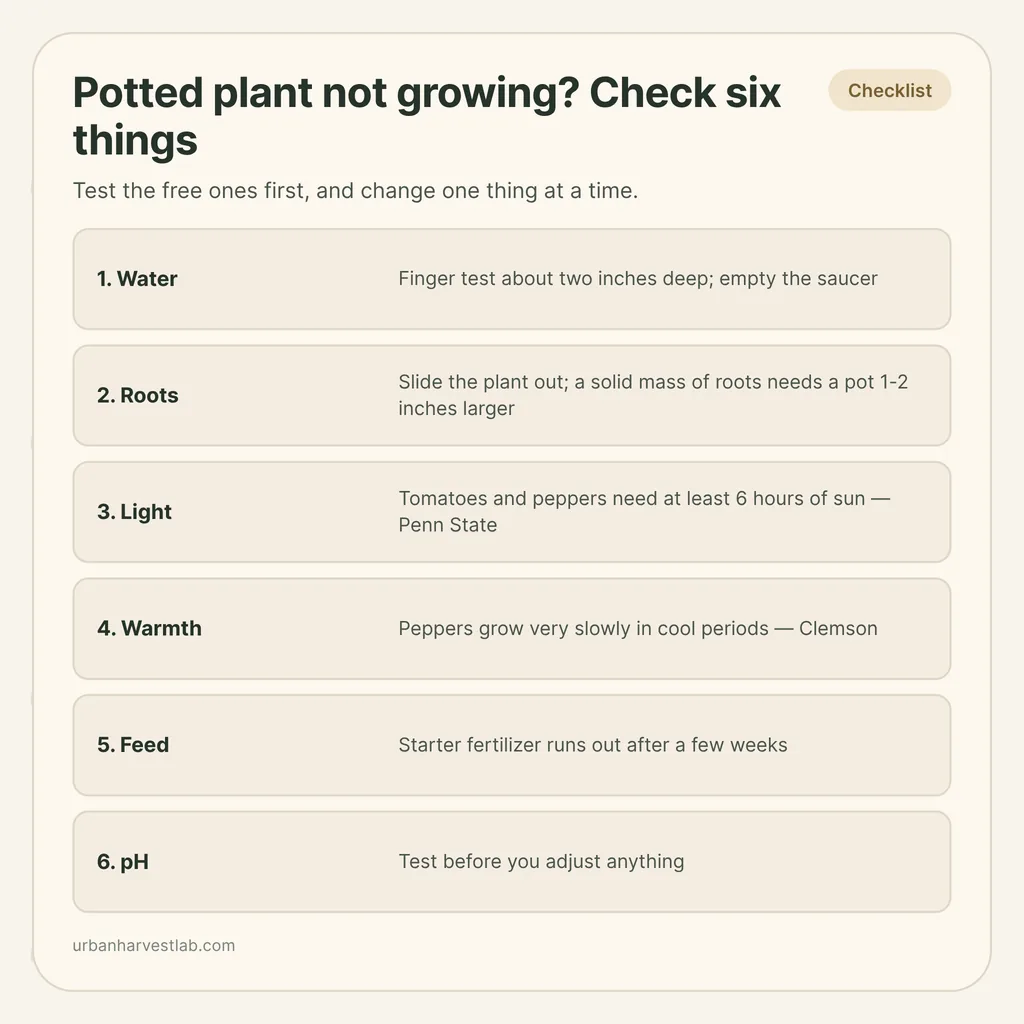
Why is my potted plant not growing? Check these six things in order
A stalled pot rarely needs a mystery cure. Work through watering, roots, light, temperature, feeding and pH in that order, and stop at the first thing that fails.