Troubleshoot the system before you change the inputs.
Symptoms
- No new leaves or shoot growth for weeks, though the plant is not dying.
- Pale, small new leaves, or pale older leaves with sparse growth.
- Mix that dries out within a day, or water that runs straight through the pot.
- Brown leaf tips, a white crust on the soil or rim, or yellow new leaves with green veins.
Possible causes
- Watering that is too frequent or too sparse, or a shrunken mix with a gap at the pot wall.
- Roots that have filled the pot.
- Too little sun for the crop, or cool weather for a warm-season plant.
- Starter fertilizer used up, or soluble salts built up from feeding and tap water.
- Mix pH outside the range the crop needs.
Quick fixes
- Test the mix with a finger two inches deep, then water until it drains and empty the saucer.
- Slide the plant out and look at the roots before changing anything else.
- Move the pot to more sun, or out of cold air, and judge by new growth.
- Feed at the label rate if the roots are healthy; leach the pot if there is a salt crust.
- Test the pH of the mix before adding any lime, sulfur or iron product.
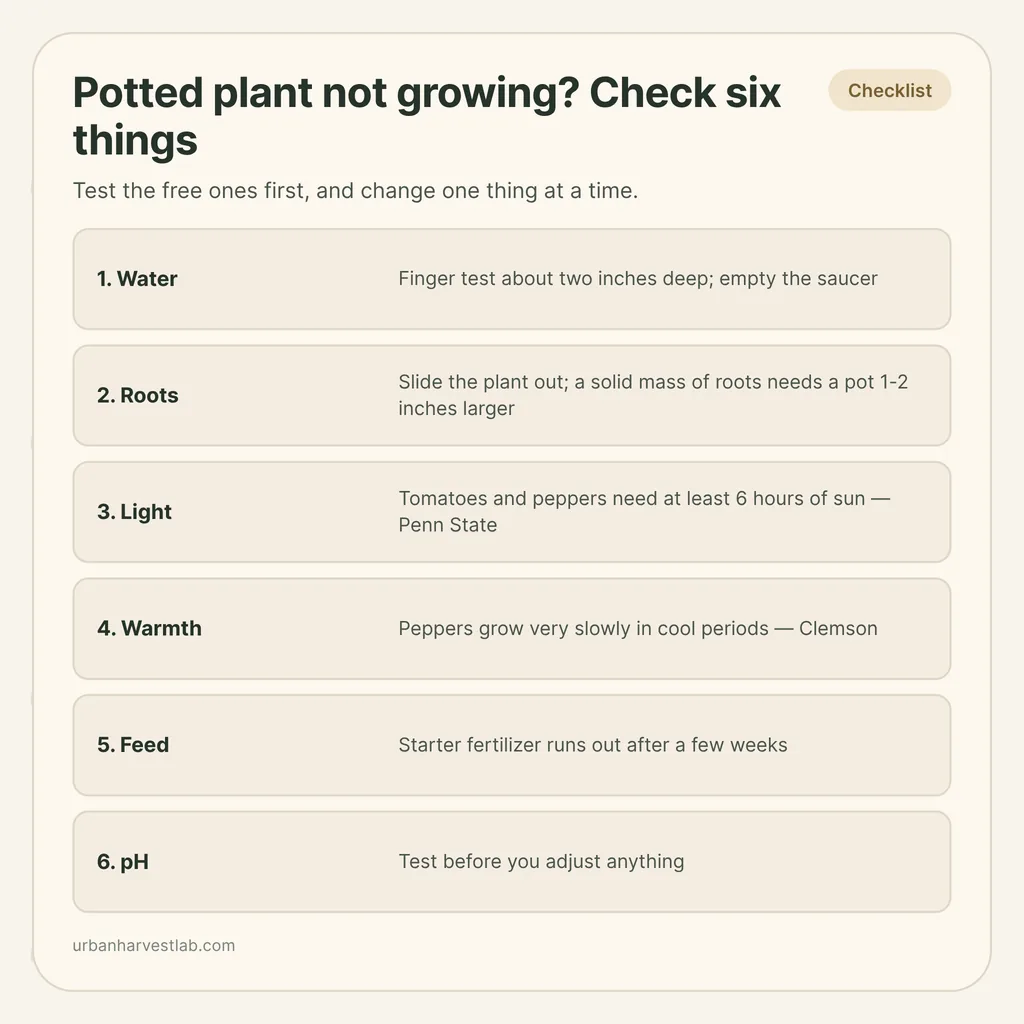
Six checks for a stalled pot, in the order to run them
| Check | What to look for | Next step |
|---|---|---|
| 1. Watering | Mix bone dry two inches down, or soggy with water in the saucer | Water until it drains; empty the saucer; check for a gap at the pot wall |
| 2. Roots | Solid mass of roots, or roots at the drainage hole | Repot into a pot 1 or 2 inches wider |
| 3. Light | Fewer hours of direct sun than the crop needs | Move the pot or change the crop |
| 4. Temperature | Cool air or a cold windowsill for a warm-season crop | Move it somewhere warmer |
| 5. Feeding | Pale older leaves with sparse growth, or a white crust | Feed at label rate, or leach the salts |
| 6. pH | Yellow new leaves with green veins, with roots and feeding ruled out | Test the mix before adjusting |
A potted plant that has stopped growing is almost always short of one of six things: a steady water balance, root room, light, warmth, feed, or the right mix pH. Check them in that order, because the first three cost nothing to test and cause most stalls.
Do not reach for fertilizer first. Stunted roots and salt buildup both look like hunger, and feeding either one makes it worse. For a more specific plant, parsley growing slowly and stunted seedlings have their own pages. For yellowing alone, start with the yellow leaves cause finder.
1. Watering: the cheapest test and the likeliest cause
University of Maryland Extension puts it bluntly: improper watering, too much and too little, “tends to be the most limiting factor in container gardening success and the number one reason for failure.”
Push a finger into the mix. University of Maryland Extension’s houseplant guidance uses a depth of about two inches. Dry there means water; wet means wait. Then check three things:
- Gap at the pot wall. If a container goes too long without water, the mix can shrink and leave a gap between the soil and the edge of the container, the university explains, and water then flows through the gap and leaves the soil dry. A pot that drains instantly may be doing exactly this.
- Soggy mix. Too much water, too often, with poor drainage is the leading cause of overwatering, and it can lead to root rot. Empty the saucer after watering.
- Standing water in the saucer. Colorado State University Extension notes that saucers holding drainage water stop salts draining out of the pot, because the water is re-absorbed.
If the plant wilts in the afternoon but recovers by evening, read why plants wilt at midday before you add more water.
2. Roots: slide the plant out and look
Tip the pot and slide the plant out. Clemson Extension’s test is simple. If roots are in a solid mass around the rootball, the plant needs repotting. So does a plant whose roots are growing out of the drainage hole, or one that needs frequent watering or wilts shortly after watering.
The same University of Maryland Extension guide adds a clue from the finger test. If your finger cannot penetrate two inches deep, the mix may be too dense, or the plant may be root bound.
UC IPM explains why this matters for the rest of this list: insufficient soil volume inhibits a plant’s nutrient uptake, so a plant squeezed into too small a pot can struggle to take up nutrients. The signs in detail are in signs your potted herb is root bound.
To fix it, Clemson Extension says to choose a pot 1 or 2 inches larger in diameter than the current one, and to loosen a tight rootball with a knife if it will not loosen by hand. Pot up only while the plant is actively growing in spring and summer, since Clemson advises not to repot ailing or dormant plants or those beginning to flower. If you need a new pot, browse pots with drainage holes on Amazon. Penn State Extension gives crop sizes: a single tomato needs a pot at least 20 inches wide, while peppers and eggplants can thrive in a 14-inch pot.
3. Light: count the hours
Penn State Extension says tomatoes and peppers need at least 6 hours of sun per day, while lettuces and kale prefer some shade. Watch the pot through a day and count hours of direct sun, not bright shade. A fruiting crop on a balcony that gets three hours has a light problem no feeding will fix. Move the pot, or switch to a leafy crop that tolerates less sun.
4. Temperature: cool weather stalls warm-season crops
Clemson Extension describes eggplant as a warm-season vegetable that grows best between 70 and 85 °F and grows slowly during cool periods. Peppers grow best at 70 to 85 °F by day and 60 to 70 °F at night, and grow very slowly during cool periods.
A pepper that has sat unchanged through a cold spring may simply be waiting. Move it out of cold drafts and off a cold sill, and judge the result by new growth after a stretch of warmer days.
5. Feeding: starter fertilizer runs out, and too much hurts
Potting mix with fertilizer already blended in gives plants enough for a few weeks, according to University of Maryland Extension, after which more is needed. Illinois Extension points to the reason: frequent watering of containers leaches nutrients. Penn State Extension’s routine is a slow-release fertilizer at planting, then a soluble fertilizer every two to four weeks.
Lack of nitrogen has a recognisable pattern. UC IPM says older leaves turn uniformly pale green to yellowish, and new growth is sparse and undersized. If that is what you see and the roots are healthy, feed at the label rate.
The opposite problem is salt. University of Maryland Extension lists reduced growth, brown leaf tips, dropped lower leaves, dead root tips and wilting as symptoms of soluble salt buildup, often with a crust on the soil or pot rim. Their remedy is to pour at least twice the pot’s volume of water through the mix and let it drain completely, after removing any crust, and to do it before you fertilize. More on this is in salt buildup in herb pots and in refreshing old potting soil. For a feeding routine, see the container vegetable fertilizer schedule.
6. pH: the last check, and only with a test
UC IPM says high pH causes interveinal chlorosis, pale mottling and blotchy or marginal death of new growth, because iron, manganese and zinc become less available. It also says to test the pH of soil from the root zone. UConn Extension gives a target of 5.5 to 6.0 for soilless media and 6.0 to 6.5 for mixes that contain soil.
Do not adjust without a reading. University of Maryland Extension warns against adding lime to commercial soilless mixes because lime is already included. The testing and correcting steps are in container soil pH.
What to do after the fix
Change one thing at a time and wait for new leaves. Judge by what the plant grows next, not by the leaves it already has.
Sources
- Clemson HGIC: Indoor Plants – Transplanting & Repotting
- Clemson HGIC: Eggplant
- Clemson HGIC: Pepper
- University of Maryland Extension: Maintaining Container Grown Vegetables
- University of Maryland Extension: Watering Indoor Plants
- Penn State Extension: Container Vegetable Gardening, Four Keys to Success
- University of Illinois Extension: Fertilizing container gardens
- UC IPM: Common Nutrient Deficiency Symptoms
- UC IPM: pH Problems
- UConn Extension: Potting Media
- Colorado State University PlantTalk: Whitish Crust on Potting Mixes
Fix the cause you find
These guides cover the three most common culprits once you have found them.
Common questions
Why has my potted plant stopped growing?
The usual suspects are watering that swings too wet or too dry, roots that have filled the pot, too little sun, cool weather for a warm-season crop, a mix whose starter fertilizer has run out, and salt or pH problems in the mix. University of Maryland Extension names watering, too much and too little, as the most limiting factor in container gardening, so check it first.
Should I fertilize a plant that has stopped growing?
Not until the roots and watering check out. UC IPM notes that deficiency symptoms commonly result from anything that makes roots unhealthy, so feeding a plant with a root problem treats the wrong thing. University of Maryland Extension warns that too much fertilizer can burn the plant and build up salt in the mix. If the roots are fine and the oldest leaves are pale, feed at the label rate.
How do I know if my potted plant is root bound?
Slide the plant out of the pot. Clemson Extension says that if roots are in a solid mass around the rootball, the plant needs repotting, as it does if roots are growing out of the drainage hole or it needs frequent watering or wilts shortly after watering.
How long should I wait for growth to restart after fixing the problem?
Judge by the next flush of new leaves rather than by the leaves it already has. Change one thing at a time so you know which fix worked.
Related guides
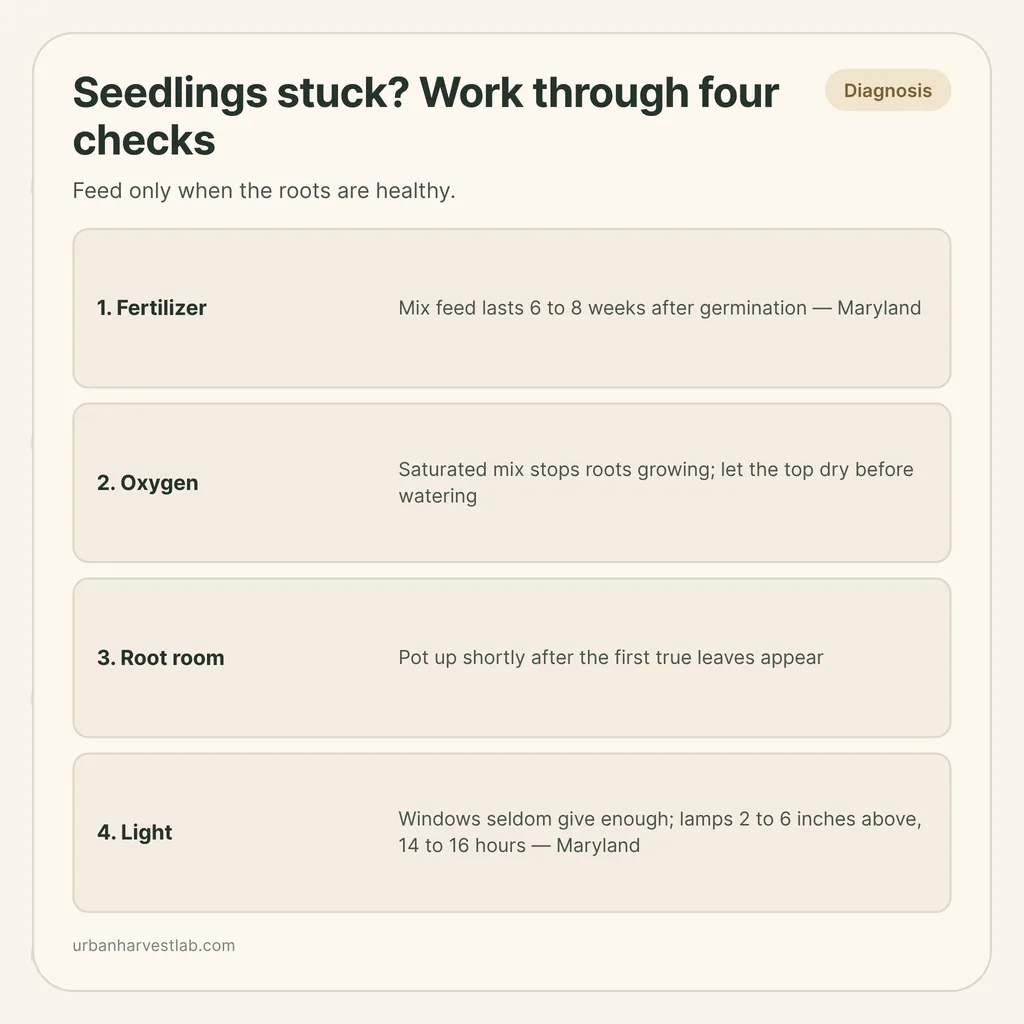
Seedlings not growing after true leaves: starved, soggy, squeezed or dim
A seedling that pushed out its first true leaves and then sat still is usually short of food, short of oxygen at the roots, short of room, or short of light. Here is how to tell which.
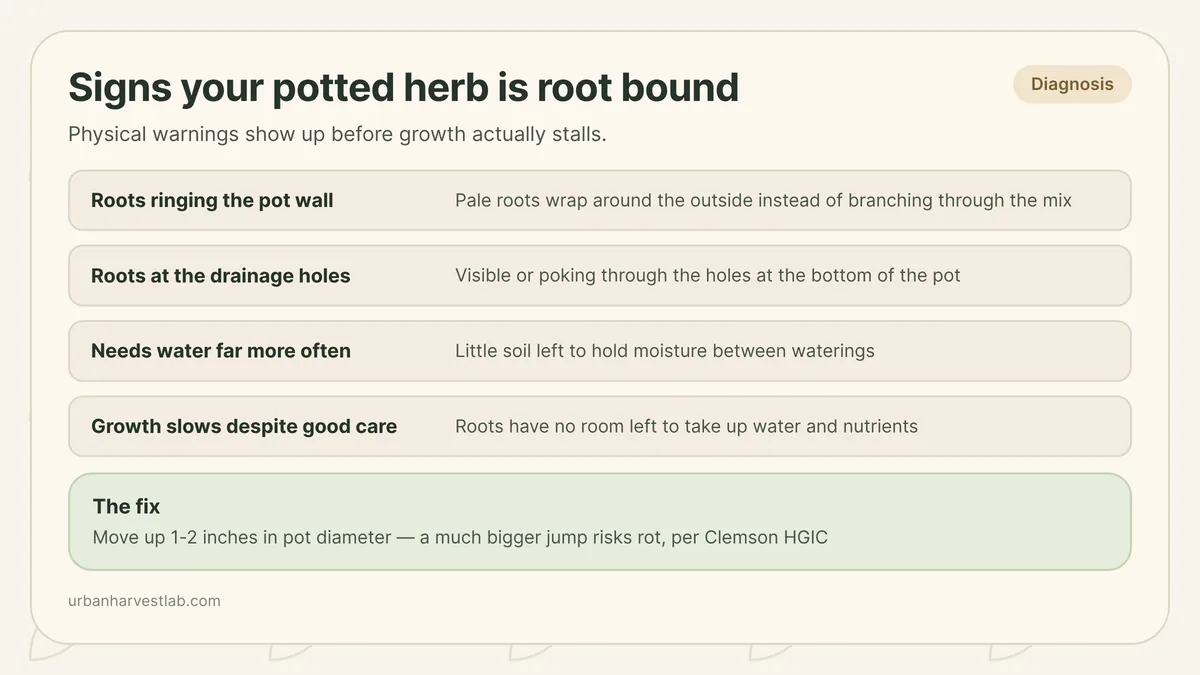
Signs your potted herb is root bound
A root bound herb gives off physical warnings before growth actually stalls. Here is what to look for, why the signs show up together, and how to repot without shocking the plant.
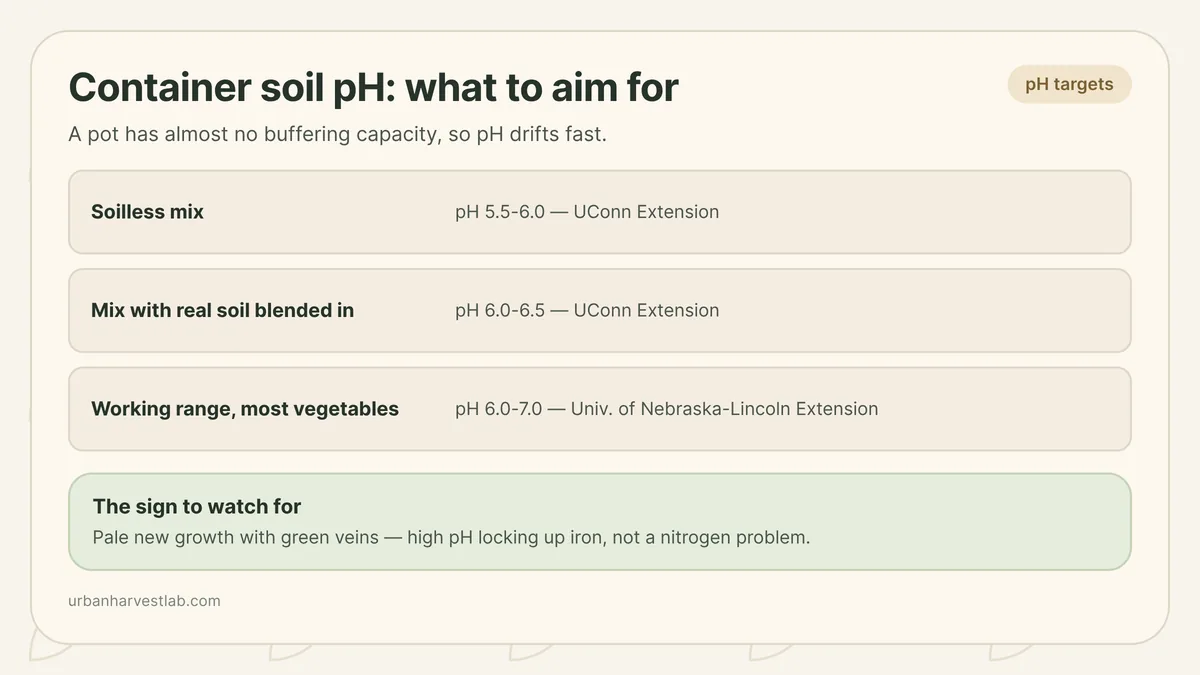
Container soil pH: when it matters and how to fix it
A container's small volume has almost none of the buffering capacity open ground has, so pH drifts faster and matters sooner. Here is when to test, what to aim for, and how to move it.