Troubleshoot the system before you change the inputs.
Symptoms
- Blobs of white froth on young stems or in leaf joints, looking like spit.
- A small pale or greenish insect, about 4-6 mm long, sitting in the froth when you push it aside.
- Occasionally a wrinkled leaf or slightly distorted shoot tip where a nymph has been feeding.
Possible causes
- Spittlebug (froghopper) nymphs, such as the meadow spittlebug, sucking sap and covering themselves in froth.
- Eggs laid in plant stems the previous late summer hatching in spring.
Quick fixes
- Do nothing if the plant is growing normally; the foam is temporary.
- Wash the froth and nymph off with a strong jet of water, or wipe it off with a gloved hand.
- Repeat if more appear, and look at shoot tips for distorted growth.
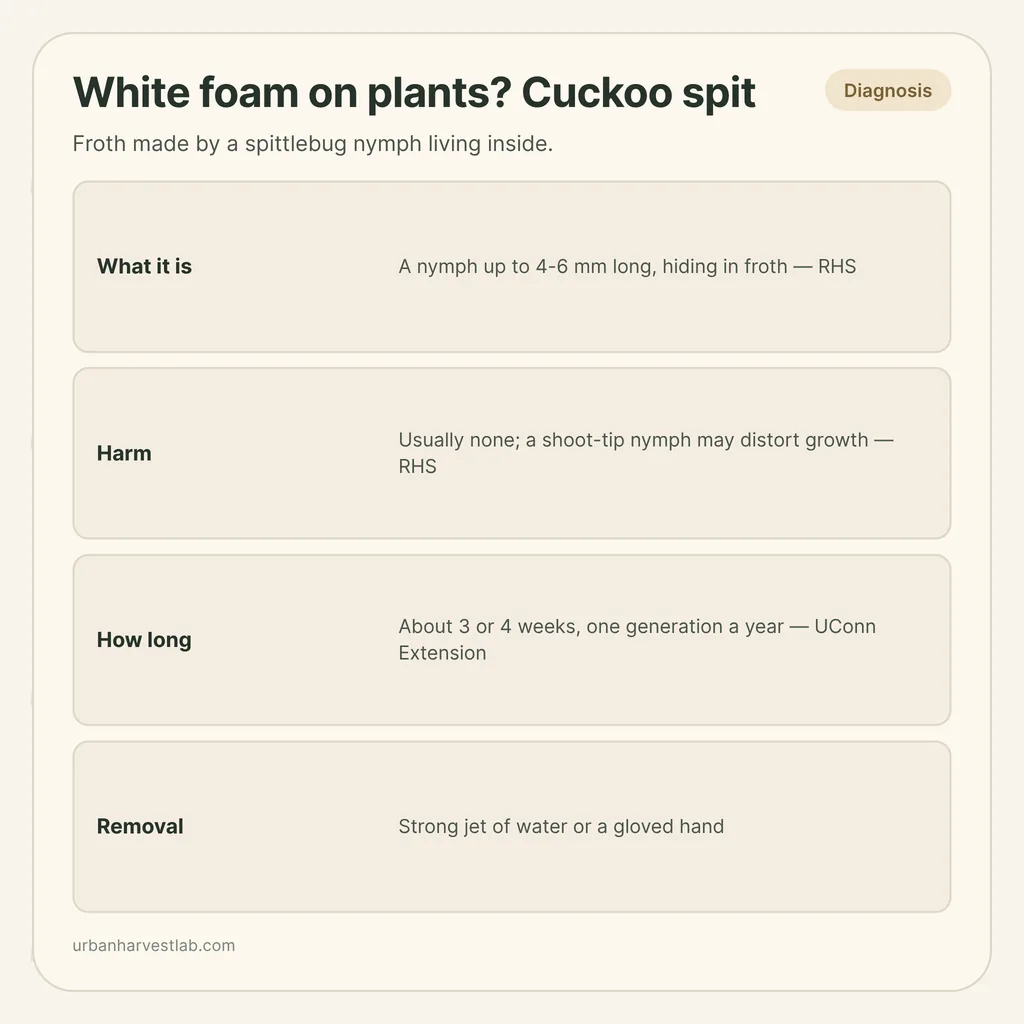
White foam on a stem is cuckoo spit: froth made by a spittlebug nymph that lives inside it. The RHS describes it as harmless, and UConn Extension says it does not harm the plant. If the plant is growing normally, you can leave it alone. If the foam bothers you, a jet of water takes it off. Other pests that leave marks on herbs are sorted in the herb pest identification chart.
What you are looking at
Push the froth aside with a finger or a twig. Inside is a small insect, creamy white or pale green. The RHS puts the nymph at up to 4-6 mm long, and the Pacific Northwest Insect Management Handbook describes young spittlebugs as mostly greenish with conspicuous red eyes.
The nymph pierces the stem and drinks sap. The University of Saskatchewan says the froth is made by mixing the ingested sap with fluid from the insect’s glands. It works as a shelter: UConn Extension says the foam protects the nymphs from drying out and from predators, and the Natural History Museum adds that parasitic wasps find it hard to stand on the foam’s surface.
The “cuckoo” in the name is only about timing. The RHS says it appears in spring when cuckoos can be heard, and has nothing to do with the bird.
The RHS lists lavender and rosemary among the plants affected, along with chrysanthemum, dahlia, fuchsia, rose and willow. UConn Extension adds herbaceous perennials such as achillea, coreopsis and phlox. Sage with brown leaves and a few froth blobs is covered in the sage problems page.
When it shows up and how long it stays
The cycle is short and happens once a year.
| Stage | When | Source |
|---|---|---|
| Eggs laid in plant stems | Late summer (August and September) | RHS, UConn Extension |
| Nymphs hatch and make froth | Spring; most active May to July | RHS |
| A single foam mass lasts | About 3 or 4 weeks | UConn Extension |
| Adults, which do not make foam | Mid to late summer | Pacific Northwest handbook |
UConn Extension notes that there is only one generation per year, so once the nymphs have turned into adults, the foam is over until next spring. The RHS says the adults do not cause any noticeable damage, despite also feeding on sap.
Does it hurt the plant?
Usually not. The RHS says plant growth is usually unaffected, and the Pacific Northwest handbook says most spittlebugs there cause little damage and can be ignored. The same handbook mentions that in some gardens there may be some wrinkling of the leaf or stem where the young spittlebugs are feeding.
Two cases deserve a closer look:
- Shoot tips. The RHS says that if a nymph has been feeding at the shoot tip, it may cause some distorted growth.
- Heavy numbers on a small plant. The Natural History Museum says that if there are enough of them, froghoppers might damage the plant by sucking its sap.
If a plant is wilting, yellowing or dying and you also see foam, do not assume the nymphs are the cause. A few froth blobs do not explain a failing plant, and the rosemary dying guide walks through the usual culprits, which start with wet roots. Sticky leaves are a different pest altogether: check honeydew on leaves.
Removing it
You do not have to. The Natural History Museum says it is best to leave froghoppers alone as they complete their life cycle, and the RHS asks that you not remove them, because they are not a pest.
If you want the plant clean:
- Hose it off. UConn Extension suggests forcefully hosing the spittle off the plants when only a few are present, and the University of Saskatchewan recommends a strong spray of water to wash away the foam and the insect. The Pacific Northwest handbook says it is easy to hose off if the spittle becomes too objectionable.
- Or wipe it off. UConn Extension says a gloved hand works, and the Natural History Museum says it can be hosed or wiped off. The University of Saskatchewan also says to pick the insects off by hand.
- Look again later. If more froth appears, repeat the rinse. Once the nymphs have become adults the foam stops, as the RHS notes that adults do not produce cuckoo spit.
Skip insecticides. The Pacific Northwest handbook lists chemical control as not recommended for home landscapes. If a different pest on edible plants does call for a spray, choosing a pest treatment for edible plants covers what the label decides.
A note on Xylella
The RHS notes that Xylella fastidiosa, a bacterial disease causing leaf scorch, wilt and dieback, is spread by insects that feed on plant xylem, and that this includes froghoppers. It is causing serious problems in southern Europe and, the RHS says, has not yet been detected in Britain. That is why the RHS describes spittlebugs as innocent carriers outside the UK: the insect is not the disease. Nothing about foam on a single plant tells you the disease is present.
Sources
Other things that show up on herbs
If the foam is not the problem, these pages sort out what else is going on with your plant.
Common questions
What is the white foam on my plants?
It is cuckoo spit, the froth made by spittlebug (froghopper) nymphs. The RHS says each blob contains a creamy white nymph up to 4-6 mm long, and University of Saskatchewan describes the foam as plant sap mixed with fluid from the insect's glands. Push the foam aside and the nymph is visible.
Does cuckoo spit harm plants?
Rarely. The RHS says plant growth is usually unaffected, though a nymph feeding at a shoot tip may cause some distorted growth. The Natural History Museum adds that a large number of them might damage a plant by sucking its sap.
How do I get rid of spittlebugs?
Hose the foam off with a strong jet of water or remove it with a gloved hand, as UConn Extension and the University of Saskatchewan suggest. The Pacific Northwest Insect Management Handbook lists chemical control as not recommended for home landscapes.
How long does cuckoo spit last?
UConn Extension says spittle masses usually persist for about 3 or 4 weeks, and there is only one generation per year. The nymph then becomes a winged adult that no longer makes foam, according to the RHS.
Related guides
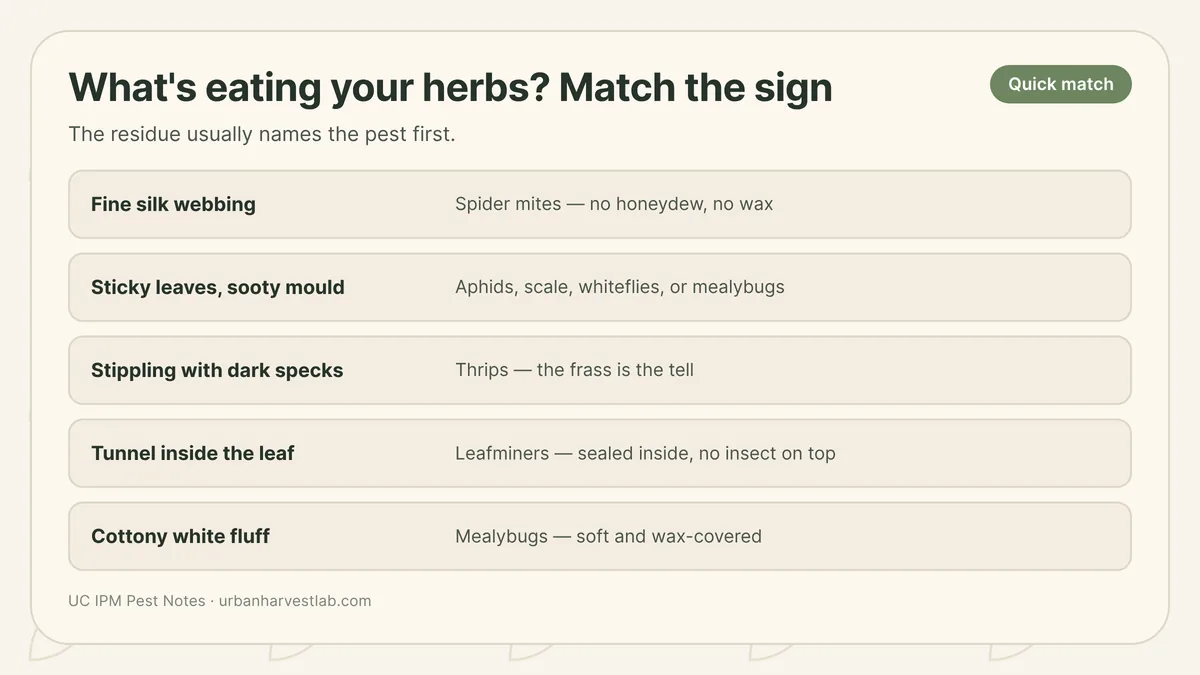
What's eating your herbs? Match the signs to the pest
Every common herb pest leaves its own tell before you ever spot the insect itself. Pick out what you are actually seeing, then go straight to the page that treats it.

Lavender dying in a pot: wet roots, winter damp, or old wood
Lavender is built for dry, stony ground, so a pot that holds water kills it faster than neglect does. Work through drainage, winter, light, and pruning in order.

Sage leaves turning brown? Wet roots, old wood, or mildew
Sage is a drought-tolerant Mediterranean shrub, so brown leaves in a pot point to drainage first, age second, and disease or pests after that.