
Troubleshoot the system before you change the inputs.
Symptoms
- Foliage greying, yellowing, or browning from the base of the plant upward while the mix stays damp.
- Stems that are dark or soft at the soil line, or a plant that stays limp after watering.
- Whole woody branches dying back after winter, or after a hard prune, with no green at the base.
Possible causes
- The mix or pot holds water for hours at a time, so the roots are rotting rather than drying between waterings.
- Winter rain or a saucer of standing water kept the compost damp while the roots were cold.
- Too little sun, a crowded or humid spot, or a tender lavender type that cannot take the winter outside.
- A cut into old, leafless wood that the plant could not regrow from.
Quick fixes
- Lift the plant out and look at the roots: firm and pale is alive, dark and soft is rotted.
- Repot into a gritty, fast-draining mix in a pot with large drainage holes, and let the mix dry out between waterings.
- Cut only back to green growth, and wait for spring growth before judging which stems are dead.
Potted lavender most often dies because its roots stay wet, and winter damp, shade, or a hard cut into old wood finish off the rest. Illinois Extension is blunt about it: “It is dampness more than cold that is responsible for killing lavender plants.” The pattern is the same one that takes down rosemary and thyme, but lavender adds two traps of its own: a winter that leaves a pot soggy, and woody stems that will not regrow if you cut too deep.
Which lavender you have changes the answer
English lavender (Lavandula angustifolia) and its hybrids are the tough ones. The RHS calls them hardy plants for borders or containers that can usually stay outside in winter in free-draining soil. French, Spanish, and other tender lavenders are a different case: the RHS says they are less hardy than English types and tend to be short-lived, best grown in containers and kept frost-free over winter. NC State Extension describes Spanish lavender as more fragile than common lavender and hardy only in zones 8 to 9.
So a tender lavender left outside through a hard frost may be a cold casualty, not a watering one. Check the plant label before you blame the pot.
Wet roots and a pot that will not drain
Lavender comes from dry Mediterranean ground. NC State Extension says it needs “perfectly drained soil, preferably on the dry side” and puts the root rot risk in one line: root rot is caused by overwatering. Utah State Extension warns against letting water stand around the plants.
In a pot the problem is concrete: a dense mix, small drainage holes, or a saucer of runoff. UC IPM notes that Phytophthora diseases can develop in as little as 4 to 8 hours of soil saturation, so one blocked hole over a wet weekend is enough. Signs to look for:
- Foliage that greys, yellows, or browns while the mix is still damp.
- Wilting that does not recover after watering.
- Stems that are dark or soft at the soil line.
Overwatered vs underwatered has the finger, weight and recovery tests that separate a dry plant from a drowning one. A wilted lavender in damp mix is not asking for water.
What a draining pot looks like
For containers the RHS recommends a pot 30 to 40 cm (1 ft to 16 in) across with large drainage holes, and a compost mixed with coarse grit, up to 25 percent by volume. That figure and the bigger sizing question are covered in what size pot lavender needs. Do not add a gravel layer at the bottom to help: the gravel-in-the-pot myth explains why it holds the root zone wetter, not drier. A potting mix built for herbs is the better starting point.
Water by the mix, not the calendar. The RHS gives once or twice a week in summer when the weather is hot and the compost begins to dry out, because pots dry quickly. UF/IFAS Extension adds that potted lavender needs more frequent watering in summer but should still dry out a bit between waterings.
Winter is where pots lose lavender
A pot gives roots far less protection than the ground does. The RHS says plants in containers are more susceptible to cold because their roots are less insulated, and that roots in damp compost make the plants more susceptible to root rots. Its advice is to keep winter containers fairly dry and to stand them in the lee of a wall, or in a coldframe or greenhouse, so winter rain does not soak them.
Do not tidy up in autumn. Illinois Extension says not to cut lavender back in the fall and to wait until new growth appears in spring. If a frost hit before you moved the pot, emergency cold snap protection for balcony plants covers the same night. A cold, wet winter that looks like sudden collapse in March usually started with damp roots in November.
Light, crowding, and humid air
The RHS says lavender needs lots of sun and will not survive long in shady, damp conditions. Illinois Extension puts the target at 8 hours of full sun each day; UF/IFAS Extension says at least 6 to 8 hours. A lavender on a dim balcony or a shaded sill is short of the one thing it is built for.
Air matters as much as sun. Illinois Extension links decline to high humidity and poor air circulation between plants in summer, and recommends inorganic mulch such as rock or pea gravel on top of the soil to keep the crown dry. UF/IFAS Extension rates English lavender as the most difficult type to grow in Central Florida because of the summer heat and humidity. In a humid climate, a more tolerant type such as a lavandin may do better, and Illinois Extension notes the lavandin ‘Phenomenal’ tolerates heat and humidity.
Old wood and the hard prune
A lavender that dies after a haircut is common. The RHS says lavender does not break new growth easily from old stems, so do not cut back into the woody stems. Illinois Extension is more specific: do not cut below the leafless wood, because it will not regrow. NC State warns that Spanish lavender does not tolerate being cut back to the ground.
The routine that works:
- Trim annually in late summer, just after flowering. The RHS says to remove the spent flower stalks and about 2.5 cm (1 in) of leaf growth.
- In spring, wait for new growth, then cut dead stems back to the first set of green leaves, as Illinois Extension describes.
- Judge dead wood only when spring growth shows which stems are alive.
The RHS also says even well-pruned lavender becomes straggly and very woody with age, and is best replaced. A plant that is simply old is not a failure of your care.
Feeding makes it worse
Lavender likes lean soil. The RHS says it prefers soil quite low in nutrients and does not generally need feeding. Illinois Extension says fertilizer can cause excessive foliage and fewer blooms. Feeding a struggling lavender adds salts and soft growth to a plant whose problem is roots.
Rescue steps
- Lift the plant out. Firm, pale roots are alive; dark, soft ones are rotted.
- Trim the soft roots and any blackened stems.
- Repot into a gritty mix in a pot with large drainage holes. Repotting herbs without shock covers the handling.
- Water lightly, then leave it until the mix dries.
- If the base is soft and nearly every root is dark, UC IPM’s note applies: a plant with a substantial Phytophthora infection rarely recovers. Take cuttings from healthy stems in early to midsummer, as the RHS describes, or replace it.
Common mistakes
- Watering a drooping lavender before checking whether the mix is already wet.
- Putting gravel in the bottom of the pot.
- Leaving the pot in a saucer or a decorative cachepot through winter rain.
- Cutting back to bare wood in autumn.
- Feeding a plant that is failing at the roots.
Sources
- RHS: How to grow lavender
- Illinois Extension: Lavender
- Illinois Extension: Essential tips for growing lavender in your backyard
- NC State Extension Plant Toolbox: Lavandula angustifolia
- NC State Extension Plant Toolbox: Lavandula stoechas
- UF/IFAS Extension Pasco County: A beginner’s guide to growing lavender
- Utah State University Extension: How to grow English lavender
- UC IPM Pest Notes: Phytophthora root and crown rot in the garden
Fix the pot, the mix, and the winter routine
These guides cover the container, mix and repotting steps once you know which cause fits.
Common questions
Why is my potted lavender turning brown and dying?
The most common cause is roots that stay wet. Illinois Extension says dampness, more than cold, is what kills lavender, and NC State Extension says lavender root rot is caused by overwatering. Check the mix a few inches down and the drainage holes before you check anything else.
Can I save a lavender with root rot?
Sometimes, if it is caught early. UC IPM says a plant with a substantial Phytophthora infection rarely recovers. If the roots are partly firm and pale, trim off the soft dark ones, repot into a gritty mix in a pot with large drainage holes, and let it dry between waterings. If the base is soft and every root is dark, start again from a cutting or a new plant.
Should I cut back a woody lavender to bring it back?
Not into bare wood. The RHS says lavender does not break new growth easily from old stems, and Illinois Extension says to cut no lower than the leafless wood because it will not regrow. Trim just below the spent flowers after bloom, and in spring cut dead stems back to the first green leaves.
How often should I water lavender in a pot?
By the mix, not the calendar. The RHS gives once or twice a week in hot summer weather when the compost begins to dry out, and says to keep containers fairly dry in winter. UF/IFAS Extension says to let lavender dry out a bit between waterings.
Related guides
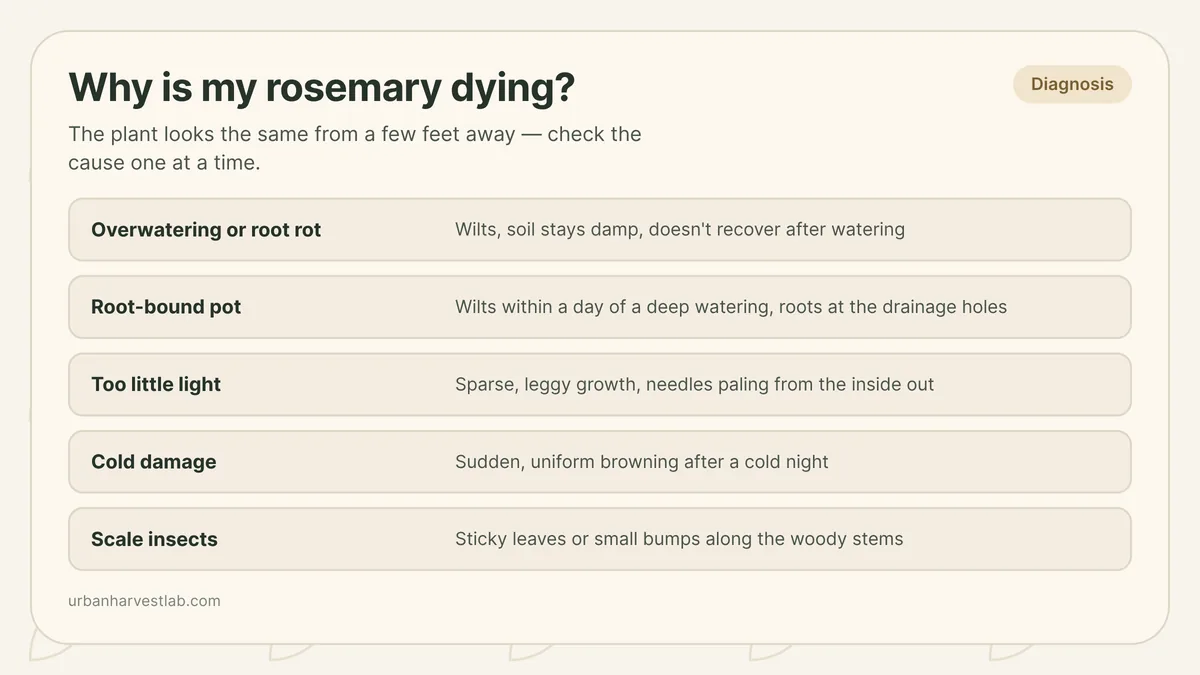
Why is my rosemary dying? A cause-by-cause diagnosis
A dying rosemary looks much the same from a few feet away no matter what caused it, so finding the fix means ruling causes in and out one at a time, not guessing.
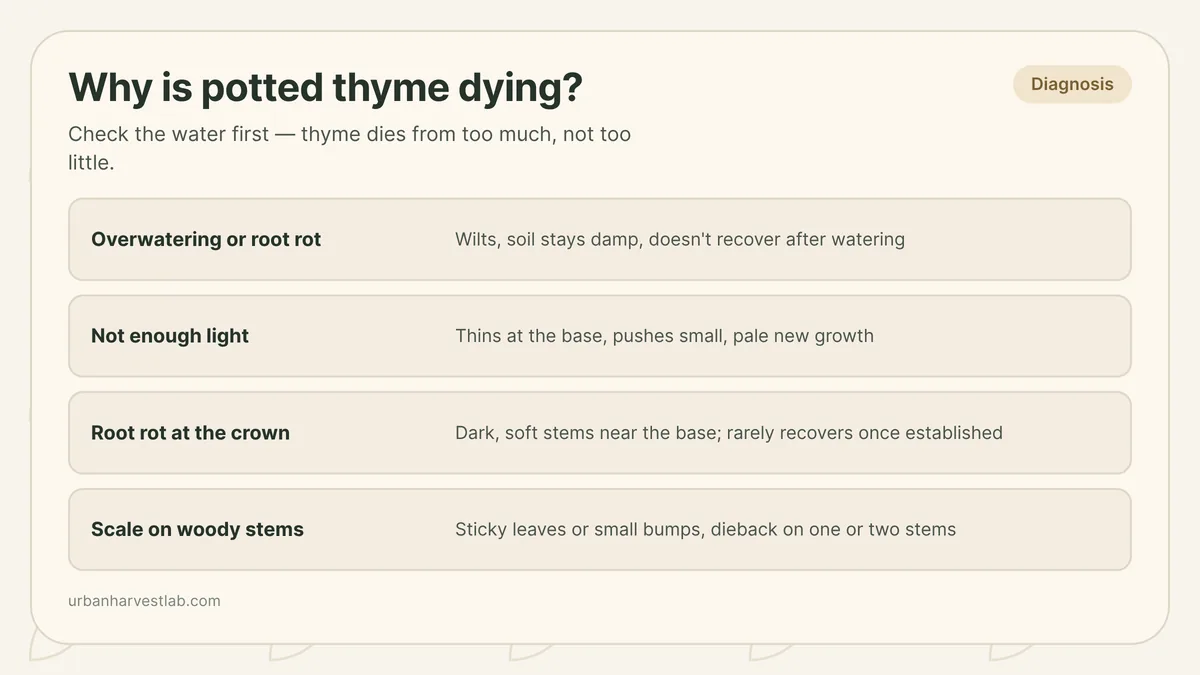
Why is potted thyme dying? Start with the water, not the leaves
Thyme fails indoors far more often from a soggy pot than a dry one. Check the root zone first, then work through light, rot, and pests in that order.
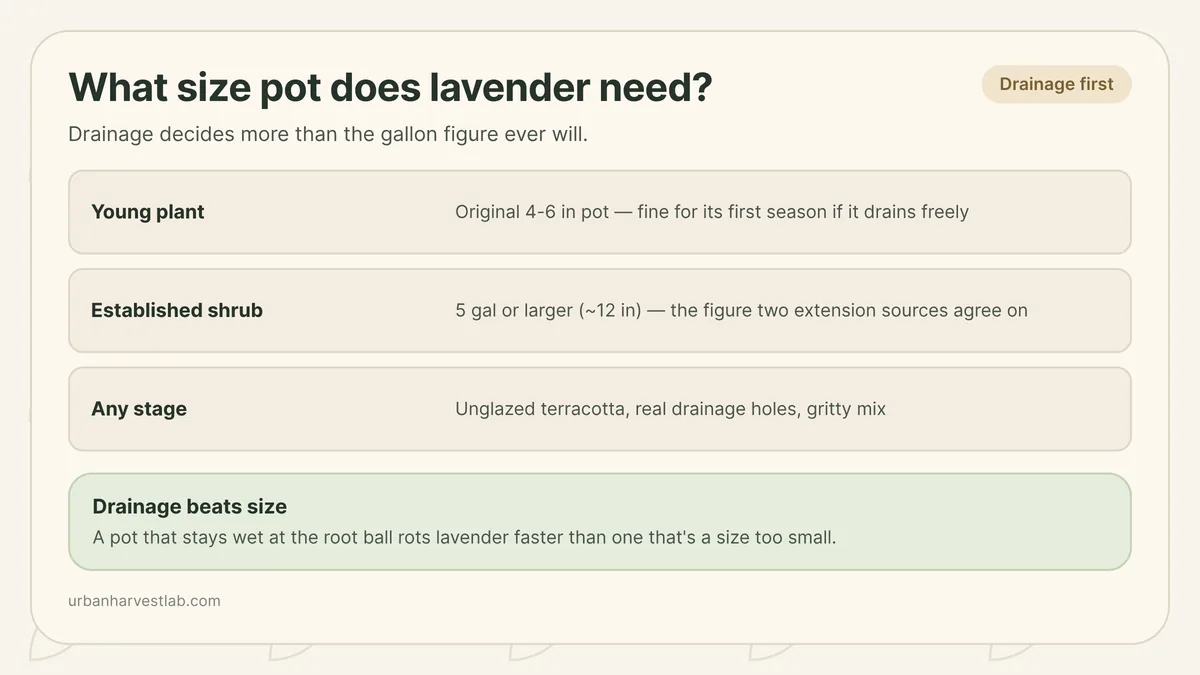
What size pot does lavender need? Drainage before diameter
Lavender is Mediterranean and drought-adapted, so the pot that keeps it alive is defined by how fast it drains, not just how big it is.