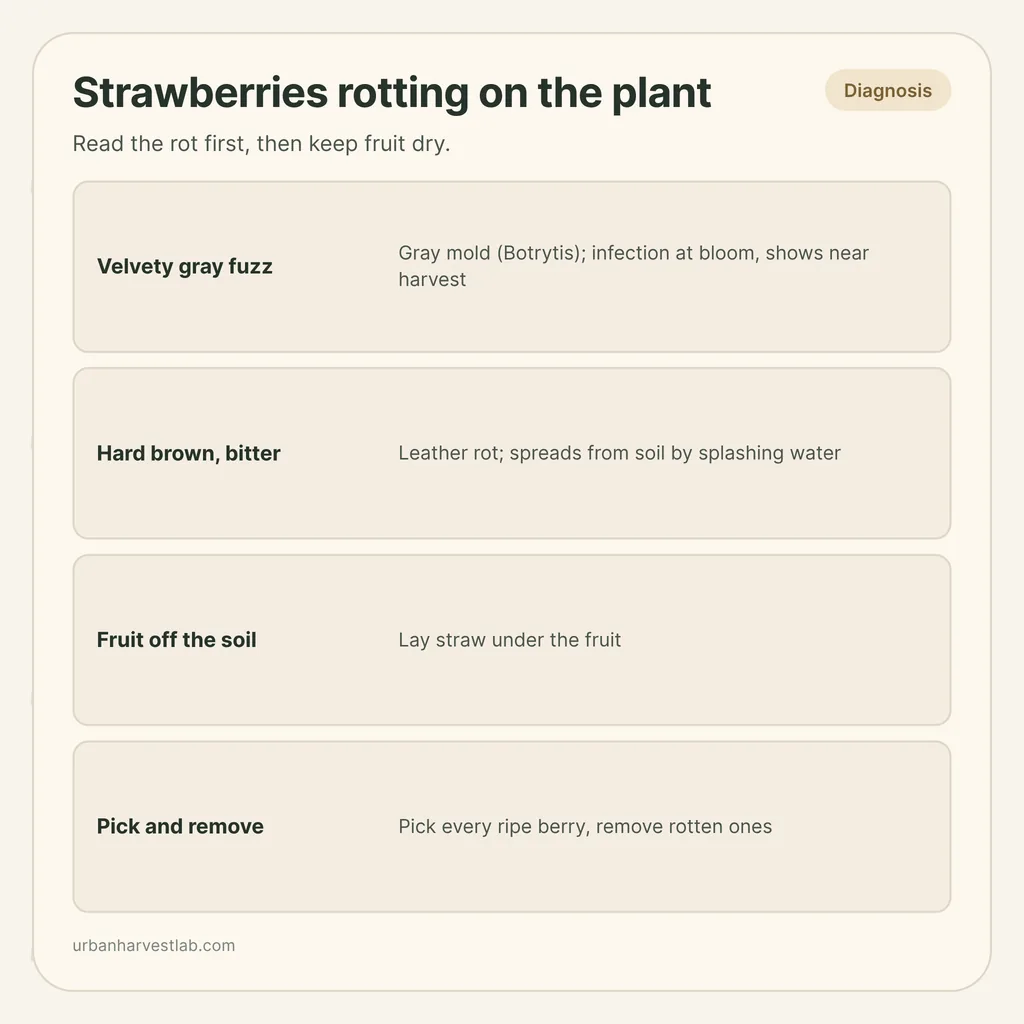
Troubleshoot the system before you change the inputs.
Symptoms
- Berries covered in a velvety gray growth, often starting at the stem end or on the side touching soil or another rotten berry.
- Brown, withered flowers or flower stalks earlier in the season.
- Green or ripening berries with hard brown areas or a dull reddish-brown to purple colour, drying to a leathery texture.
- Berries that smell or taste bitter even though they look nearly normal.
Possible causes
- Gray mold (Botrytis cinerea): infection at bloom, favoured by humid, still air and wet foliage.
- Berries resting on damp potting mix or on another rotten berry or dead leaf.
- Leather rot (Phytophthora cactorum): soil water splashed onto fruit by rain or watering.
- Ripe berries left on the plant, or bruised during picking.
Quick fixes
- Pick every ripe berry and remove every rotten one, bagging the rotten ones before you carry them away.
- Lay straw under the fruit so it no longer touches the mix, and keep the pot where rain cannot splash it from the ground.
- Water at the soil in the morning rather than over the leaves and flowers.
- Cut away dead leaves and thin crowded foliage so the planting dries faster.
Fuzzy gray berries are gray mold (Botrytis), and the infection usually got in at bloom, not when you saw the fuzz. Hard, brown, bitter berries are more likely leather rot. Both are managed mostly by keeping fruit dry and off the soil, picking promptly, and removing rotten berries.
Read the rot first
Look at the berry before you change anything. The two common rots look different.
| What you see | Likely cause | Where it starts |
|---|---|---|
| Velvety gray growth, flesh still fairly firm, nothing leaking | Gray mold (Botrytis cinerea) | Stem end, or the side touching soil or another rotten berry |
| Hard brown patches on green fruit, reddish-brown to purple on ripening fruit, drying leathery; bitter taste | Leather rot (Phytophthora cactorum) | Berries near the soil, where water splashes up |
UC IPM says the velvety growth and the absence of liquid leaking from the fruit distinguish gray mold from other fruit rots such as Rhizopus. The same page says lesions usually show first near the stem end or on the side of the fruit touching other decayed fruit, soil or standing water.
Iowa State describes leather rot as a soilborne fungus. Green fruit may develop hard, brown areas, and ripening fruit takes on a reddish or brownish purple colour with slight softening before it shrivels. The smell has been compared to rancid motor oil and the taste called “bitter”. NC State adds that infected mature fruit can taste and smell bad even when there is little change in colour.
If your berries are merely small or lumpy rather than rotten, that is a different problem: see why strawberries come out small or misshapen. Spots on the leaves are covered in red and purple spots on strawberry leaves.
Why the rot appears at harvest
Ohio State University Extension says most fruit infection actually occurs during bloom, but symptoms usually do not develop until close to harvest. The fungus colonises the flowers, then sits latent in the young green fruit until the fruit starts to mature. The RHS describes the same pattern: the fungus enters flowers and colonises the developing fruit, but does not break out until the fruit ripens and its sugar content rises.
That timing explains why changes made when you first see fuzz help the next berries, not the ones already rotting. It also points to the weeks when the planting matters most: bloom, and the run-up to picking.
Ohio State says temperatures between 70 and 80 °F (20 to 27 °C) together with free moisture on the foliage from rain, dew, fog or irrigation are ideal for the disease, and that it is worst in years with prolonged rainy, cloudy periods during bloom or harvest. In a pot you control part of that: how wet the leaves and flowers get, and how crowded the plant is.
Get the fruit off the soil
Iowa State says the most commonly infected berries are those touching the soil or other infected berries, and that berries resting on damp or wet soil are more susceptible. Ohio State lists berries resting on soil, or touching another decayed berry or a dead leaf in dense foliage, as the most commonly affected.
For leather rot the soil contact matters even more. Iowa State says the fungus spreads from soil onto berries by splashing raindrops and through puddles, and calls mulching the cheapest and most effective control, and says a barrier several inches thick is an excellent protector against leather rot. NC State likewise lists splash dispersal by rain and overhead irrigation water.
In a container, that means:
- Lay straw under the trusses (straw mulch on Amazon) once flowers set, so the berries rest on it rather than on the potting mix. Iowa State recommends straw to keep the berries off the ground; the RHS notes that a mulch or membrane around the plants stops soil splashing onto the fruit.
- Pick up fallen berries and dead leaves rather than letting them lie against fruit.
Water the soil, not the flowers
Free moisture on foliage is part of what the fungus needs. UC IPM recommends drip or furrow irrigation to keep water off foliage and fruit, and says that if sprinklers are used, you should water in the morning so plants dry off during the day. Iowa State gives the same morning advice.
Container strawberries still need regular water; the RHS notes that plants in containers, especially hanging baskets, need regular watering. The point is where and when. Pour at the base of the plant, early in the day, and leave the flowers and fruit dry.
Open up the plant
Gray mold is favoured by poor air circulation and high humidity, Iowa State says. Ohio State adds that fruit infection is most severe in well-protected parts of the plant where humidity is high and air movement poor.
- Space plants out. UC IPM says plants should be far enough apart for good air circulation around the fruit. The RHS says to reduce humidity by improving ventilation and not overcrowding plants. If your container is packed, see how many strawberry plants a pot holds.
- Do not feed June-bearing plants nitrogen in spring. Iowa State says nitrogen fertiliser applied in spring promotes lush growth, and dense foliage slows the drying of the planting.
- Keep weeds out of the pot. Iowa State says they reduce air circulation and slow drying.
- Remove dead strawberry leaves. Ohio State says nearly all of the overwintering inoculum in strawberry plantings comes from mycelium in dead strawberry leaves within the planting, so last year’s debris is where this year’s spores come from.
Pick clean, and handle gently
Iowa State’s advice is to “clean-pick” the planting: harvest frequently, pick berries as soon as they are ripe, handle them carefully to avoid bruising, and refrigerate the unwashed berries straight away.
This matters because rot does not stop at the plant. Ohio State says mature fruit is extremely susceptible to gray mold after picking, especially if bruised, and that handling infected fruit during picking spreads the fungus to healthy berries. Under favourable conditions, it says, healthy berries can become a rotted mass within 48 hours after picking. Given that 48-hour window, it is worth checking the punnet for soft or moldy berries before refrigerating it.
Remove the rotten ones, carefully
Iowa State says berries with gray mold should be picked and removed from the bed, and UC IPM says removing moldy fruit reduces disease inoculum. The RHS warns that spores are dispersed very easily when you cut off affected parts, and advises enclosing them in a bag, either before or immediately after removal. So pick with a bag in the other hand.
Slugs and soil dwellers
Berries chewed from the side or hollowed out are a pest problem first, and rot gets in afterwards. The RHS says growing strawberries in containers makes the fruits less likely to be damaged by slugs or snails than in a bed, which is one real advantage of a pot. If you find slime trails or ragged holes, slugs and snails in potted plants covers what is worth doing.
What not to rely on
Sprays are not the home-garden fix. Iowa State says fungicides are used by commercial strawberry growers, but cultural practices are the best way to control Botrytis fruit rot in home gardens. For leather rot, Iowa State says several fungicides are labelled but are generally not available at local garden centers. The RHS says no fungicides are approved for use against grey mould by gardeners, which applies to the UK. Rules differ by country, so a product label is the authority if you do use one.
Ohio State notes that the most critical period for fungicide application against gray mold is bloom, which is the same reason the cultural steps above start at flowering rather than at the first fuzzy berry.
The same fungus attacks herb leaves and stems; for that version, see gray mold on herbs.
Sources
- Iowa State University Extension, “Some of my strawberries in the garden are covered with a gray, velvety growth”
- Iowa State University Extension, “Leather Rot: Wet-weather disease on strawberries” (1998)
- Ohio State University Extension, “Botrytis Fruit Rot ‘Gray Mold’ of Strawberry, Raspberry, and Blackberry”
- UC IPM, “Botrytis Rot (Gray Mold) on Strawberries”
- NC State Extension, “Leather Rot of Strawberry”
- Royal Horticultural Society, “Grey mould”
- Royal Horticultural Society, “How to grow strawberries”
Strawberry problems and pots
Related fixes for fruit, leaves and containers.
Common questions
Why are my strawberries turning gray and fuzzy before they ripen?
That is gray mold, caused by Botrytis cinerea. Ohio State University Extension says most fruit infection actually occurs during bloom, and the fungus stays latent in green fruit until the berry starts to mature, so the fuzz appears close to harvest even though the infection came weeks earlier.
How do I tell gray mold from leather rot?
UC IPM says gray mold berries stay fairly firm, do not leak and are covered with velvety gray growth. Iowa State describes leather rot as hard brown areas on green fruit and a reddish or brownish purple colour on ripening fruit, drying to a leathery texture, with a bitter taste and a smell compared to rancid motor oil.
Do I need a fungicide to save container strawberries?
Iowa State University Extension says fungicides are used by commercial growers but cultural practices are the best way to control Botrytis fruit rot in home gardens. The RHS says no fungicides are approved for use against grey mould by gardeners in the UK. For leather rot, Iowa State says the labelled fungicides are generally not sold at garden centers.
Should I throw away strawberries that have gray mold?
Remove them from the plant. Iowa State says berries showing gray mold should be picked and removed from the bed, UC IPM says removing moldy fruit reduces disease inoculum, and the RHS advises bagging infected parts because the spores spread very easily.
Related guides
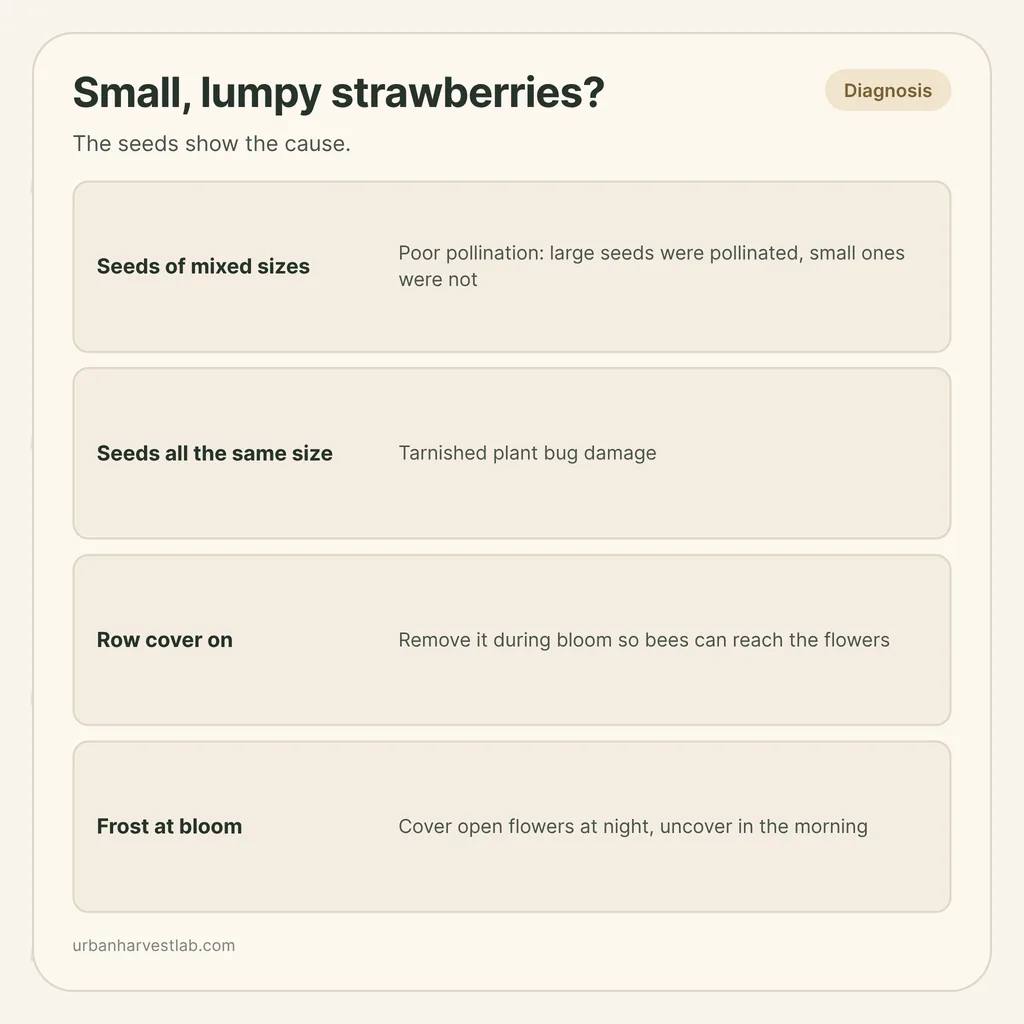
Small, lumpy strawberries? Pollination, cold or plant bugs
Knobby, lopsided or tiny strawberries have a handful of causes, and the seeds on the surface show which one you have. Here is how to read them and what to change.

Strawberry plants not fruiting in pots: type, age, light, and heat
A strawberry pot with leaves and no berries is rarely sick. The variety type, the plant's age, the sun, the heat and an early frost explain most of it.
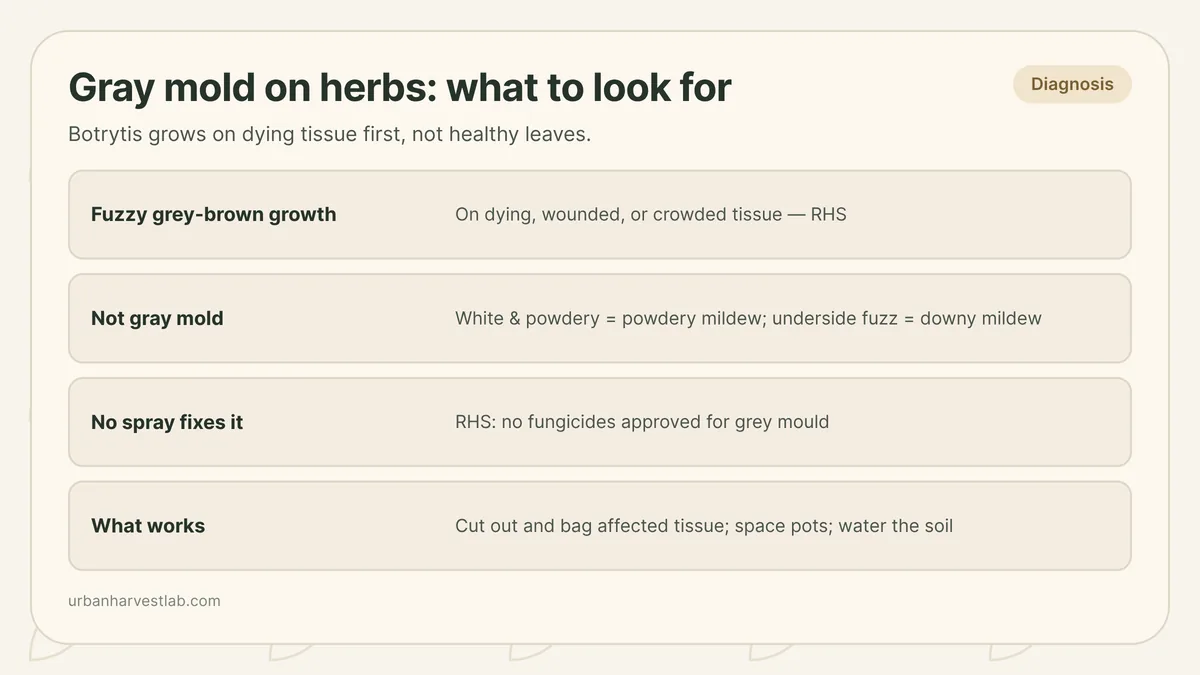
Gray mold on herbs: what botrytis looks like and how to stop it spreading
Gray mold grows on dying or wounded tissue first, not healthy leaves. Remove the source, open up the canopy, and stop watering overhead.