Troubleshoot the system before you change the inputs.
Symptoms
- A potted plant wilts or collapses in autumn, winter or early spring even though the compost is not dry, and the top growth looks otherwise normal.
- Irregular notches along leaf margins appeared in summer, most obvious on thick-leaved evergreens.
- Plump, white, legless, C-shaped grubs with pale brown heads, up to 10 mm long, sit among the roots or in the root ball.
Possible causes
- Vine weevil grubs have been eating the roots since late summer, after adult females laid eggs in the compost.
- An infested plant was bought or divided and carried the grubs into the pot, since adults cannot fly and spread on plant material.
- Waterlogged or dry compost is stressing roots with no grubs present, which looks similar above ground.
Quick fixes
- Tip the plant out and check the roots and root ball for grubs before treating anything.
- Repot into fresh compost, picking out as many grubs as you can find from around the roots.
- Where grubs remain, apply parasitic nematodes to moist, warm compost, and hand-pick adult weevils on summer evenings.
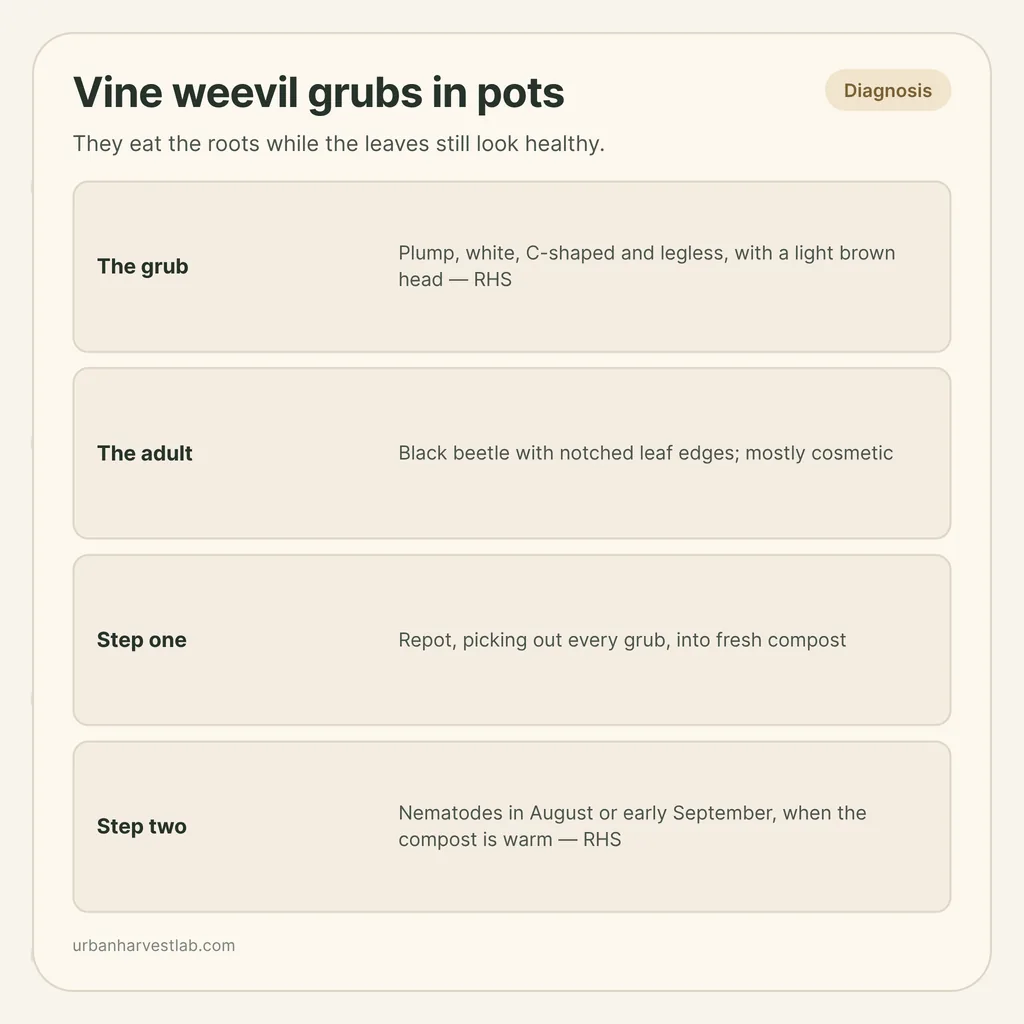
Vine weevil grubs in pots are plump, white, legless, C-shaped larvae with pale brown heads that eat the roots, and they are the reason a container plant can wilt and die while its leaves still look healthy. Tip the plant out and look. If you find grubs, pick them out, repot into fresh compost, and consider nematodes while the compost is warm.
The RHS says the adult weevils eat leaves in spring and summer, but it is the grubs that cause the most damage over autumn and winter. It adds that plants in pots and containers, outdoors or under cover, are the most likely to be severely damaged. That is why the damage is worst on balconies and patios rather than in open beds.
What you are looking for
The grubs are the proof. The RHS describes them as plump, white, C-shaped and legless, with light brown heads and up to 10 mm (about 3/8 in) long, found among the roots. UConn Extension gives about 1/2 inch for a mature larva and notes fine hairs on the body, which you will only see up close.
The adults leave a different sign. Both sources describe notches along the leaf margin; UConn calls the damage primarily cosmetic, and the RHS says adults rarely cause enough damage to affect a plant’s vigour. The beetle is dull black with dirty yellow marks on the wing cases, about 9 mm long. It is active after dark and hides in leaf litter or under containers by day. It cannot fly.
| Stage | What you see | Where | Harm |
|---|---|---|---|
| Adult | Black beetle, about 9 mm, notched leaf edges | Foliage at night, under pots by day | Mostly cosmetic |
| Egg | Brown, under 1 mm, effectively invisible | Top inch or two of the compost | None yet |
| Grub | White, C-shaped, brown head | Among roots, in the root ball | Wilting, plant death |
Eggs are laid in the upper one to two inches of the growing medium, according to UConn Extension, and the RHS notes that larger yellowish-brown balls in potting compost are likely to be slow-release fertiliser pellets, not eggs.
Check before you treat
Wilting has many causes, and the roots tell you which one you have. UConn Extension advises checking the root system and surrounding root ball for larvae when plants wilt. If the roots are intact and the compost is soggy or bone dry, the problem is watering, and overwatered versus underwatered will sort it out. If the roots are chewed, stripped of fine fibres, or the base of the stem is gnawed, you have your answer.
Timing helps too. The RHS says most plant losses occur from September to March, as the grubs become fully grown. UConn Extension says larvae hatch in August, overwinter fully grown and resume feeding in early spring, often causing the heaviest damage then. A plant that collapses in autumn or late winter with no obvious leaf pest is a prime suspect.
Strawberries deserve particular attention. The RHS lists them among the plants where heavy grub populations occur, and adults feed on the foliage too. If you grow them in tubs or baskets, the strawberry container guide covers the pots themselves.
Step one: repot and remove
The RHS advice is to repot affected plants, removing as many larvae as possible from around the roots and compost. For a pot, that means:
- Tip the plant out onto newspaper or a tray.
- Pick out every grub you can see, from the root ball and the old compost.
- Discard the old compost rather than reusing it in other pots.
- Replant in fresh compost, and check the roots as you go.
UConn Extension also advises discarding heavily infested plants immediately and keeping infested plants away from new, susceptible ones. If a plant has lost most of its roots, replacing it is kinder than nursing it.
Step two: nematodes
For grubs you have not removed, or for pots you cannot easily tip out, the RHS recommends biological control with microscopic parasitic nematodes. It lists Steinernema kraussei, Heterorhabditis megidis, H. bacteriophora and S. feltiae, sold by biological control suppliers and in sachets from some retailers, and says they suit containers and open ground. It also says nematodes can be used safely on all edible and ornamental plants. Follow the instructions on the pack you buy.
Timing and conditions decide whether this works:
- Season. The RHS says to apply in August or early September, when the compost is warm enough and before the grubs are large enough to do serious damage. UConn Extension gives March to May and August to November.
- Temperature. The RHS gives 5-20 °C (41-68 °F) for Steinernema species and 12-20 °C (54-68 °F) for Heterorhabditis. UConn Extension gives a minimum of 57 °F for H. bacteriophora and 41 to 86 °F for S. kraussei. If your compost is cool, pick a species suited to it.
- Moisture and weather. UConn Extension says to apply as a drench to moist growing medium, early morning or evening, ideally in cloudy weather, to avoid heat and direct sun.
- Compost. The RHS says results can be poor in dry or heavy soils and are best in lighter soils and open potting composts such as peat or coir.
- Duration. UConn Extension says the nematodes stay active up to 6 weeks and that repeated applications may be needed.
Nematodes kill all larval stages and pupae, but UConn Extension is clear they do not kill eggs or adults. That is why the third step matters. The RHS also cautions that nematodes have the potential to infect other animals, so use them with care and only when there is a specific problem to treat.
Step three: deal with the adults
Because the adults cannot fly and lay in summer, catching them cuts next year’s grubs. The RHS suggests inspecting plants and walls by torchlight on mild spring or summer evenings and picking off the adults, shaking shrubs over an upturned umbrella or newspaper to collect more, and looking under pots in greenhouses. Sticky barriers around pots can trap adults under cover. A nematode trap using Steinernema carpocapsae is also available for adults, placed on the ground below damaged plants in summer.
Tolerate the notched leaves themselves. The RHS says adult damage rarely affects plant growth.
Keeping them out of next year’s pots
- Inspect new plants before they join your pots, and check root balls when you divide older plants. UConn Extension advises closely inspecting incoming plants and checking older stock when dividing.
- Check susceptible plants often, so you act before a damaging population builds up. The RHS notes numbers can build up again after an apparent disappearance.
- Let predators help. The RHS lists birds, frogs, toads, shrews, hedgehogs and predatory ground and rove beetles as eaters of weevils and grubs.
If you are weighing nematodes against other options on a food plant, choosing a pest treatment for plants you will eat sets out the order to work in. For other creatures turning up in the same pots, pill bugs mostly eat decaying matter, while the pest identification chart matches signs to culprits.
Sources
Other creatures in pots and soil
Several small invertebrates turn up in containers, and they are managed very differently.
Common questions
What do vine weevil grubs in pots look like?
The RHS describes plump, white, C-shaped, legless larvae with light brown heads, up to 10 mm (about 3/8 in) long, found among the roots. UConn Extension gives about 1/2 inch for a fully grown grub. Brown spherical bits in the compost are more likely to be controlled-release fertiliser pellets than eggs, which are under 1 mm.
Do nematodes work on vine weevil grubs in pots?
Yes, within limits. The RHS lists several nematode species for containers and open ground and says they can be used safely on edible and ornamental plants. UConn Extension says larvae are susceptible to nearly all commercially available species, but eggs and adults are not killed, and repeat applications may be needed. The RHS warns of poor results in dry or heavy soils.
When should I apply nematodes to a pot?
The RHS recommends August or early September, when the compost is warm enough and before the grubs are large. It gives 5-20 °C (41-68 °F) for Steinernema species and 12-20 °C (54-68 °F) for Heterorhabditis species. UConn Extension also lists March to May and August to November, and says to apply to moist growing medium in the early morning or evening.
Will vine weevil kill my strawberry plants?
It can. The RHS names strawberries among the plants where heavy grub populations can occur, even in open ground, and says damage to roots can result in wilting and plant death. A strawberry that collapses in autumn or spring with healthy-looking leaves is worth tipping out to check.
Related guides

Pill bugs in plant pots: when they hurt seedlings and how to cut their numbers
Grey, armoured, roll-into-a-ball creatures in your potting mix are usually decomposers. Here is when they threaten seedlings, how to confirm it after dark, and what actually reduces them.
Slugs and snails in potted plants: barriers that actually work
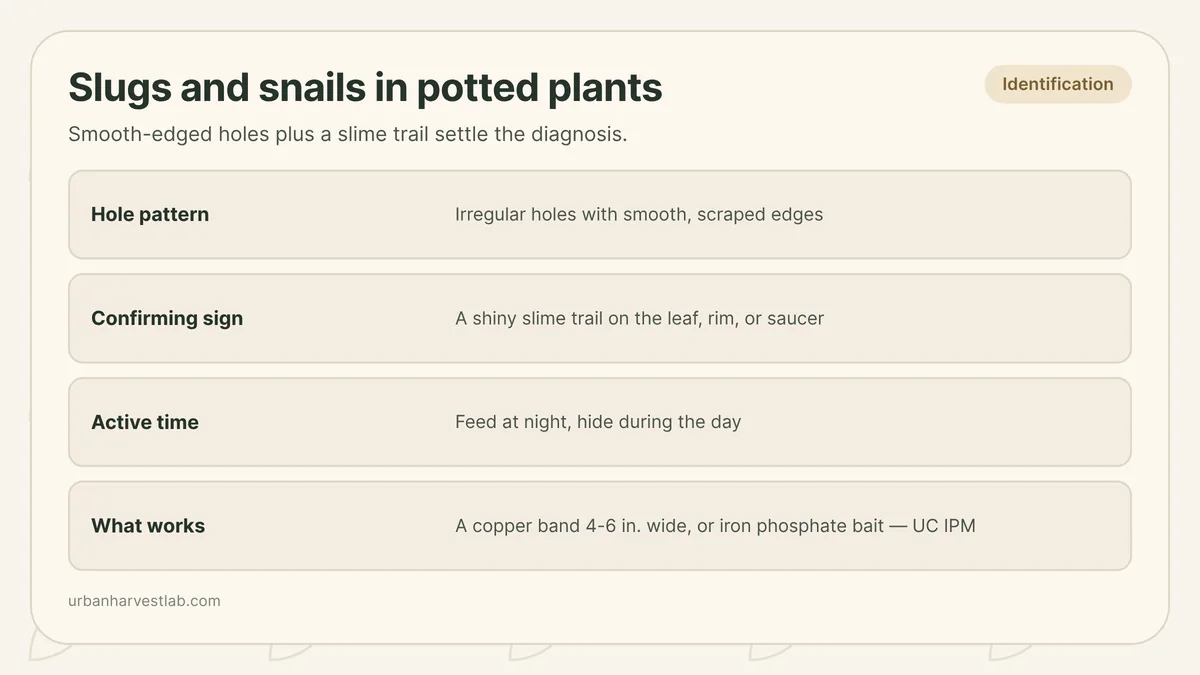
Smooth-edged holes and a shiny trail on a potted herb point to slugs or snails. A copper barrier, iron phosphate bait, and checking after dark are the responses with evidence behind them.
Overwatered vs underwatered: how to tell which one you have
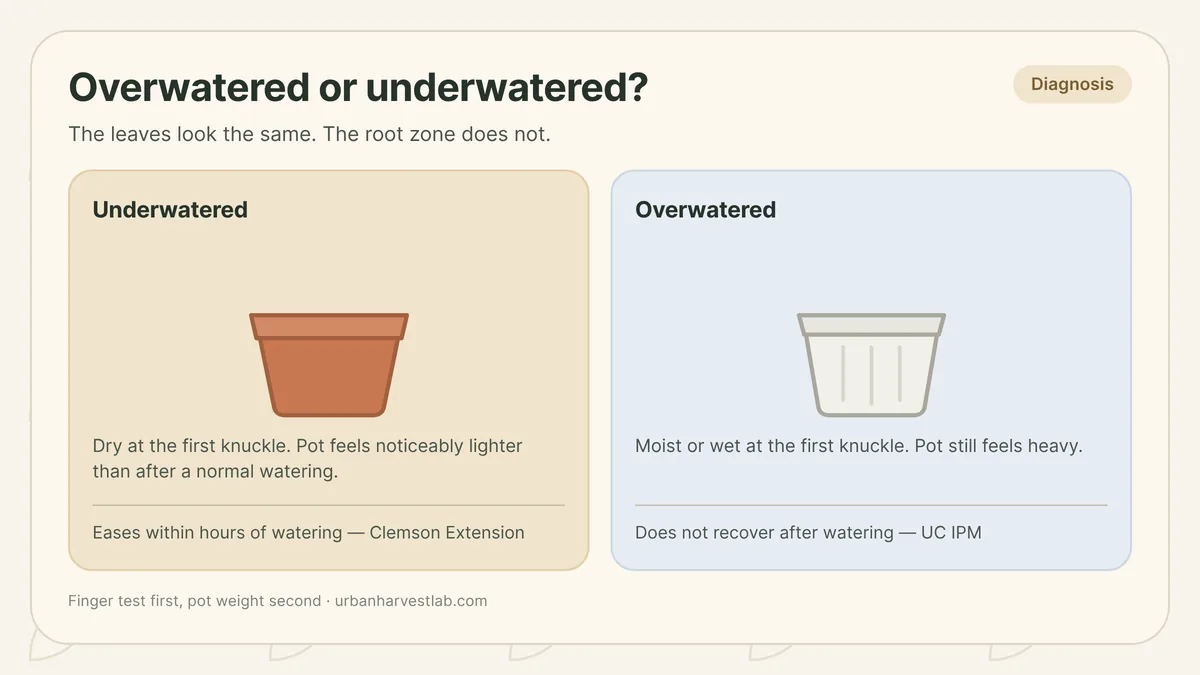
Reading the root zone directly, with a finger test, pot weight, and how the plant responds to being watered, settles what the leaves alone cannot.