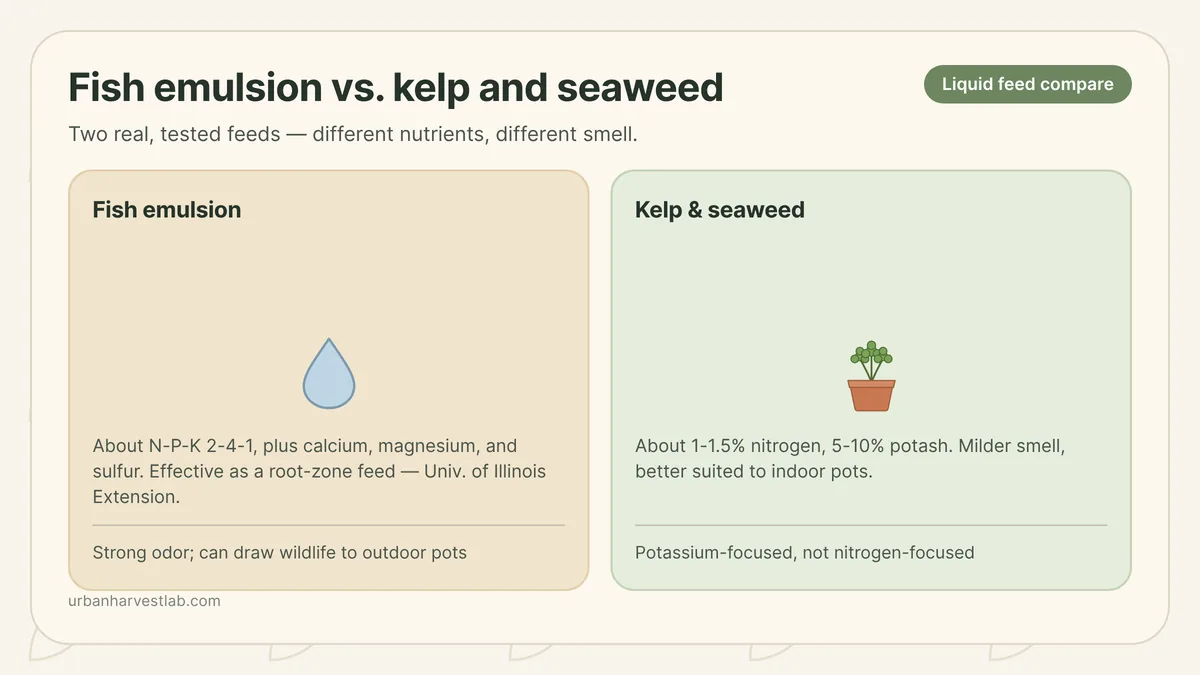
Fish emulsion vs. seaweed and kelp feeds
| Product | Typical N-P-K | Main nutrient contribution | Release speed |
|---|---|---|---|
| Fish emulsion (liquid) | About 2-4-1, plus calcium, magnesium, sulfur, chlorine, and sodium | Nitrogen and phosphate, plus protein that may feed soil microorganisms | Fast — nutrient is already in solution |
| Kelp meal (dry) | About 1-1.5% N, 5-10% K2O | Potassium | Moderate — releases as the meal breaks down |
| Liquid seaweed extract | Whatever the products own label states | Potassium, already in solution | Fast, like any diluted liquid feed |
Fish emulsion is a real, tested fertilizer with a specific nutrient profile, not a folk remedy — but two of its most repeated claims do not hold up under direct testing. University of Illinois Extension puts commercial fish emulsion at roughly N-P-K 2-4-1, plus calcium, magnesium, sulfur, chlorine, and sodium, and confirms it works as a fertilizer. The same source tested soaking seed in it and spraying it on leaves, and rejected both practices as effective. Seaweed and kelp products add a different nutrient, at a milder smell. The real tradeoff for either one is odor management, which changes where and how you use it.
Before reaching for a bottle, check whether feeding is the actual next step with choosing a fertilizer for potted herbs — an organic liquid feed only matters once you know the mix needs one at all.
The nutrient analysis behind a fish emulsion bottle
Fish emulsion is made from processed fish byproduct, and University of Illinois Extension’s figure for a commercial product is an N-P-K ratio around 2-4-1, with meaningful calcium, magnesium, sulfur, chlorine, and sodium alongside the headline three numbers. That is a lower concentration than most synthetic all-purpose feeds.
The nitrogen and phosphate are the part a plant uses immediately once diluted and watered in. The secondary minerals are a smaller but real contribution, part of the analysis University of Illinois Extension reports for a commercial fish emulsion.
What seaweed and kelp add instead
Kelp meal, the dried form most often listed in organic-fertilizer references, sits in a different part of the nutrient profile. Utah State University Extension’s release-rate table gives kelp meal roughly 1 to 1.5 percent nitrogen and 5 to 10 percent potash (K₂O), placing it in the same moderate-release category as bone meal and compost — slower to act than a rapid-release input like fish meal or blood meal, and built around potassium rather than nitrogen. Liquid seaweed extract, sold already dissolved, delivers potassium in solution, so it behaves like any diluted liquid feed once it is watered in — the release-speed distinction applies to the dry meal, not the bottled extract, and a bottled extract’s full analysis is whatever its own label states.
Because fish emulsion supplies nitrogen and phosphate while kelp and seaweed supply potassium, the two are often sold blended, and a combined product is not redundant the way stacking two nitrogen-heavy feeds would be.
Two claims the research tested — and rejected
Fish emulsion carries more home-garden folklore than most liquid feeds, and University of Illinois Extension addressed two of the most common practices directly rather than leaving them as untested advice — slow-release vs liquid fertilizer covers where a liquid organic feed like this one sits against a resin-coated granular product:
- Soaking seed in fish emulsion before sowing does not improve germination. The claim shows up often enough to sound like settled wisdom, but the tested result was no improvement over an untreated control.
- Spraying fish emulsion on foliage produced no yield difference in sweet peppers. A foliar application is often recommended as a quick pick-me-up, but the trial found the leaf-spray route added nothing measurable to the crop.
What the same source does support is more modest and still useful: fish emulsion functions as an effective fertilizer when applied as a normal liquid feed to the root zone, and its protein content may feed soil microorganisms and support the soil food web over time. That is a slower, structural benefit rather than an instant fix — closer to what worm castings contribute to a container mix than to a synthetic feed’s fast, isolated nutrient hit.
The odor problem, and why it changes where you use it
Fish emulsion smells like what it is made from, and that smell does not fade the moment the bottle is capped. University of Illinois Extension notes the odor can persist on a treated container long enough to draw wildlife — specifically raccoons digging in pots that have been fed with it. For an apartment balcony or a windowsill tray, that is a genuinely relevant caution rather than a minor annoyance: an indoor application means living with the smell in an enclosed space, while an outdoor container risks an animal treating the pot as something worth investigating.
Practical placement follows from that directly. Feed outdoor herbs with fish emulsion when the container sits somewhere a curious animal is a manageable nuisance rather than a real problem, and reserve indoor use for when the odor is tolerable in your space or you can water it in and ventilate the room. Seaweed and kelp products, being plant-based rather than fish-protein-based, carry a milder smell and are the easier choice for an indoor pot where odor is the deciding factor.
Dosage and avoiding a stacked feed
Fish emulsion and kelp are organic inputs, and organic does not mean automatically gentle. Utah State University Extension is explicit that many organic materials carry real salt content, and that over-application burns plants from that salt load exactly the way a synthetic product would — the ceiling it gives, no more than about 1.5 pounds of nitrogen per 1,000 square feet in a single application, is stated as applying to organic and synthetic fertilizers alike, not as a synthetic-only limit. In container terms, that means following the bottle’s own dilution and interval rather than assuming “it’s organic” raises the safe ceiling. University of Illinois Extension’s half-strength-at-every-watering routine and Clemson’s three-way indoor-feeding options (label rate every two to three months, a tenth-strength dose at every watering, or a full dose every seventh watering) are the sourced schedules to pick from rather than improvise; the fertilizer dilution calculator handles the arithmetic once you have picked one.
The other stacking risk is less obvious: fish emulsion, kelp meal, and a pre-fertilized potting mix can all be feeding the same pot at once without you noticing, because none of them look like “fertilizer” the way a granular synthetic product does. Before adding a liquid organic feed on top of an existing routine, check what the potting mix and any other product already supply — signs of overfertilizing herbs covers the symptoms that show up when that stacking goes too far, and how to back off once it does.
How often to apply either product, and how that interval interacts with a slow-release granular fertilizer already in the mix, is a scheduling question with its own answer at fertilizer schedule for container vegetables. The choice between an organic input like fish emulsion and a synthetic equivalent is a separate question again, covered at organic vs. synthetic fertilizer — this is about what the two organic liquids themselves deliver, not about ranking the whole category against synthetic feeds.
The practical read
Use fish emulsion as a root-zone liquid feed for its nitrogen, phosphate, and secondary minerals; the seed-soak and foliar-spray shortcuts were tested and did not work. Kelp and seaweed products add potassium, not nitrogen, and their milder smell makes them the more forgiving choice indoors. Dilute either one to the label rate, count it as a real feeding, and manage the smell with placement.
Sources
Fitting a liquid organic feed into the rest of the routine
These guides cover choosing a fertilizer overall, avoiding overfeeding, and when a potted herb needs feeding in the first place.
Common questions
Does fish emulsion actually work as a fertilizer for herbs?
Yes. University of Illinois Extension describes commercial fish emulsion as an effective fertilizer, with an N-P-K ratio around 2-4-1 plus calcium, magnesium, sulfur, chlorine, and sodium. Its main limits are the odor and a dilution you have to measure rather than eyeball.
Does soaking seeds in fish emulsion improve germination?
No. University of Illinois Extension tested this claim directly and found that soaking seed in fish emulsion did not improve germination over an untreated control.
Does spraying fish emulsion on leaves boost yield?
Not reliably. The same University of Illinois Extension research found that a foliar fish-emulsion spray produced no yield difference in sweet peppers, which points to root-zone feeding as the more useful use of the product rather than a leaf spray.
Why does fish emulsion smell so strong, and does seaweed fertilizer smell the same way?
The odor comes from the fish protein itself, and University of Illinois Extension notes it can attract wildlife such as raccoons to a treated container, which is one reason outdoor use is usually more practical than indoor. Seaweed and kelp products are milder because they come from a plant, not an animal protein.
Related guides
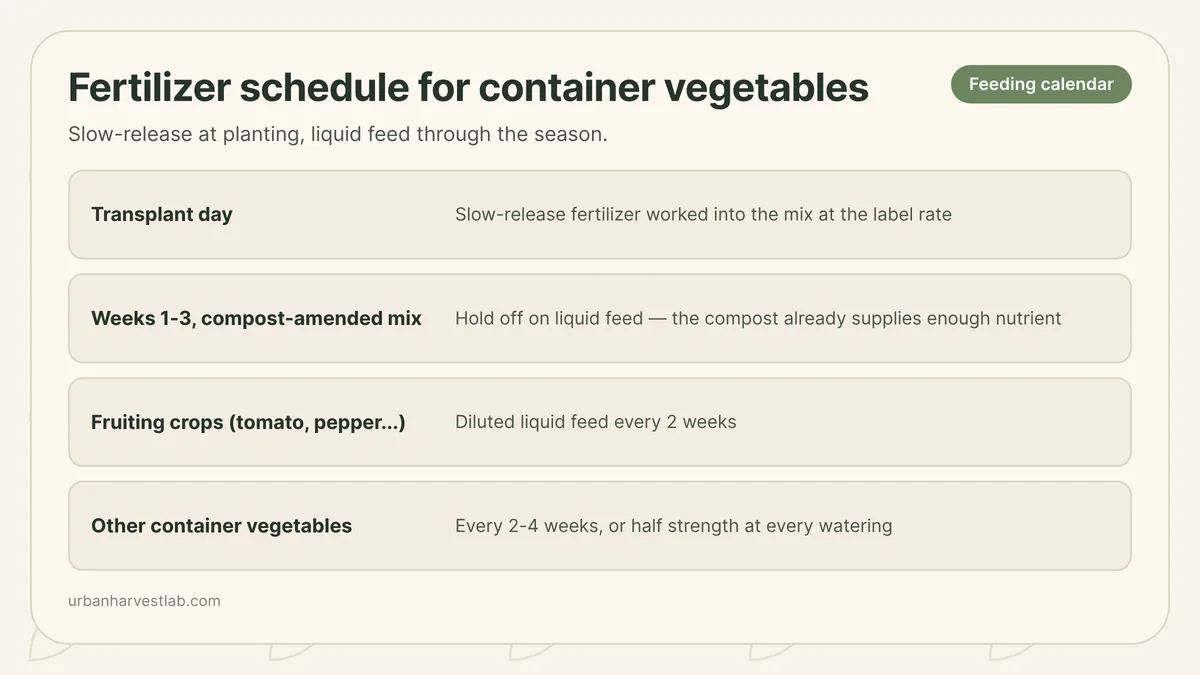
Fertilizer schedule for container vegetables: what to feed and when
A stage-by-stage feeding calendar for container vegetables, built from extension guidance on slow-release charges, liquid top-ups, and the intervals that keep fruiting crops producing.

Best fertilizer for herbs in pots: a label-first guide
A practical, label-first guide to complete liquid and controlled-release fertilizers for potted herbs, with a decision table and a safer first application.
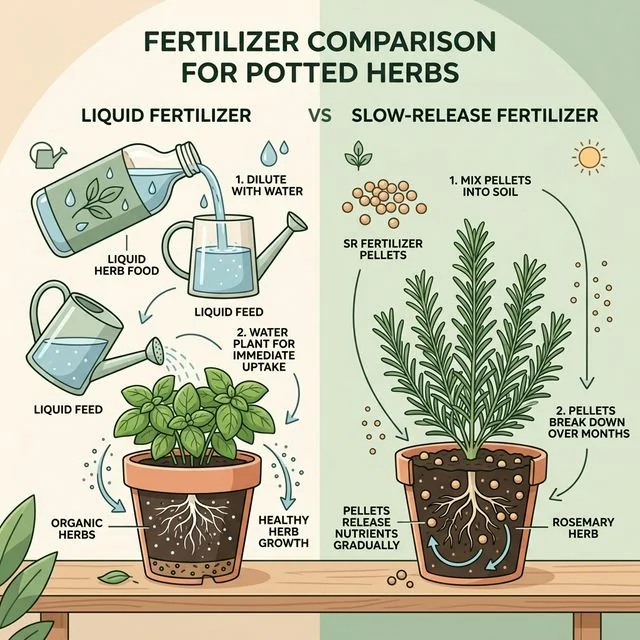
Do potted herbs need fertilizer? When to feed and avoid burn
Most potted herbs need fertilizer eventually, but timing matters. This guide explains when to feed, how often to do it, and how to avoid burning stressed roots.