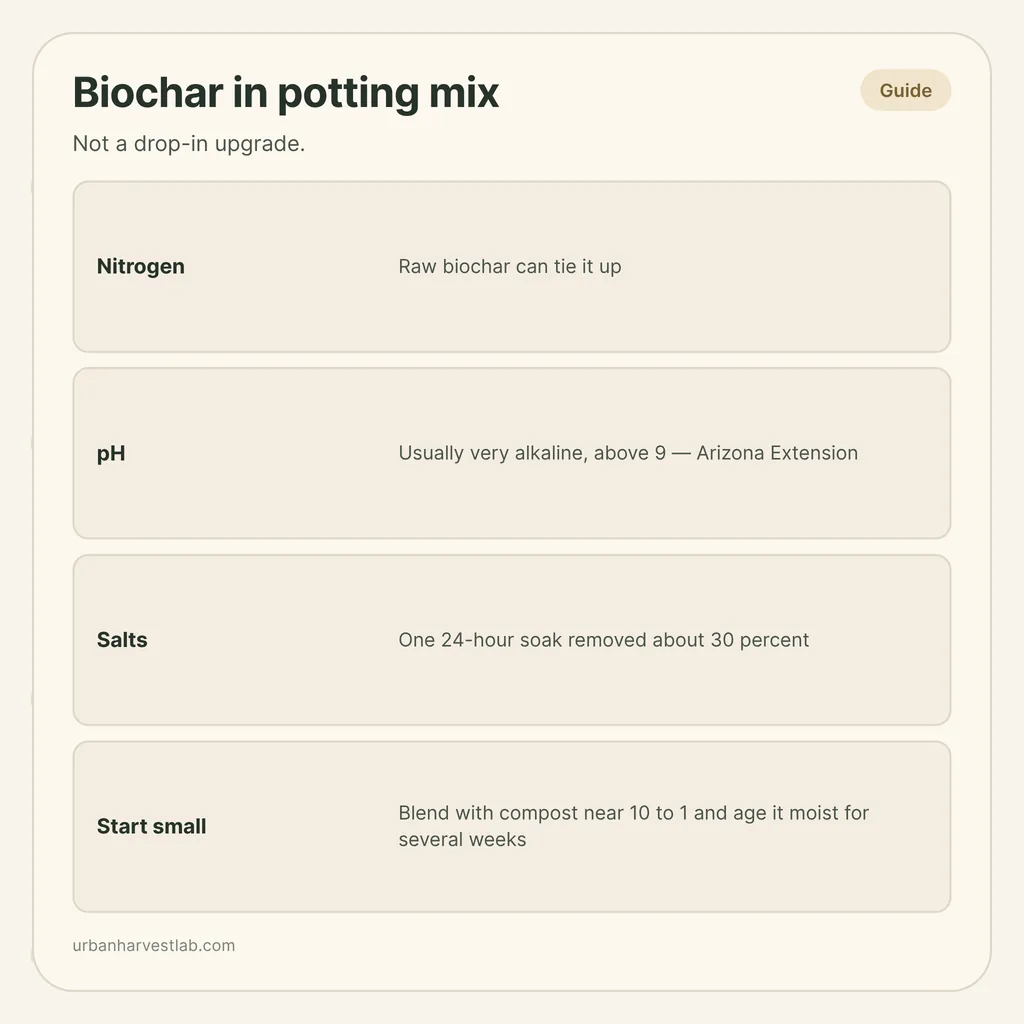
Biochar can work in a potting mix, but it is not a drop-in upgrade. It is porous, usually very alkaline and carries almost no nutrients, so a handful of raw char in a pot can lock up nitrogen or lift container soil pH. The trials that went well used a specific biochar at a measured rate in a fertilised soilless mix.
What biochar is and what it brings to a pot
Biochar is charcoal made from wood or other plant material heated with little oxygen. University of Arizona Cooperative Extension calls it “a light, porous material” and notes that “biochar lacks nutrients like nitrogen and phosphorous”, which is why it is paired with compost or manure.
Properties vary a lot between products. A 2023 review in Frontiers in Plant Science says biochar properties “vary widely depending on feedstocks, production temperature, and pre- and post-treatment”. It also warns that biochar may contain heavy metals, polycyclic aromatic hydrocarbons or dioxin depending on the raw material and how it was made, and that those can reduce plant growth. A bag that does not say what it was made from and how is a gamble for a vegetable pot.
Three things the trials keep finding
1. Nitrogen can get tied up
The same review reports that adding green waste biochar to a substrate reduced available nitrogen, which the authors tie to the porous structure binding it. A University of Valencia and CEBAS-CSIC study put raw olive-prune biochar into a coir-based mix for tomatoes. Seed germination and early root growth improved, but the raw biochar reduced growth in adult plants of both cultivars, probably because of ammonium retention, and the plants showed low-nitrogen stress symptoms. The authors conclude raw biochar suits seedling production in nurseries.
The same review also describes the other side of that property: a trial with 10 percent sawdust biochar in a peat-based mix increased nitrate and phosphate retention and reduced their leaching. Holding nutrients is the benefit and the risk in one property. Whether you see one or the other depends on what the mix already contains and how much you feed.
2. pH starts high and then drifts
Arizona Extension describes biochar as “usually very alkaline (pH above 9)” and says it may temporarily raise soil pH and salinity. The review gives a mixed hardwood biochar at pH 10.8 to 11.8.
A potting mix wants to sit lower. Penn State Extension gives pH 5.5 to 6.5 for premium potting mixes tested by the saturated paste method. The marigold trial from the University of Illinois Urbana-Champaign and UC Davis is the clearest test of how much that matters. It swapped a softwood biochar of pH 10.9 for peat in a 70 percent peat, 30 percent perlite mix, in steps of 10 percent of total volume. Starting pH ran from 4.4 to 10.4. By harvest, nine weeks later, the mixes without any pH adjustment had converged to pH 5.6 to 7.5, and the substitution did not hurt marigold biomass or flowering. The authors say even a 70 percent share needed no pH adjustment for that crop. They also say crop- and biochar-specific effects still need testing, so treat it as one result on marigolds, not a rule for tomatoes or basil.
Container soil pH covers testing a mix and what moves the number.
3. Salts wash out of the biochar
Arizona Extension reports that soaking its biochar once for 24 hours removed about 30 percent of the salt, and that repeated soaks with fresh water removed more. In their own lettuce and Bermuda grass trials the early biochar hurt germination and seedlings; after several waterings, soil pH and salinity returned to normal. Their home advice is to let the biochar sit submerged overnight or longer and repeat two or three times. If a pot already shows a white crust, salt buildup in herb pots is a separate problem to rule out.
Rates the studies actually used
No single “right” percentage exists. Each number below belongs to one biochar, one crop and one setup.
| Source | Setup | Rate | Result |
|---|---|---|---|
| University of Illinois and UC Davis | Softwood biochar replacing peat in 70:30 peat-perlite, marigold, greenhouse | 10 to 30% of total volume | Biomass and leaf greenness above the 0% control |
| Same study | Same | up to 70% of total volume | No harm to biomass or flowering, no pH adjustment needed |
| University of Valencia and CEBAS-CSIC | Raw olive-prune biochar in coir mix, tomato | Rate not reported in the sources read | Adult plants grew less; seedlings did well |
| University of Arizona Extension | Compost-biochar blend for garden soil or potting mix | Up to 1 part compost to 1 part biochar; most gardeners start near 10 to 1 | Aged moist for several weeks before use |
| Frontiers review, citing Altland and Locke | Sawdust biochar in peat-based mix | 10% | More nitrate and phosphate retained |
The review adds that the highest peat replacement it found was 80 percent, with a pine bark biochar. That is a nursery number from a controlled setup, not a recipe for a balcony box.
If you decide to try it
The sources do not test one home method end to end, so keep the experiment small.
- Know what it was made from. Skip char with no stated feedstock, given the contaminant warning above. If you are buying, browse biochar on Amazon and check that the listing names the material it came from.
- Crush it small and keep dust down. Arizona Extension suggests pieces about a quarter inch or smaller, advises a dust mask when crushing dry biochar, and says wetting it first helps contain the dust.
- Blend it with compost and age it moist. Arizona Extension says to age the mix for several weeks under moist conditions so the two materials can exchange nutrients, and to start near 10 parts compost to 1 part biochar. How much compost a mix can take is covered in how much compost to add to potting mix.
- Test one pot against a control. Fill one pot with your usual mix and one with the biochar blend, plant the same crop, and compare growth and leaf colour. Pale new growth early on points to the nitrogen effect.
- Check the pH. Compare the finished mix with the Penn State range above before you plant anything fussy.
Biochar versus the other amendments
Biochar is not a mycorrhizal inoculant, and nothing in these trials ties it to one. Mycorrhizal inoculants have their own evidence and their own ways to fail. If your real goal is air space and drainage, perlite, pumice or rice hulls are the aeration choices compared there, and the biochar trials above treated char as a peat or perlite substitute rather than an extra. For leaving peat out altogether, peat-free potting mix problems lists what to watch.
Sources
- University of Arizona Cooperative Extension, “Guide to Making and Using Biochar for Gardens in Southern Arizona” (AZ1752)
- Margenot et al. 2018, “Substitution of peat moss with softwood biochar for soil-free marigold growth,” Industrial Crops & Products (University of Illinois Urbana-Champaign and UC Davis)
- Review: “Alleviate environmental concerns with biochar as a container substrate,” Frontiers in Plant Science, 2023
- Fornes et al. 2025, “Effects of biochar, N-enriched biochar and urea on tomato seed germination, vegetative growth, and fruit traits,” Journal of the Science of Food and Agriculture
- Penn State Extension, “Potting Media and Plant Propagation”
Potting mix amendments
Other things people add to a pot, and how pH and salts behave in containers.
Common questions
Can you put biochar straight into potting soil?
The trials point against it for edible crops. In a University of Valencia study, raw biochar in a coir mix reduced the growth of adult tomato plants, probably because it held ammonium. University of Arizona Extension advises mixing biochar with compost and ageing the blend moist for several weeks before it goes into a potting mix.
How much biochar should go in a potting mix?
Only trial rates exist, and they depend on the biochar and the crop. A University of Illinois and UC Davis study replaced 10 to 70 percent of the peat in a peat-perlite mix with one softwood biochar and grew marigolds without harm; marigold biomass was higher at 10 to 30 percent. Arizona Extension suggests gardeners start with about 10 parts compost to 1 part biochar.
Does biochar raise the pH of potting soil?
It can. Arizona Extension describes biochar as usually very alkaline (pH above 9) and notes it may temporarily raise soil pH and salinity. In the marigold trial, mixes that started between pH 4.4 and 10.4 had converged to pH 5.6 to 7.5 by harvest, nine weeks later.
Is biochar worth it for a few herb pots?
The published work is on nursery crops in engineered mixes, so there is little direct evidence for a home herb pot. Perlite, pumice or rice hulls handle aeration at lower risk, and a compost-rich mix handles fertility.
Related guides
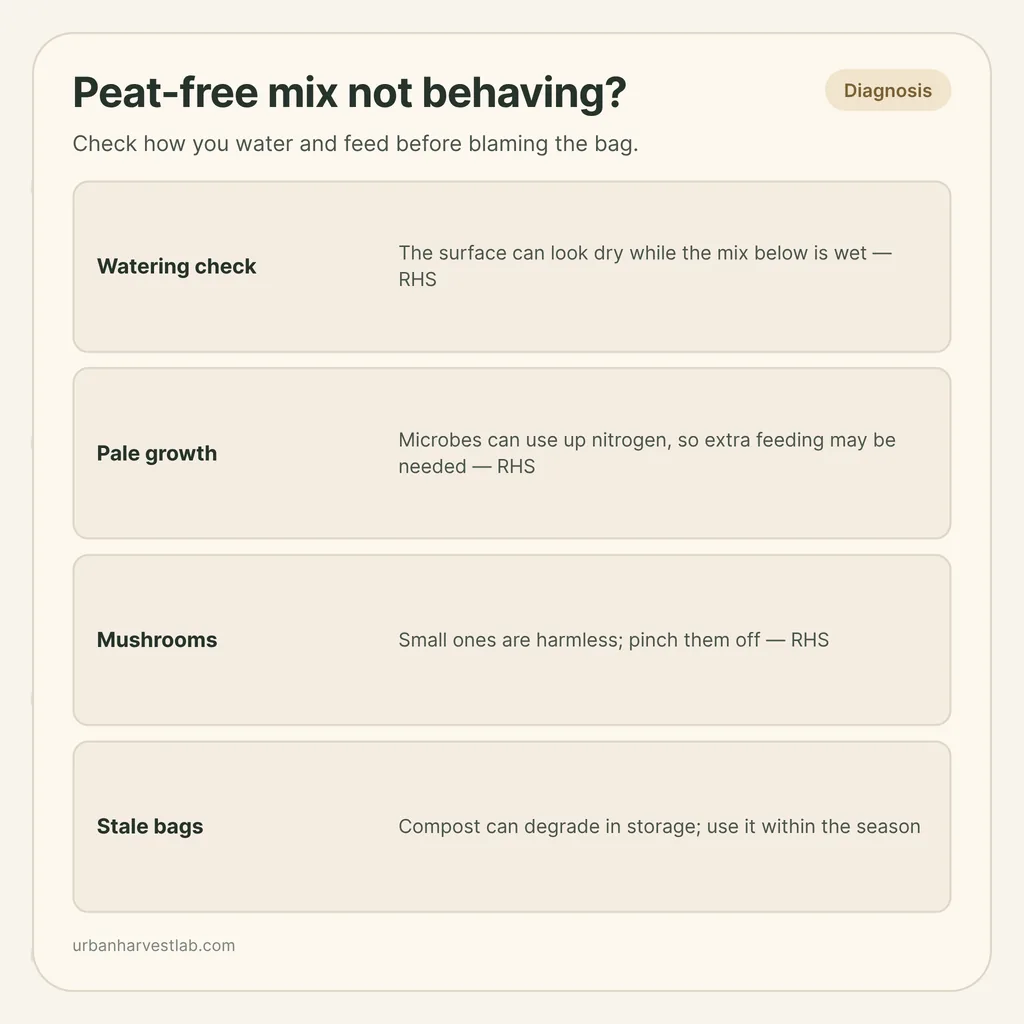
Peat-free potting mix problems: drying, nitrogen and feeding fixes
Peat-free mixes look like peat mixes but behave differently: the surface fools you, the watering rhythm shifts, and feeding often needs adjusting. Here is how to read the pot and correct course.
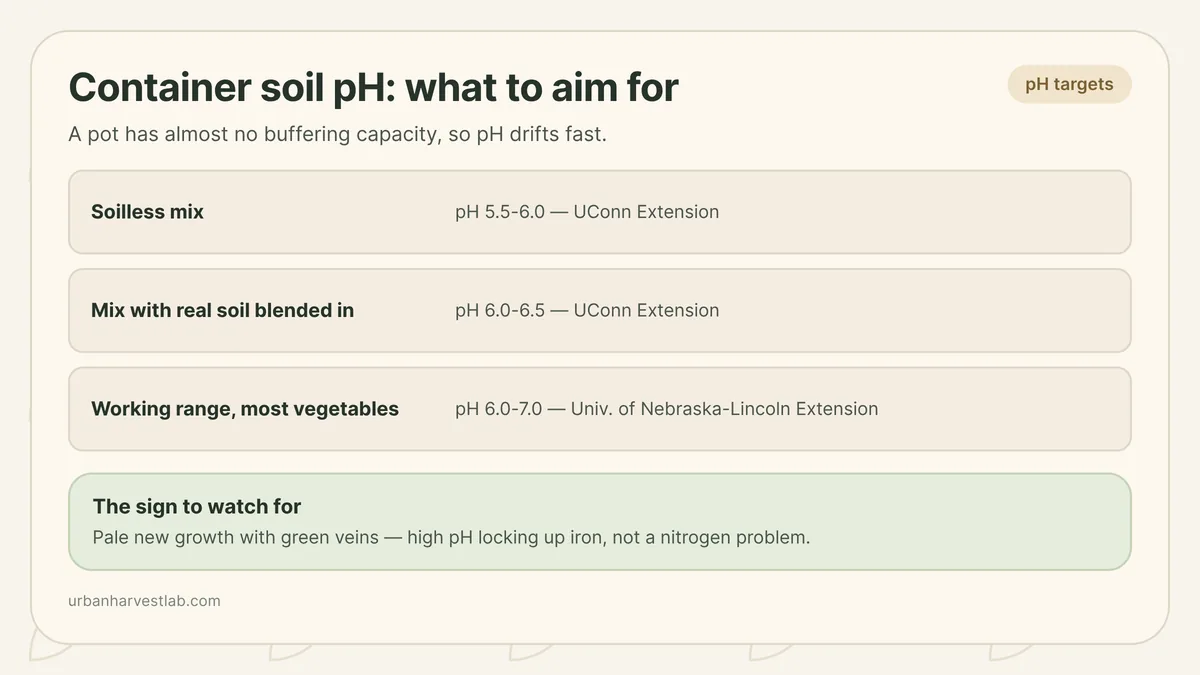
Container soil pH: when it matters and how to fix it
A container's small volume has almost none of the buffering capacity open ground has, so pH drifts faster and matters sooner. Here is when to test, what to aim for, and how to move it.
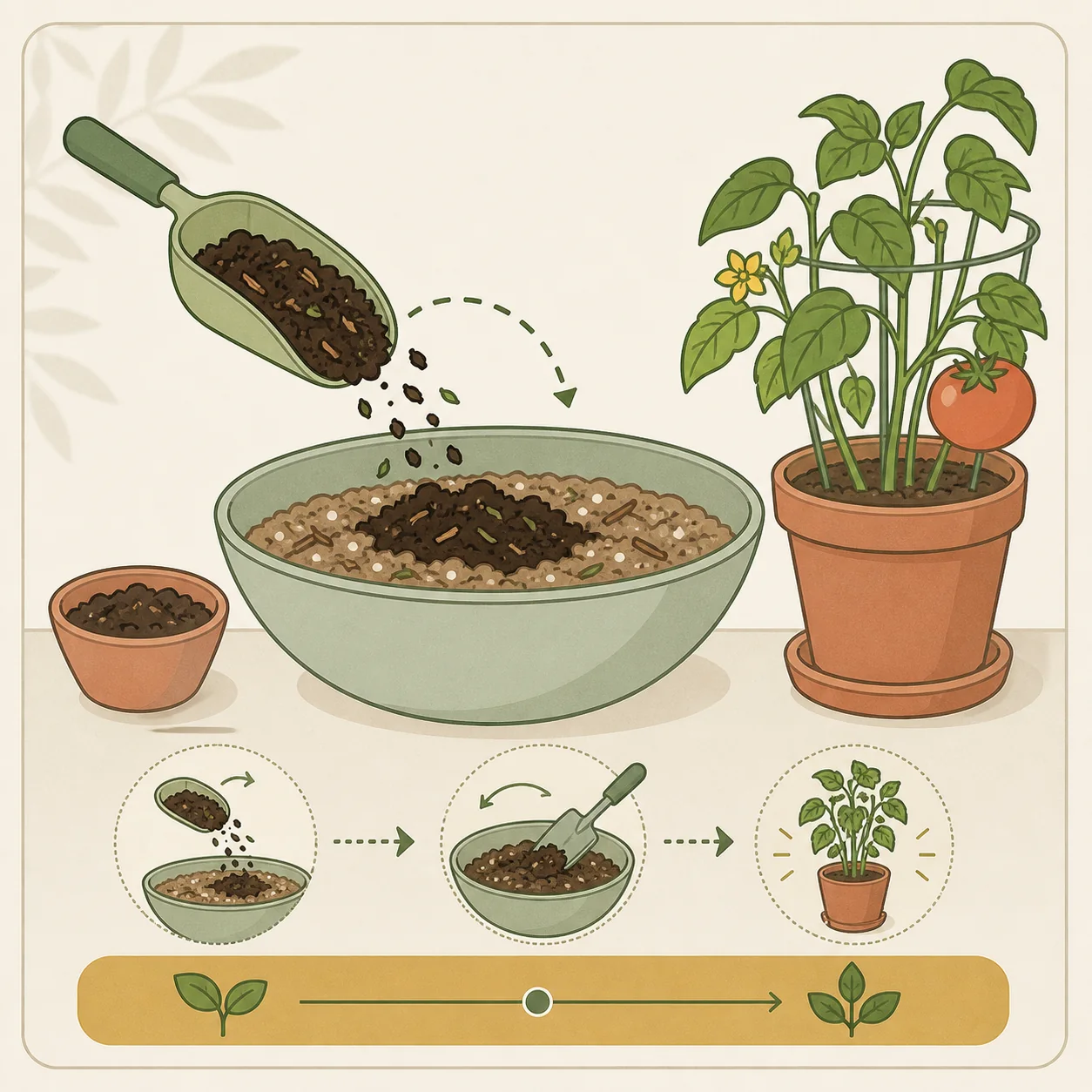
How much compost should you add to potting mix?
More compost is not automatically better. In a container, compost must share limited space with the coarse particles that preserve air around roots.