What research reports about mycorrhizal fungi in different growing situations
| Situation | What the sources report | Source |
|---|---|---|
| Sterilized container media in greenhouse or nursery production | Some success inoculating | WSU Extension |
| Peat-based mix with P-enriched clay, no added soluble phosphate (chives) | Colonization developed; plant weight and phosphorus uptake markedly improved | Kron and Caspersen, International Peat Congress |
| Peat-based mix, medium or high soluble phosphate (chives) | Colonization reduced; no positive effect on growth | Kron and Caspersen, International Peat Congress |
| Gardens and landscapes | Amendments generally ineffective and unnecessary | WSU Extension |
| Mustard family (cabbage, broccoli) | Generally accepted to be non-mycorrhizal, with exceptions | University of Massachusetts Amherst and University of Tennessee review |
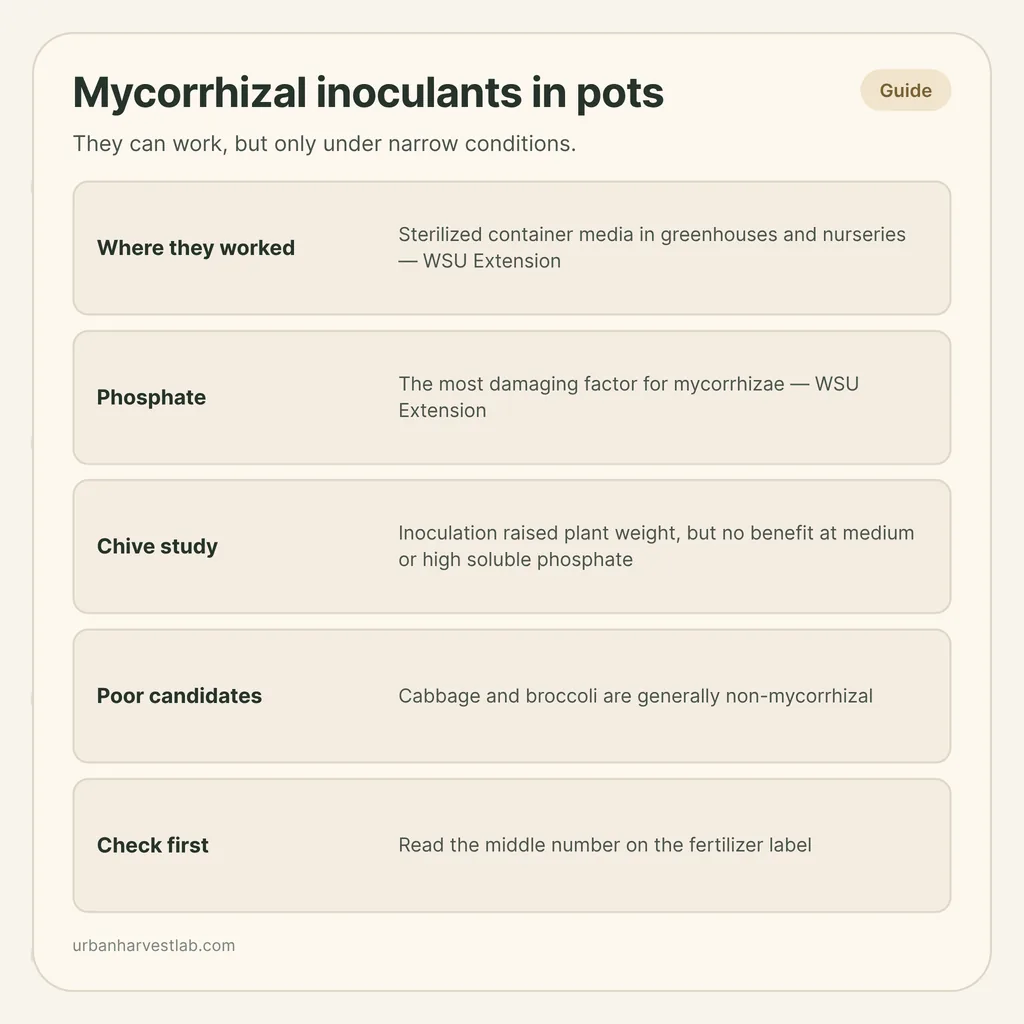
Mycorrhizal inoculants can work in a pot, but only under narrow conditions, and the usual potting-mix-plus-fertilizer routine tends to switch them off. Washington State University (WSU) Extension reports some success inoculating sterilized container media in commercial greenhouses and nurseries. The same publication says that in gardens and landscapes the products are generally ineffective and unnecessary. A home pot sits between those two situations, and the deciding variable is phosphate.
If you already use a rich mix, the first question is not which inoculant to buy. It is how much phosphate is in the potting mix and in whatever you feed it with.
What mycorrhizae are, and why gardeners care
Mycorrhizae are partnerships between fungi and plant roots. The fungal threads reach water and nutrients that roots alone cannot, and the plant pays for it in sugars. WSU Extension says mycorrhizae are particularly good at extracting phosphate, which is often immobile in soil. University of Arizona Cooperative Extension says about 80% of higher plants can be colonized, and that mycorrhizae can improve phosphorus uptake when phosphorus availability is low.
That last clause matters for everything below. The benefit is tied to a plant that is short of phosphorus.
Where inoculants have worked
The cleanest pot result comes from a chive experiment in peat-based substrate, reported by Kron and Caspersen at the 14th International Peat Congress. In peat mixes where P-enriched clay held soluble phosphate down, commercial inoculants produced well-developed root colonization, and plant weight and phosphorus uptake were markedly improved. That is a conference paper rather than a journal article, so treat it as one study, not a settled finding.
WSU Extension, summarising container work, notes some success in sterilized container media in greenhouse or nursery production. Chalker-Scott’s Master Gardener Magazine article says the same: the products can be effective for inoculating sterilized container media. Sterilized, commercial and controlled is the setting where the evidence is best.
Why phosphate decides the outcome
The same chive study found that colonization was reduced when medium or high amounts of soluble phosphate were added. At those levels, there was no positive effect of inoculation on plant growth. The authors point out that the high levels of soluble phosphate commonly used in commercial potting media limit mycorrhizal formation.
WSU Extension agrees from the other direction. It calls unnecessary fertilizer, especially fertilizer containing phosphate, by far the most damaging factor for mycorrhizal health. It adds that many soilless potting mixes are inhibitory if they contain moderate to high levels of phosphate, and that a plant whose tissues contain enough phosphate becomes less receptive to colonization. University of Wisconsin Extension puts it plainly: additions of nitrogen, phosphorus or complete fertilizers reduce the presence and activity of mycorrhiza, with the effect varying by fungal strain.
Organic does not automatically mean safe. WSU lists nutrient-rich organic material, including composted manure, as inhibitory when it carries moderate to high phosphate. USDA’s Agricultural Research Service reported that organic fertilizers are usually compatible with mycorrhizae while phosphorus-rich inorganic fertilizers usually inhibit them, that some composts may suppress the fungi because of high phosphorus levels, and that coir does not inhibit mycorrhizae. Whether a given compost, worm casting or bagged mix crosses the line is not something you can read off the bag.
Reading your own phosphate
On a fertilizer label, the middle number is phosphate. Clemson Cooperative Extension’s example: an 18-4-10 fertilizer contains 18% nitrogen, 4% phosphate and 10% potash. The NPK label guide covers reading the numbers. If a mix does not state its phosphate content, treat it as an unknown rather than a pass.
Which plants are worth it
Arizona’s figure covers higher plants in general, so most garden crops are likely hosts; the mustard family is the documented exception. The clear exception is the mustard family. A review by researchers at the University of Massachusetts Amherst and the University of Tennessee says the Brassicaceae is generally accepted to be non-mycorrhizal, though it documents exceptions. Cabbage and broccoli belong to it. For those crops, an inoculant is a poor bet.
Herbs and vegetables outside that family can form the partnership. Whether it pays off in your pot still depends on phosphate, not on the plant.
What the research says about gardens, and why it matters for pots
WSU Extension reports that studies on gardens and landscapes find mycorrhizal amendments generally ineffective and unnecessary. Plants quickly become colonized by native fungi, and in follow-up studies there was no trace of the inoculant species. University of Arizona Cooperative Extension reaches the same view for native soils.
A balcony pot is cut off from that soil. Whether native fungi can reach it depends on what you filled it with, and the research above does not measure that. What it does show is that if the mix and the feeding schedule are inhibitory, adding fungi on top is the weaker move.
A practical order of operations
- Check what you feed. WSU recommends applying fertilizer only when soil tests indicate a deficiency, which is hard to apply in a pot. A lighter hand is the closest equivalent; see how often potted herbs need fertilizer.
- Compare feed types. Organic and synthetic inputs behave differently around the fungi, as the USDA findings above suggest. The organic versus synthetic comparison lays out what changes in a pot.
- Decide if an inoculant is worth testing. If you do, pair it with a low-phosphate routine. Follow the label of whatever you buy, since the sources here give no dose.
- Consider established soil. WSU suggests a handful of soil from an established landscape to inoculate container plantings. Garden soil carries its own problems in pots; the garden soil in pots page covers them.
Sources
- WSU Extension, A Gardener’s Primer to Mycorrhizae (FS269E)
- WSU, Chalker-Scott, Mycorrhizae: so what the heck are they, anyway? (Master Gardener Magazine, 2009)
- Kron and Caspersen, Reduced phosphorus fertilization in peat-based substrates with added Bara clay and mycorrhizal inoculation (14th International Peat Congress)
- USDA Agricultural Research Service, Helping beneficial fungi work
- University of Wisconsin Extension, Mycorrhizae
- University of Arizona Cooperative Extension, Mycorrhizae in the Landscape
- Trautwig and others, Reviewing ecological implications of mycorrhizal fungal interactions in the Brassicaceae
- Clemson Cooperative Extension, Reading a fertilizer label
Get the potting mix and feeding right first
What the mix contains and how you feed it decide whether mycorrhizal fungi can establish at all.
Common questions
Do mycorrhizal inoculants work in potted plants?
Sometimes. WSU Extension reports some success inoculating sterilized container media in greenhouse and nursery production, and a chive study in peat-based mix found inoculation markedly improved plant weight and phosphorus uptake at low soluble phosphate. At medium or high phosphate, that study found no growth benefit.
Why would mycorrhizal fungi fail to establish in my potting mix?
Phosphate is the usual reason. WSU Extension says many soilless potting mixes are inhibitory if they contain moderate to high levels of phosphate, and that a plant with enough phosphate becomes less receptive to colonization. Fertilizer added on top makes it worse.
Which plants benefit from mycorrhizal inoculant?
University of Arizona Cooperative Extension says about 80 percent of higher plants can be colonized, so most garden plants are likely hosts. A university review describes the mustard family, which includes cabbage and broccoli, as generally accepted to be non-mycorrhizal.
Can I use a handful of garden soil instead of buying inoculant?
WSU Extension suggests a handful of soil from an established landscape to inoculate container plantings. Garden soil also brings weeds and drainage problems into a pot, so weigh that trade-off before mixing any in.
Related guides
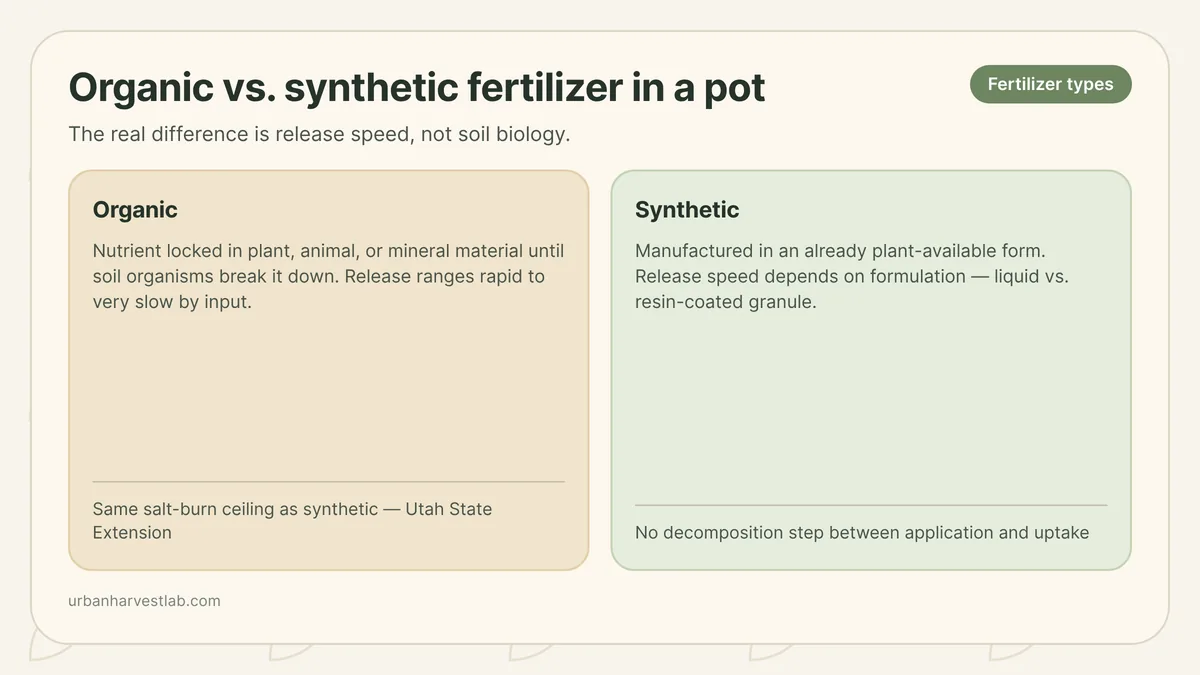
Organic vs. synthetic fertilizer: what actually changes in a pot
Extension sources sort organic fertilizer by release speed, not by a soil-biology edge over synthetic feed, and the same salt-burn ceiling applies to both.
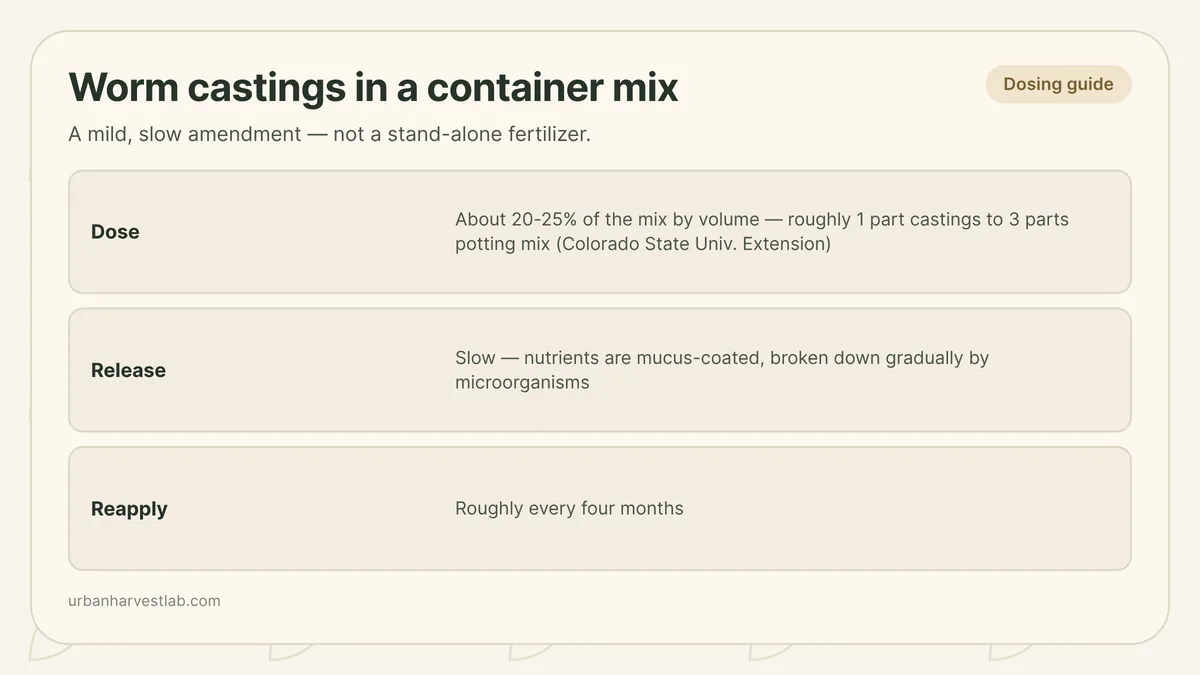
Worm castings in a container mix: what they do and how much to use
Worm castings are a modest, slow-release amendment, not the cure-all the bag copy suggests. Here is what the extension research actually supports and the ratio to mix them at.
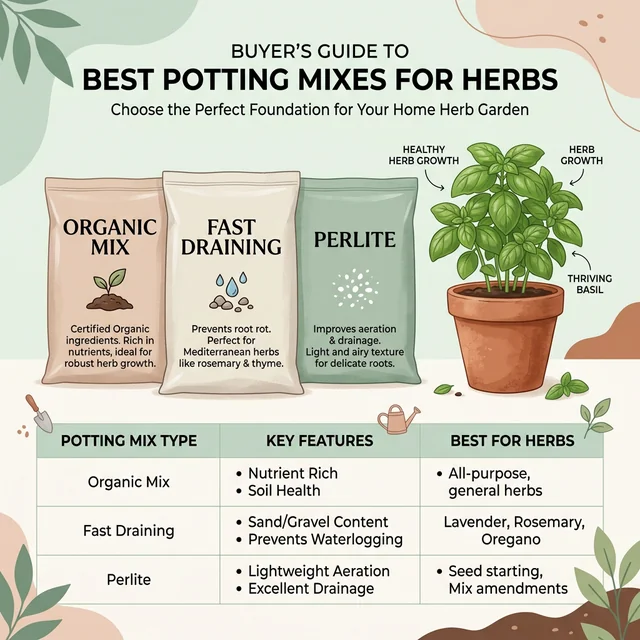
Best potting soil for potted herbs: how to pick the right mix
A practical buyer's guide to choosing potting mix for potted herbs, from richer blends for basil and parsley to faster-draining options for rosemary and thyme.