
Bone meal, blood meal and feather meal as extension sources describe them
| Meal | Main nutrient | Typical analysis | Release speed reported |
|---|---|---|---|
| Blood meal | Nitrogen | 12-0-0 (Colorado State); 12% N, 1-2% phosphate (Utah State) | Rapid (Utah State); two to six weeks (Oregon State); 1-4 months (Colorado State) |
| Bone meal | Phosphorus | 3-15-0 (Colorado State); 1-6% N, 11-30% phosphate (Utah State) | Moderate (Utah State); 1-4 months (Colorado State) |
| Feather meal | Nitrogen | 12-0-0 (Utah State); N varies 7-12% by process (Colorado State) | Moderate (Utah State); 4+ months (Colorado State); most N within four weeks (Oregon State) |
Blood meal feeds nitrogen and bone meal feeds phosphorus, so the right one is whichever nutrient your plant is short of. For a leafy herb that has turned pale and slow, that points to a nitrogen source such as blood meal or feather meal. Bone meal is a phosphorus fertilizer, and Utah State Extension’s table gives it only 1-6% nitrogen.
A pot leaves little room to correct a mistake. If the three numbers on a bag still look like code, reading an NPK label comes first.
What each meal contains
Utah State Extension lists blood meal at 12% nitrogen, 1-2% phosphate and 0-1% potash, with rapid availability. It lists bone meal at 1-6% nitrogen and 11-30% phosphate, with moderate availability. Colorado State’s Master Gardener notes give blood meal as 12-0-0 and bone meal as 3-15-0.
The ranges are wide because these are rendered animal by-products. The number on your own bag is the one that counts.
Feather meal is the third meal in the aisle. Utah State lists it at 12-0-0. Colorado State says the nitrogen varies from 7 to 12% depending on processing. Like blood meal, it brings nitrogen and no phosphorus. Oregon State Extension points to feather meal and blood meal as organic options low in phosphorus.
One label quirk is worth knowing. Colorado State notes that feed-store labels may state phosphorus as elemental phosphorus, which runs 2.3 times higher than the phosphate figure garden-center labels use: 12% phosphate is the same as 27% phosphorus. Two bone meals can look very different on the shelf and be much closer in practice.
Blood meal: nitrogen, at a speed the sources dispute
Use it when the shortfall is nitrogen: pale new growth, slow leaf production, a plant that has used up what the mix started with. Utah State’s advice is to match the material to need, and its example is that if a soil test indicates a nitrogen need, you select a high-nitrogen material like blood meal or fish meal.
On speed, the sources disagree: Utah State rates blood meal rapid, Oregon State describes it as slow release over two to six weeks, and Colorado State gives one to four months.
The catch is burn. Colorado State says blood meal is one of the highest non-synthetic nitrogen sources and that, if over-applied, it can burn plants through excessive ammonia. In a pot, with a small volume of mix around the roots, there is less buffer than in a bed. Utah State adds that many organic materials contain high levels of salts that burn plants when over-applied.
The bed rates published in extension notes (Colorado State’s blood meal figure is 5-10 pounds per 100 square feet) do not scale cleanly to a pot. Use the rate on the package, and if it gives none for containers, start well below it. Spotting overfertilizing early tells you what a too-heavy hand looks like before it costs you the plant.
Bone meal: a phosphorus fix, and only in the right pH
Bone meal earns its place when phosphorus is the missing nutrient, and only then. Clemson Extension advises against defaulting to a balanced formula when phosphorus is already adequate, and Utah State warns that excess applications of organic materials may create a nutrient imbalance and reduce plant growth.
There is a pH condition too. Colorado State reports that its research found phosphorus from bone meal is only available to plants in soils below pH 7.0. UConn Extension gives a typical soilless mix target of 5.5-6.0, so a pot of ordinary potting mix is normally inside the range where the bone meal can work. A pot filled with alkaline garden soil or one that has drifted upward is not, and container soil pH explains how to check and move it.
Feather meal: where the sources disagree
Feather meal is the meal whose reputation is “slow nitrogen”, and the extension sources do not agree on that. Colorado State calls it slow to release and gives 4+ months. Utah State rates it moderate, the same class as bone meal. Oregon State’s vegetable nutrient guide says pelleted fish, chicken and feather meal fertilizers decompose quickly and supply most of their plant-available nitrogen in the first four weeks, and an Oregon State garden article says feather meal breaks down faster than blood meal.
Those results come from different conditions and different products, mostly field soil and not a pot. For a container, treat the timeline as a range of a few weeks to a few months. If you are choosing between feather meal and blood meal, nitrogen content is not what separates them, since both sit near 12%. Pick on what the bag in front of you says and what you are willing to wait for.
Why release is a range, not a date
Both meals are organic nitrogen or phosphorus locked in dried animal material. Microbes have to break them down before roots can take them up, which is why Oregon State’s nitrogen-release predictions assume the soil has enough moisture and is warm enough for that process to run. A cool windowsill or a bone-dry pot slows the release.
That range is also the reason these meals are poor tools for a quick fix. If a plant needs nitrogen this week, a liquid feed delivers it faster, and slow-release versus liquid fertilizer covers that trade-off. For the broader question of whether organic inputs behave differently from synthetic ones in a pot, see organic vs synthetic fertilizer.
Which one to reach for
Work through it in this order.
- The plant is pale and slow, and the mix is more than a few weeks old. Nitrogen is the likely gap, so blood meal or feather meal fits. Water the pot first, because fertilizer goes on moist mix.
- The plant is growing well. Add nothing. There is no gap for either meal to fill.
- You have a reason to think phosphorus is short, such as a soil test result. Bone meal is a candidate, provided the mix is below pH 7.0.
- You are not sure what is short. Start with the best fertilizer for herbs in pots, which sets out a label-first route, instead of guessing between meals.
Applying both meals “to cover everything” adds salts and a nutrient you may not need. One meal for one identified gap is the safer pattern.
For the wider set of small-space growing decisions, the small-space herb gardening hub links the rest of the container series.
Sources
- Utah State University Extension: Selecting and Using Organic Fertilizers
- Colorado Master Gardener, Colorado State University Extension: Garden Notes 234, Organic Fertilizers
- Oregon State University Extension: Nutrient Management for Sustainable Vegetable Cropping Systems in Western Oregon (EM 9165)
- Oregon State University Extension: Choosing the right fertilizer for your garden
- Oregon State University Extension: OSU organic fertilizer and cover crop calculator (EM 9235)
- Clemson Cooperative Extension, HGIC: Reading a Fertilizer Label
- UConn Extension, Home Garden Education Office: Potting Media
Choosing and dosing a fertilizer for a pot
Read the label first, then pick a feeding style, then watch for the signs of too much.
Common questions
What is the difference between bone meal and blood meal?
Blood meal is a nitrogen fertilizer: Utah State lists it at about 12% nitrogen with rapid release. Bone meal is a phosphorus fertilizer: Utah State lists 1-6% nitrogen and 11-30% phosphate, and Colorado State gives a typical 3-15-0 analysis. Choose blood meal when the plant needs nitrogen for leafy growth and bone meal only when phosphorus is the nutrient that is short.
Can you use bone meal and blood meal together?
You can, and the two cover different nutrients, but there is little reason to apply both unless you know the mix is short of both nitrogen and phosphorus. Utah State warns that excess applications of organic materials may create a nutrient imbalance and reduce plant growth, so add only the nutrient that is missing.
Is blood meal or bone meal better for potted herbs?
A nitrogen source such as blood meal is the more common fit for leafy herbs that have gone pale, because bone meal supplies phosphorus rather than nitrogen. Neither is needed when the plant is growing well. Apply either one sparingly and to moist mix, and watch for leaf-tip scorch.
How long do blood meal and bone meal take to work?
Sources give ranges rather than one number. Oregon State describes blood meal as slow release over two to six weeks, Colorado State gives one to four months for both blood meal and bone meal, and Utah State rates blood meal rapid and bone meal moderate. Warm, moist mix speeds the microbial breakdown these meals depend on.
Related guides
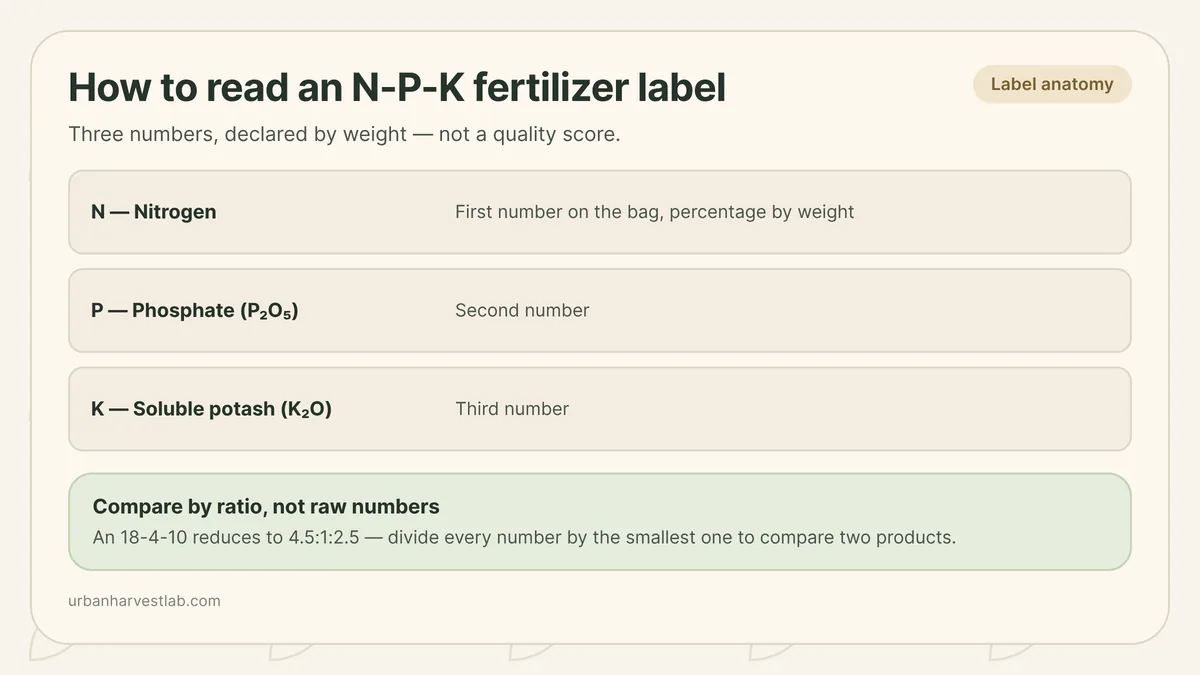
How to read an NPK fertilizer label for herbs
The three numbers on a fertilizer bag tell you exactly what's inside by weight, nothing about whether your herbs need it. Here's how to read them and compare products correctly.
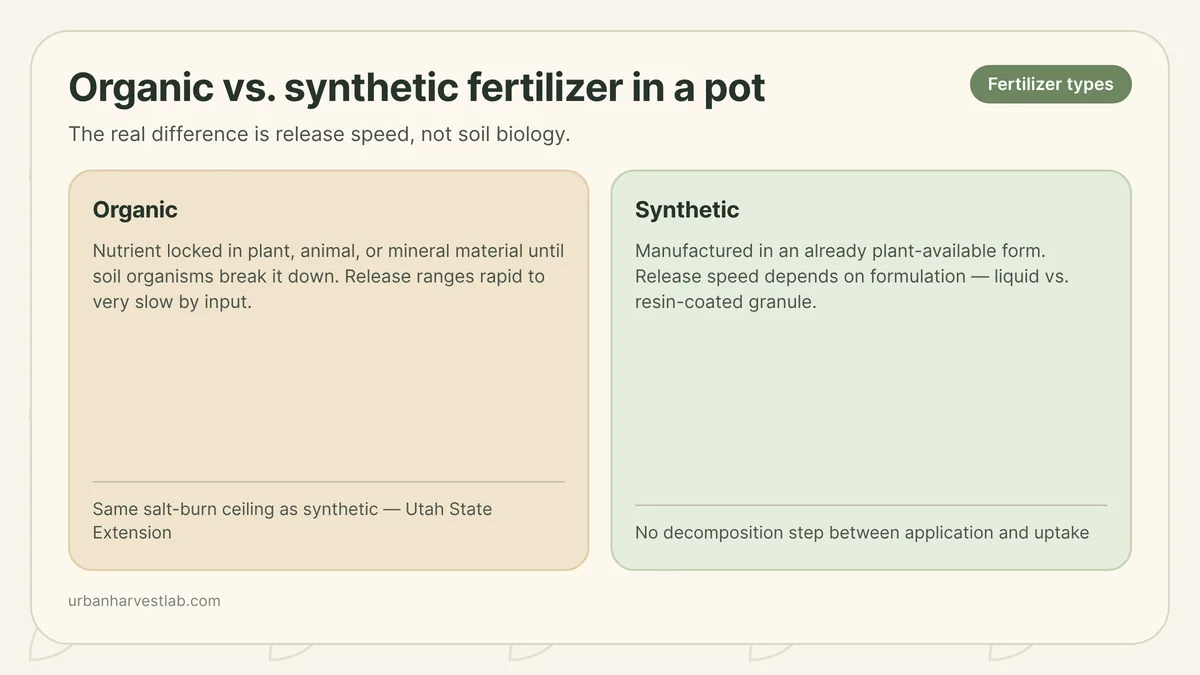
Organic vs. synthetic fertilizer: what actually changes in a pot
Extension sources sort organic fertilizer by release speed, not by a soil-biology edge over synthetic feed, and the same salt-burn ceiling applies to both.
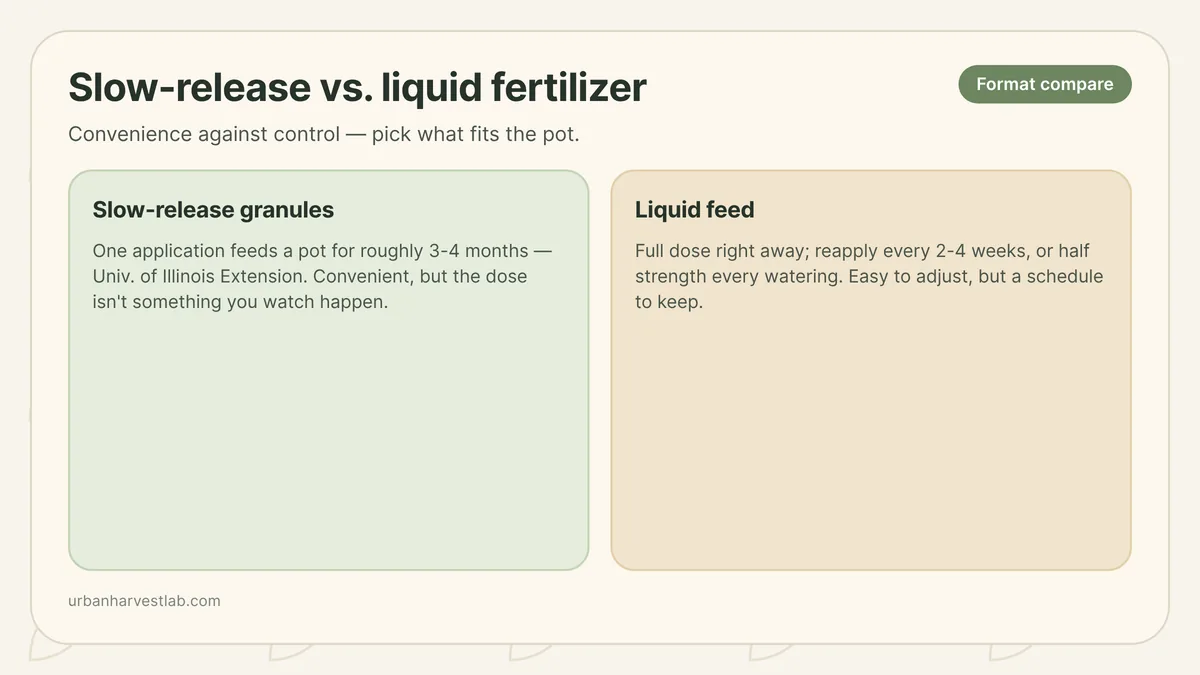
Slow-release vs. liquid fertilizer: which one fits your container
Granular slow-release and liquid fertilizer solve different problems in a pot. Here is how each one actually releases nutrient, and which situation calls for which.