What to do with dug garden soil, by use
| Use | Verdict | Why |
|---|---|---|
| Pot filled with straight garden soil | Skip it | Penn State Extension says not to use straight garden soil in containers; it is heavy, dense and drains poorly. |
| Up to 10% of the volume in a very large container | Allowed, with care | University of Maryland Extension caps topsoil at 10% of the volume and only for very large containers. |
| One-third of a seedling mix, after oven pasteurising | Possible | Oregon State Extension's formula uses one-third pasteurised soil or compost, with one-third sand, vermiculite or perlite and one-third coir or peat. |
| Seed trays or small pots, untreated soil | Skip it | University of Maryland Extension says garden soil contains weed seeds and possibly pathogens. |
| Soilless mix, compost, or half and half | Use this | University of Maryland Extension lists all three as good container mixes. |
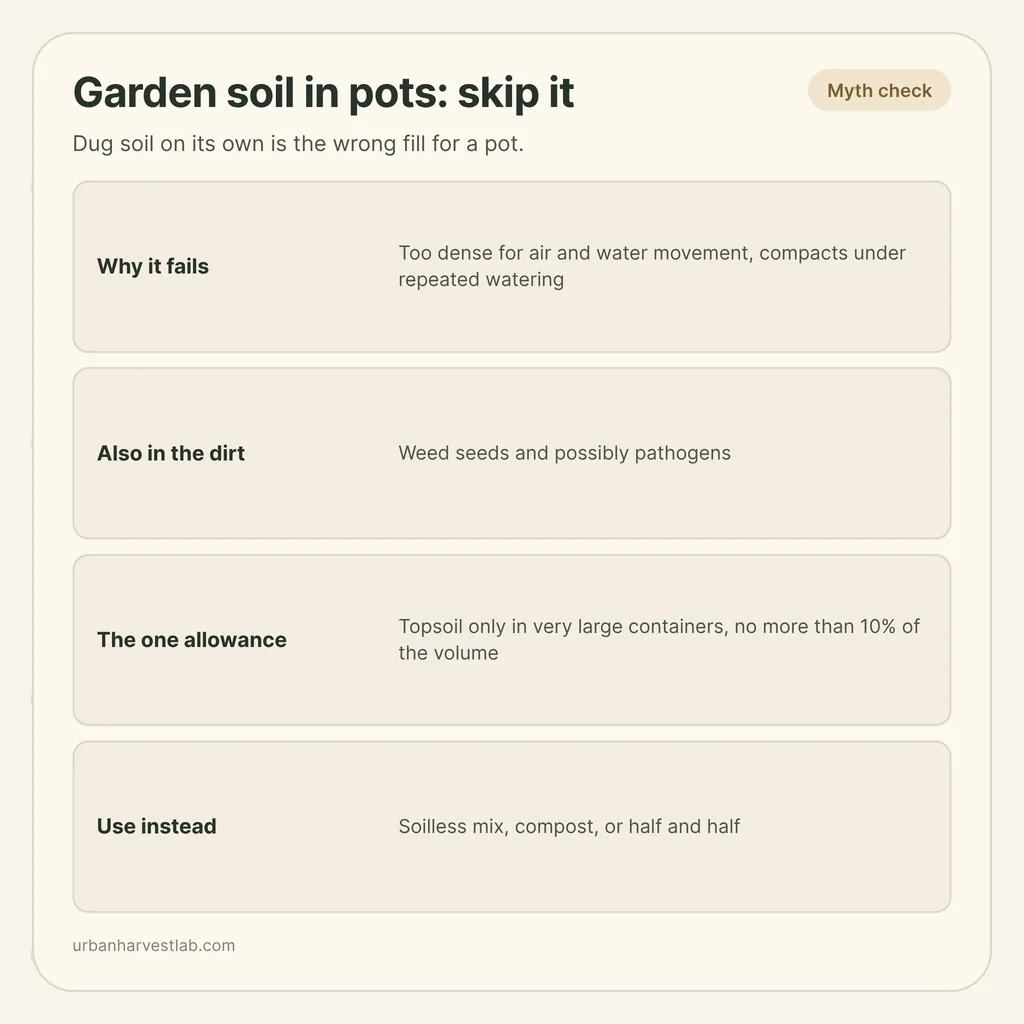
Skip it. Dug garden soil on its own is the wrong fill for a pot. If you want to use some, University of Maryland Extension allows topsoil only in very large containers and no more than 10% of the volume. Everything else should be a soilless mix, compost, or a blend of the two.
The temptation is understandable. You have a bed of dark, crumbly soil that grows tomatoes in the ground, and a bag of potting mix costs money. But the same dirt behaves differently once a plastic wall surrounds it, and the way it fails is slow enough that you may blame the watering, the fertiliser, or the plant first. The wider comparison of bagged products lives in potting mix vs raised bed soil for containers; the question here is the dirt in your own yard.
Why garden soil compacts in a pot
In the ground, water drains into the soil beneath. In a pot there is no beneath. University of Maryland Extension puts it this way: “Soils are too dense to allow for good air and water movement when added to a container garden.” Soil also “hold[s] water very well in their small pore spaces and can drown roots,” especially in shallow containers.
Roots need air as much as water. The same Maryland page explains the failure chain: if excess water cannot drain away, fresh air cannot enter and the roots suffocate. A fine, mineral fill keeps its pores full of water, and each irrigation compresses it a little more.
UConn Extension names the repeated watering as the culprit. Mineral-based soils, it says, “physically do not hold up well under repeated watering and will rapidly become very compacted.” That is why a pot of garden soil can look fine at planting and be a brick by midsummer.
Layering stones or shards under the soil does not rescue it. Why a gravel layer fails to improve drainage explains the mechanism.
Weeds, pathogens and the seedling problem
Density is half of it. For seed starting, University of Maryland Extension is blunt: do not try to save money with garden soil, because it is too dense and “contains weed seeds and possibly pathogens.” Oregon State Extension says the same of typical backyard soil: compacted, full of weed seeds and not pasteurised, which can lead to seedling diseases and plant loss. It adds that native soil often does not drain as well as seedling mixes and can form a crust that seedlings cannot push through.
Bagged soilless mixes are the opposite on that score. Maryland describes them as lightweight, free-draining, and generally free of weeds, insects and diseases. For trays and small pots, seed-starting mix vs potting mix covers which bag fits.
The one allowance: a small share in a big container
Extension sources do leave a narrow door open. University of Maryland Extension writes that topsoil should be added only to very large containers and should not exceed 10% of the volume. A second line on the same page, in its list of mixtures, gives the ceiling as 5-10%. The page does not say how big “very large” is, so treat a 5-gallon bucket or a window box as outside it and use your own judgement for a half-barrel or a big tub.
In practice that means ten litres of soil in a 100-litre container at most, mixed through a light base so it behaves like an ingredient and not like the main fill. There is a reason to do it at all. UConn Extension notes that heavy mixes containing some sand or mineral soil suit large or top-heavy houseplants, which is a stability argument rather than a growth one.
If you are filling something like a bucket, the better move is the lighter fill described in five-gallon bucket gardening.
Pasteurising garden soil before you mix it
Pasteurising removes the weed seeds and disease organisms. It does not change how dense the soil is. Treat it as a way to make a minor ingredient safer, not as a way to make a pot of dirt work.
UConn Extension describes sterilised potting soil as heated to about 180 degrees Fahrenheit to kill microorganisms and weed seeds. Oregon State Extension gives the small-batch oven method with exact figures:
- Moisten the soil slightly.
- Place it in a heat-resistant container or pan and cover with a lid or foil.
- Put it in a 250 °F (about 121 °C) oven.
- Check the temperature with a candy or meat thermometer.
- When the mix reaches 180 °F (about 82 °C), hold it there for 30 minutes (Oregon State Extension).
Oregon State warns to avoid overheating because it can damage the soil structure. Its worked example is a seedling medium of one-third pasteurised soil or compost, one-third sand, vermiculite or perlite, and one-third coconut coir or peat moss. That formula is for seed starting, and the soil share there is a full third, far more than the 10% Maryland allows for finished container mixes, so do not carry it over to a big planter of tomatoes.
What to use instead
If you came to garden soil because you want to spend less, there are cheaper routes that keep the mix light.
- Compost. University of Maryland Extension says vegetables, herbs and flowers can be grown in 100% compost or leaf mold. Its listed mixes for container vegetables are 100% compost, 100% soilless mix, and half soilless mix with half compost. Pick finished compost, as covered in choosing compost that is safe for edible containers, and see how much compost to add to potting mix for smaller shares.
- A homemade blend. How to make potting mix for container vegetables builds a mix from a base, a coarse component and a nutrient source.
- Last year’s mix. Maryland suggests mixing last year’s media 50:50 with fresh media or compost, provided root disease was not a problem. Reusing potting soil covers when that is safe.
Quick decision guide
| Situation | Do this |
|---|---|
| Any pot, bucket or window box | Soilless mix, compost, or half and half |
| Seed trays and seedlings | Bagged seed-starting mix, or pasteurised soil within Oregon State’s one-third formula |
| Very large tub or half-barrel, you have spare topsoil | Up to 10% of the volume, mixed through a light base |
| Already planted in garden soil and water sits on top | Repot into a lighter mix |
Sources
- University of Maryland Extension, Growing Media (Potting Soil) for Containers
- University of Maryland Extension, Containers and Potting Soil for Indoor Seed Starting
- Penn State Extension, Container Vegetable Gardening: Four Keys to Success
- UConn Extension, Potting Media
- Oregon State University Extension, Make your own seed-starting mix for winter prep
Choose the right fill for your pots
These pages cover bagged mixes, homemade recipes, and why the bottom layer of a pot cannot rescue a dense fill.
Common questions
Can you use garden soil in pots?
Not on its own. Penn State Extension tells growers to fill containers with a soilless mix and not use straight garden soil, and University of Maryland Extension says soil is too dense for good air and water movement in a container. The one allowance is a small share: topsoil only in very large containers and no more than 10% of the volume.
How much garden soil can I mix into potting mix?
University of Maryland Extension gives a ceiling of 10% of the volume, and a second line in the same page says 5-10%, both for very large containers only. In a 20-litre container that is 2 litres at most. The page does not define how large counts as very large, so treat smaller pots as zero.
Does baking garden soil make it safe for pots?
It deals with weed seeds and disease organisms, not with density. Oregon State Extension heats a moistened batch until a thermometer reads 180 °F (about 82 °C) and holds it there for 30 minutes. The soil still compacts afterwards, so it only works as a minor part of a mix.
What can I use instead of garden soil in a pot?
A soilless mix, compost, or a 50:50 blend of the two. University of Maryland Extension lists 100% soilless mix, 100% compost, and 50% soilless mix plus 50% compost as good container mixes for vegetables.
Related guides
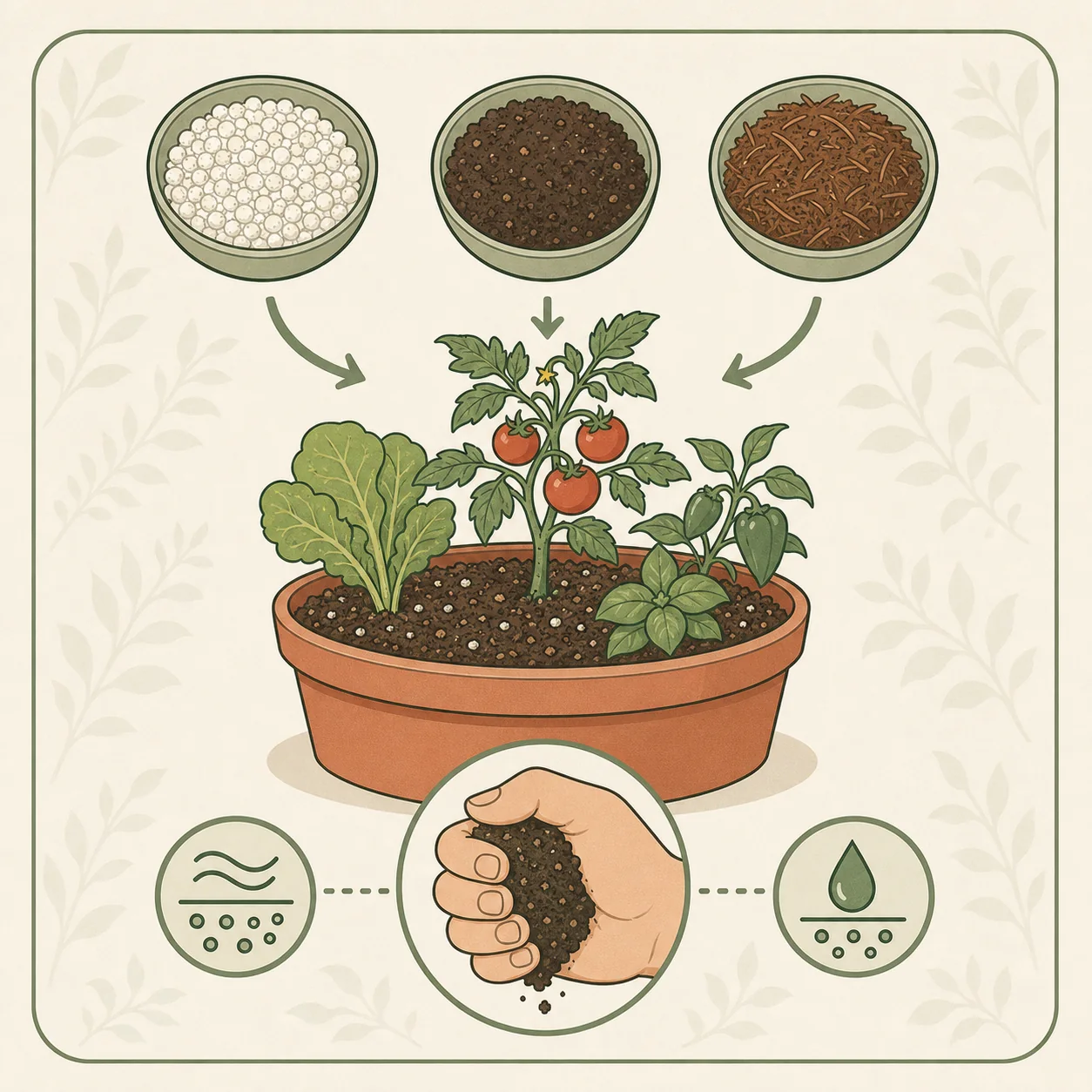
How to make potting mix for container vegetables
A useful potting mix recipe describes the job of each ingredient and gives you a way to correct the result. The goal is stable air and moisture, not a magic ratio.
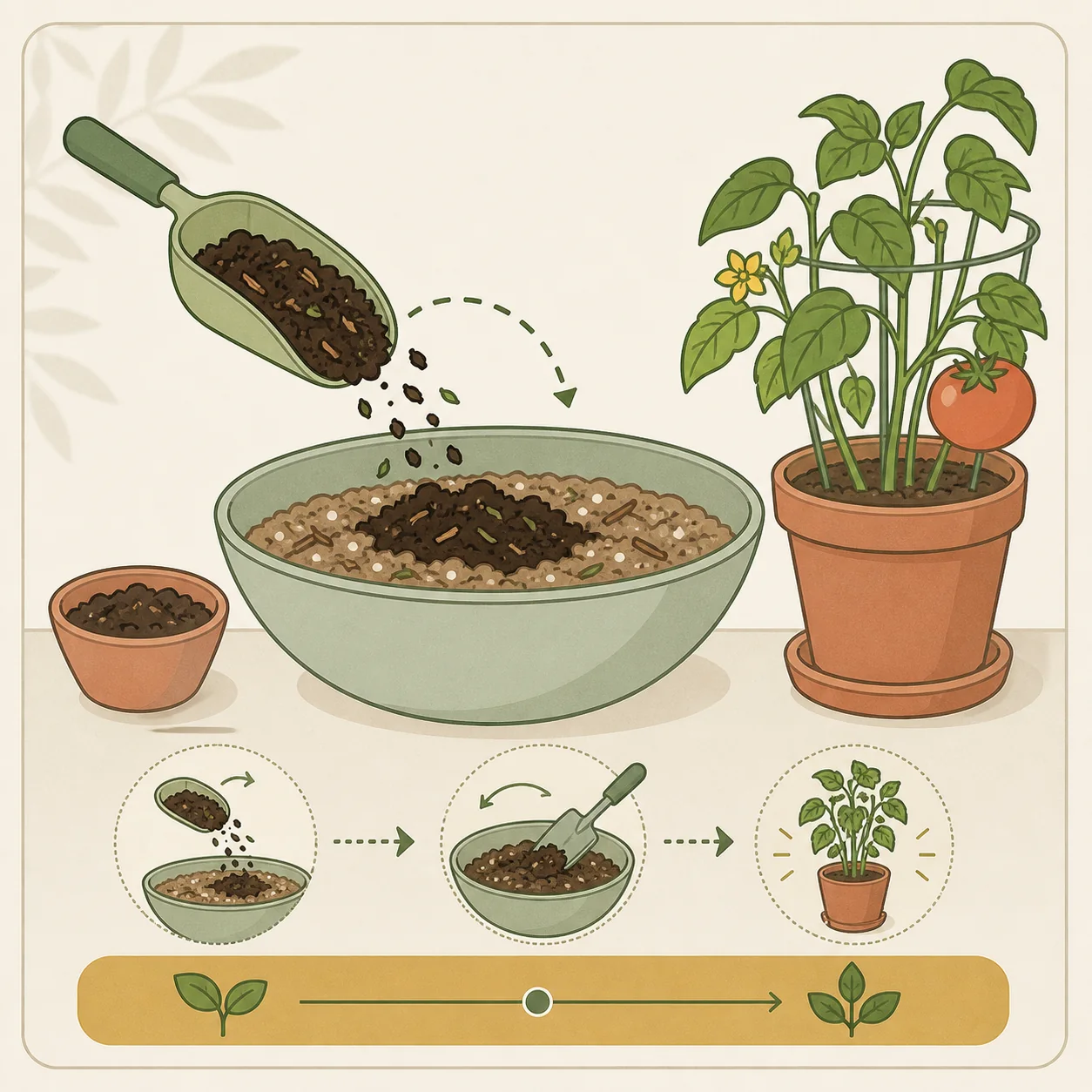
How much compost should you add to potting mix?
More compost is not automatically better. In a container, compost must share limited space with the coarse particles that preserve air around roots.
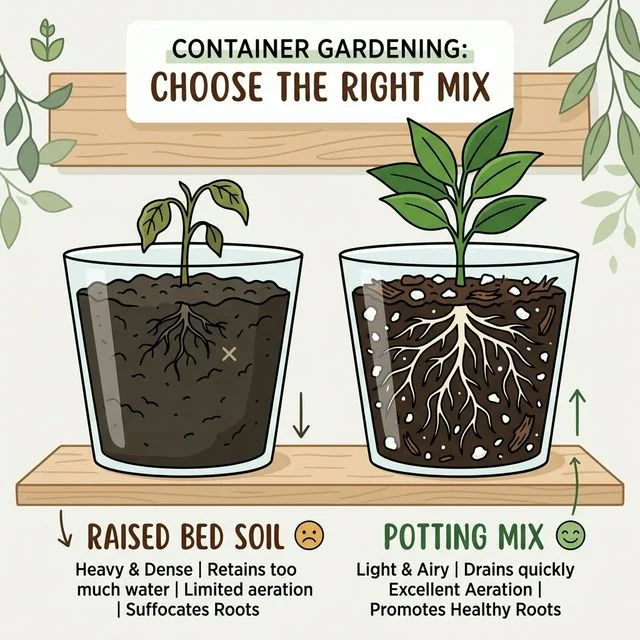
Potting mix vs raised bed soil for containers: what works in pots
Most container problems start with the wrong medium, not the wrong fertilizer. This guide explains why pots usually need a lighter mix than raised beds.