Worm castings versus other container amendments
| Amendment | Typical dose by volume | Release pattern | Reapplication |
|---|---|---|---|
| Worm castings | 20-25%, about 1:3 with potting mix | Slow; nutrients are mucus-coated and released as microorganisms break the coating down | Roughly every four months |
| Compost | 10-33% depending on use | Faster and less predictable; a fresh compost-amended mix supplies its main starter nutrition for about two to three weeks | Depends on the mix; see the compost dosing guide |
| Controlled-release fertilizer granules | Per product label at planting | Steady release from a resin coating over roughly 3-4 months, tied to watering and temperature | Per product label, typically once per season |
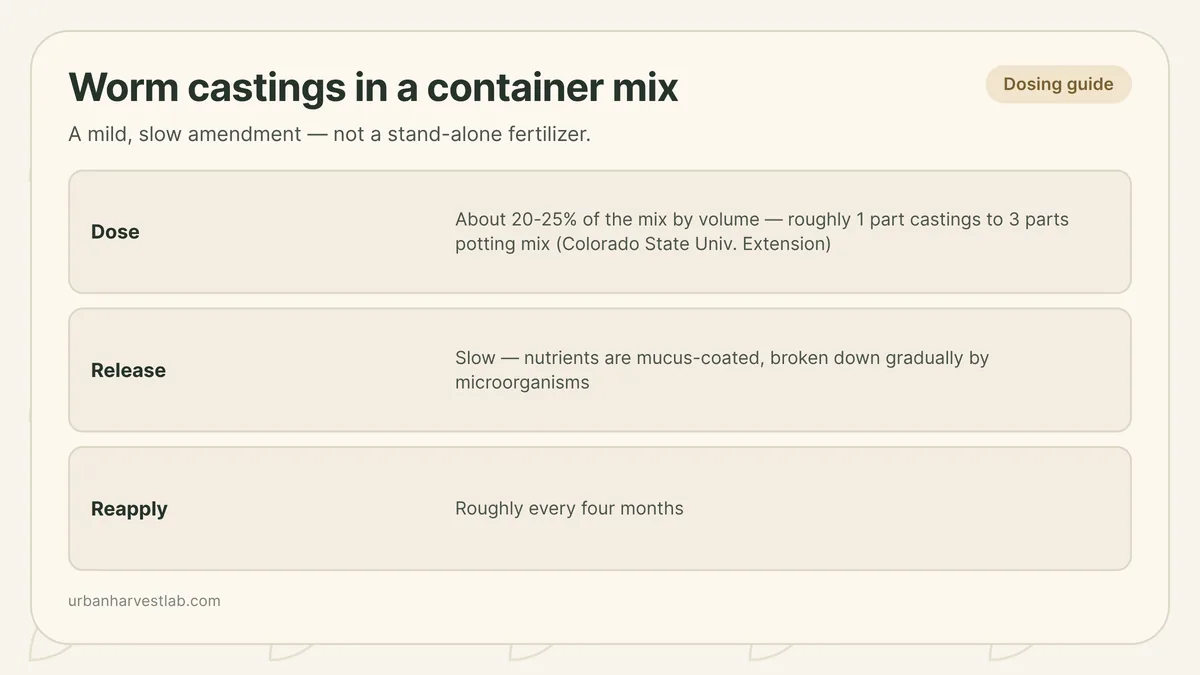
Worm castings work best mixed into a container medium at roughly 20-25% of the finished volume — close to one part castings to three parts potting mix, per Colorado State University Extension — as a mild, slow-release amendment, not a stand-alone fertilizer or a cure-all soil treatment. The nutrients they carry are coated in a mucus layer that breaks down gradually as soil microorganisms work on it, so the effect is closer to a steady trickle than a dose that shows results in a few days.
That is a smaller claim than the bag copy on most worm-castings products, which tends to promise everything from disease resistance to a dramatic yield jump. Colorado State University Extension’s own framing is more restrained: worm castings are a soil amendment, priced and used the way you would use any concentrated organic input, and if you are also deciding how much compost belongs in the same potting mix, the two behave differently enough that swapping one for the other at the same rate is a mistake.
Castings are a soil amendment, not a feed
Colorado State University Extension frames vermicompost’s nutrient release mechanically: the nutrient content is coated in a mucus layer, and that coating “degrades slowly by microorganisms” rather than dissolving into the water in the pot the moment you water it in. Practically, that means castings behave more like a slow, cumulative soil conditioner than a fertilizer you’d dose and expect to see act within a week.
The same source is candid about cost and where castings make sense: vermicompost is “relatively expensive” compared with ordinary compost, which is why extension guidance reserves it for small gardens and potting mixes rather than treating a whole raised bed or garden row with it. A container is exactly the scale where that expense is proportionate — you are amending a few gallons of medium, not several cubic yards of bed.
Colorado State University Extension frames castings as a soil amendment alongside compost, not as a substitute fertilizer — which is the practical difference between the two bags on the shelf: compost corrects structure and adds a modest nutrient charge, castings correct structure with an even milder, slower one, and neither replaces a feeding plan sized to what the plant is actually doing.
How much to use, and how often
Colorado State University Extension’s figure is stated a few different ways across the sources it draws on — “about 20 percent,” “up to 20% by volume,” and “1 part worm castings to 3 parts potting mix,” which works out to roughly 25%. Treat 20-25% by volume as the practical range rather than chasing a single exact number.
Measure by volume, not weight, using the same scoop or bucket for every ingredient in the batch. Applying Colorado State University Extension’s 20-25% range to a 12-liter batch of finished mix works out to roughly 2.5 to 3 liters of castings folded into 9 to 9.5 liters of the rest of your mix — a ratio you can scale up or down to whatever container size you are filling. Going well past that range does not scale the benefit — castings still occupy pore space that would otherwise go to the aeration components (perlite, bark, coarse coir) that keep roots supplied with air, and a mix overloaded with any fine organic material settles and drains more slowly.
Fold the castings through the rest of the mix rather than layering them in one band, the way potting soil sometimes ships from a bag with compost concentrated near the bottom. An even distribution means every root gets a similar share of the slow-release nutrient instead of a lucky few roots sitting directly in a concentrated pocket while the rest of the root ball gets none. This matters more for castings than for a granular fertilizer, precisely because the release is gradual and passive — there is no watering-in step that redistributes a mucus-coated nutrient the way dissolving a soluble feed does.
Because release is gradual, a single application does not carry a container through an entire growing season. Colorado State University Extension’s guidance points to roughly four-month intervals for repeat applications — closer to a seasonal top-up than a set-it-and-forget-it amendment.
Worm castings, compost, and slow-release fertilizer are not interchangeable
It is easy to treat any dark, earthy-smelling organic amendment as roughly the same thing, but the numbers do not line up. Ordinary compost is dosed across a wider range in a container — commonly 10-33% by volume depending on the crop and mix, as covered in the compost dosing guide — and its main starter-nutrient effect runs out faster: Utah State University Extension gives a two-to-three-week window before a fresh compost-amended mix needs its first liquid feed. Worm castings, dosed lower and releasing more slowly, are working on a longer, gentler curve than that.
A controlled-release fertilizer granule is a third, different tool again. University of Illinois Extension describes its resin coating releasing nutrient with each watering over roughly three to four months, depending on moisture and temperature — a similar time horizon to castings’ four-month reapplication interval, but a purpose-built, concentrated feed rather than an organic-matter amendment. Many growers use both in the same pot: castings and compost for structure and a slow nutrient base, a complete fertilizer for the plant’s actual seasonal demand. If you are assembling that fertilizer side of the plan, best fertilizer for herbs in pots covers choosing between liquid and controlled-release products.
Do worm castings replace fertilizer?
Not for a plant with real seasonal demand. A long-season fruiting crop — tomato, pepper, cucumber — needs a sustained nutrient supply that a mild, slow amendment is not designed to carry on its own. Do potted herbs need fertilizer? walks through how to tell whether a container actually needs feeding yet, which is worth checking before adding castings, compost, and a fertilizer all into the same fresh pot at once — stacking every gentle input still adds up.
Because the release is mild and gradual rather than concentrated, castings feel forgiving compared with a synthetic fertilizer. Utah State University Extension notes that many organic materials carry high salt levels and will burn plants if over-applied, which applies to castings as much as to any organic input — stay inside the 20-25% range rather than assuming an organic amendment cannot be overdone. Organic vs synthetic fertilizer covers the burn-risk comparison in full. Past that range, an organic material added well past the working range can also crowd out aeration and slow drainage. If you notice a stalled pot, salt crust, or scorched leaf tips after building up several organic inputs at once, signs of overfertilizing herbs covers what to check before assuming any one ingredient caused it.
Producing your own castings
Everything above assumes you are buying or already have finished worm castings to mix in. Running an indoor worm bin to produce your own is a separate project, with its own bin size, feeding rhythm, and harvest timeline — that setup and maintenance routine belongs to vermicomposting in an apartment rather than this mixing ratio.
Bought or homegrown castings behave the same way once they are in the mix — Colorado State University Extension’s 20-25% figure and four-month reapplication interval do not depend on where the material came from. The practical difference is supply: a bag of commercial castings gives you a known, consistent quantity to measure against a recipe, while a home bin’s output arrives in smaller, less predictable batches tied to how much the worms have processed since the last harvest. Either way, treat what you have as the same ingredient at the same dose, rather than assuming homegrown castings are stronger or weaker without a reason to think so.
Sources
Build the rest of the feeding plan
Worm castings are one input in a container mix. These cover the base mix, the compost fraction, and the fertilizer schedule around them.
Common questions
What do worm castings actually do for potted plants?
They add a mild, slow-release source of nutrients coated in a mucus layer that soil microorganisms break down gradually, plus organic matter that helps the mix hold structure. That is a modest, cumulative benefit rather than the fast growth boost or disease cure some marketing implies.
How much worm castings should I mix into potting soil?
Colorado State University Extension's guidance points to roughly 20 to 25 percent of the finished mix by volume, close to one part worm castings to three parts potting mix. More is not automatically better, since castings still need to share pore space with the aeration components that keep roots supplied with air.
How often should I reapply worm castings in a container?
About every four months, per Colorado State University Extension, since the nutrient release is gradual rather than a single dose that runs out on a fixed schedule.
Can worm castings replace fertilizer in a container?
Not on their own for a heavy feeder. Their release is mild and slow, so a long-season fruiting crop with sustained nutrient demand still needs a feeding plan built around a complete fertilizer, with castings as a supporting input rather than the whole program.
Related guides
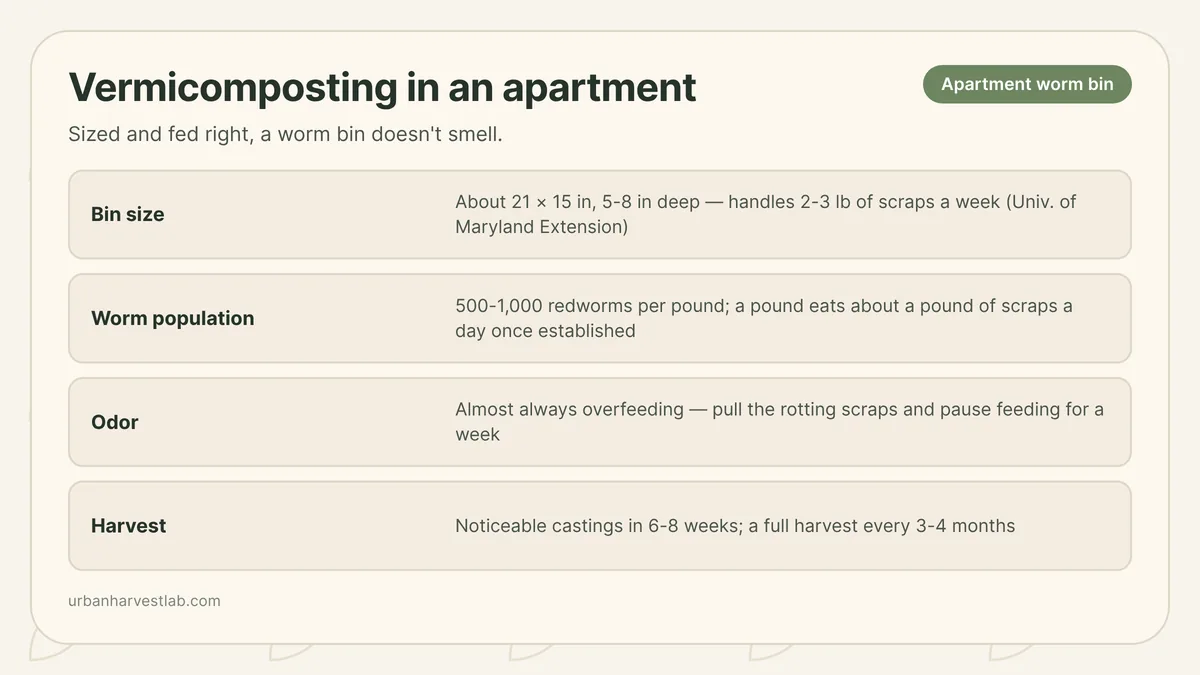
Vermicomposting in an apartment: bin setup, feeding, and harvest
A worm bin sized and fed correctly runs in a closet or under a sink without odor. Here is the setup, the feeding rules, and how to harvest the castings.
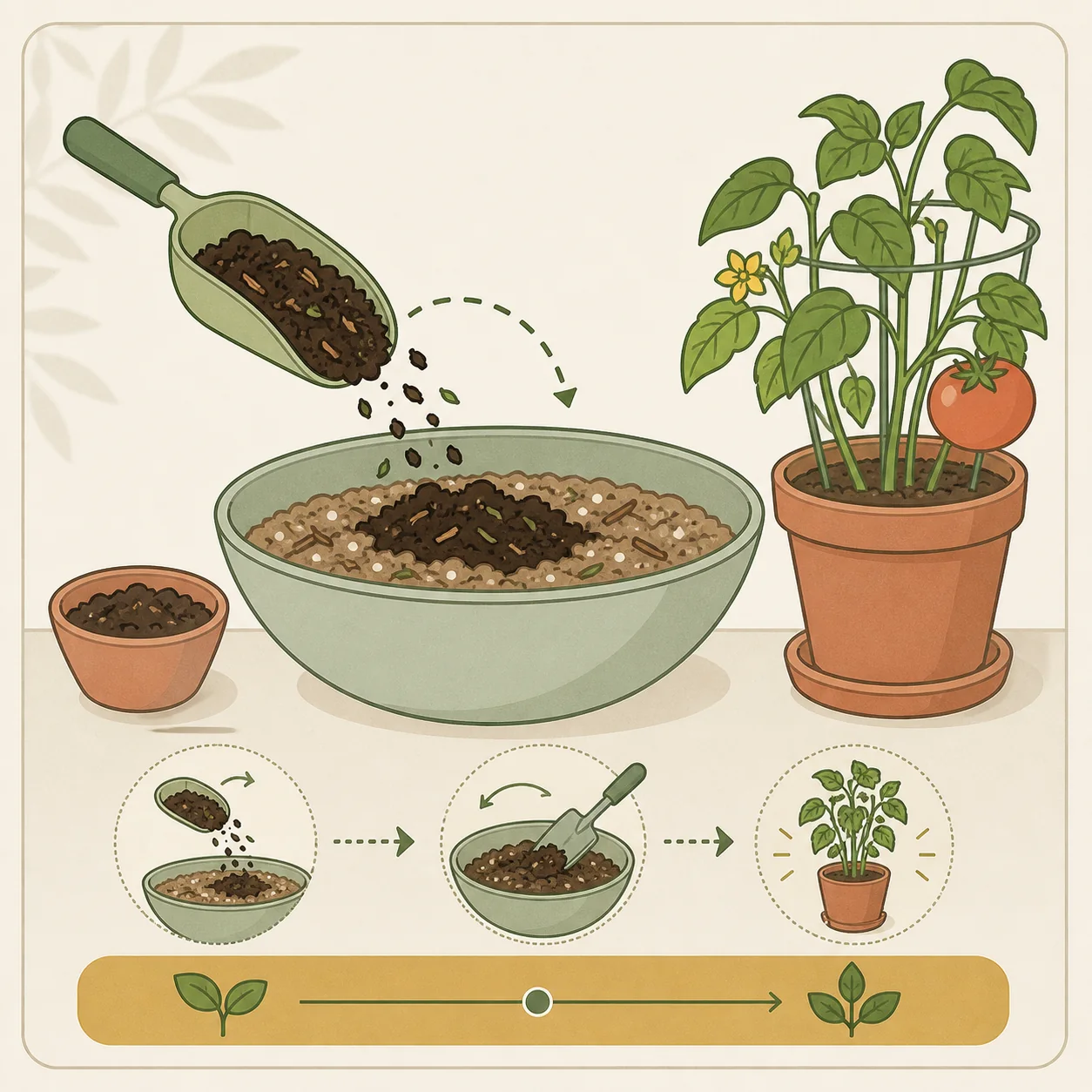
How much compost should you add to potting mix?
More compost is not automatically better. In a container, compost must share limited space with the coarse particles that preserve air around roots.
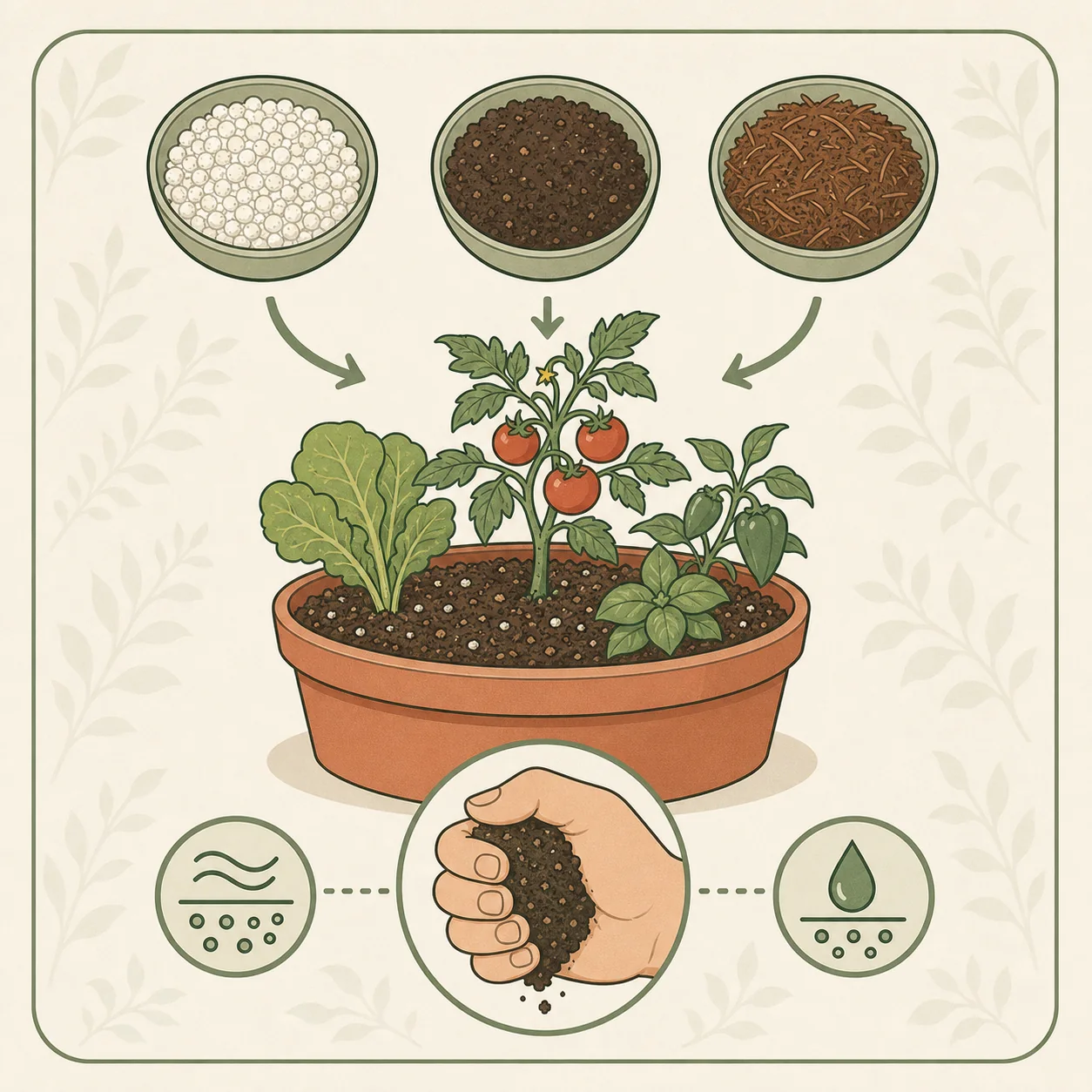
How to make potting mix for container vegetables
A useful potting mix recipe describes the job of each ingredient and gives you a way to correct the result. The goal is stable air and moisture, not a magic ratio.