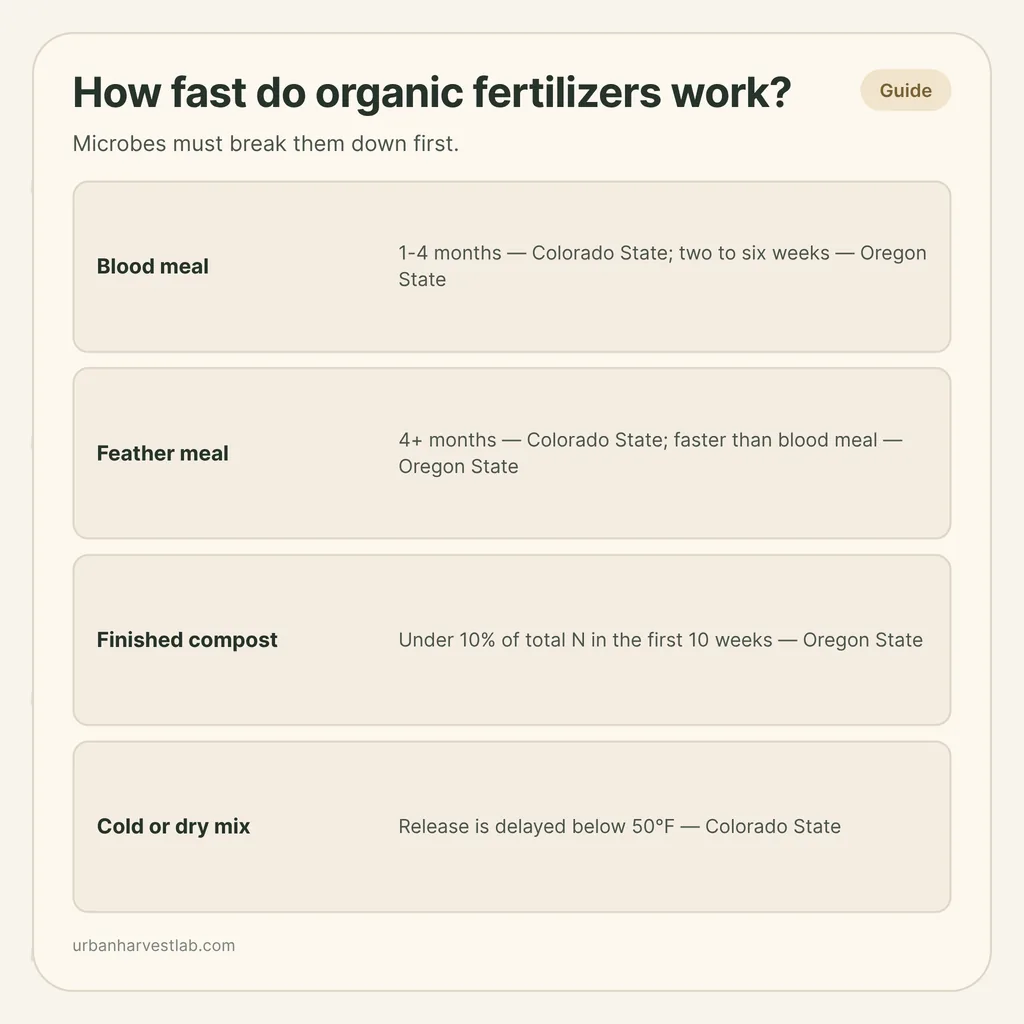
Organic fertilizers work on a delay, and the length of that delay depends on the material and the temperature. The concentrated meals (blood, feather, fish, seed meals) release most of their available nitrogen within weeks in warm, moist soil. Alfalfa and the slower meals take one to several months. Finished compost releases only a small share of its nitrogen in the first season. A cold or dry pot stretches all of these.
Plants cannot use organic nitrogen directly, as Oregon State Extension puts it. Soil microbes have to break the material down first, a step called mineralization, and only then does the nitrogen reach the root as ammonium or nitrate. A dissolved synthetic fertilizer skips that step. The trade-offs of that difference are in organic vs synthetic fertilizer. What follows is the timing, material by material.
What the three extension sources say
No two sources describe release speed the same way. Utah State gives a rating, Colorado State gives a time span, and Oregon State gives the share of nitrogen that became available in a measured test. Put side by side:
| Material | Utah State rating | Colorado State release time | Oregon State |
|---|---|---|---|
| Blood meal | Rapid | 1-4 months | Slow release over two to six weeks |
| Feather meal | Moderate | 4+ months | Breaks down faster than blood meal; most available N in the first 4 weeks (pelleted) |
| Alfalfa | Slow to moderate (alfalfa hay) | 1-4 months (alfalfa meal) | – |
| Poultry manure | Rapid | – | Chicken-manure fertilizers release at rates expected for fresh materials |
| Cattle / horse manure | Moderate / slow | – | – |
| Finished compost | Moderate | – | Under 10% of total N in the first 10 weeks |
Utah State’s footnote defines its column as the “approximate rate of nutrient release from the material”. It does not attach a number of weeks to any of the ratings.
Why Oregon State’s numbers are faster
The Oregon figures come from a laboratory incubation. Oregon State Extension tested organic fertilizer products sold to organic farmers in the Willamette Valley, mixing them into moist soil held at 72°F (22°C) for 4 weeks. Products containing 8-14% total nitrogen, including seed meals, fish and animal by-products, released approximately 60% of their nitrogen as plant-available nitrogen in that time.
That is warm, evenly moist soil with nothing leaching away. A potting mix on a shaded balcony in April is neither. The bulletin also says the concentration matters: materials with the highest nitrogen content have the highest rates of decomposition and release in soil, while composted materials are more resistant to decomposition.
Colorado State’s longer spans cover the whole period a product keeps releasing, not the time to the first useful dose. Colorado State describes its release period as how long the products are available once applied, so read “1-4 months” as the window in which the material is working and the Oregon figure as how much had arrived by week four. The feather meal disagreement is real, though: Oregon State reports fast release and Colorado State calls it slow. For the container-specific question of which meal fits which gap, see bone meal vs blood meal.
Temperature and moisture set the pace
Colorado State states the condition plainly: microbial activity depends on soil temperatures above 50°F with sufficient moisture, and dry or cold conditions delay the release of nutrients from organic sources. Oregon State’s extension gardening advice says the same thing in other words: the conversion takes time, especially in cold soil when microbial activity is low.
Oregon State’s soil nitrogen bulletin adds numbers for soil in general rather than for a particular fertilizer. It reports that the rate of mineralization increases about fivefold as soil temperature rises from 40 to 80°F, and that the rate is near zero below 40°F.
Oregon State’s calculator bulletin adds a wrinkle that is easy to miss. For the high-nitrogen specialty products applied in cold soil, it says nitrate release occurs more rapidly than crop uptake of nitrogen, even in cold soils. The bottleneck for a cold-weather crop is often the plant, not the fertilizer. It also notes the calculator itself does not adjust its predictions for soil temperature, so treat its 4-week and 10-week figures as warm-soil numbers.
In a pot this means a few practical checks before concluding a fertilizer has failed:
- Is the mix warm? A pot on a cold sill or a north-facing step sits in soil that may be well under 50°F in early spring. A soil thermometer reads it in seconds.
- Is the mix moist? A dry root ball stalls the microbes. Water first, then judge.
- How long ago did you add it? If it has been less than a few weeks, nothing is wrong yet.
Stacking a second dose because the first seems slow is how pots end up with a nitrogen surge once the weather warms. Signs of overfertilizing lists what that looks like.
Compost and manure: the slow end
Finished compost releases very little in the short term. Oregon State describes finished composts as the product of a controlled decomposition, usually actively managed for 60 to 90 days, which then decompose slowly and release plant-available nitrogen slowly. Its calculator predicts less than 10% of total nitrogen in the first 10 weeks. Utah State’s table rates compost as moderate, a looser category that does not conflict so much as fail to quantify.
The calculator only covers the first 10 weeks. After the application year, Oregon State says approximately 5% to 10% of the total nitrogen provided by an organic input is converted in the second year. Compost keeps giving, in small amounts, for longer than a meal does.
Manure depends on what it is. Utah State rates poultry manure rapid, cattle moderate and horse slow. Oregon State notes that most chicken-manure fertilizers, pelleted or sold as composted, release at the rates expected of fresh materials, so a “composted” label on poultry manure should not be read as slow. Whether manure belongs in a pot at all is a separate question, covered in manure in containers.
Matching speed to the job
The delay is the reason an organic meal is a poor rescue for a plant that is already pale. Colorado State’s own table puts powdered fish at immediate to one month, against one to four months for blood meal and bone meal. A liquid feed or fish powder is the organic route to something faster; slow-release vs liquid fertilizer compares those formats.
Plan the slower materials the other way round. Mixed in before planting, a meal or alfalfa has weeks to start releasing while the plant is still small. Colorado State even warns that soybean meal may inhibit seed germination and should go on several weeks before planting. For how organic and slow-release feeding fit into a full season, the container vegetable fertilizer schedule lays out the sequence.
Application rates come from the product label. The release data above come from soil trials, not from pots, so they describe the direction and rough pace rather than a schedule for one container.
Sources
- Oregon State University Extension: OSU organic fertilizer and cover crop calculator (EM 9235)
- Oregon State University Extension: Nutrient Management for Sustainable Vegetable Cropping Systems in Western Oregon (EM 9165)
- Oregon State University Extension: Choosing the right fertilizer for your garden
- Oregon State University Extension: Baseline Soil Nitrogen Mineralization (EM 9281)
- Colorado State University Extension: Garden Notes 234, Organic Fertilizers
- Utah State University Extension: Selecting and Using Organic Fertilizers
Feeding container plants organically
Where release speed fits into the rest of the feeding decisions for pots.
Common questions
How long do organic fertilizers take to work?
It depends on the material and the temperature. Oregon State measured about 60% of the nitrogen in specialty products with 8-14% nitrogen as plant-available after 4 weeks in moist soil at 72°F, and says pelleted fish, chicken and feather meal supply most of their available nitrogen in the first 4 weeks. Colorado State lists blood meal and alfalfa meal at 1-4 months and feather meal at 4+ months. Finished compost releases the least: under 10% of its nitrogen in Oregon State's 10-week predictions.
Why is my organic fertilizer not working in cold weather?
Soil microbes do the conversion. Colorado State says their activity depends on soil temperatures above 50°F with enough moisture, and that cold or dry conditions delay release. Oregon State's soil work reports the mineralization rate is near zero below 40°F and rises about fivefold between 40 and 80°F.
Is blood meal faster than feather meal?
The sources disagree. Oregon State says feather meal breaks down faster than blood meal and gives blood meal as two to six weeks. Utah State rates blood meal rapid and feather meal moderate, and Colorado State lists blood meal at 1-4 months and feather meal at 4+ months. Different products, soils and test conditions explain part of the gap.
Does compost feed plants quickly?
No. Oregon State says finished compost releases plant-available nitrogen slowly, with predictions under 10% of total nitrogen in the first 10 weeks. It is not a quick nitrogen fix.
Related guides
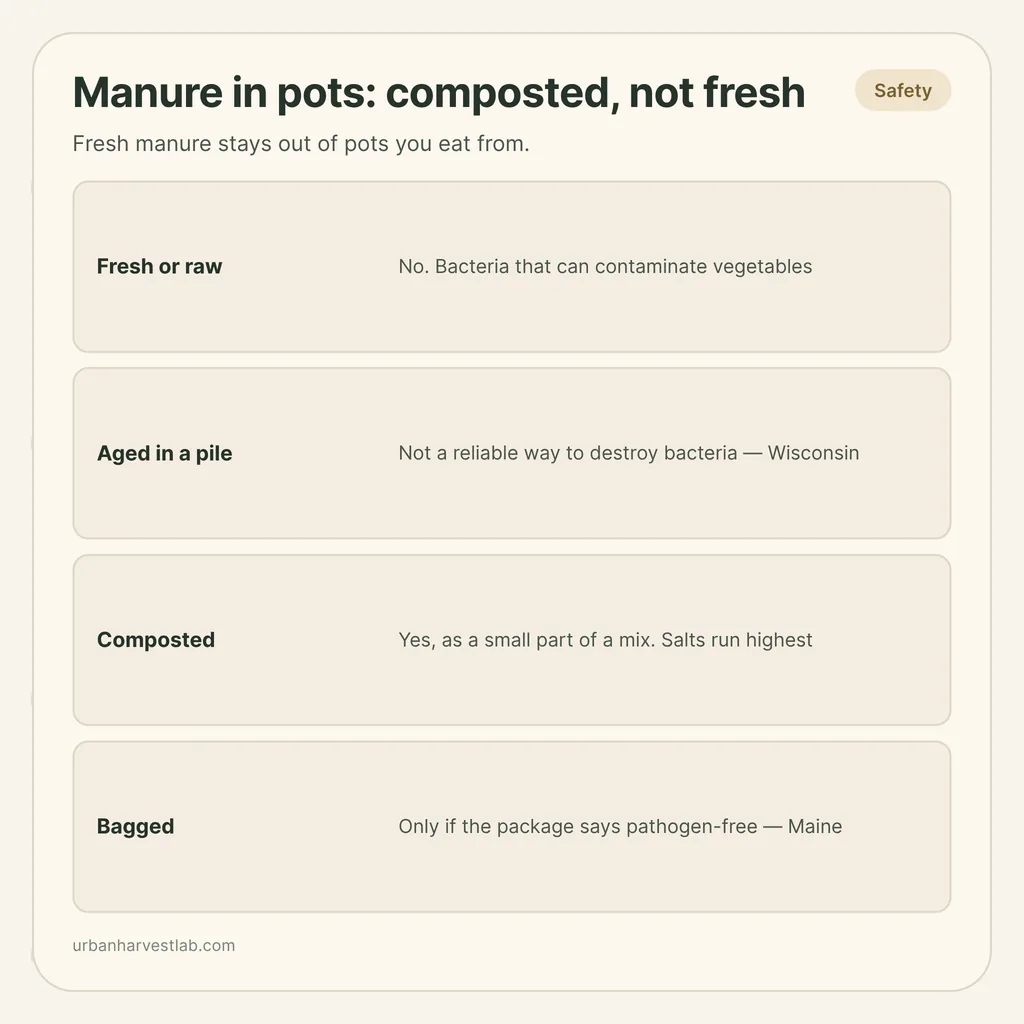
Can you use manure in potted plants? Composted versus fresh
Fresh manure is a pathogen risk in a pot. Composted manure is usable, but it runs salty. What the extension sources say before you fill a planter.

Bone meal vs blood meal: which one a potted plant actually needs
Bone meal is a phosphorus source and blood meal is a nitrogen source, so the choice follows the nutrient your plant is short of. Feather meal is the third option, with its own release-speed puzzle.
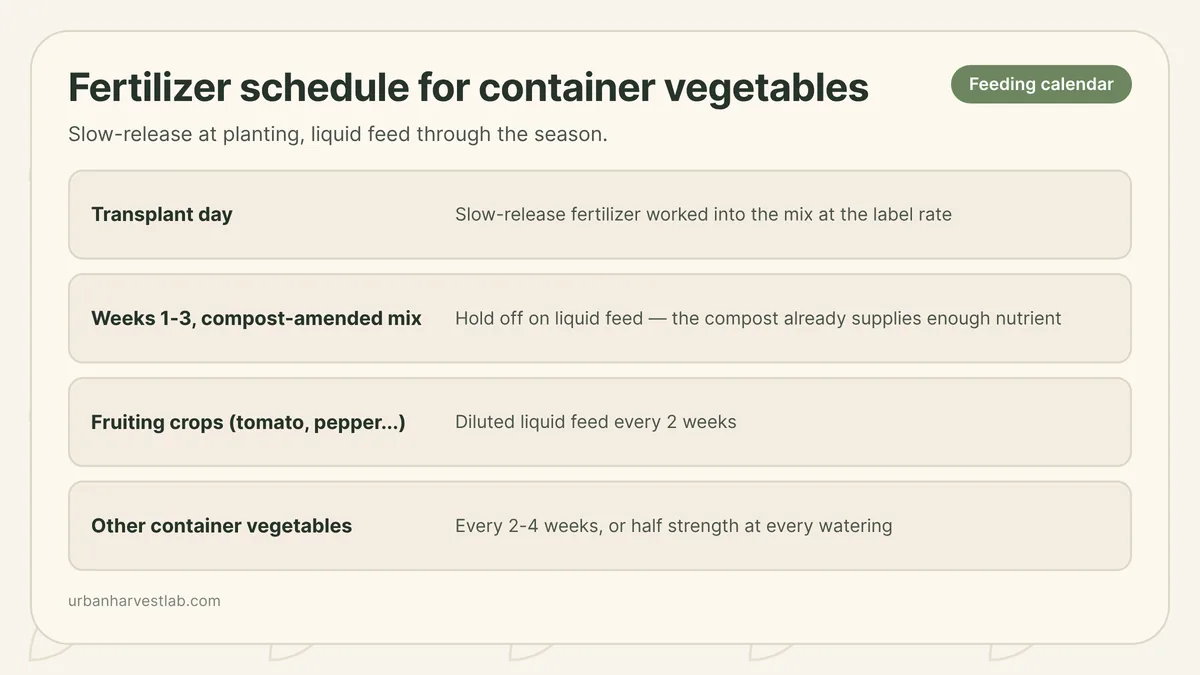
Fertilizer schedule for container vegetables: what to feed and when
A stage-by-stage feeding calendar for container vegetables, built from extension guidance on slow-release charges, liquid top-ups, and the intervals that keep fruiting crops producing.