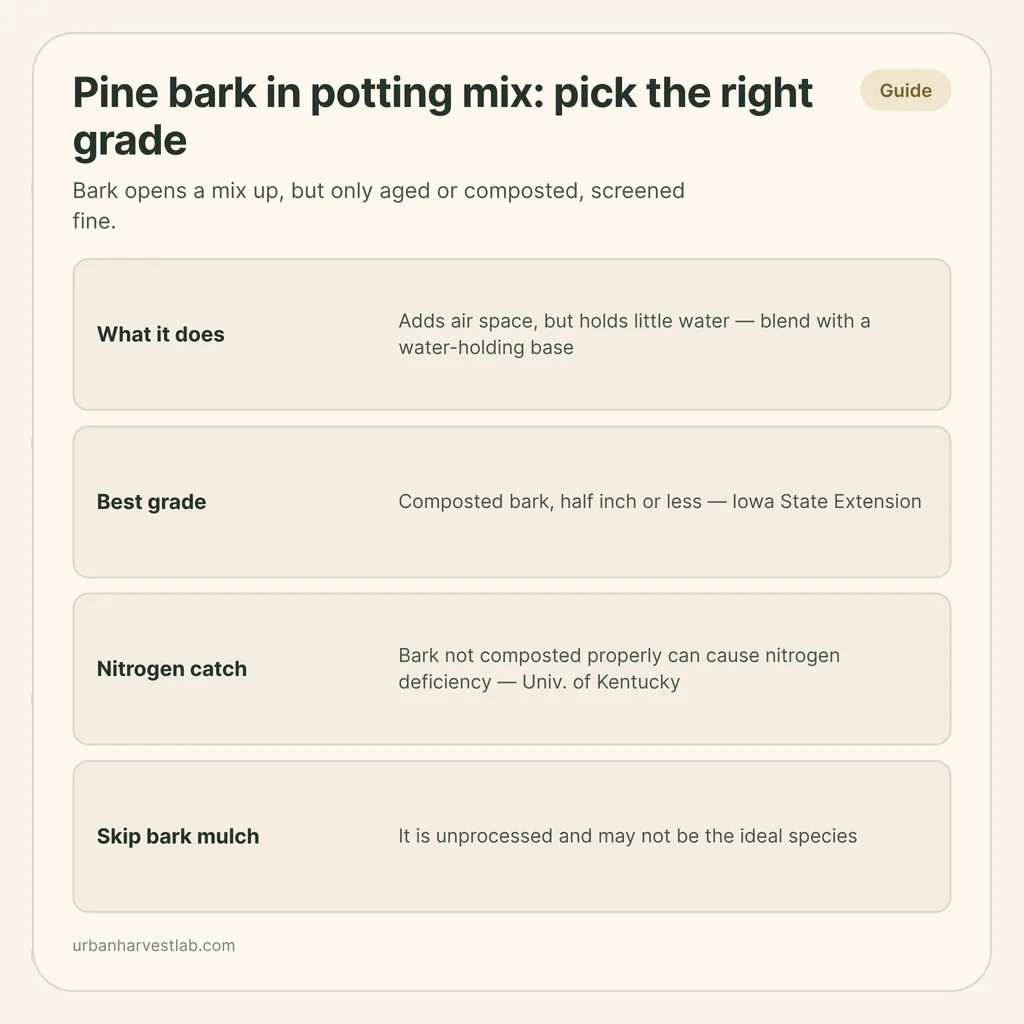
Pine bark is a structure ingredient, not a soil. It opens up a mix, breaks down slowly, but it holds less water than peat and, in the wrong grade, can leave plants short of nitrogen. Buy aged or composted bark screened fine, blend it with something that holds water, and skip bark mulch.
What bark does in a pot
University of Kentucky Extension says bark is used in container media “to increase the air porosity within a mix.” University of Florida Extension is blunter about the trade-off: pine bark “creates a light potting mix with air space but low water holding capability. It degrades slowly and is a good component for mixes for potted ornamentals.”
North Carolina State researchers say pine bark is desirable because it is “light in weight, well-drained, pathogen-free and disease suppressive.” The University of Arkansas adds that pine is preferred over hardwood bark because it resists decomposition and has fewer leachable organic acids.
Water is the part people get wrong. Kentucky notes that although pine bark has a lower water-holding capacity than peat moss, it “holds a greater amount of available water for the plant.” If you are weighing it against the alternatives, perlite, pumice and rice hulls are inert aeration options, while bark is organic and will slowly break down.
Fresh, aged, composted, mulch: pick the grade
“Pine bark” on a bag can mean four different things. Extension sources treat them differently.
| Grade | What the sources say | Use in a pot |
|---|---|---|
| Fresh bark | Can induce nitrogen deficiency (Kentucky). Repels water more than aged bark (Kentucky). | Avoid |
| Aged bark | Growers favour it over fresh for its particle size distribution (Kentucky), but a greater nitrogen draw-down than composted bark (Arkansas). | Acceptable; feed it |
| Composted bark | Composted with enough nitrogen, it “should not pose this problem” (Kentucky). | Best choice |
| Bark mulch | Unprocessed, may not be the ideal species (Iowa State). | Skip for potting mix |
There is no sharp line between fresh and aged. A US Department of Agriculture research team working with Virginia Tech and NC State on commercial bark notes that both terms “can include a continuous spectrum of age with no universally accepted definition of fresh vs. aged bark.” So a bag labelled “aged” from one supplier is not guaranteed to match another’s.
Particle size changes how the mix behaves
Iowa State Extension says the bark generally added to potting media has been composted and processed to a half inch or less. Orchid bark is “much coarser and tends to produce more air-filled pores.” The composted half-inch-minus grade “will hold more water and less air than the bark used in orchid production.” So the choice is practical: finer bark for vegetables and herbs that need steady moisture, chunky bark only for plants that want to dry fast.
Age shifts the numbers too. In the USDA Agricultural Research Service team’s study of six commercial sources, aging pine bark from a month or less to six months or more moved particles from coarse (over 2 mm) to fine (under 0.5 mm), which raised container capacity by 21.4 percent and cut air space by 17.2 percent. Total porosity barely changed. Air space fell from 49.0 percent in fresh bark to 31.8 percent in aged bark. Those are nursery measurements, not a promise for your bag, but they show why the same species of bark behaves differently at different ages.
The same authors cite a commercial potting-mix standard of 10 to 30 percent air space. Fresh bark overshot it. Aged bark in their tests was only just above it.
The nitrogen catch
Extension sources call it nitrogen draw-down, and it is the main reason raw bark is a poor choice for a pot. University of Kentucky Extension puts it plainly: bark “which has not been composted properly induces nitrogen deficiency problems; however, composted bark with sufficient nitrogen fertilizer added during the process should not pose this problem.”
Arkansas Extension gives the nursery workaround. Growers who use fresh bark add nitrogen to compensate for the draw-down in the pot, and the same fact sheet says aged bark has “a greater nitrogen draw-down in the container than composted bark.” Those nursery rates are per cubic yard and are not a home recipe, so for a balcony the lesson is simpler: buy composted or well-aged bark, and expect a bark-heavy mix to need regular feeding. The fertilizer schedule for container vegetables covers how often.
Hardwood bark is a separate case. Kentucky reports it breaks down three times more quickly than softwood bark, and that hardwood bark “must be composted before use or phytotoxicity may ensue,” whereas some softwood bark can be used without composting. If a bag does not say pine, you cannot tell which case you are in.
Acidity
Raw pine bark is acidic. Kentucky gives an initial pH of 4.0 to 5.0 for fresh pine or softwood bark, and says it does not rise appreciably as the bark ages. University of Florida notes that lime is usually added to mixes to balance the pH. If you blend your own with a large share of bark, check the result against the targets in container soil pH before planting acid-sensitive crops. Do not guess a lime rate: the figures Kentucky gives are per cubic yard of nursery media.
How much bark, with what
Sourced ratios are narrow, and each belongs to a specific use.
- Nursery media. Kentucky lists peat-moss-based media containing 25 to 50 percent pine bark as one suggested formulation for container-grown crops.
- Houseplants. University of Florida gives “1 part peat; 1 part pine bark; 1 part coarse sand” as one of two foliage plant recipes, and the same for bromeliads. Florida also says finely ground bark may partly substitute for peat, and that it must have been through the aging process first.
Neither source gives a ratio for vegetables. For a full vegetable recipe, use the DIY container vegetable mix, and note that bark is also common in peat-free mixes. If coir is your water-holding base instead, coir versus peat explains the pairing.
Buying and wetting
Look for bags that say aged or composted pine bark with a small particle size, and keep the mulch aisle out of it. If you want to compare what is on offer, browse pine bark fines on Amazon. Check the bag for tree species and particle size before you buy, because the listing will not always say.
Dry bark can resist water. Kentucky says fresh pine bark repels water more than aged bark, and that to raise its moisture content you soak it. At home, wet the bark in a bucket before you mix it, so the first watering does not run straight through the pot.
Sources
- University of Kentucky Cooperative Extension, Soilless Substrate Management for Nursery Crops
- University of Arkansas Division of Agriculture, Growing Media for Container Production in a Greenhouse or Nursery, Part I (FSA6097)
- Altland, Owen, Jackson and Fields (US Department of Agriculture, Agricultural Research Service, with Virginia Tech, NC State and LSU), HortScience 53(12), 2018, Physical and Hydraulic Properties of Commercial Pine-bark Substrate Products
- North Carolina State University, What To Do When Pine Bark Runs Short
- UF/IFAS Extension, Homemade potting mix
- Iowa State University Extension, Potting Media: Components and Handling
Potting mix ingredients and recipes
Where bark fits next to the other aeration and water-holding components.
Common questions
What size pine bark is right for a potting mix?
Iowa State Extension says the bark generally added to potting media has been composted and processed to a half inch size or less. Bark used in orchid mixes is much coarser and gives more air-filled pores. The same source says the composted half-inch-minus bark holds more water and less air than orchid bark, so match the grade to the plant.
Does pine bark steal nitrogen from plants?
Bark that has not been composted properly can. University of Kentucky Extension says it induces nitrogen deficiency problems, while composted bark with enough nitrogen added during composting should not. University of Arkansas adds that aged bark has a greater nitrogen draw-down in the container than composted bark.
Can I use bark mulch in a potting mix?
Iowa State Extension advises against it: bark mulch has not been processed and may not come from the ideal tree species. Look for bagged aged or composted pine bark sold for potting or soil mixes instead.
How much pine bark should go in the mix?
It depends on the plant. University of Kentucky Extension lists peat-based nursery media with 25 to 50 percent pine bark as one suggested formulation. For a houseplant mix, University of Florida Extension gives 1 part peat, 1 part pine bark and 1 part coarse sand as one of its foliage plant recipes.
Related guides
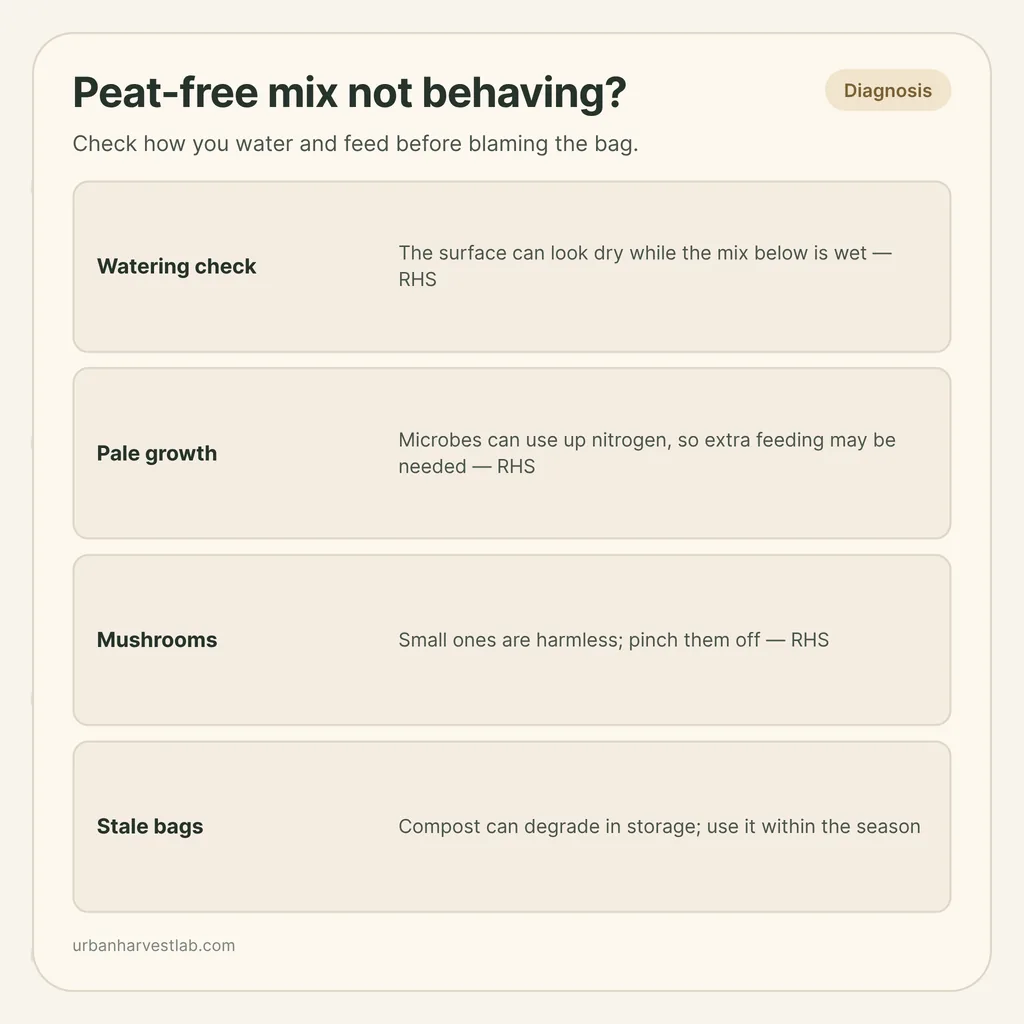
Peat-free potting mix problems: drying, nitrogen and feeding fixes
Peat-free mixes look like peat mixes but behave differently: the surface fools you, the watering rhythm shifts, and feeding often needs adjusting. Here is how to read the pot and correct course.
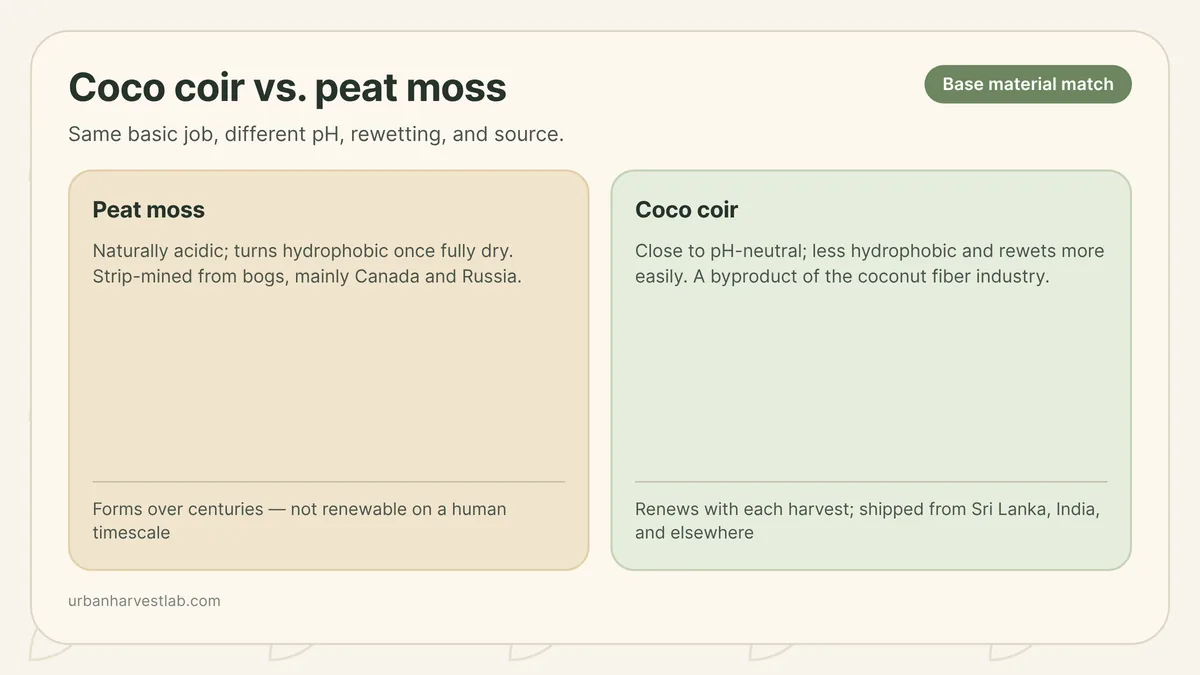
Coco coir vs peat moss: how the two potting bases really compare
Peat moss and coco coir do the same basic job in a potting mix, but they part ways on pH, on how they behave once they dry out, and on the environmental cost of getting the bag to your shelf.
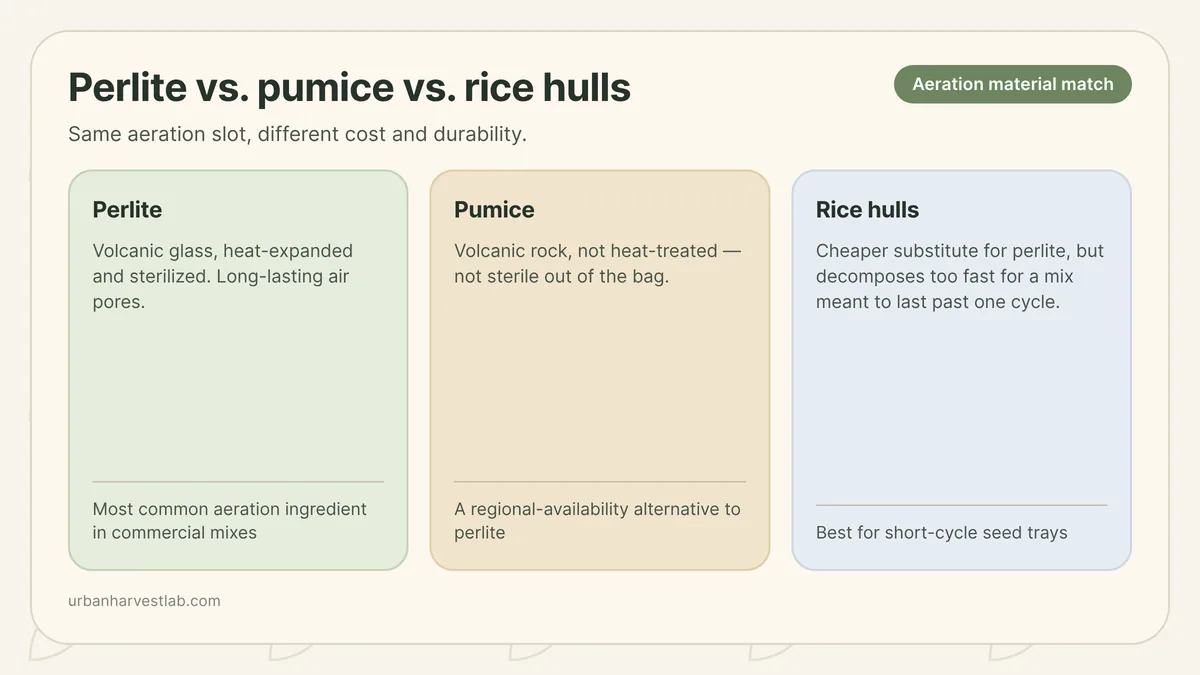
Perlite vs pumice vs rice hulls: cost, durability, and sterility compared
All three fill the same aeration slot in a mix, but they get there differently. Here is what separates them on cost, how long they last, and sterility.