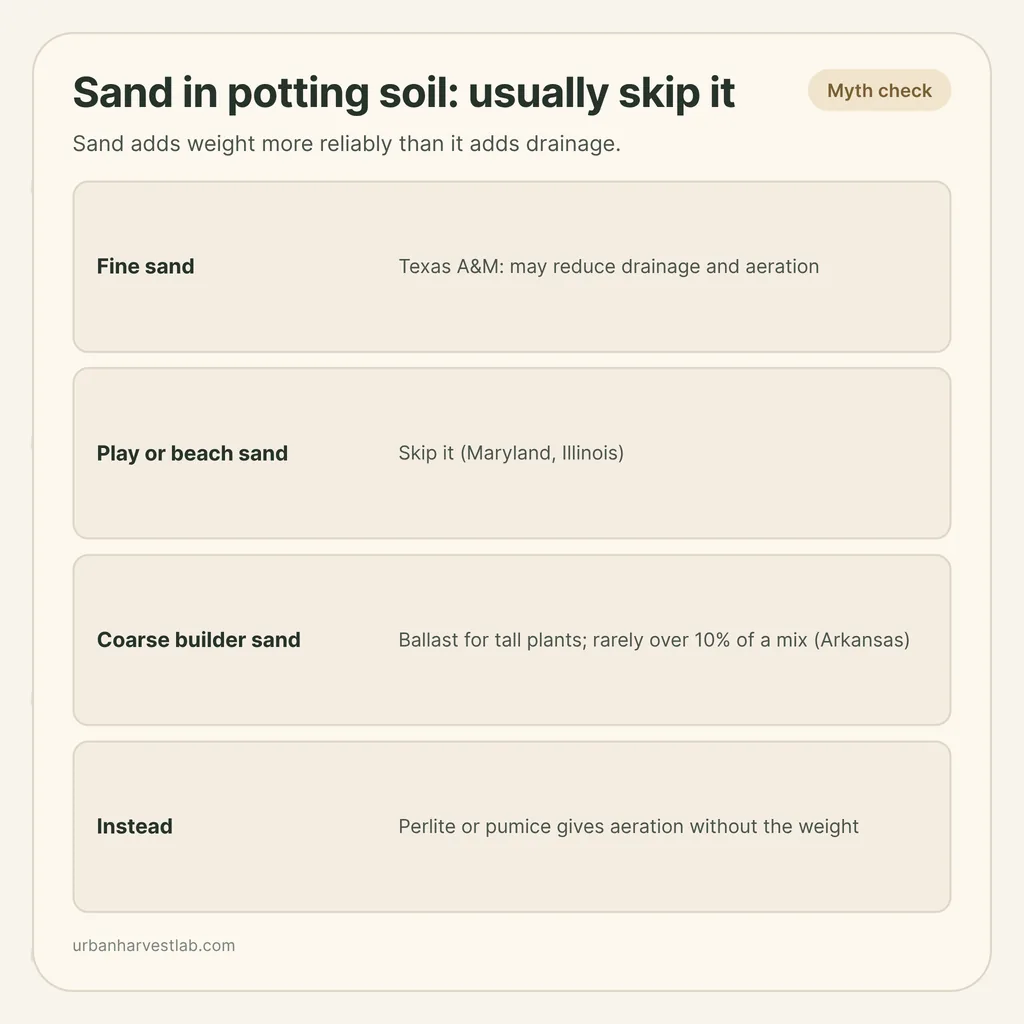
Sand grades in a container mix
| Grade | Verdict | What the sources say |
|---|---|---|
| Fine sand (0.05-0.25 mm) | Skip it | Texas A&M says fine sands do little for a medium and may reduce drainage and aeration. |
| Play sand or beach sand | Skip it | Maryland says use only coarse builder sand, not play sand. Illinois rules out fine beach sand and play sand. |
| Ocean or calcareous sand | Skip it | The University of Arkansas says to avoid calcareous sands and ocean sands that are obviously saline. |
| Medium to coarse sand (0.25-2 mm) | Small share, for a reason | Arkansas lists this range as what growers use, mostly for drainage or ballast. |
| Washed horticultural or builder sand | Fine for succulent mixes and heavy pots | UConn says coarse sand adds drainage and weight and turns up mostly in mixes for succulents. |
Usually leave it out. In a pot, sand adds weight far more reliably than it adds drainage, and fine sand can make drainage worse. If you do add it, use coarse, washed builder or horticultural sand, keep it to a small share of the mix, and have a reason for it: ballast for a tall plant, or a gritty blend for succulents.
The idea comes from the ground. Sandy garden soil drains fast, so a handful in a pot feels like the obvious fix for soggy roots. Iowa State Extension flags exactly that jump: sand is known for good drainage in soil, but “caution needs to be used extrapolating that to its performance when placed in a container.” Water behaves differently once it is held in a pot. If soggy soil is your problem, perlite, pumice or rice hulls are the usual fix, and they do not weigh the pot down.
Why sand underperforms in a container
Iowa State Extension says sand “does not function as well for aeration” in a container. Its comparison is direct: a standard peat-based potting media will have superior drainage to sand or soil. It adds that a pot filled with sand or soil lacks the porosity of a quality mix. In its words, “This makes overwatering and poor rooting more common.”
Particle size decides most of the outcome. Texas A&M’s greenhouse handbook puts sand between 0.05 and 2.0 mm and splits it. Fine sands, at 0.05 to 0.25 mm, “do little to improve the physical properties of a growing media and may result in reduced drainage and aeration.” Medium and coarse sand are the grades that adjust texture usefully.
That also explains why a mix that already feels dense gets no help from the wrong sand. If your potting soil stays wet for days, the missing ingredient is air-filled pore space, and the grade of sand that is easiest to buy is the one least likely to supply it. If the mix does the opposite and runs water straight through, that is a different problem with its own fix in hydrophobic potting mix.
Which sand, if you add any
Three extension pages agree on the type, and a fourth adds a warning.
- University of Maryland Extension: “Use only coarse builder sand, not play sand.” It also says sand increases porosity because of the large particles, and that it is relatively inexpensive and heavy.
- UConn Extension: only washed or horticultural grade sand belongs in a potting mix.
- Illinois Extension: “Don’t use fine beach sand or play sand.”
- The University of Arkansas: avoid calcareous sands and ocean sands that are obviously saline in nature. It lists the useful range as medium to coarse sand, 0.25 to 2 mm.
In practice, that means a bag labelled builder’s sand, coarse sand or horticultural sand and not sand scooped from a beach. A bag that does not say what grade it is leaves you guessing, and fine grains are the risk.
What sand costs you: weight
Texas A&M calls sand the least expensive inorganic amendment and also “the heaviest.” The University of Arkansas puts a number on it: a bulk density of 80 to 100 lbs/ft3, and that “tremendous weight” is the reason sand rarely occupies more than 10% of the volume of a mix. Its example outdoor nursery recipe is 80% pine bark, 10% peat and 10% sand.
Texas A&M’s table of greenhouse soilless mixes includes peat and sand at 2:1 and 3:1 by volume, so higher shares exist in commercial production. Those are written for a grower who controls watering and does not carry the pots. A balcony gardener moving a container twice a season is in a different position, and a heavier pot is harder to lift, harder to empty at season’s end and harder to hang or put on a railing.
When sand does earn its place
As ballast. Iowa State Extension says one reason sand is still used is to give tall crops weight. The University of Arkansas describes the same job: ballast to decrease container blow-over in outdoor nurseries, and says sand and soil are often added to increase the weight and reduce tip-over. UConn Extension adds that heavy mixes containing some sand or mineral soil are especially suitable for large or top-heavy houseplants. A tall, narrow pot on a windy balcony is a fair case.
In a gritty mix for succulents. UConn Extension says coarse sand is most often found in potting soils used for succulents. Illinois Extension notes that succulents, herbs and perennials tend to prefer soils that are well drained and do not hold moisture for long, and suggests media with more bark, perlite or sand for them. Perlite does the same aeration job at a fraction of the weight, so sand is a choice, not a requirement.
In a soil-based blend. Illinois Extension’s acceptable soil-based mix is one part garden soil, one part peat moss and one part perlite or coarse builder’s sand. It also notes that soil-based mixes are heavier, which may suit a container that needs weight. Whether dug soil belongs in a pot at all is covered in can you use garden soil in pots.
What to do instead
Leave sand out of a vegetable or herb mix and build the aeration from lighter parts. Perlite, pumice and rice hulls compared covers cost and durability, vermiculite vs perlite covers the water-holding side, and how to make potting mix for container vegetables gives a complete base recipe.
Do not try to fix a dense mix by putting a coarse layer in the bottom of the pot either. As the gravel-in-the-pot page explains, water does not move from the finer mix into the coarse layer until the mix above it is saturated. Whatever you add has to be mixed through the whole fill.
If you add sand anyway, mix it evenly, keep it small, and watch the first few waterings. A pot that stays wet longer than before is telling you the sand is the wrong grade.
Sources
- University of Maryland Extension: Growing media (potting soil) for containers
- Texas A&M AgriLife: Texas Greenhouse Management Handbook, growing media
- University of Arkansas Division of Agriculture: Growing media for container production (FSA6097)
- Iowa State University Extension: Potting media, components and handling
- UConn Extension: Potting media
- University of Illinois Extension: Container gardens, soil
Fix drainage without the guesswork
Lighter aeration materials, the gravel-layer myth, and a base recipe that already drains.
Common questions
Should I add sand to potting soil?
Usually not. Iowa State Extension says sand does not function as well for aeration in a container, and a standard peat-based mix has better drainage than sand. The reasons to add it are ballast for a tall plant or a deliberately gritty mix for succulents.
What kind of sand can go in a pot?
Coarse, washed builder or horticultural sand. University of Maryland Extension says to use only coarse builder sand and not play sand, UConn Extension says washed or horticultural grade, and Illinois Extension rules out fine beach sand. Arkansas also says to avoid saline ocean sands.
How much sand is too much?
The University of Arkansas says sand rarely occupies more than 10% of a mix by volume because of its weight, and its example nursery recipe is 80% pine bark, 10% peat and 10% sand. Texas A&M lists peat-and-sand greenhouse mixes at 3:1 by volume. Those are production mixes, not tested home recipes, so start low.
Does sand improve drainage in a pot?
Not reliably. Texas A&M says fine sands do little for a medium and may reduce drainage and aeration. Only medium and coarse grades adjust texture usefully, and perlite or pumice gives the aeration with far less weight.
Related guides
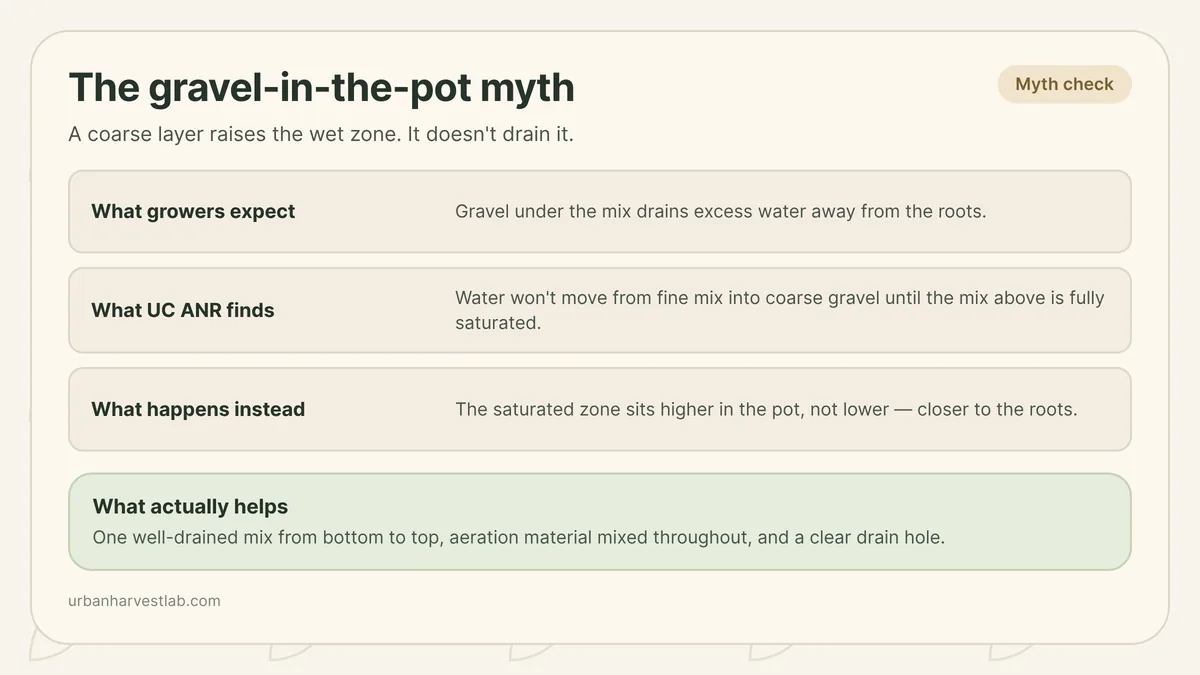
The gravel-in-the-pot myth: why it doesn't improve drainage
Putting gravel or rocks under potting mix feels like it should help drainage, but it creates a wetter zone right where roots grow, not a drier one.
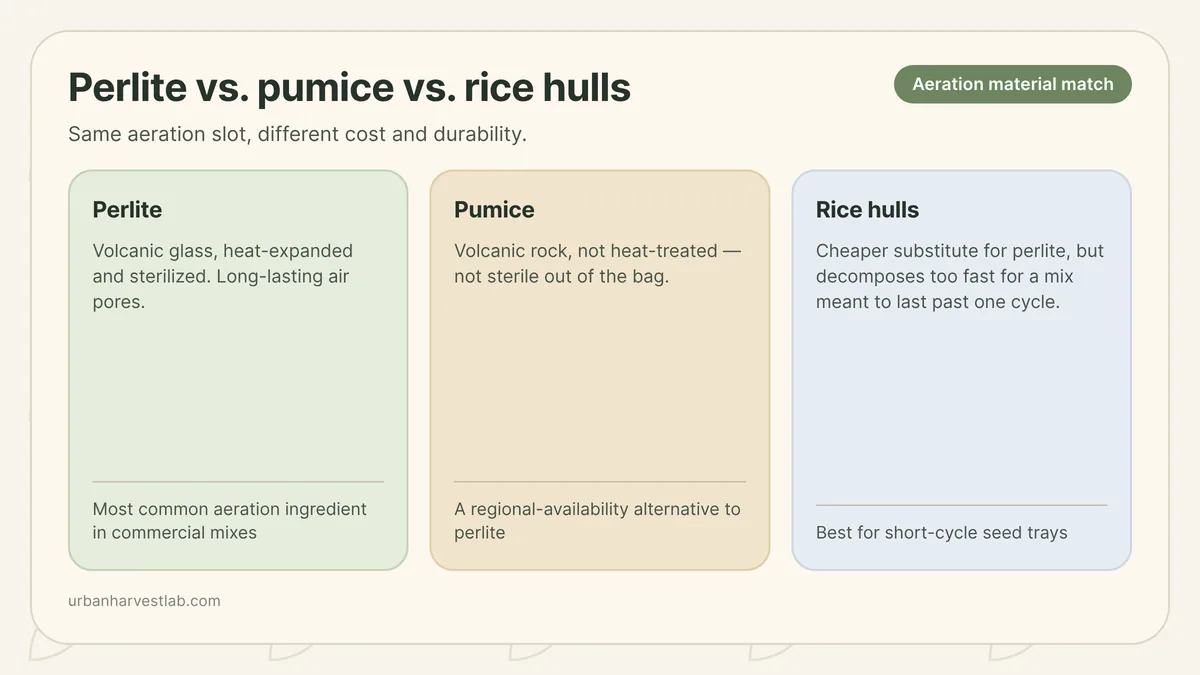
Perlite vs pumice vs rice hulls: cost, durability, and sterility compared
All three fill the same aeration slot in a mix, but they get there differently. Here is what separates them on cost, how long they last, and sterility.
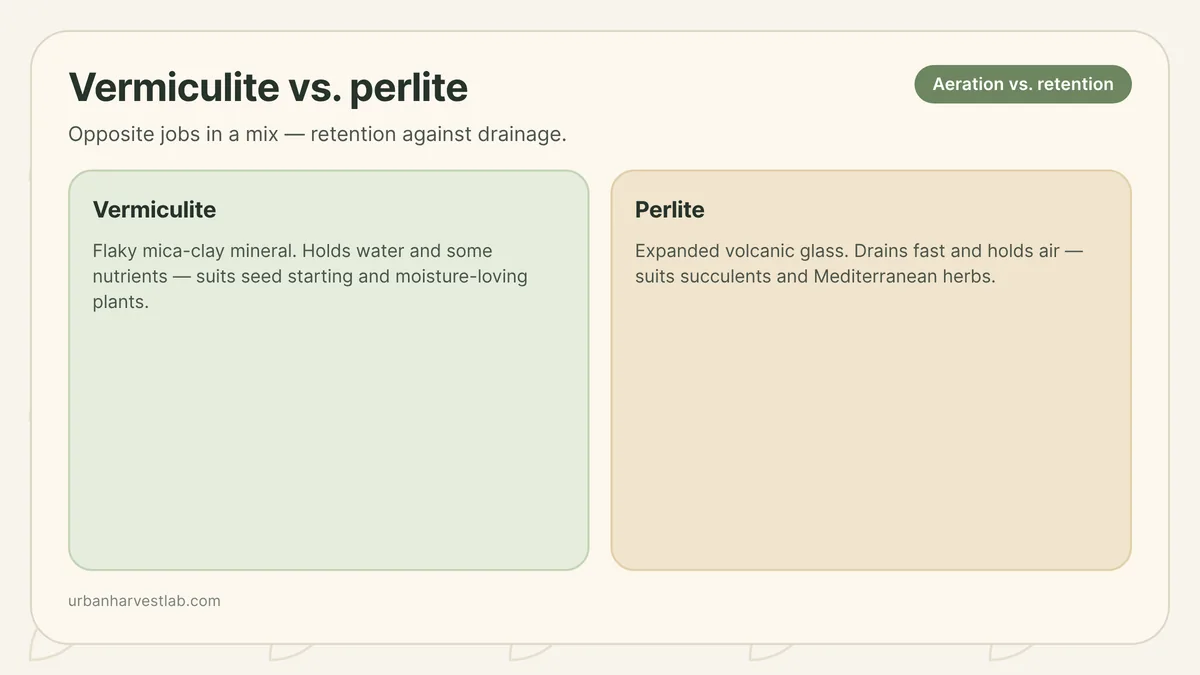
Vermiculite vs perlite: what each one actually does in a mix
Vermiculite and perlite solve opposite problems in a growing medium. Here is which one your container actually needs, and when the answer is both.