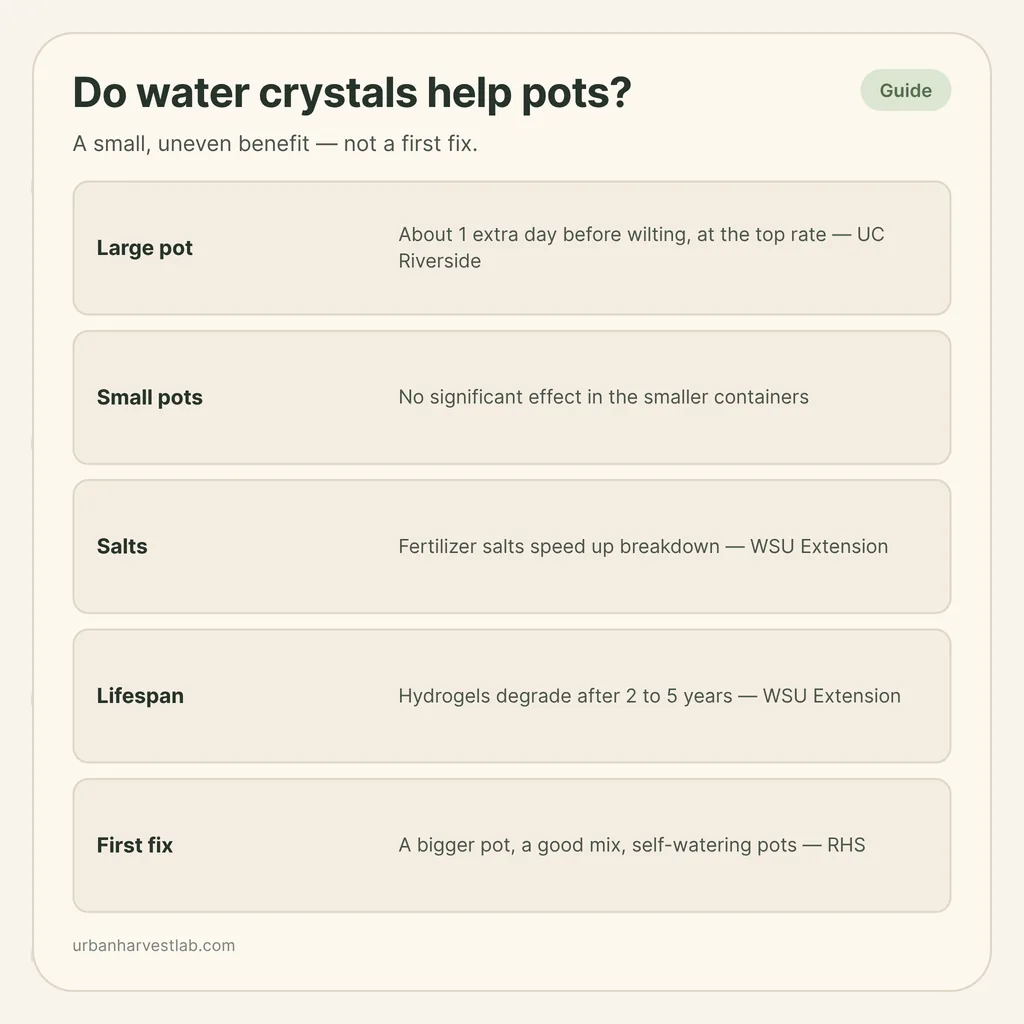
What the main sources say about water crystals in pots
| Question | What the source reports | Source |
|---|---|---|
| Do they extend the time between waterings? | Only in the largest container tested: wilting took 6.1 days without polymer and 7.4 days at the top rate | UC Riverside greenhouse trial |
| Do they save water? | No. Evapotranspiration did not change, so the pot needs the same water over time | UC Riverside greenhouse trial |
| Do salts matter? | Salinity reduced hydrogel absorption by 84 percent; fertilizer salts increase breakdown | Scientia Agricola study; WSU Extension |
| How long do they last? | Degrade after 2 to 5 years, according to WSU Extension | WSU Extension |
| Does the RHS recommend them? | As a last resort when potting up a container; synthetic types not recommended | RHS |
Water-retaining crystals give a small and uneven benefit in pots. In the one controlled container trial from a university, they stretched the time before wilting by about a day in a large pot and did nothing measurable in small ones, and they did not reduce the water the plants used. The Royal Horticultural Society treats them as a last resort, not a first fix. If your pot dries out too fast, a larger container, a better mix and a mulch layer do more (the mulch guide covers the last).
What the trial found
The best-documented test is a 1992 greenhouse experiment by John Letey, Pete Clark and Christopher Amrhein at the University of California, Riverside. They grew marigolds in three container sizes of roughly 1, 3 and 6 quarts, in a mix of sand, bark and peat with fertilizer added. The mix was amended with 0, 1, 2 or 4 pounds of polymer per cubic yard. Suppliers of that polymer recommended 2 pounds per cubic yard.
The results were narrow:
- Statistically significant effects appeared only in the largest, 8-inch container.
- There, only the top rate of 4 pounds retained significantly more water than the untreated mix. The two lower rates did not.
- The University of California, Riverside team measured time to wilt rising from 6.1 days with no polymer to 7.4 days at the top rate. They put it as “about 1 day out of a week”.
- Plant growth was not affected in any container.
That is a long way from the label on the water district sample packet they tested, which promised a 6-inch pot would go 2 to 3 weeks without watering. The researchers wrote that the gain “certainly would not allow” that.
Two points from the same paper matter more than the day itself. First, the water held by the polymer was usable: soil water content at wilting was the same with and without it, so the plants could get at it. Second, the polymer did not change evapotranspiration. A pot that goes longer between waterings holds more water at each watering, so across a season the plant drinks the same amount. The authors concluded that polymers do not conserve water; they shift when you water, not how much. They also noted that media with large pores gain the most, which is why a coarse mix benefits more than a dense one.
One caveat on all of this: it is one trial, with marigolds, from 1992, using one type of polymer. Other trials may differ. Nothing here claims otherwise.
Why real pots do worse than the packet
Packets and the UC trial’s own introduction describe polymers that absorb hundreds of times their weight in water. A pot packs the crystals into a mix, and two things work against that figure.
Weight. A laboratory study of superabsorbent polymers in soil measured absorption falling from 338.5 g of water per gram of polymer with no load to 19.3 g per gram as soil load increased, and swelling took longer. The study tested soil layers, not a flowerpot, but it shows why the headline number does not transfer to a mix packed around the crystals.
Salts. A 2022 study in Scientia Agricola tested a polyacrylamide-type hydrogel against water salted with NaCl at electrical conductivity from 0.5 to 4.5 dS/m. Salinity reduced the gel’s absorption by 84 percent. In sandy soil the polymer still reduced water losses by 58 percent, but it did not raise final soil moisture. That test used sodium chloride, not fertilizer or hard tap water, so treat it as a direction rather than a measurement for your balcony. For the salt side of the problem in pots, see salt buildup in herb pots.
WSU Extension horticulturist Linda Chalker-Scott adds that exposure to fertilizer salts increases the rate at which hydrogels break down, and that it makes no difference whether the fertilizer is synthetic or organic. A pot that is fed is a pot with fertilizer salts in it.
How long they last
WSU Extension says hydrogels degrade after 2 to 5 years and are not a lasting fix for dry conditions. The RHS adds a practical warning: an excess of granules may push plants up and out of their containers, so stay at the pack rate and mix them into the compost rather than sprinkling them on top.
Safety and what is actually established
Polyacrylamide is made from acrylamide, so the safety question is really about that monomer.
- The US Environmental Protection Agency calls acrylamide a potent neurotoxicant at low levels when it occurs as a monomer, and lists it as a probable human carcinogen. It says exposure happens mainly in workplaces, through skin contact and inhalation.
- The National Cancer Institute notes that rodent studies found acrylamide raises the risk of several cancers, that high occupational exposure by inhalation causes neurological damage, and that studies of workers have not suggested increased cancer risk.
- WSU Extension reports that hydrogels release acrylamide and potassium acrylate when they break down, and that the commonly sold types are polymers of acrylamide and potassium acrylate. Chalker-Scott describes the polymer as non-toxic in its polymerized form.
None of these pages measures how much acrylamide a bag of garden crystals releases into a pot, so the sources do not tell you a dose or a risk for growing herbs. What they support is caution: wash your hands after handling (the RHS says the granules are potentially harmful), and think twice before putting the mix in a compost heap or a bed where you grow food.
Natural versus synthetic
The RHS says both natural and synthetic (plastic) granules are sold and it is difficult for the buyer to know which is which. It does not recommend synthetic ones, because it does not fully understand their composition or breakdown, and says they break down into microplastics. Natural-based options, in its words, break down into natural components and are suitable for composting. The RHS also says that in practice container plants grow to use up the available water by late summer, after which granules do not much reduce how often you water.
What to do instead
The RHS order of operations for a thirsty pot is a suitably large pot, a good-quality mix that holds enough water, a saucer underneath and slow watering. It names self-watering pots and micro-irrigation as better options than granules. Only then, as a last resort when potting up, does it mention granules. Surface mulch is the cheaper related technique and has its own page: mulch for potted plants.
If you travel, the answer is a watering method rather than an additive: see vacation watering for potted herbs. If you are unsure whether your pots need more water or less, how often to water container vegetables covers the checks. A mix that repels water when dry is a separate problem from one that drains too fast; hydrophobic potting mix explains that one. Self-watering planters are compared in self-watering pots for herbs.
If you do add crystals anyway, the sources point to these limits: follow the packet rate, mix them in rather than layering them on top, and keep checking the pot, because the RHS says granules do not replace regular checks.
Sources
- Royal Horticultural Society: Water-retaining granules
- Letey, Clark and Amrhein, University of California, Riverside: A greenhouse experiment finds water-sorbing polymers do not conserve water, California Agriculture 46(3), 1992 (archived copy)
- Linda Chalker-Scott, Washington State University Extension: The Myth of Polyacrylamide Hydrogels
- Hydrogel composed of potassium acrylate, acrylamide, and mineral as soil conditioner under saline conditions, Scientia Agricola (FAO AGRIS record)
- Swelling behaviour of superabsorbent polymers for soil amendment under different loads, Polymers (PMC)
- US EPA: Acrylamide hazard summary
- National Cancer Institute: Acrylamide and cancer risk
Holding moisture in containers
Other ways to keep a pot from drying out, from mulch to self-watering planters.
Common questions
Do water-retaining crystals reduce how often you water pots?
A little, in a large pot. In the University of California, Riverside greenhouse trial, plants in the biggest containers took 6.1 days to wilt with no polymer and 7.4 days with the highest rate. The one-quart and three-quart containers showed no meaningful difference in water retention or growth.
Do water crystals save water?
The UC Riverside researchers found they did not. Evapotranspiration was the same with and without the polymer, so the plants used the same amount of water; the crystals only changed how much could be stored between waterings.
Do fertilizer and tap water ruin water crystals?
Salts hurt them. In a 2022 Scientia Agricola study, salty water cut the hydrogel's absorption by 84 percent, and WSU Extension says fertilizer salts increase the rate at which hydrogels break down, whether the fertilizer is synthetic or organic.
Are water crystals safe to use around vegetables and herbs?
The sources do not settle it for edible containers. The RHS says granules are potentially harmful and advises washing your hands after handling. The EPA and the National Cancer Institute describe the acrylamide monomer, which polyacrylamide is made from, as a health hazard, mostly in workplace exposure. WSU Extension warns that these gels release acrylamide as they degrade.
Related guides
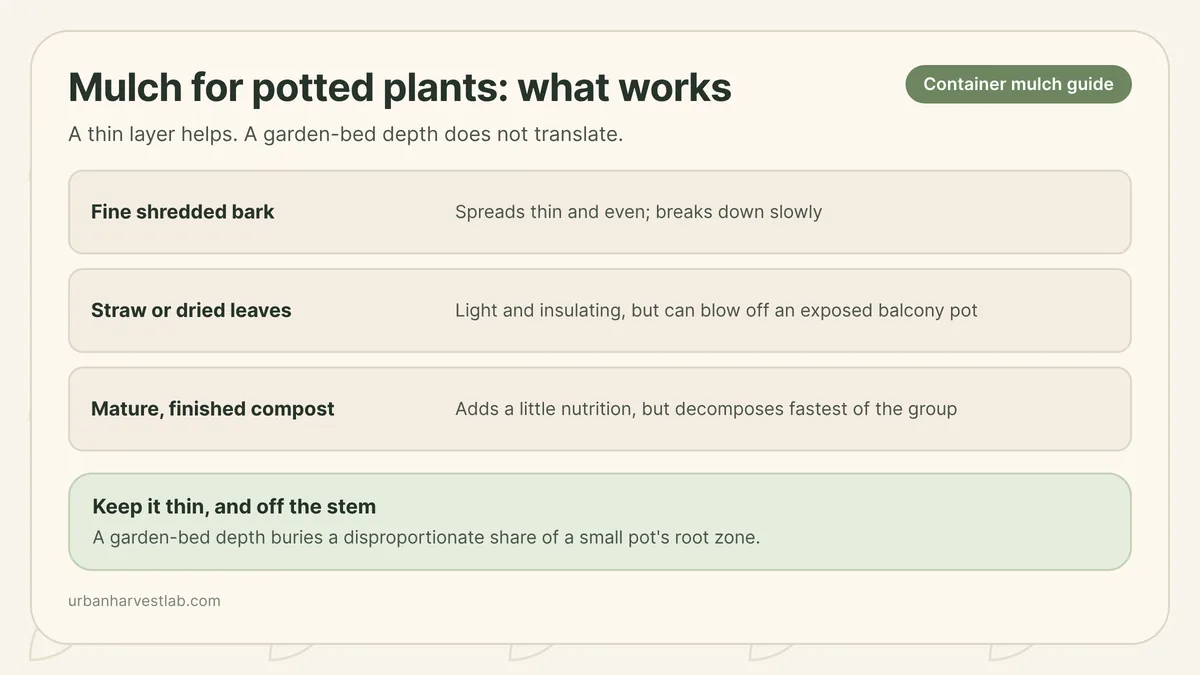
Mulch for potted plants: what actually helps in a container
A thin surface layer slows evaporation and softens heat swings in a container, but it does not fix a small pot, a compacted mix, or salt buildup on its own.
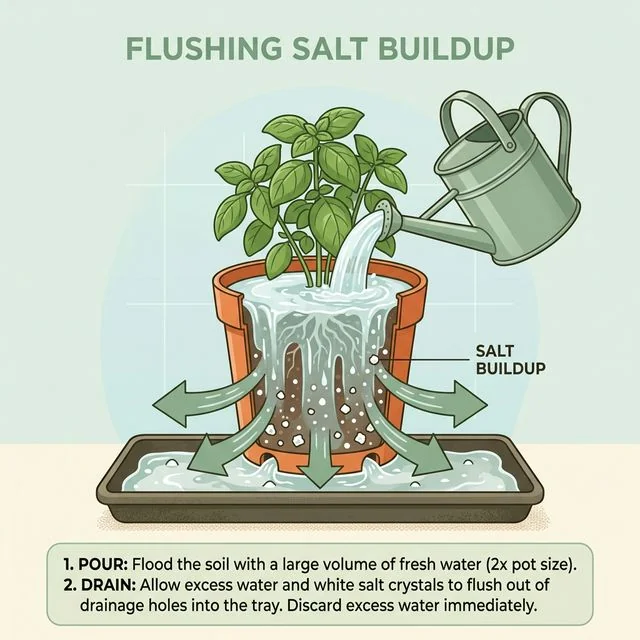
Salt buildup in herb pots: when to flush and when to repot
Every time you water your plants with liquid fertilizer, you are leaving heavy chemical salts behind. If you don't periodically wash them out, your herbs will suffer from chemical burn and nutrient lockout.
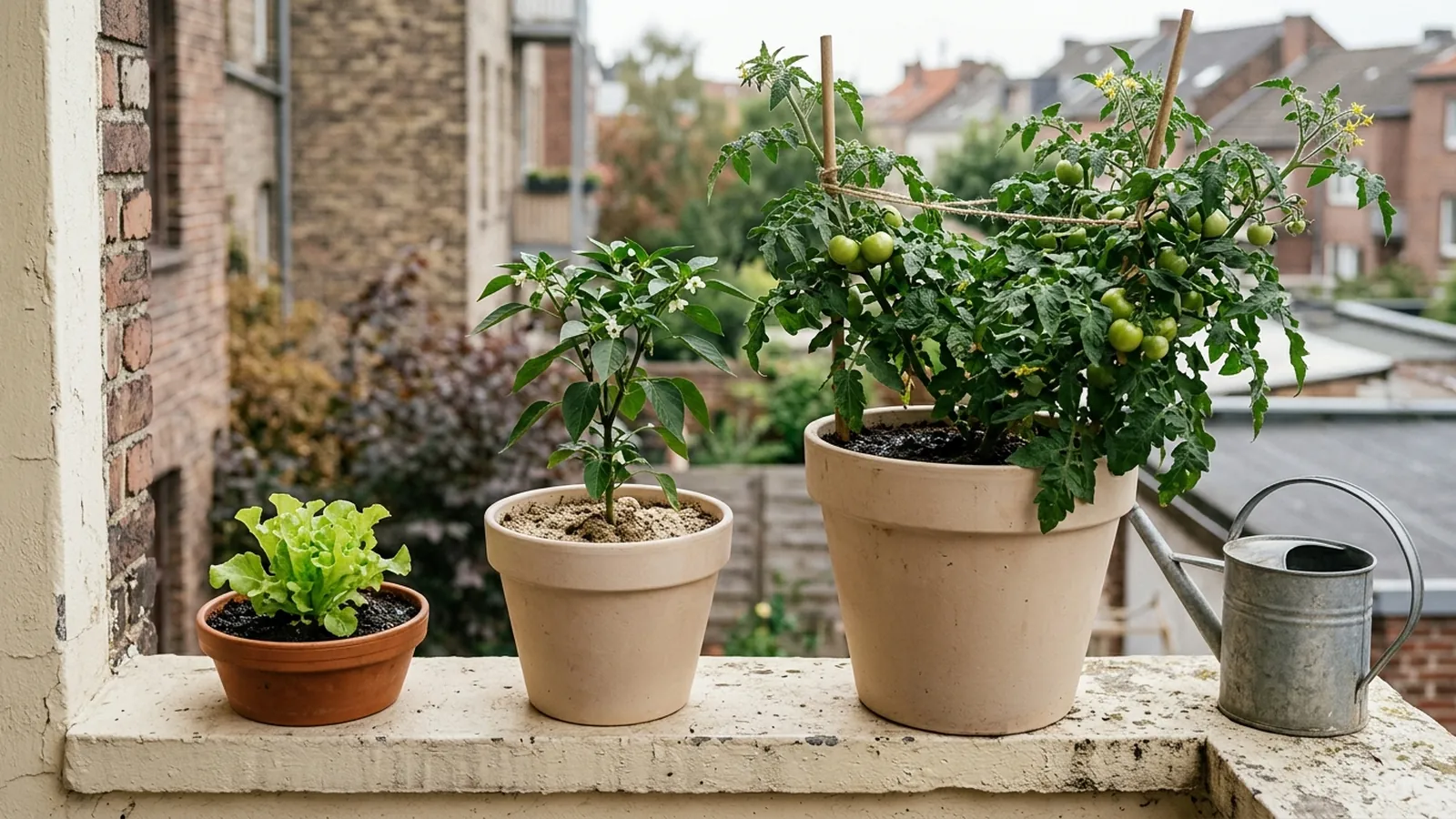
How often to water container vegetables: volume and crop stage set the interval
A pepper in a 2-gallon pot in May and the same pepper in the same pot in August are two different watering problems. Once you can see why, the question stops being how often and becomes how much mix you gave the plant, and what it is carrying right now.