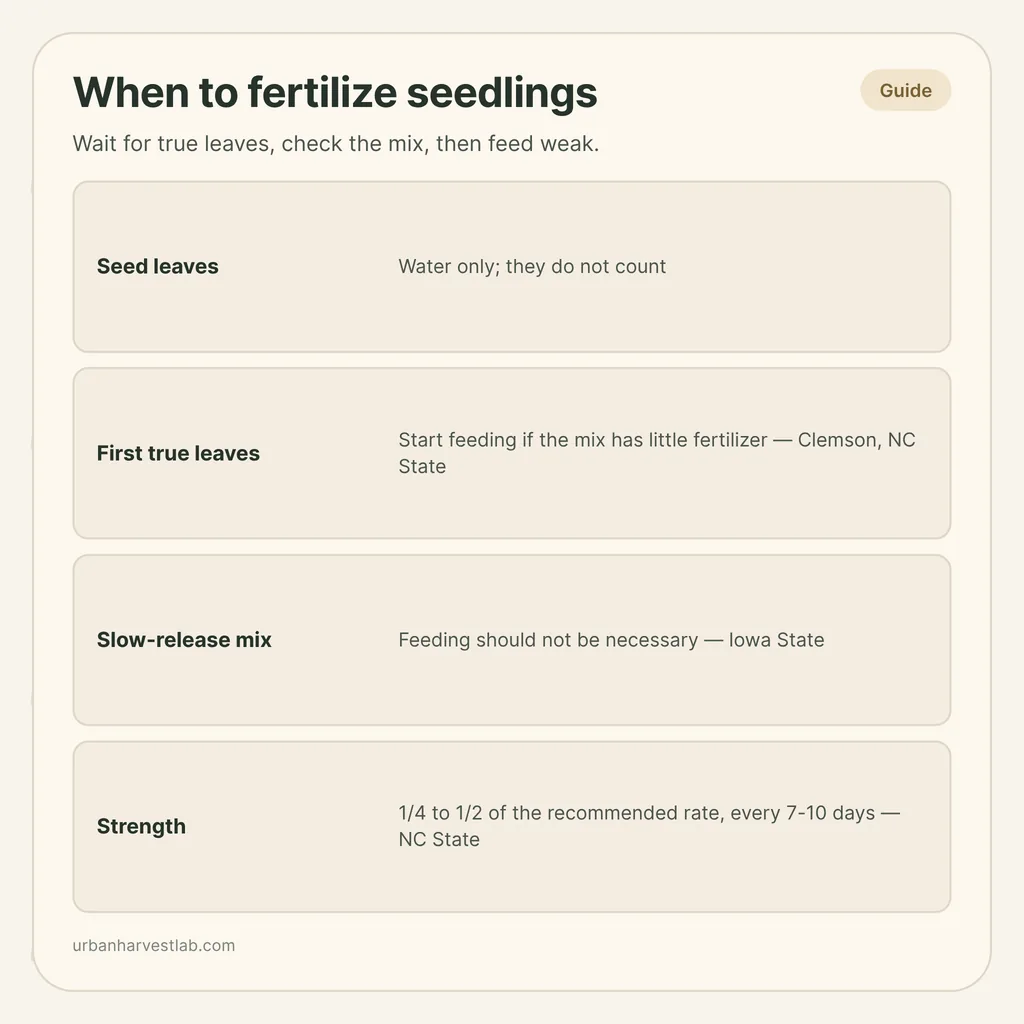
Feed seedlings only once the first true leaves have opened, and only if the mix is not already fertilized. Then use a dilute solution: one quarter of the label rate is the most cited starting point. Seed leaves do not count. A mix with little or no fertilizer listed is the case that needs feeding; a mix that lists a fertilizer charge may not need it for weeks.
Read the bag before you reach for a bottle
Most of the disagreement between extension pages comes from one variable: what is in the mix. The type of mix is covered in seed-starting mix vs. potting mix. For feeding, what matters is whether the label lists fertilizer or slow-release granules.
University of Maryland Extension says soilless growing media “often contains a small amount of fertilizer, enough to support plants for 6 to 8 weeks after germination.” Another Maryland page on vegetable seedlings is more conservative, giving 5-6 weeks, and a third says “at least 6 weeks.” The spread is real, so treat it as a window, not a date. Maryland adds that if transplants will be grown for more than 6 weeks you may need to feed with a soluble fertilizer.
Iowa State Extension puts the rule in terms of the mix: with a commercial potting mix containing a slow-release fertilizer, “fertilization should not be necessary.” NC State Extension says the same of a purchased seed-starting mix with fertilizer. If your mix has no fertilizer listed, the trigger changes, as the next section shows.
The signal: true leaves, not seed leaves
The first pair of leaves to open are the cotyledons, the “seed leaves.” Maryland describes the true leaves as appearing “above or between the cotyledons.”
Two extension services tie feeding to that moment, for mixes that carry little fertilizer:
- Clemson Extension: “Fertilize seedlings growing in soilless mixes when the first true leaves appear.”
- NC State Extension: “Since most germination media is low in fertility, fertilize seedlings with a dilute soluble fertilizer or fish emulsion once they have grown ‘true’ leaves.”
Maryland’s advice looks opposed (“Hold back on fertilizing your seedlings”) but the two fit together once you account for the mix: Maryland assumes the typical bag contains a starter charge, NC State assumes a mix with little in it (“most germination media is low in fertility”), and Clemson addresses soilless mixes.
How strong, and how often
The sources agree on strength and differ on frequency.
| Source | Strength | Frequency |
|---|---|---|
| Iowa State Extension | Dilute, 1/4 strength, water-soluble | Once every two weeks for mixes without slow-release fertilizer |
| NC State Extension | One quarter to one half of the recommended rate | Every 7-10 days while seedlings are small |
| Clemson Extension | Water-soluble starter fertilizer | Every other watering, plain water in between |
| University of Maryland Extension | Label directions for indoor plants or transplants | When nutrients are running low |
A quarter-strength feed is the label dose divided by four, so one-quarter of the amount of concentrate you would use for a mature plant in the same volume of water. The fertilizer dilution calculator turns a label rate into millilitres per litre or teaspoons per gallon. Iowa State adds that regular dilute feeding “will help to produce stockier transplants, provided enough light is available”.
A reasonable path through these numbers: start at one quarter, watch the next set of leaves, and move toward one half only if growth is slow and the roots and light are fine. If growth is the problem and not the feed, stalled seedlings lists the other causes in order.
For the product itself, the sources ask for a water-soluble fertilizer, or in NC State’s case fish emulsion. If you do not own one, you can browse water-soluble fertilizers on Amazon and read the label for the application rate for indoor plants or transplants. Slow-release versus liquid in a container is its own question, covered in slow-release vs. liquid fertilizer.
Avoiding burn
NC State’s warning is short: “Full doses of fertilizer can burn seedlings.” Maryland adds a condition that matters on a windowsill. Young seedlings “are easily damaged by too much fertilizer, especially if they are under any stress from drying roots.” So feed a seedling that is evenly moist, not one that has just wilted.
Three habits follow from the sources:
- Alternate with plain water. Clemson says to water between feedings with plain water “to prevent any salt from accumulating in the media.” The mechanism and the flushing method are in salt buildup in herb pots.
- Keep it off the leaves. Maryland says to rinse off any liquid fertilizer that contacts foliage.
- Do not feed a stressed tray. A tray that is waterlogged, drying out or starved of light has a different problem, and more fertilizer will not fix it.
A simple schedule
This is a synthesis of the sources above, not a single institution’s protocol.
- Until the first true leaves open: water only.
- Mix with fertilizer listed, or slow-release granules: keep watering and wait. Iowa State says feeding should not be necessary; Maryland’s window is 5-8 weeks. Feed only if the tray is still waiting to be planted out past that point or growth stalls.
- Mix with little or no fertilizer: from the first true leaves, give a dilute feed. Iowa State’s version is 1/4 strength every two weeks, NC State’s is a quarter to a half every 7-10 days, Clemson’s is every other watering.
- Once the plant is in its final container: the schedule changes; see fertilizer schedule for container vegetables.
Sources
- University of Maryland Extension: Starting seeds indoors
- University of Maryland Extension: Care of vegetable seedlings
- Iowa State University Extension: How to successfully start seed indoors
- NC State Extension, Caldwell County: Tips for seeding success
- Clemson Cooperative Extension: Starting seeds indoors
Seed-starting mix, stalled seedlings and dilution math
The pages that cover the mix, the symptoms and the arithmetic of a quarter-strength feed.
Common questions
When should I start fertilizing seedlings?
Clemson Extension says to fertilize seedlings in soilless mixes when the first true leaves appear. NC State Extension gives the same signal. University of Maryland Extension is more cautious: it says to hold back, because most potting mixes carry enough fertilizer for roughly 5 to 8 weeks.
How strong should the fertilizer be?
Iowa State Extension recommends a dilute, 1/4-strength water-soluble fertilizer. NC State Extension gives one quarter to one half of the recommended rate, applied every 7-10 days while seedlings are small.
Do seedlings in a fertilized potting mix need extra feeding?
Often not at first. Iowa State says fertilization should not be necessary with a slow-release mix, and NC State says a seed-starting mix with fertilizer may mean you do not need to feed at all. Maryland suggests supplementing only when nutrients run low or seedlings stay in the tray past about 6 weeks.
Can you give seedlings too much fertilizer?
Yes. University of Maryland Extension warns that young seedlings are easily damaged by too much fertilizer, especially when their roots are drying out, and NC State says full doses can burn seedlings.
Related guides
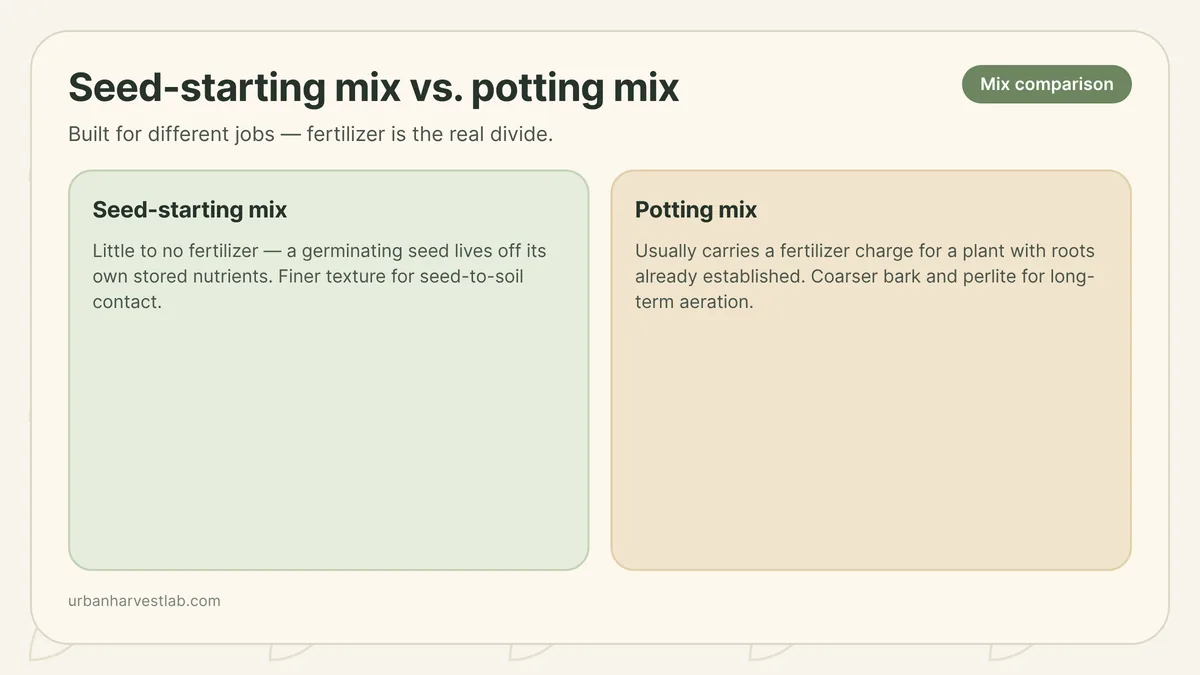
Seed-starting mix vs. potting mix: why your seedlings need a different bag
Potting mix is built to feed an established plant; seed-starting mix is built to stay out of a germinating seed's way. The difference is fertilizer content and particle size, and it matters before the first true leaf appears.
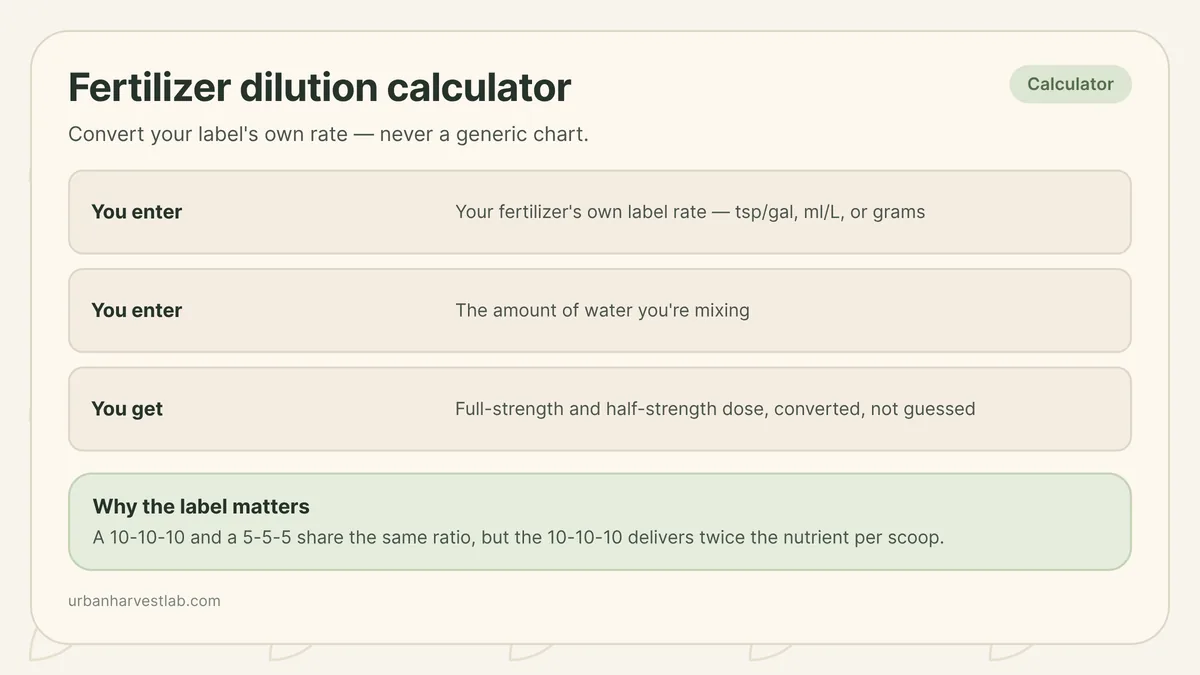
Fertilizer dilution calculator: label rate to ml/L, tsp/gal, and half strength
A calculator that converts a fertilizer's own label rate into ml/L, tsp/gal, or a half-strength dose for the water you're mixing, plus the manual conversion if you'd rather check it by hand.
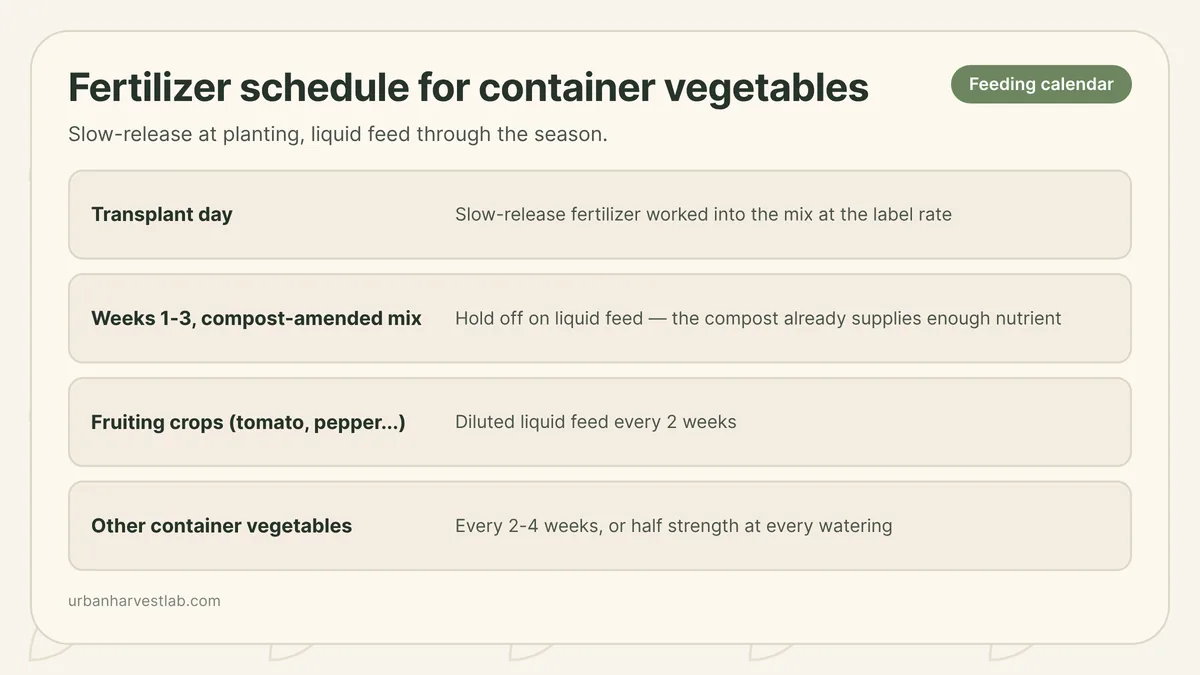
Fertilizer schedule for container vegetables: what to feed and when
A stage-by-stage feeding calendar for container vegetables, built from extension guidance on slow-release charges, liquid top-ups, and the intervals that keep fruiting crops producing.