
Wood ash is a strong, fast-acting liming material that also carries potassium and a heavy load of soluble salts, and extension services publish rates for lawns and garden beds only, so for most potted plants the sensible answer is to leave it out. A pot holds a few quarts of mix with almost no buffering, which means an overdose of alkalinity cannot dilute away. If your plant is short of potassium or your mix has gone acidic, there are easier-to-measure fixes, covered below.
What wood ash actually is
Ash is what remains after the nutrients that burn off have gone. Oregon State University Extension notes that when wood burns, nitrogen and sulfur are lost as gas, while calcium, potassium, magnesium and trace elements remain. Alabama Extension adds that the potassium, calcium, magnesium and sodium stay behind as carbonates, oxides and hydroxides, all of which are alkaline and can react rapidly to raise soil pH.
So the first thing ash does is neutralize acid. Oklahoma State University Extension tested ash from five fireplaces. The average pH of a 1 percent ash solution was 11.6, the average soluble salt content was 22 percent, and potassium, expressed as K2O, averaged 6 percent. Its acid-neutralizing power was about 20 percent of pure lime. UNH Cooperative Extension gives a higher range, 25 to 59 percent, in the table below. The two sources report different figures and neither explains the gap, so treat ash strength as variable and unlabelled. The five samples varied a lot, and OSU ties that to the wood burned and to how hot the fire ran.
| What was measured | Figure | Institution |
|---|---|---|
| Average pH of a 1 percent ash solution | 11.6 | Oklahoma State |
| Average available potassium (K2O) | about 6 percent | Oklahoma State |
| Average total soluble salts | about 22 percent | Oklahoma State |
| Range of potash (K2O) across ash samples | 1 to 10 percent | Alabama Extension |
| Calcium carbonate equivalent (CCE) of wood ash | 25 to 59 percent | UNH Cooperative Extension |
A scoop of fireplace ash has no stated analysis, and two fireplaces make two different products. A bag of fertilizer states its numbers; the NPK label guide shows how to read them.
Why pots make the risk worse
The extension publications are written for ground. Alabama Extension warns that gardeners using ash can create a high soil pH problem very quickly and that ash could raise pH above 9.0. Oregon State says too much ash can raise pH to levels that interfere with plant growth, and that repeated heavy applications in the same spot can effectively sterilize soil. It also points out that the larger area of a lawn helps prevent many of the problems that follow repeated applications in a small garden. A pot is the smallest garden there is.
High pH matters because it locks nutrients away from roots even when they are present, which is the nutrient lockout pattern: pale new leaves with green veins. Soilless mixes are typically kept at pH 5.5 to 6.0, per UConn Extension, and container soil pH covers why a pot drifts faster than a bed. Ash pushes the same dial hard in one direction, with a pH of around 11.6 at the source.
The salts are the second problem. Oklahoma State advises against applying ash directly to green plants because of its high pH and salt content, and Oregon State says to avoid leaving ash in piles, since concentrated salts can leach into the soil and damage plants. A pot that already collects fertilizer salts at the surface has little spare tolerance, which is the situation described in salt buildup in herb pots.
The rates exist, but not for pots
Each extension service gives its rate per area of ground:
- Oregon State: no more than 10 pounds per 100 square feet per year, after testing soil pH, with ash sifted through quarter-inch to half-inch hardware cloth first.
- Oklahoma State: 10 gallons per 1,000 square feet on sandy soil or 20 gallons on others, and not again for 10 years or until a soil test shows a need.
- UNH Cooperative Extension: a garden of 1,000 square feet at pH 6.5 would generally require no more than 20 pounds.
All three assume a soil test, and Oklahoma State says the safe amount depends on soil type, with sandy soils taking about half as much as finer ones. None of those rates was worked out for a soilless potting mix, which has far less buffering than garden soil (see the container pH guide), and scaling a bed rate down to a pot is guesswork.
When ash is clearly the wrong choice
Oregon State advises against ash:
- on acid-loving plants such as blueberries, rhododendrons, ferns and azaleas
- when soil pH is above 7.0
- at seeding, because salts in ash can burn tender seedling roots
UNH Cooperative Extension also says not to mix ash with nitrogen fertilizers such as urea, ammonium sulfate or ammonium nitrate, because they give off ammonia gas on contact with a high-pH material. And ash from trash, cardboard, coal, barbecue charcoal, or pressure-treated, painted or stained wood is out entirely, per Oregon State. Oregon State also recommends gloves, eye protection and a dust mask, handling ash like other strong alkaline materials such as bleach or lye.
If you do not know your mix pH, ash is a guess on top of a guess. Test first, using the approach in the pH guide.
Better routes to the same goals
You want more potassium. Oregon State notes that nitrogen is lost as gas when wood burns, so ash is not a complete feed. A labelled fertilizer states its K2O on the bag and can be dosed by the label. Start with do potted herbs need fertilizer and, for other organic nutrient sources, bone meal vs blood meal.
You want to raise pH. Container mixes are normally bought already limed to a target, so the practical move is choosing a mix formulated for your plant, as the pH guide explains. If a test shows a real problem, change the mix at repotting rather than dosing a small volume repeatedly.
You want to get rid of fireplace ash. Oregon State notes that if wood is your only heat source you can generate more ash in a season than a typical home garden absorbs. Spread it thinly on a lawn or an in-ground bed with a tested pH instead of the windowsill herbs. That is also the sensible place to start for gardeners building a small-space herb garden: keep ash for the ground and use measured inputs in the pots.
Sources
- Oklahoma State University Extension, Fireplace Ashes for Lawn and Garden Use (PSS-2238)
- Oregon State University Extension, Use fireplace ash sparingly to boost garden soil
- UNH Cooperative Extension, Guide to Using Wood Ash as an Agricultural Soil Amendment
- Alabama Cooperative Extension System, Wood Ashes For Lime And Potash
- UConn Extension, Potting Media
Get pH and feeding right in a pot
Ash is one way to move pH and potassium. These cover the safer, better-measured routes.
Common questions
Can I put wood ash in potted plants?
For most pots, no. Oregon State University Extension and Oklahoma State University Extension describe ash as a liming material with high pH and high salt content, and give rates only for lawns and garden beds after a soil test. No pot-sized dose is published, and a small volume of mix cannot absorb a mistake.
Does wood ash add potassium to potting soil?
Yes, but with a lot of alkalinity attached. Oklahoma State University Extension measured about 6 percent available potassium (K2O) and about 22 percent soluble salts on average; Alabama Extension reports 1 to 10 percent K2O across samples. A labelled fertilizer lets you add potassium without moving pH.
Which plants should skip wood ash?
Oregon State University Extension advises against ash on acid-loving plants such as blueberries, rhododendrons, ferns and azaleas, when soil pH is above 7.0, and at seeding time, because the salts can burn tender seedling roots.
What kind of ash is unsafe to use at all?
Oregon State University Extension says not to use ash from burned trash, cardboard, coal, barbecue charcoal, or pressure-treated, painted or stained wood. UNH Cooperative Extension adds that ash from garbage or treated wood can carry heavy metals and materials toxic to plants.
Related guides
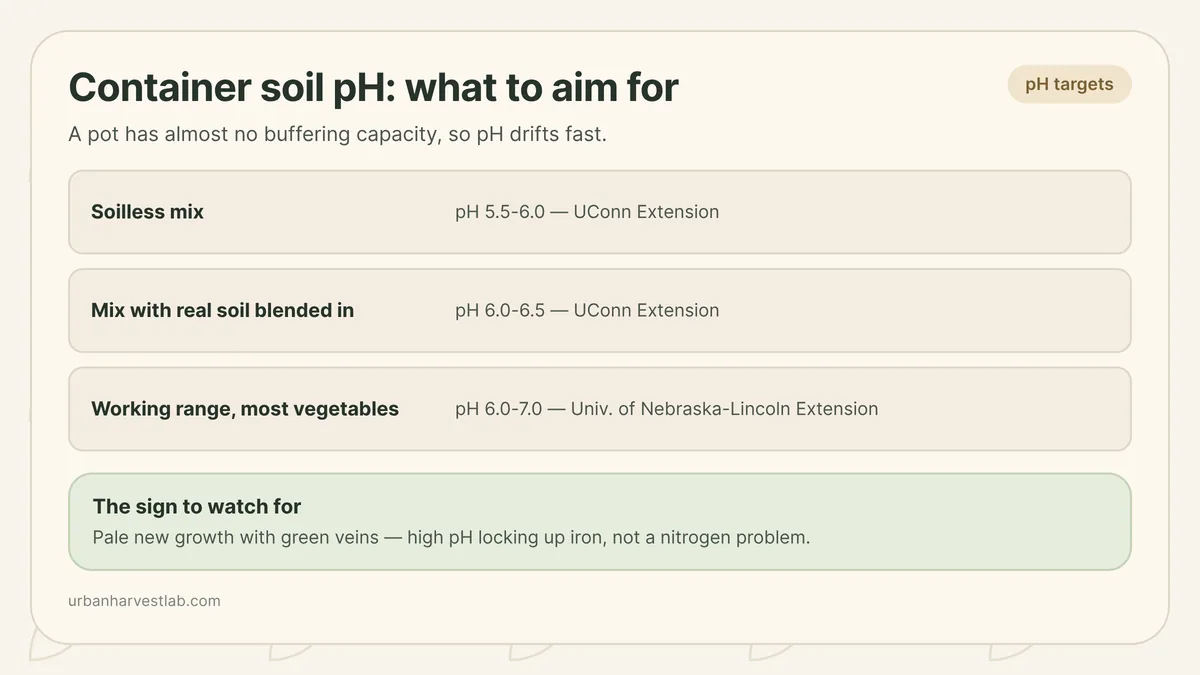
Container soil pH: when it matters and how to fix it
A container's small volume has almost none of the buffering capacity open ground has, so pH drifts faster and matters sooner. Here is when to test, what to aim for, and how to move it.
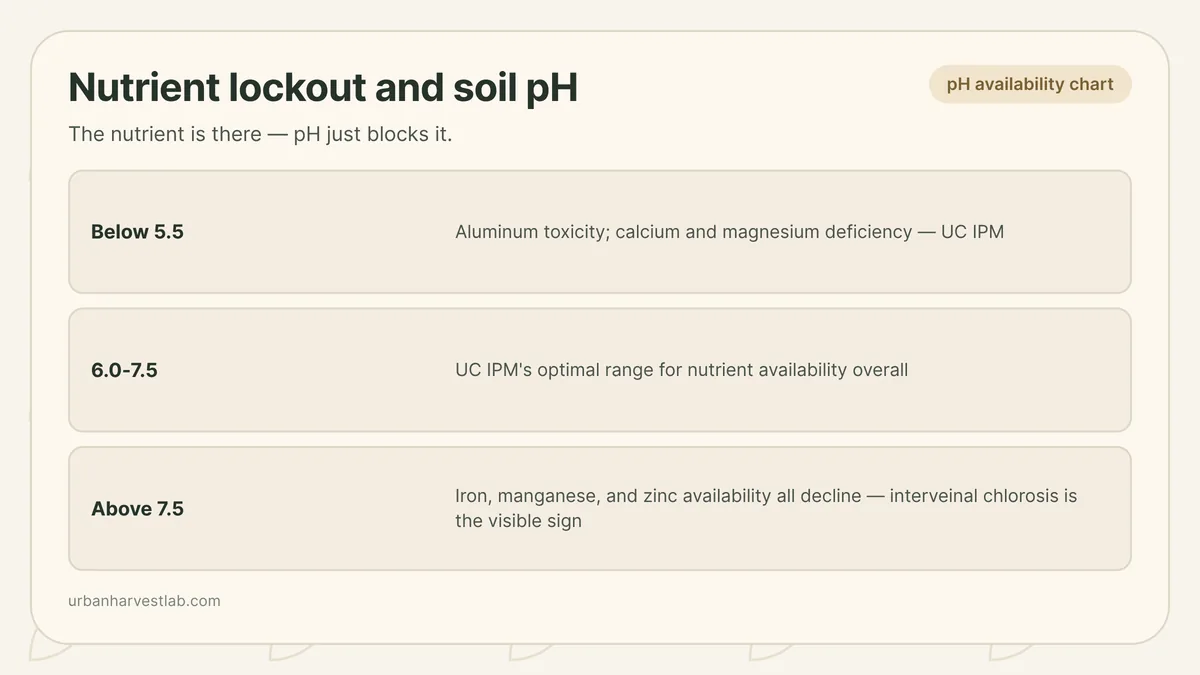
Nutrient lockout and soil pH: why pH blocks nutrients that are already there
A fertilizer that tests complete on the label can still leave a plant starving if the mix's pH is wrong. Here is what pH does to nutrient availability, zone by zone, and why it isn't a salt problem.

Bone meal vs blood meal: which one a potted plant actually needs
Bone meal is a phosphorus source and blood meal is a nitrogen source, so the choice follows the nutrient your plant is short of. Feather meal is the third option, with its own release-speed puzzle.