
Basil types for containers at a glance
| Type | Named examples | What the sources say | Choose it when |
|---|---|---|---|
| Genovese and large-leaf Italian | Genovese, Napoletano, Italian Large Leaf | Penn State Extension calls Genovese a favourite for bruschetta and pesto; NC State Extension gives Genovese larger leaves and a height of 2 ft | You want a big leaf harvest for pesto and have a large pot |
| Compact globe and dwarf | Spicy Globe, Green Globe, Greek Dwarf, Pluto | Penn State Extension: compact small-leaf bush types; NC State: Greek Dwarf 6 in tall, Spicy Globe good for containers; RHS: Pluto compact and ideal for pots | Pot or windowsill space is limited |
| Thai | Siam Queen, Thai Sita, Queenette | Penn State Extension: spicy licorice flavour, and Thai basil is less susceptible to downy mildew than sweet basil; NC State: Siam Queen has purple stems and flowers, Queenette is listed as downy mildew resistant | You want a licorice-mint flavour in place of Italian basil |
| Lemon and lime | Mrs Burns' Lemon, Sweet Dani, Lemon, Lime | Penn State Extension: citrus flavours and less susceptible to downy mildew than sweet basil; NC State lists Lemon and Lime as downy mildew resistant; RHS gives Mrs Burns' Lemon its Award of Garden Merit | You want a citrus note for fish, salads or drinks |
| Purple and red-leaved | Dark Opal Purple, Purple Ruffles, Red Leaf, Rubin | Penn State Extension: purple basil is less sweet than common basil and less susceptible to downy mildew; NC State lists Red Leaf as downy mildew resistant and says: showy purple types suit containers | You want colour on a balcony as well as leaves to eat |
For a pot, choose the basil that matches how you cook and how much room you have: Genovese for pesto, a compact globe or dwarf type for a small container, and Thai or lemon basil when you want a different flavour. All of them are the same species or close relatives and share the same needs, so the variety decides what you taste and how big the plant gets, not whether it will grow.
Penn State Extension says the most common type is sweet basil, with other types including purple basil, lemon and lime basil and Thai basil. If you are still working out which herbs suit your space, the best herbs for a sunny balcony puts basil in context with the rest.
Start with how you will use it
Taste is the clearest reason to prefer one type over another.
Genovese and other large-leaf Italian basils. Penn State Extension calls Genovese one of the most popular sweet basil cultivars for cooking, particularly for bruschetta and traditional pesto. It also lists large lettuce-leaf types such as ‘Napoletano’ and ‘Italian Large Leaf’. NC State Extension describes Genovese as having larger leaves than traditional basil and a height of 2 feet. That is a plant that wants a proper pot, not a jam jar.
Thai basil. Penn State Extension describes Thai basil as having a spicy licorice flavour. NC State Extension says the same of ‘Siam Queen’, whose stems and flowers are purple, with a flavour resembling spicy licorice-mint. The RHS lists ‘Thai Sita’, also with purple flower spikes. If you have only ever grown Italian basil, the taste is a real change, not a variation.
Lemon and lime basil. Penn State Extension describes these as having wonderful citrus flavours. The RHS gives ‘Mrs Burns’ Lemon’ its Award of Garden Merit and calls it an excellent form of lemon basil with a strong fragrance and flavour. The RHS awards an AGM to plants that performed well in its trials, so it is a useful tiebreaker when you are choosing between lookalikes.
Purple and red basil. Penn State Extension says purple basil is less sweet than common basil. NC State Extension notes that sweet basil cultivars with showy purple foliage are often used as ornamentals and are perfect for containers, and lists purple types including ‘Dark Opal Purple’, ‘Purple Ruffles’ and ‘Rubin’. They earn their place on a balcony for looks as much as flavour.
Match the plant to the pot
Size matters more in a container than in a bed, because a big plant in a small pot dries out fast and flowers early. The RHS says most basils form fairly compact plants 20-50 cm (8-20 in) tall, kept bushy by regular picking; the top of that range is a lot of plant for a small pot.
If your space is tight, three kinds of plant solve it:
- Compact globe types. Penn State Extension lists ‘Spicy Globe’ and ‘Green Globe’ as compact, small-leaf bush varieties. NC State Extension describes ‘Spicy Globe’ as dwarf and good for containers or edging.
- True dwarfs. NC State Extension gives ‘Greek Dwarf’ as compact at 6 inches tall, with a spicy, slightly anise flavour.
- Compact ornamentals. NC State Extension lists ‘Queen of Sheba’ as often used as an ornamental, also edible, and compact and good for containers. The RHS describes ‘Pluto’ as compact, domed and ideal for pots, with small, strongly flavoured leaves.
The catch with all of these is leaf size. Small leaves are fine scattered over a plate and slow to strip for a jar of pesto. If pesto is the point, give a Genovese type a larger pot rather than shrinking the variety to fit the pot.
For how big that pot should be, the basil pot size guide has the measurements. As a floor, the RHS says to choose a container at least 20 cm (8 in) wide and deep. Penn State Extension’s author describes a plentiful harvest from one large pot, 1 ft by 2 ft by 8 in deep. Several plants of a large type in one box is a different job from one dwarf in a mug.
Downy mildew and the resistance label
Penn State Extension says all sweet varieties are very susceptible to downy mildew, while Thai, lemon, lime, purple and spicy basil have all been found to be less susceptible. NC State Extension also lists ‘Queenette’, ‘Lemon’, ‘Lime’ and ‘Red Leaf’ as downy mildew resistant. Some basil is sold labelled “DMR”, for downy mildew resistance. It is worth knowing what that buys before you pay extra for it.
The University of Maryland Extension describes infected basil as having a yellowish appearance similar to a nutritional problem, with gray sporulation on the underside of the yellow areas, and says green-leafed varieties are particularly susceptible. Because it looks like a feeding problem, it is easy to misread. The downy mildew guide covers how to tell the two apart.
NC State Extension lists resistant cultivars including ‘Prospera’, ‘Rutgers Passion’, ‘Rutgers Obsession’, ‘Rutgers Devotion’ and ‘Rutgers Thunderstruck’. Its Master Gardener trial, which used ‘Genovese’ as the reference, found ‘Prospera’ to be the overall favourite among the resistant types. ‘Prospera’ is taller and needed staking in some gardens. ‘Rutgers Obsession’ was highly rated for colour and compact growth, and ‘Rutgers Passion’ for aroma, vigour and branching.
Resistance is not a shield. In a University of Maryland field trial, four of five resistant cultivars (Passion, Obsession, Devotion and Thunderstruck) became infected with downy mildew at the same time as a susceptible cultivar, and only ‘Prospera’ showed no symptoms. Cornell then reported growers seeing the disease on resistant varieties, including ‘Prospera’, and concluded the pathogen has evolved to overcome resistance in these varieties.
So treat resistance as a way to improve the odds. In a pot, you can also improve them yourself: leave space between plants, water the soil rather than the leaves (Penn State Extension) and check the undersides of leaves regularly for the gray sporulation Maryland Extension describes.
Pick by situation
| If you have… | Choose |
|---|---|
| One sunny windowsill and little space | A compact globe or dwarf type such as Spicy Globe or Greek Dwarf |
| One large balcony pot and a pesto habit | Genovese or another large-leaf Italian type |
| Two pots | A large-leaf Italian type in one, Thai or lemon in the other |
| Concern about downy mildew | A Thai, lemon or purple type, which Penn State finds less susceptible, or a DMR sweet basil, spaced out |
| A wish for something ornamental as well | Purple or red-leaved basil, or a compact ornamental such as Queen of Sheba |
Types differ in height, so check the expected size before putting two in one pot. Basil can share a pot with other herbs under the right conditions; the companion herb guide covers which.
Whatever you pick, the rules are the same
Variety does not change the basics.
- Sun and warmth. Penn State Extension says to choose a site with full sun, meaning at least six to eight hours per day. The herb sunlight chart shows how this compares with other herbs.
- It is an annual. Penn State Extension says basil is a tender annual that needs replanting every season. Cold nights hurt it: temperatures below 40°F will discolour leaves, according to Penn State.
- Crowding and dryness bring flowers. The RHS says overcrowded basil plants tend to start flowering sooner, ending harvests, and that basil may flower sooner in dry conditions. Pinching and harvesting delays it, and the guide to basil flowering covers what to do when it starts. Watering rhythm for pots is in the basil watering guide.
- Seed gives the widest choice. The RHS says you get the widest choice of varieties if you grow basil from seed. Most of the named types above are easier to find as seed than as plants. The seed or plants comparison helps decide which route suits you.
Common mistakes
- Choosing a variety for its photo. A tall Genovese in a 6-inch pot will dry out and flower early. Pick for the container you actually have.
- Planting a dwarf for a pesto harvest. The leaves are small, so the yield per picking is small.
- Assuming a DMR label means no mildew. It improves the odds.
- Buying a supermarket pot as the variety. The RHS says supermarket pots usually contain many thin, overcrowded plants that tend to succumb to fungal diseases or soon start flowering, although they may survive if divided up and repotted promptly. Treat those as a mix of seedlings, not a named variety.
Sources
- Penn State Extension, “Basil, A Summer Favorite”
- Royal Horticultural Society, “How to grow basil”
- NC State Extension Plant Toolbox, Ocimum basilicum
- University of Maryland Extension, “Basil Downy Mildew Cultivar Study”
- Cornell Vegetable Program, “Basil Downy Mildew Developing on Resistant Varieties”
Growing basil in a pot
Once you have chosen a type, these guides cover the pot, the watering and the pruning that keep it productive.
Common questions
What is the best basil variety for pots?
It depends on what you cook. For pesto and Italian dishes, Genovese is the type Penn State Extension singles out. For a very small pot, a compact globe type such as Spicy Globe is the safer fit, and the RHS rates Pluto as compact, domed and ideal for pots. For a mix of uses, grow one Genovese or similar large-leaf plant and one compact or flavoured type in separate pots.
Can you grow Thai basil in a pot?
Yes. Thai basil is a form of the same species as sweet basil, so the container, sun and warmth rules are the same. The RHS lists Thai Sita, and NC State Extension describes Siam Queen as having a spicy licorice-mint flavour. Penn State Extension also finds Thai basil less susceptible to downy mildew than sweet basil, which is a second reason to choose it.
Is lemon basil different from regular basil to grow?
Penn State Extension describes lemon and lime basils as having citrus flavours, and the RHS gives Mrs Burns' Lemon its Award of Garden Merit. It grows the same way as sweet basil (warmth, 6-8 hours of sun, regular picking), but Penn State Extension finds lemon and lime basil less susceptible to downy mildew than sweet basil.
Are dwarf basils worth growing?
They are worth it if space or pot size is tight. NC State Extension lists Greek Dwarf at 6 inches tall and Spicy Globe as good for containers or edging. The trade-off is a small leaf, which suits scattering over food more than making a large batch of pesto.
Should I buy a mildew-resistant basil?
A resistant sweet basil lowers the odds but does not remove the risk, and Penn State Extension finds Thai, lemon, lime, purple and spicy basils less susceptible than sweet basil. The University of Maryland trial found four of five resistant cultivars infected at the same time as a susceptible one, while Prospera stayed free of symptoms in that trial. Cornell has since reported growers seeing downy mildew on resistant varieties, including Prospera. Spacing, morning watering and checking leaf undersides still matter.
Related guides
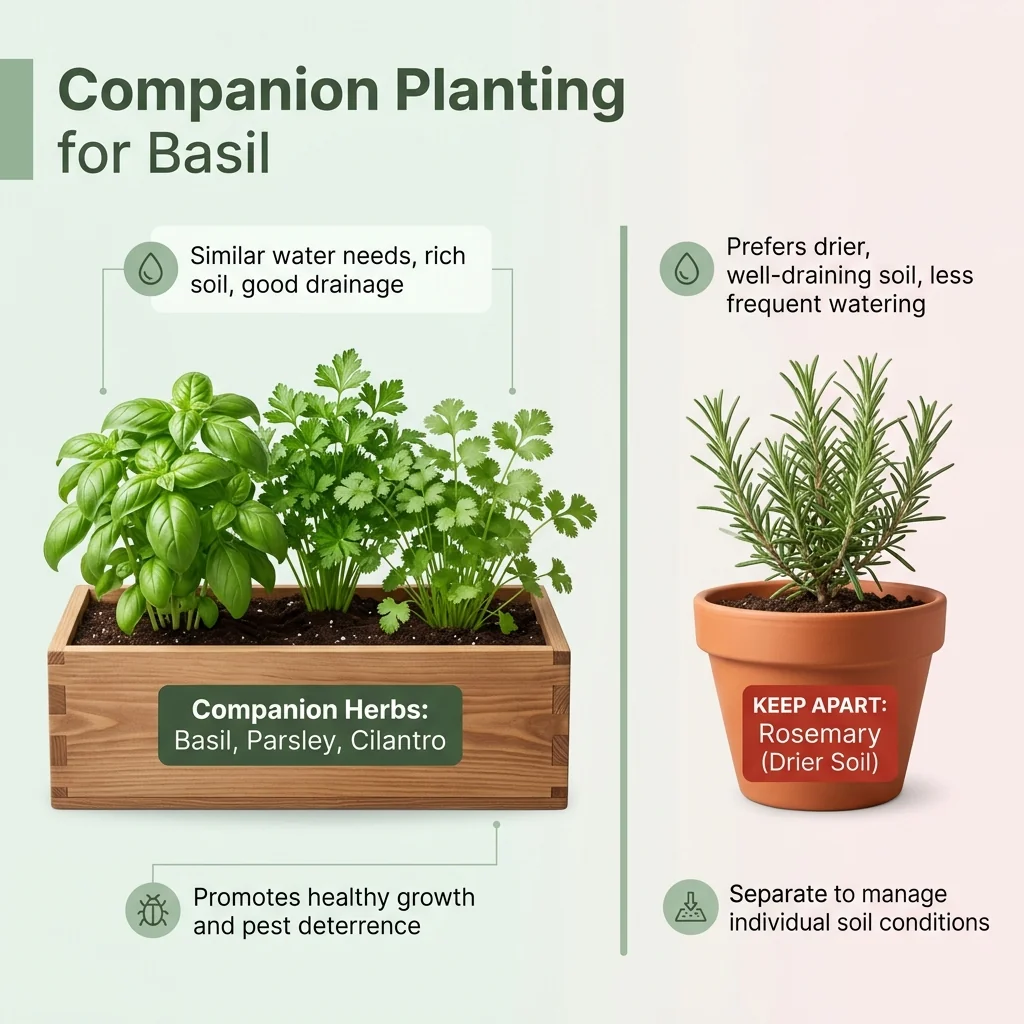
Can basil share a pot? Yes, with parsley, cilantro or chives
Basil grows happily with other thirsty herbs like parsley, cilantro, and dill, but clashes with drought-tolerant herbs. Here is what to plant with basil and what to skip.
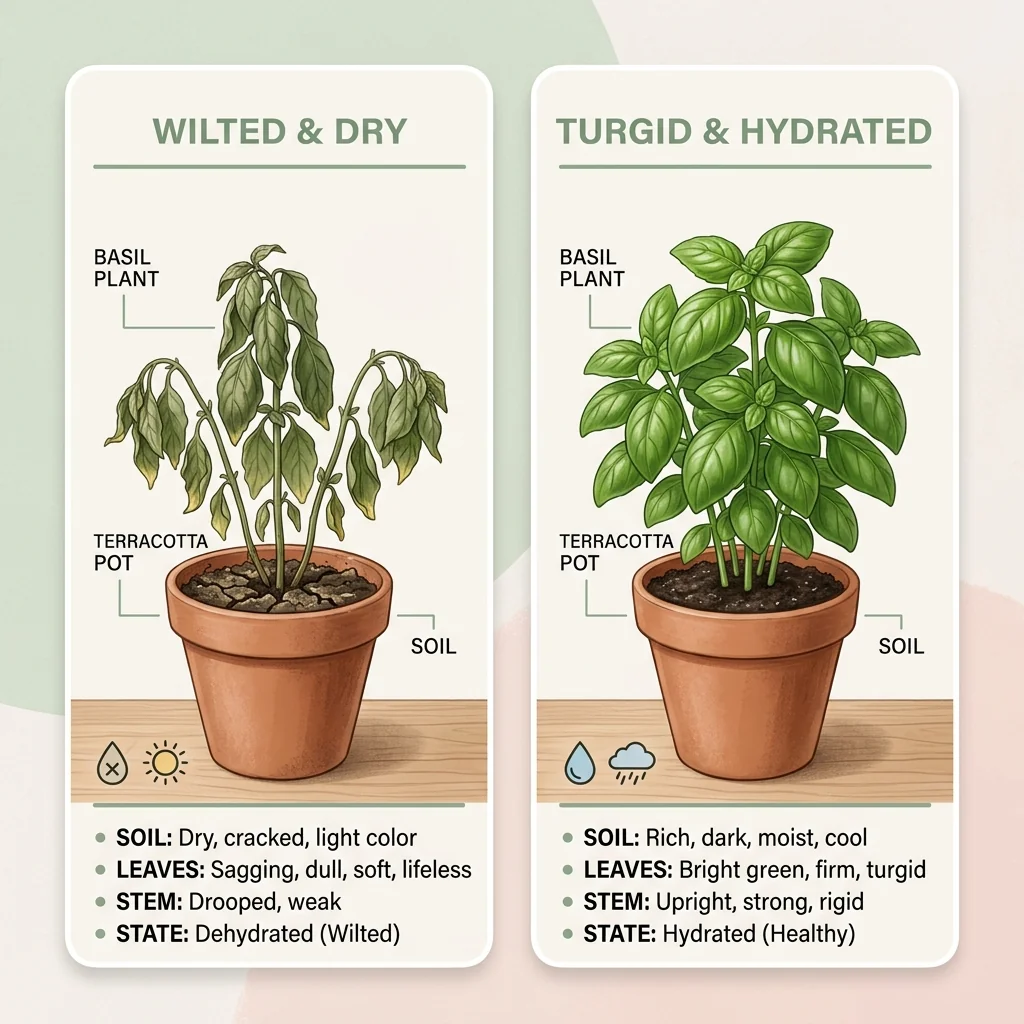
How often to water basil in pots: a 1–3 day check
Potted basil often needs water every one to three days, but the reliable trigger is a drying upper root zone plus a lighter pot—not a repeating alarm.

Basil flowering: pinch it back or let it bloom?
Flower buds on basil are the plant switching from leaves to seed. Pinching them off keeps leaf production going; letting them open trades leaves for pollinator food.