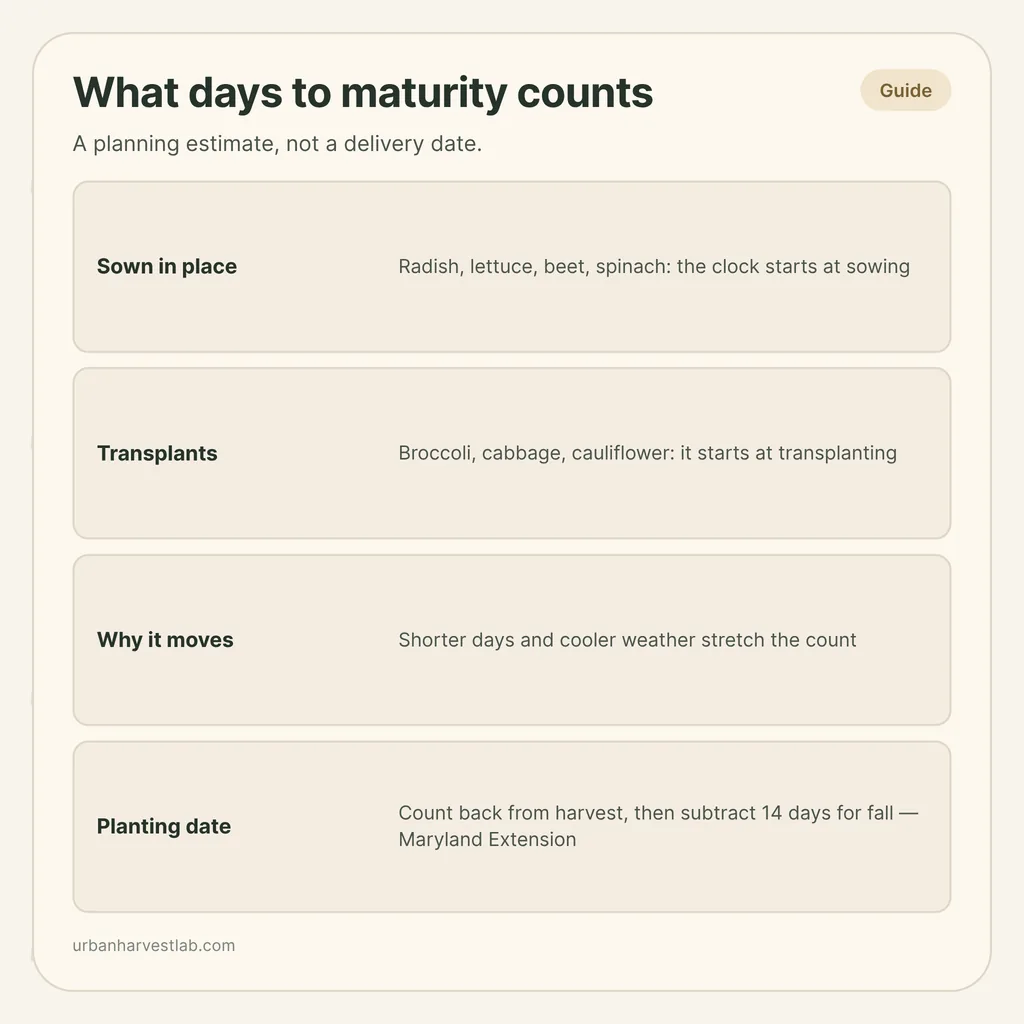
Days to maturity is the number of days from a starting point to harvestable maturity, and the starting point depends on the crop. For lettuce, spinach, beet, radish and leafy greens it is sowing the seed in the garden. For broccoli, cabbage, cauliflower and Brussels sprouts it is transplanting the seedling, according to University of Maryland Extension. Treat the figure as a planning estimate for your pots, not a delivery date.
Where the count starts
University of Maryland Extension describes the number as “the number of days from seeding in the garden to harvestable maturity” for the first group of crops and “the number of days from transplanting to maturity” for the second. In practice:
- Sown in place (radish, lettuce, beet, spinach, greens): the clock starts when the seed goes into the pot.
- Sold or grown as transplants (broccoli, cabbage, cauliflower, Brussels sprouts): the clock starts when the seedling goes into its final container. The weeks it spent indoors come before day one. If you raise your own seedlings, the seed starting calculator works out when to sow them.
Penn State Extension words it differently: “The number of days to maturity is the same whether you are putting a seed in the ground or starting with a transplant.” Two extension sources, two framings. When a packet or catalog does not say which it means, check the variety description for “from transplant” or “from direct seeding”. Which crops are worth starting in the pot at all is covered in direct sow vs transplant.
Why the number moves
Penn State Extension notes that “Days to maturity are based on spring planting.” Plant into shortening days and the count stretches. Maryland puts the cause as “decreasing light and lower temperatures that slow growth.”
Oregon State University measured how much, in trials at its North Willamette Research and Extension Center. Arcadia broccoli “reportedly takes 63-94 days to mature depending on the seed catalog referenced,” and the model OSU built from 2011 to 2015 field data predicted 66 to 103 days from transplant to maturity. Early spring plantings took 20 to 30 days longer than mid-summer ones, cooler years ran slower than warmer ones, and “crops planted one month apart matured 14-26 days apart.”
That is a research farm in Oregon, so your balcony will differ. The pattern is what matters: the same variety does not take the same number of days at every planting date. OSU’s reasoning is that “time and temperature (degree-days) can often predict maturity more accurately than just time (calendar days).” You do not need degree-day tables for a pot of lettuce. Just expect a cool spell to push harvest back, and a catalog number to be a rough guide. One Oregon seed breeder quoted by OSU calls catalog days to maturity “not useful to farmers, except in a vague relative sense.” Relative is the useful part: a 45-day lettuce is ready before a 60-day one.
Using it to pick a planting date
Count backward from the first harvest you want.
- Pick the harvest start date.
- Subtract the days to maturity.
- For fall crops, subtract a season adjustment as well.
University of Maryland Extension gives a worked case: beets harvested from October 15, packet says 55 days. October 15 minus 55 days is August 20. Subtract the 14-day Short-Day Factor and the sowing date is about August 7.
| Source | Adjustment for fall planting |
|---|---|
| University of Maryland Extension | 14 days (Short-Day Factor); matters most for crops grown for heads or pods, less for root and leafy crops |
| Penn State Extension | A week for quick-maturing crops, longer for slow ones; its Gypsy broccoli example adds 10 days to 65 |
| Iowa State Extension | Work back from the average first frost, and add a couple of weeks before it to allow for harvest |
Penn State’s broccoli example: 65 listed days plus 10 for decreasing daylight, counted back from October 17, gives a planting date of August 3.
In spring, the same subtraction runs from your target harvest or from your last frost date; see first and last frost dates for a balcony. For fall, the fall planting calculator does the arithmetic crop by crop, so you do not have to repeat it by hand.
Ranges give you the quick versus the slow
Iowa State Extension lists days to maturity as ranges: leaf lettuce 45 to 60, radish 25 to 40, broccoli 60 to 65 from transplants. A radish is ready in a month; a broccoli head takes two months or more. Anything with a long number needs an early start, and an early-maturing variety buys room when the season is tight. Iowa State advises: “Use early maturing cultivars and count back the number of days to maturity to determine the last possible planting date.”
Germination can undo the arithmetic. Penn State points out that sowing seed directly in hot, dry August soil is tricky and tells gardeners to “Pay attention to the recommended soil temperatures for seed germination found in the seed catalog or the seed packet.” Starting indoors and setting out transplants gets around it, and Maryland notes that transplants let you plant later into the fall.
What the number does not tell you
It describes when the first harvest is ready, not how big or productive the plant is. Packet words like “patio,” “bush” or “determinate” describe plant size and habit; what those terms mean is a separate question. Crops you pick over many weeks keep producing after the number is reached, and planning a steady supply is a job for succession planting in containers.
Sources
Planning your planting dates
Turn the packet number into sowing dates and pick varieties that suit pots.
Common questions
What does days to maturity mean on a seed packet?
It is the number of days to harvestable maturity. University of Maryland Extension says it runs from seeding in the garden for crops like lettuce, spinach, beet, radish and leafy greens, and from transplanting for crops like broccoli, cabbage, cauliflower and Brussels sprouts.
Do the weeks I spend starting seeds indoors count?
For crops counted from transplanting, they come on top of the number, according to University of Maryland Extension. Penn State Extension words it differently, saying the figure is the same whether you put in a seed or a transplant, so read the packet or catalog wording for your variety.
Why is my crop ready later than the packet says?
The number is based on spring planting (Penn State Extension). Oregon State trials found early spring plantings of one broccoli variety took 20 to 30 days longer than mid-summer ones, and development was slower in cooler years.
How do I use days to maturity to pick a planting date?
Start from the harvest date you want and subtract the days to maturity. For fall crops, also subtract 14 days (University of Maryland Extension) or at least a week (Penn State Extension). Iowa State Extension adds a couple of weeks before the first frost for harvest.
Related guides
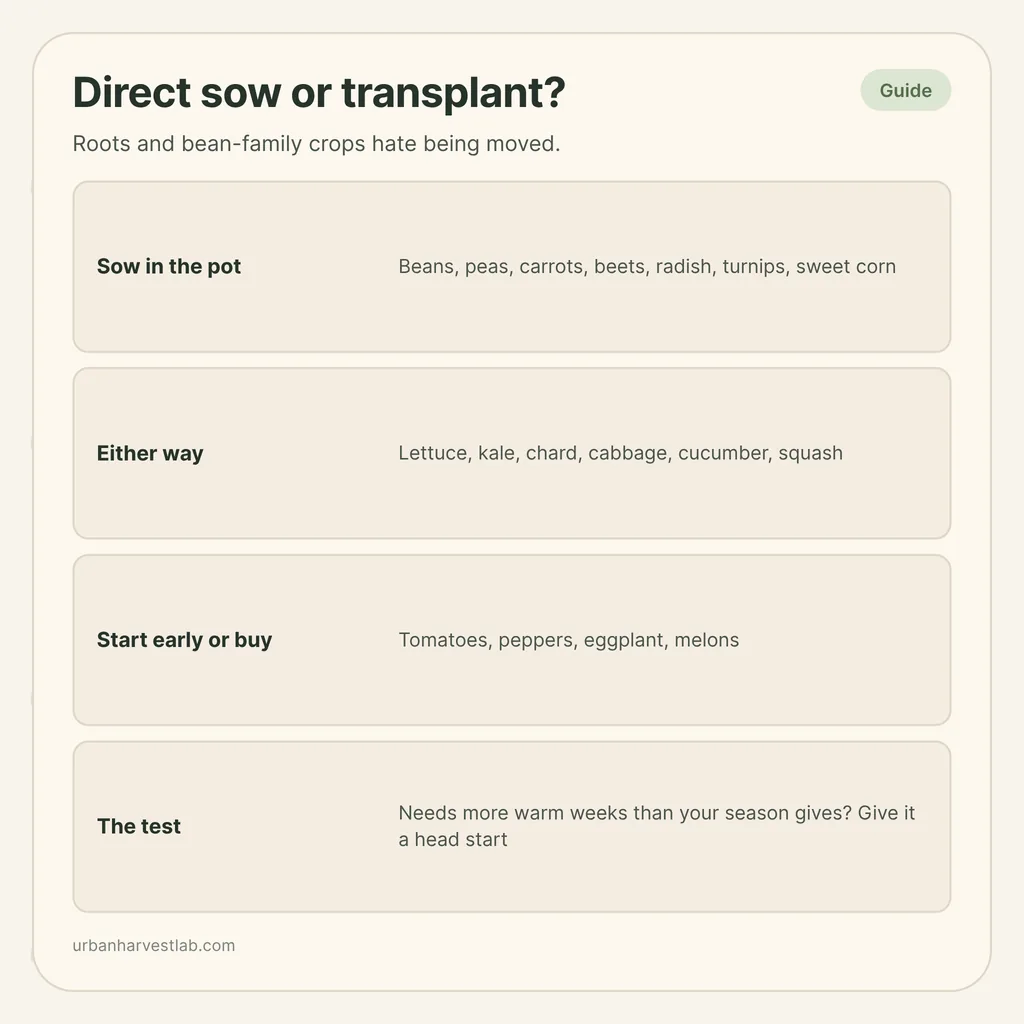
Direct sow vs transplant: which crops to start in the pot
Some crops sulk when moved, others need a head start. Here is which vegetables to sow where they will grow, which to start indoors or buy, and which work either way.
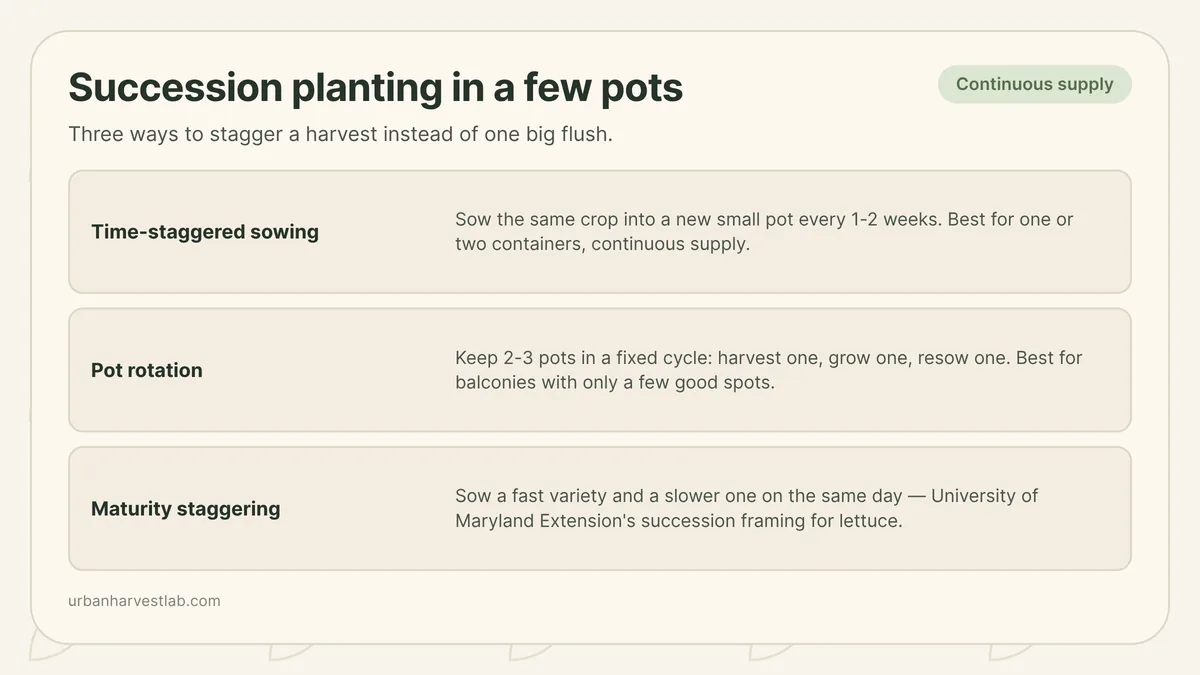
Succession planting in containers: how to stagger a harvest from a few pots
Succession planting in containers is a sowing rhythm: a few pots restarted on a schedule keep producing, where one large planting ripens together and then quits together.
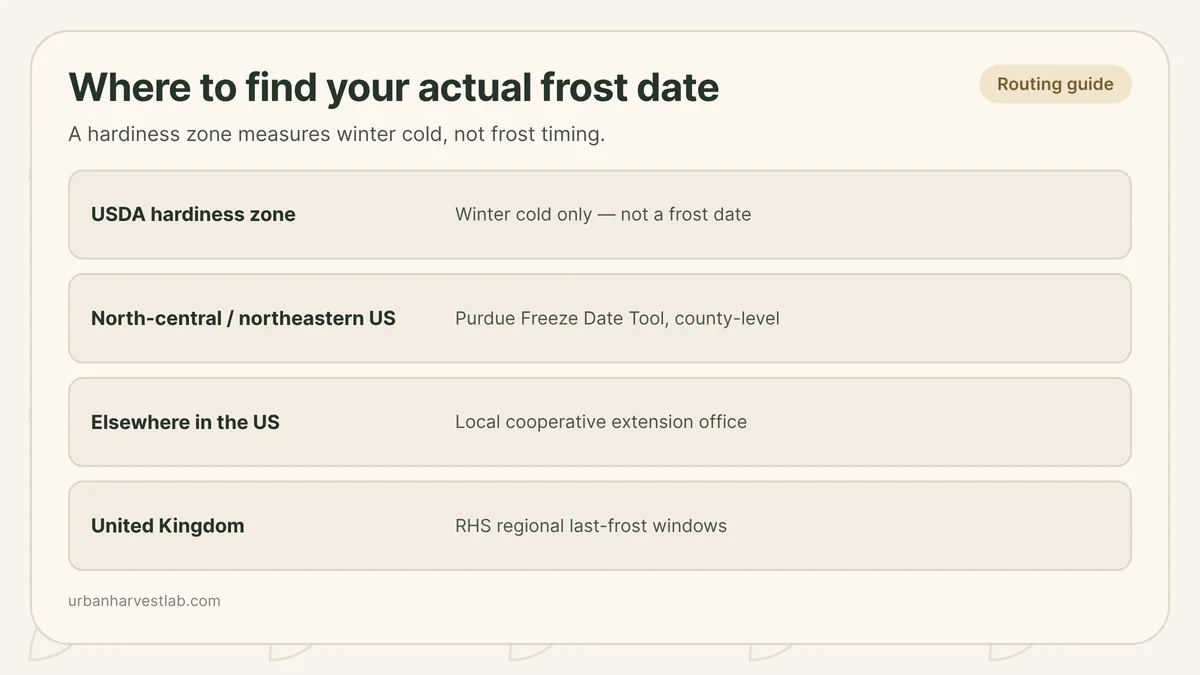
First and last frost dates for a balcony: start with your zone
Your hardiness zone tells you how cold winter gets, not when frost starts or ends. Look up the zone's temperature band, then use the tools built to answer the date question directly.