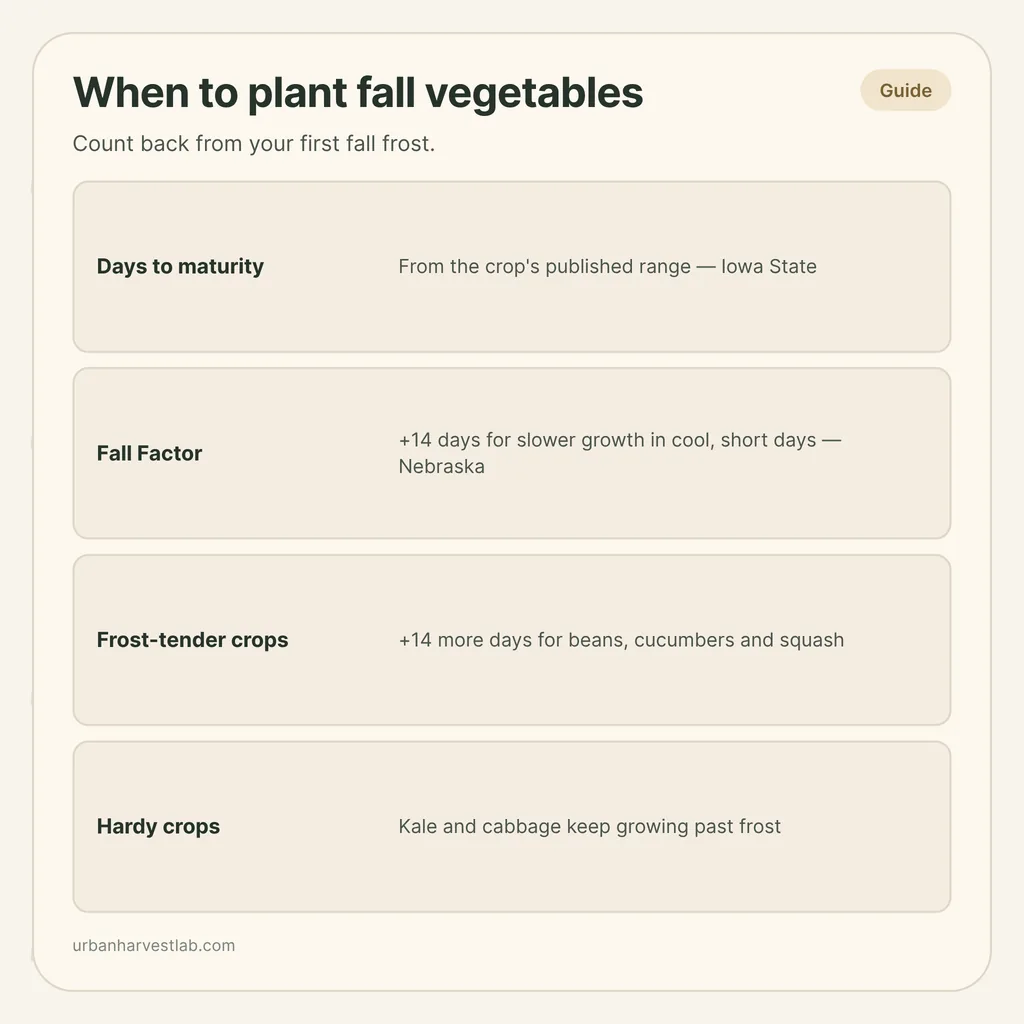
To find your last safe planting date for a fall crop, count backward from your first fall frost by the crop’s days to maturity, plus about 14 days for slower autumn growth, plus another 14 for crops that frost kills, the method University of Nebraska-Lincoln Extension publishes. Radish gives you weeks of leeway in late summer. Cucumber gives you almost none. The calculator below does that arithmetic for each crop and prints every step, so you can check it against your own frost date. Spring has its own version of this count, which starts from the last frost: use the seed starting calculator for that one.
Calculate your fall planting date
Live estimate
Enter your average first fall frost date and pick a crop. The result is a planting window counted backward from that date, using the published days to maturity.
Plant outdoors between
—
Choose a crop to begin
- Start seed indoors between
- —
- Days to maturity (published)
- —
- Fall Factor
- —
- Frost-tender factor
- —
Enter your first fall frost date and choose a crop.
Working it out by hand takes four steps. Take the crop’s days to maturity from the table below. Add the Fall Factor of 14 days, add another 14 if the crop is frost-tender, and add the number of days you want to keep harvesting. Count that many days back from your first fall frost. The result is the last day to plant. Do it twice, once with each end of the days-to-maturity range: the slow count gives the safe date and the fast count gives the latest one that could still work.
Worked example, leaf lettuce. Say the average first frost is October 15. Iowa State University Extension gives leaf lettuce 45 to 60 days, it is semi-hardy, and you are not counting extra harvest days. Using Nebraska’s 14-day Fall Factor, the slow count is 60 + 14 = 74 days, which lands on August 2. The fast count is 45 + 14 = 59 days, which lands on August 17. Sow between those dates.
Worked example, cucumber. Same frost date. Iowa State gives cucumber 55 to 65 days and Nebraska treats it as frost-tender, so the slow count is 65 + 14 + 14 = 93 days, which is July 14, and the fast count is 55 + 14 + 14 = 83 days, which is July 24. A tender crop has to go in two to three weeks before the lettuce.
Where the method comes from
The University of Nebraska-Lincoln Extension NebGuide on fall vegetable gardening gives the formula: the days from seeding or transplanting outdoors to harvest, plus the days from seed to transplantable size if you start your own transplants, plus the average harvest period, plus a Fall Factor of about 14 days, plus a Frost Tender Factor of 14 days where it applies, equals the number of days to count back from the first expected fall frost.
Nebraska explains the two additions plainly. The Fall Factor takes into account the slower growth that results from cooler weather and shorter days. The Frost Tender Factor applies only to frost-sensitive crops, such as corn, beans, cucumbers, tomatoes and squash, because they must mature at least two weeks before frost to produce a reasonable harvest.
Iowa State University Extension makes the same point from the other side. If a fall crop is started too late, it will not have time to produce before a hard frost. Started too early, the summer heat can inhibit the growth of cool-season crops. The window between those two is what the calculator reports.
Days to maturity, by cold tolerance
Iowa State University Extension sorts fall crops into three groups. Tender crops will be damaged or destroyed by a light frost, semi-hardy crops can tolerate temperatures in the upper 20s °F, and hardy crops will survive temperatures in the mid to low 20s °F. These are the days-to-maturity ranges the calculator uses, taken from Iowa State’s tables for the container-friendly crops. Iowa State’s tender table also lists sweet corn, which the calculator leaves out; the corn in containers guide covers it.
| Group | Crop | Days to maturity (Iowa State) |
|---|---|---|
| Tender | Green beans | 50-70 |
| Tender | Cucumber | 55-65 |
| Tender | Okra | 50-65 |
| Tender | Summer squash | 50-60 |
| Semi-hardy | Beets | 50-70 |
| Semi-hardy | Carrots | 60-80 |
| Semi-hardy | Leaf lettuce | 45-60 |
| Semi-hardy | Green onions | 30-50 |
| Semi-hardy | Kohlrabi | 55-70 |
| Semi-hardy | Radish | 25-40 |
| Semi-hardy | Winter radish | 45-70 |
| Semi-hardy | Spinach | 45-60 |
| Semi-hardy | Swiss chard | 60-65 |
| Hardy | Brussels sprouts (transplants) | 80-90 |
| Hardy | Broccoli (transplants) | 60-65 |
| Hardy | Cabbage (transplants) | 60-90 |
| Hardy | Cauliflower (transplants) | 55-80 |
| Hardy | Kale | 55-75 |
| Hardy | Rutabaga | 80-100 |
| Hardy | Turnip | 45-70 |
Iowa State also lists approximate planting dates for each crop, but those are written for Iowa, where the first frost arrives between September 30 and October 15. The days are portable; the dates are not. Use the days and your own frost date.
A packet beats the table where they differ. Both extension services tell you to choose short-season or early varieties for a fall crop, and the days printed on the packet describe the variety you actually hold.
Which crops suit a late start
The cold-tolerance group tells you how much margin a crop has once the date is wrong. Tender crops have none: a light frost damages or destroys them, so their count includes both the Fall Factor and the Frost Tender Factor. Semi-hardy crops can tolerate the upper 20s, so harvest frequently happens after the first frost date. Hardy crops tolerate the mid to low 20s and are frequently harvested after the first frost, some as late as November, according to Iowa State.
In practice that means a late-summer container is easiest to fill with radish, green onions, spinach and leaf lettuce, which Iowa State puts at 25 to 60 days, or with hardy crops that shrug off the first frosts. For the leaf crops, growing salad greens in containers this fall covers the mix and the succession sowing, and the single-crop guides for kale and radishes cover pot size and picking. Herbs follow a different calendar, set out in herbs to plant in fall.
For hardy crops, treat the Nebraska count as the conservative end. Sources differ here: Illinois Extension adds about 10 days for broccoli from transplants, and Utah State times kale to mature about 2-3 weeks after the first fall frost, so hardy crops can go in later than this calculator’s window. The broccoli and kale container guides give those later dates.
Transplants: sow earlier, plant on the same count
Iowa State’s days for Brussels sprouts, broccoli, cabbage and cauliflower are counted from transplants. Plants that take longer to mature, such as broccoli, cauliflower and Brussels sprouts, benefit from being started indoors, and Iowa State suggests sowing seed six to eight weeks before the fall planting date. Nebraska says seedlings can be grown in five to six weeks. Type your own figure into the transplant field and the calculator moves the seed-sowing window back by that many weeks; the outdoor planting date does not change.
When summer heat is the problem
Late summer sowing runs into warm soil. University of Nebraska-Lincoln Extension notes that some seeds, such as lettuce, peas and spinach, will not germinate well if the soil temperature is above 85 °F. If summer temperatures are especially hot, it also suggests pre-sprouting cool-season seeds indoors on a moist paper towel, in air-conditioned comfort, and planting them as soon as most have sprouted.
Common mistakes
- Using the Iowa planting dates. Those assume a frost between September 30 and October 15. Your count has to start from your own frost date.
- Skipping the Frost Tender Factor. Nebraska says frost-sensitive crops must mature at least two weeks before frost to produce a reasonable harvest, which is what the extra 14 days buys.
- Using the spring count. Counting forward from the last frost and counting back from the first frost are different jobs, and the second needs a Fall Factor. The first and last frost dates guide shows how to get both dates.
- Forgetting harvest days. A crop that is ready the day of the frost has no harvest window. Add the days you want to be picking.
- Planting the whole container on one day. The calculator gives a window. Spread sowings across it rather than putting everything in on the last day.
Once the first frost is close, season extension on a balcony walks through row covers and cold frames. Nebraska’s advice for frost-tender plants is to cover them on a frost night and uncover them once the temperature climbs back above 32 °F.
Sources
Plan the rest of your fall garden
Your frost date, the greens that suit fall containers, and ways to keep the harvest going once nights cool.
Common questions
When should I plant fall vegetables?
Count backward from your average first fall frost. University of Nebraska-Lincoln Extension adds the days from planting to harvest, the harvest period, a Fall Factor of about 14 days for slower growth in cool, short days, and another 14 days for frost-tender crops such as beans, cucumbers and squash. Iowa State University Extension lists days to maturity for each crop, for example 45 to 60 for leaf lettuce and 55 to 75 for kale, and hardy crops such as kale tolerate a later sowing.
Why add 14 days for fall?
University of Nebraska-Lincoln Extension says the Fall Factor takes into account the slower growth that results from cooler weather and shorter days. A crop that needs 50 days in midsummer needs longer once daylight shrinks and nights cool.
Which vegetables can I still plant in late summer?
Quick crops and hardy crops. Iowa State University Extension gives 25 to 40 days for radish, 30 to 50 for green onions and 45 to 60 for spinach and leaf lettuce, and it classes kale, cabbage and broccoli as hardy crops that survive temperatures in the mid to low 20s degrees Fahrenheit.
Do I need to know my first frost date?
Yes. Every method starts from it, and a hardiness zone is a winter-minimum band, not a date. The first and last frost dates guide for a balcony explains where to find a date for your area.
Related guides
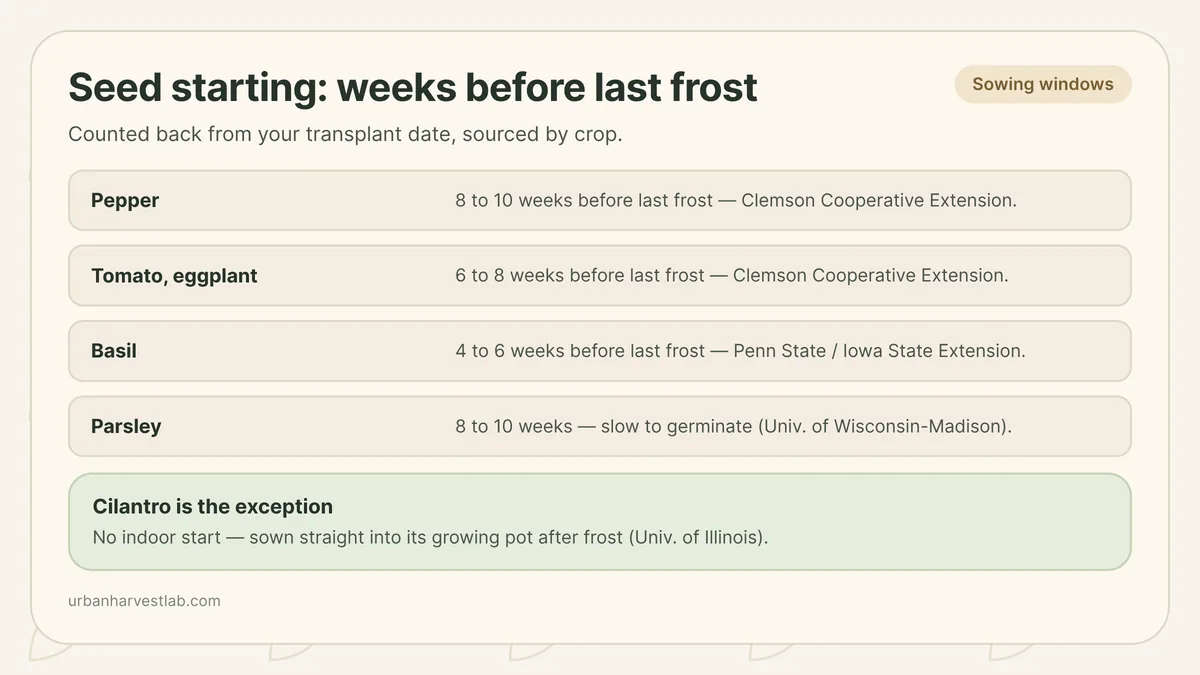
Seed starting calculator: sowing dates from your last frost date
A last frost date is only useful once you count backward from it. This works out that count crop by crop, instead of applying one week figure to everything in the seed drawer.
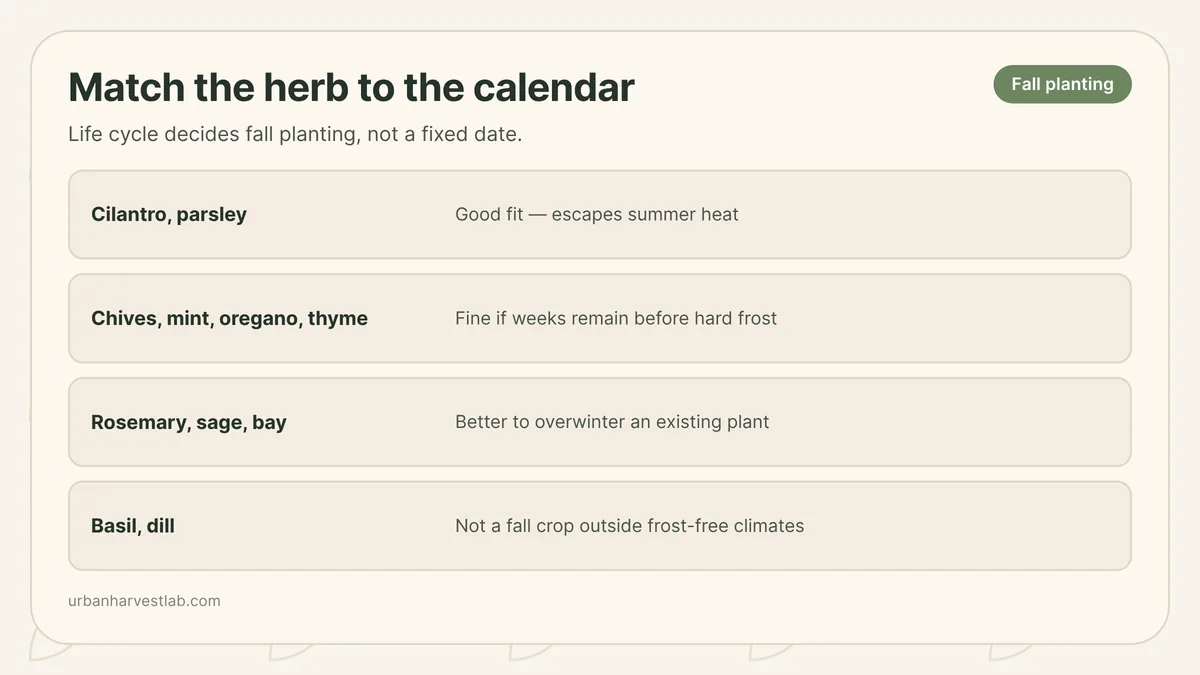
Herbs to plant in fall: what to sow now and what should wait
Fall planting suits herbs by life cycle and climate, not by calendar date. Cool-season herbs, cold-hardy perennials, and heat-loving annuals each answer the question differently.

How to grow kale in pots: cold, caterpillars and picking by the leaf
Kale suits containers: it is shallow-rooted enough for a modest pot, shrugs off frost, and gives leaf after leaf if you pick from the bottom.