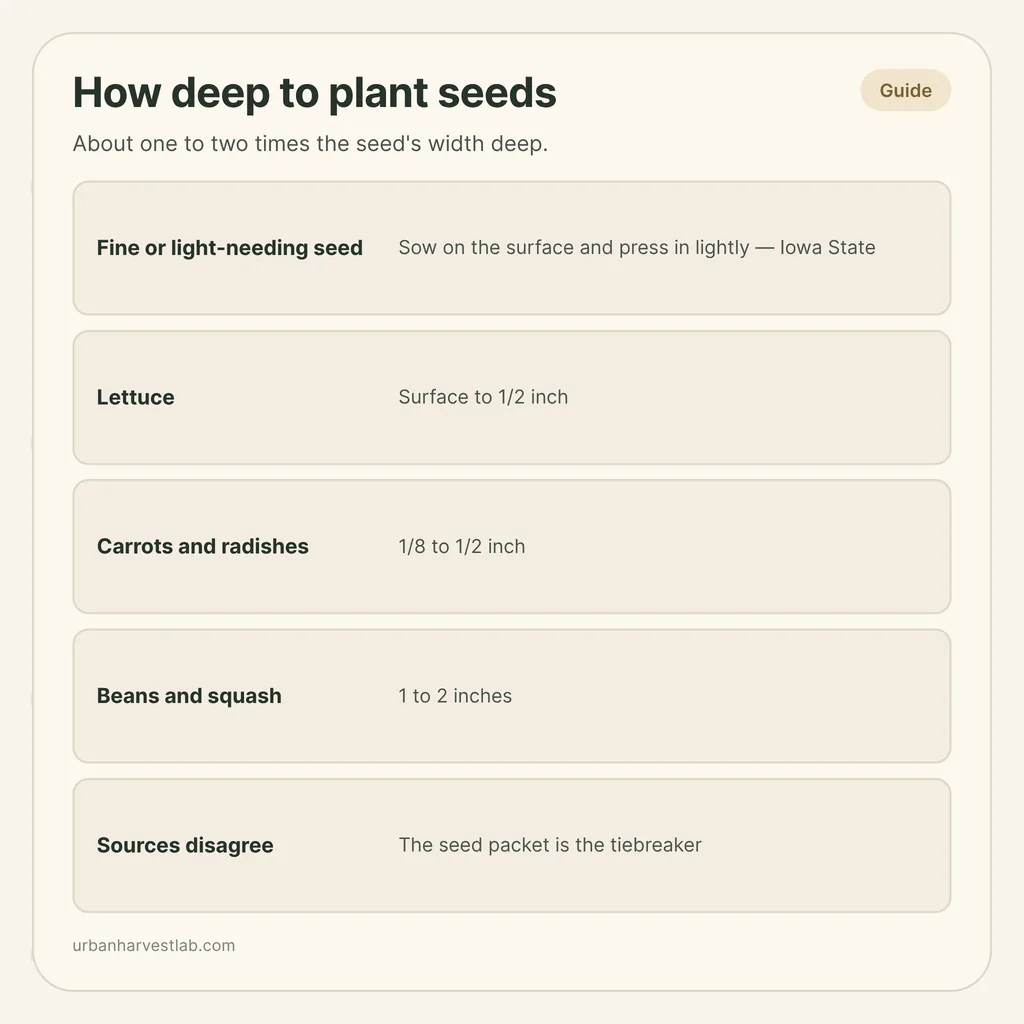
Plant most seeds about one to two times their own width deep, and leave fine seed and seed that needs light on the surface. Iowa State Extension covers most seed with one to two times its diameter. University of Maryland Extension puts a suitable depth at about twice the diameter, so a seed 1/8 inch (3 mm) wide goes about 1/4 inch (6 mm) down. In practice that means a surface scattering for lettuce and about an inch for beans. The table below turns the rule into numbers by crop.
Why depth matters
Iowa State Extension states the risk plainly: seed planted too deep may not receive the light it needs to germinate, will not have enough stored energy to reach the soil surface, and may die in the process.
Scaling depth to the seed is why the same rule gives a lettuce seed almost no cover and a bean about an inch. If a pot stays bare, depth is one of the first things to check. Why seeds are not sprouting in pots goes through the checks in order.
Seeds that stay on the surface
Iowa State Extension says fine seeds and those that require light for germination are sown on the surface of the medium and then lightly pressed in. University of Maryland Extension names lettuce: its seed can be left on the surface, uncovered or very lightly covered.
Your packet tells you which group a seed belongs to. Iowa State’s advice is to follow the packet’s planting depth, and it is the quickest way to spot a seed that needs light.
Pressing matters as much as not burying. Maryland describes pressing the seed down gently so it makes good contact with the mix. Contact lets the seed take up water, and a surface seed has nothing above it to hold moisture in.
Depth by crop
No single extension chart covers every crop, so the table sets three side by side. Georgia gives depth in its vegetable planting chart (Circular 963), Mississippi State in its planting guide, and Rutgers in a table for seeds started indoors in flats or pots. Depths are in inches. A dash means that source does not list the crop.
| Crop | University of Georgia | Mississippi State | Rutgers (indoor start) |
|---|---|---|---|
| Lettuce | 1/8 | 1/4 (leaf and head) | 1/4 |
| Carrot | 1/4 | 1/4 to 1/2 | - |
| Radish | 1/2 | 1/2 | - |
| Beet | 1/2 | 1/2 | - |
| Kale | 1/2 | 1/4 to 1/2 | 1/4 |
| Spinach | 1/2 to 3/4 | 1/2 | - |
| Parsley | - | 1/4 | - |
| Tomato, pepper, eggplant | - | - | 1/4 |
| Broccoli, cabbage | - | 1/4 to 1/2 | 1/4 |
| Celery, leeks | - | - | 1/8 |
| Cucumber | 1/2 to 3/4 | 1 | 1/2 |
| Okra | 1 | 1 | 3/4 |
| Bush beans | 1 to 1 1/2 | 1 | 1 (snap) |
| Peas | 1 to 2 | 1 to 2 | - |
| Sweet corn | 1 to 1 1/2 | 1 to 2 | 1/2 |
| Summer squash | 1 to 2 | 1 | 1 |
| Pumpkin | 1 | 1 to 2 | 1 |
Two more herb figures: Utah State Extension and the University of Kentucky both put basil at 1/8 inch, and Kentucky points out that basil seeds are very small.
The sources differ most on carrot and corn. Utah State’s fall chart also puts lettuce and radishes at 1/4 to 1/2 inch, deeper than Georgia’s 1/8 for lettuce. Carrot ranges from 1/8 inch in Utah State’s fall chart to 1/2 inch in Mississippi State’s. Georgia lists sweet corn at 1 to 1 1/2 inches in the garden, while Rutgers lists 1/2 inch for corn started indoors. The sources are writing for different climates, soils and sowing methods, and the packet for your variety settles it.
Sowing in a pot
Fill, firm, then sow. Fill the pot with moist mix and firm the surface so the depth is the same across it. Maryland describes the mix as moist as a wrung-out sponge, not sopping wet. The seed-starting mix page covers choosing one.
Measure the depth rather than pushing seed in with a finger. A fingertip is far wider than a lettuce seed, and the hole it makes is far deeper than the 1/8 to 1/4 inch the extension charts give. Lay the seed on the firmed surface, then sift mix over it to the depth in the table.
Water without moving the seed. Rutgers bottom-waters its seed containers by setting them in a shallow pan of water until the surface is moist, because overhead sprinkling can carry away smaller seeds. Iowa State describes the same approach, partially submerging the container. Once the surface is wet, lift the pot out to drain.
Keep the surface damp until sprouts show. Shallow seed sits where the mix dries first. Rutgers seals seeded containers in a clear plastic bag until seedlings emerge, and Iowa State removes the covering as soon as the seed germinates, to allow ventilation.
Expect to thin. Seed sown at the right depth and density comes up thick. Thinning seedlings covers when to cut and what to keep. For microgreens, which are sown on the surface at much higher density, see the microgreens seed density chart.
Which crops to sow in the pot
Rutgers says some vegetables, like carrots, beets and peas, should be seeded directly in the garden rather than started in a tray and moved. In a pot, that means sowing them in the container they will finish in. Direct sow vs transplant sorts the crops, and the temperature the seed needs to wake up is in the germination temperature chart.
Sources
- Iowa State University Extension, “How to Successfully Start Seed Indoors”
- University of Maryland Extension, “Starting Seeds Indoors”
- University of Georgia Extension, Circular 963, “Vegetable Planting Chart”
- Mississippi State University Extension, “Planting Guide” (Vegetable Gardens)
- Rutgers Cooperative Extension, FS787, “Starting Vegetable Seeds Indoors”
- Utah State University Extension, “Planting Dates (Fall)”, Washington County
- Utah State University Extension, “How to Grow Basil in Your Garden”
- University of Kentucky Cooperative Extension, “Basil” (NEP-237)
Depth is one step of sowing
Once the seed is at the right depth, these cover what goes around it: the mix, the warmth, thinning and what to check if nothing comes up.
Common questions
How deep should I plant seeds?
About one to two times the seed's width. Iowa State Extension covers most seed with one to two times its diameter, and University of Maryland Extension gives about twice, so a seed 1/8 inch wide goes about 1/4 inch deep. Fine seed and seed that needs light stays on the surface, and the packet depth wins when it differs.
Which seeds should not be covered?
Iowa State Extension says fine seeds and seeds that require light for germination are sown on the surface and pressed lightly into the mix. University of Maryland Extension says lettuce seed can be left on the surface, uncovered or very lightly covered. Your seed packet says which kind you have.
What happens if I plant seeds too deep?
Iowa State Extension says seed planted too deep may not receive the light it needs, will not have enough stored energy to reach the soil surface, and may die in the process. The result is a pot with nothing showing.
How deep do I plant seeds in a pot compared with the ground?
None of the sources here gives separate depths for pots. The width rule (Iowa State's one to two times the diameter, Maryland's about twice) applies to any container. Rutgers' indoor-start table runs at or shallower than the garden charts for some crops: sweet corn is 1/2 inch indoors against 1 to 1 1/2 inches in Georgia's garden chart. Georgia's chart adds one soil caveat: plant shallowly in heavy clay soil when moisture is adequate.
Related guides
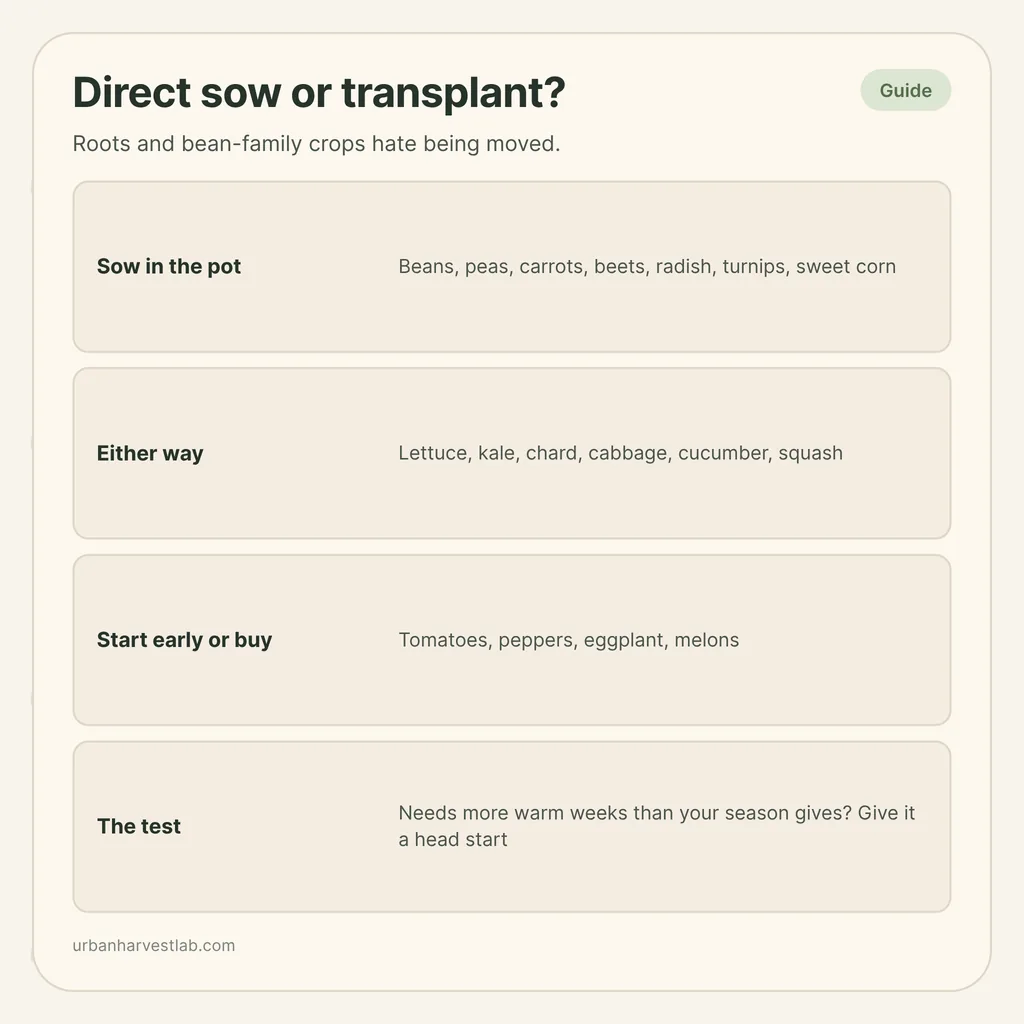
Direct sow vs transplant: which crops to start in the pot
Some crops sulk when moved, others need a head start. Here is which vegetables to sow where they will grow, which to start indoors or buy, and which work either way.

How to thin seedlings in pots: when to cut, what to keep
Seed packets ask you to sow thick and then remove most of what comes up. Here is when to do it in a pot, how to cut without hurting the keepers, and what to do with the extras.
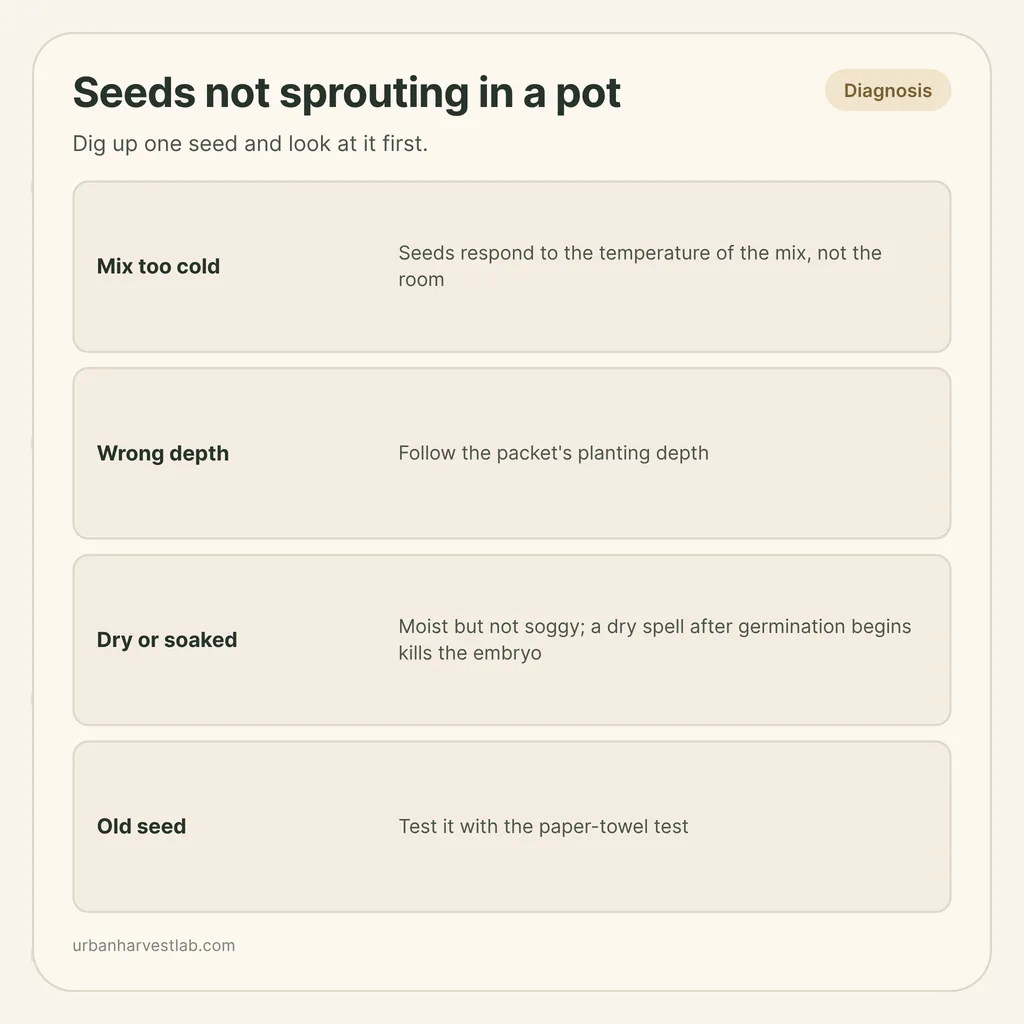
Seeds not sprouting in pots: temperature, depth, water or old seed
A pot of bare soil after two weeks has several possible causes. Cold mix, burial depth and one dry spell after sowing each leave a clue you can check.