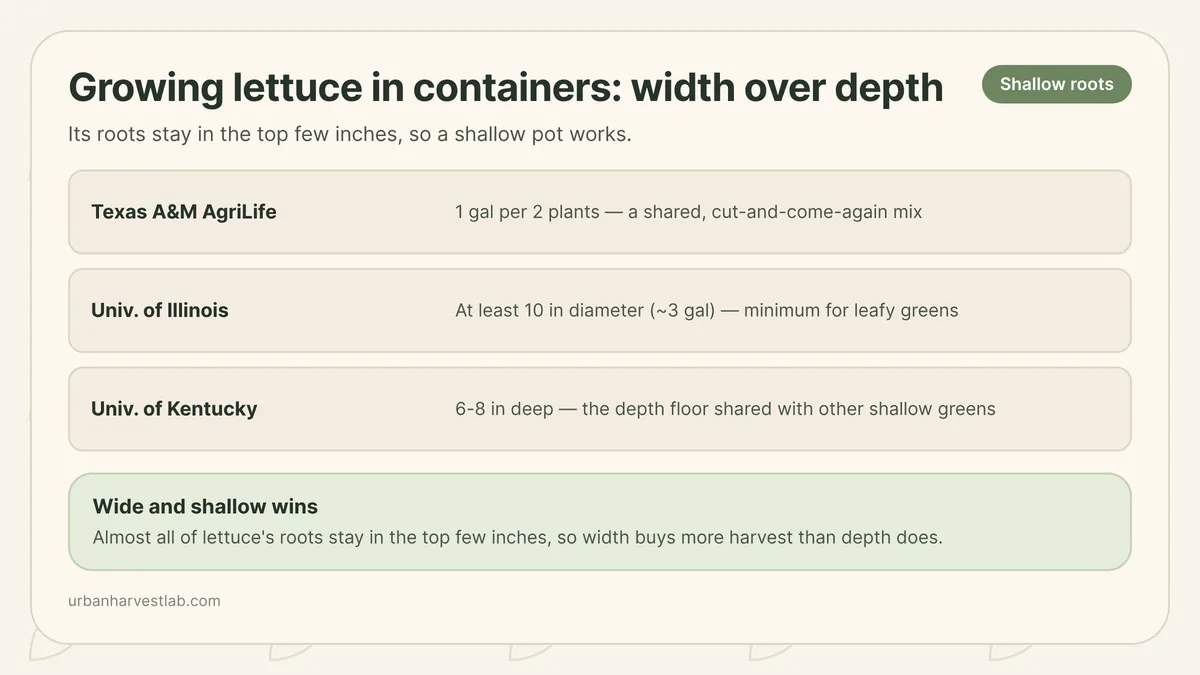
Lettuce container size, by source
| Source | Figure | What it's sized for |
|---|---|---|
| Texas A&M AgriLife Extension | 1 gal (3.8 L) per 2 plants | A shared, cut-and-come-again mix |
| University of Maryland Extension | 1/2 gal (1.9 L) per plant | Close to Texas A&M's ratio split in half |
| University of Illinois Extension | At least 10 in (25 cm) diameter, roughly 3 gal | Minimum container diameter for leafy greens |
| University of Kentucky Cooperative Extension | 6-8 in (15-20 cm) deep | Depth floor, shared with other shallow-rooted greens |
Illinois Extension sets a 10-inch minimum diameter for leafy greens, and University of Kentucky Cooperative Extension gives 6 to 8 inches as the depth floor, and wide-and-shallow suits lettuce better than narrow-and-deep, because it keeps almost all of its roots in the top few inches of the mix. That is a different growing method from the hydroponic lettuce setups covered elsewhere on this site: no reservoir, no nutrient solution, no pump that has to keep running. If you are weighing which route to take, hydroponics vs. soil lays out what genuinely differs between the two methods and what does not. Everything below is about the soil route: how wide, how deep, and how far apart to space the plants.
The drainage and material logic that applies to lettuce is the same logic that applies to any container crop; best containers for herbs covers that ground once, and it holds here too.
Why wide and shallow beats narrow and deep
Lettuce is shallow-rooted. University of Kentucky Cooperative Extension’s container guide lists 6 to 8 inches deep as adequate for lettuce, grouping it with beets, kale, onions, radish, spinach, chard, and turnip — crops that share the same shallow profile. Because the roots do not reach far down, a tall pot mostly adds weight and unused soil rather than usable root space; the volume that matters for lettuce is spread across the surface, not stacked underneath.
University of Illinois Extension backs that up from the width side, grouping lettuce among leafy greens and setting a minimum diameter of 10 inches. On Illinois’s own diameter-to-soil-volume conversion table, a 10-inch round pot holds roughly 3 gallons of mix. That is a shallow, wide footprint by design, and it is worth keeping in mind if lettuce is sharing a mixed container garden with deeper-rooted crops: a tomato or pepper needs a foot or more of rooting depth in the same setup, which container depth for tomatoes, peppers, and herbs covers on its own terms.
The size range, and why the two ends of it agree more than they look like they do
Texas A&M AgriLife Extension’s container table lists lettuce at one gallon of mix per two plants. University of Maryland Extension gives a smaller-looking figure: about half a gallon per plant. Split Texas A&M’s ratio in half and the two numbers land close to each other — roughly half a gallon of soil per plant either way, once you account for two plants sharing that gallon. Illinois’s 10-inch, roughly 3-gallon minimum sits well above both, but it is answering a different question: that figure is sized for one plant’s full-grown footprint, not for a cluster of seedlings splitting a pot. All three can be right at once, depending on how many plants you are actually growing per container.
Spacing: a cut-and-come-again mix vs. a full head
This is the decision that changes the container math more than the pot size does. Texas A&M’s ratio, two plants sharing a gallon, suits a loose-leaf lettuce mix you intend to cut young and repeatedly: crowding is the point, because you are harvesting outer leaves before the plants seriously compete for room, and a fresh flush of growth follows each cut. Sow a little more thickly than that ratio calls for, then thin as the seedlings crowd each other, keeping the strongest and eating the rest as microgreens-sized thinnings. Arugula, mizuna, and spinach share lettuce’s shallow footprint and can go in the same wide, shallow container; salad greens for fall containers covers growing them together.
A head-forming variety is a different bet. It needs to bulk into a full rosette before harvest, so it does better with a pot to itself rather than splitting one with a neighbor — give it the full diameter Illinois lists, at least 10 inches, on its own. Crowding a head-forming plant the way you would a cut-and-come-again mix stunts the head rather than producing two smaller ones.
Material and drainage for a shallow pot
A wide, shallow container has more surface area exposed to sun and air relative to its volume than a narrow, deep one, so it tends to dry faster — a real consideration for lettuce, which wilts under moisture stress more readily than a deep-rooted crop with a soil reserve to draw on. The general material tradeoffs, plastic and glazed ceramic holding moisture longer than terracotta or fabric, are the same ones plastic vs. terracotta pots for herbs walks through, and they apply to lettuce’s shallow root zone just as much as to a deep herb pot.
Skip a layer of gravel at the bottom regardless of the material you pick. Washington State University Extension’s research into layered container media found that a coarse layer under potting mix creates a perched water table, holding the root zone wetter rather than drier than mix run straight to the pot’s base — despite older printed advice, including a Texas A&M publication, that still recommends adding one. Drainage holes plus a uniform mix do the job a gravel layer cannot.
Food-safe containers, if you are repurposing a bucket
A shallow lettuce planting is an easy fit for a repurposed bucket, since the per-plant ratios above land close to a bucket’s actual volume. University of Maryland Extension narrows which plastics are safe for that: recycling code #2 (HDPE) and #5 (PP) are food-safe, especially with a “food grade” or “FDA approved” label or the glass-and-fork symbol, while #3 (PVC), #6 (polystyrene), and #7 (polycarbonate/BPA) should be avoided. A bucket that held anything other than food — paint, cleaning chemicals — does not become food-safe again just because it started out as #2 HDPE, per the same University of Maryland guidance.
Keeping a shallow pot from drying out
Because a wide, shallow lettuce container dries faster than most, a self-watering design is worth considering here specifically. University of Maryland Extension’s sub-irrigated design sits the growing medium on a perforated platform above a water reservoir, with roots drawing water upward by wicking rather than depending on the surface layer staying moist. Their own bucket-garden model needs 2 to 3 gallons to fill the reservoir at the start and roughly 1 to 2 quarts a day to keep it topped up during active growth. Self-watering pots for herbs walks through the build and its tradeoffs in more depth.
Why the wide-and-shallow shape is more than a preference
Illinois Extension’s diameter-to-volume conversions model straight-sided round pots specifically; a tapered or unusually shaped container will hold a different volume at the same diameter, so the figures above are a starting point, not an exact match for every pot shape. Illinois also distinguishes shorter “azalea” pots, which it says suit plants with minimal roots, from taller “standard” pots, its safer default for vegetables — lettuce’s shallow, wide-spreading root system is squarely the azalea case, which is what makes the wide-and-shallow shape correct here rather than just convenient. Hydroponics vs. soil covers what changes if you are weighing the hydroponic route instead.
Sources
- Texas A&M AgriLife Extension — Vegetable Gardening in Containers
- University of Illinois Extension — How to Grow Fruits, Vegetables, Herbs in Container Gardens
- University of Maryland Extension — Growing Vegetables in Containers and Salad Tables
- University of Maryland Extension — Self-Watering Containers
- University of Kentucky Cooperative Extension — Vegetables Grown in Containers Improves Accessibility
- Washington State University Extension — The Myth of Drainage Material in Container Plantings
Sizing a container for lettuce? These go with it
These guides cover the container basics, material choice, and moisture management that soil-grown lettuce shares with other container crops.
Common questions
What size container does lettuce need in soil?
Illinois Extension sets a 10-inch minimum diameter for leafy greens, and University of Kentucky Cooperative Extension gives 6 to 8 inches as the depth floor. Texas A&M AgriLife Extension gets there a different way, listing one gallon of mix per two lettuce plants grown close together.
Does lettuce need a deep pot?
No. Most of its roots stay in the top 6 to 8 inches of soil, so depth matters far less than width. A wide, shallow container holds the same volume as a narrow, deep one while giving the roots more of the layer they actually use.
How far apart should lettuce plants be spaced in a container?
Two plants can share a gallon of mix for a loose-leaf, cut-and-come-again planting, following Texas A&M AgriLife Extension's ratio. A head-forming variety does better with a full-size pot to itself.
How many lettuce plants fit in a 12-inch pot?
On Illinois Extension's diameter-to-volume table, a 12-inch pot holds roughly 5 gallons. At Texas A&M AgriLife Extension's ratio of one gallon per two loose-leaf plants sharing a mix, that is room for about ten plants grown close together for repeated cutting, or one to two head-forming plants given more room each.
Related guides
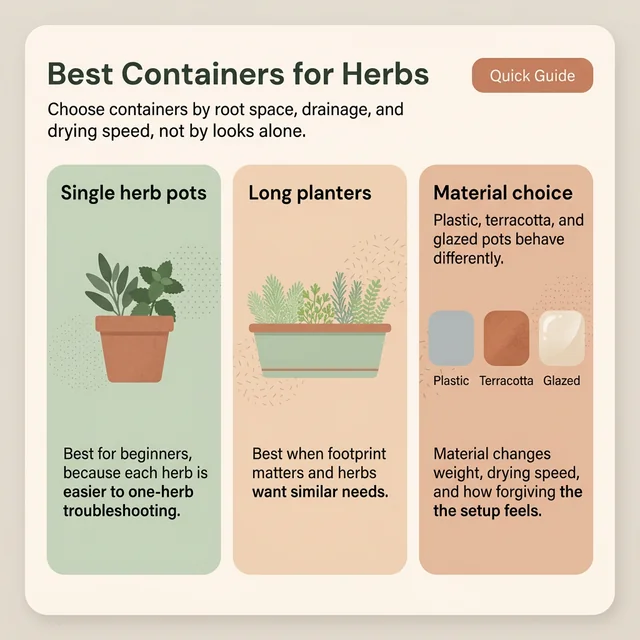
Best containers for herbs: drainage, pot size, and materials that work
A practical guide to herb containers that explains which pots work best, why drainage matters, and how material changes the way containers dry.
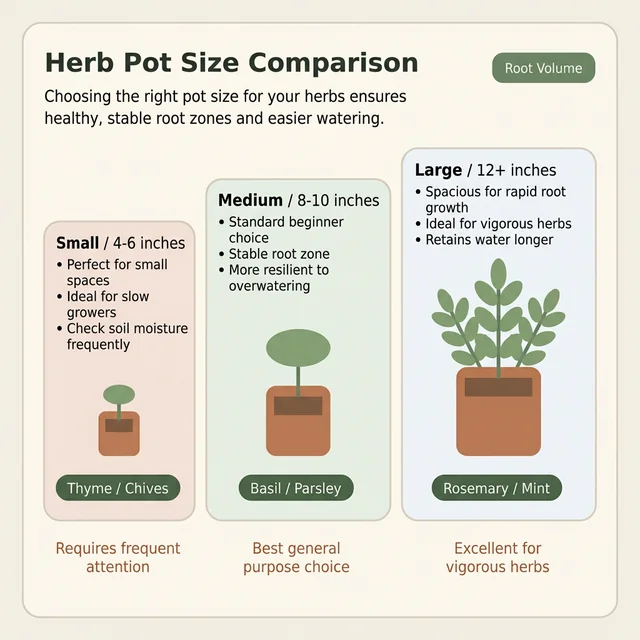
Container depth for tomatoes, peppers, and herbs: how much root space matters
Container size is one of the highest-leverage decisions in small-space gardening. When root volume is too small, every other care task becomes harder.
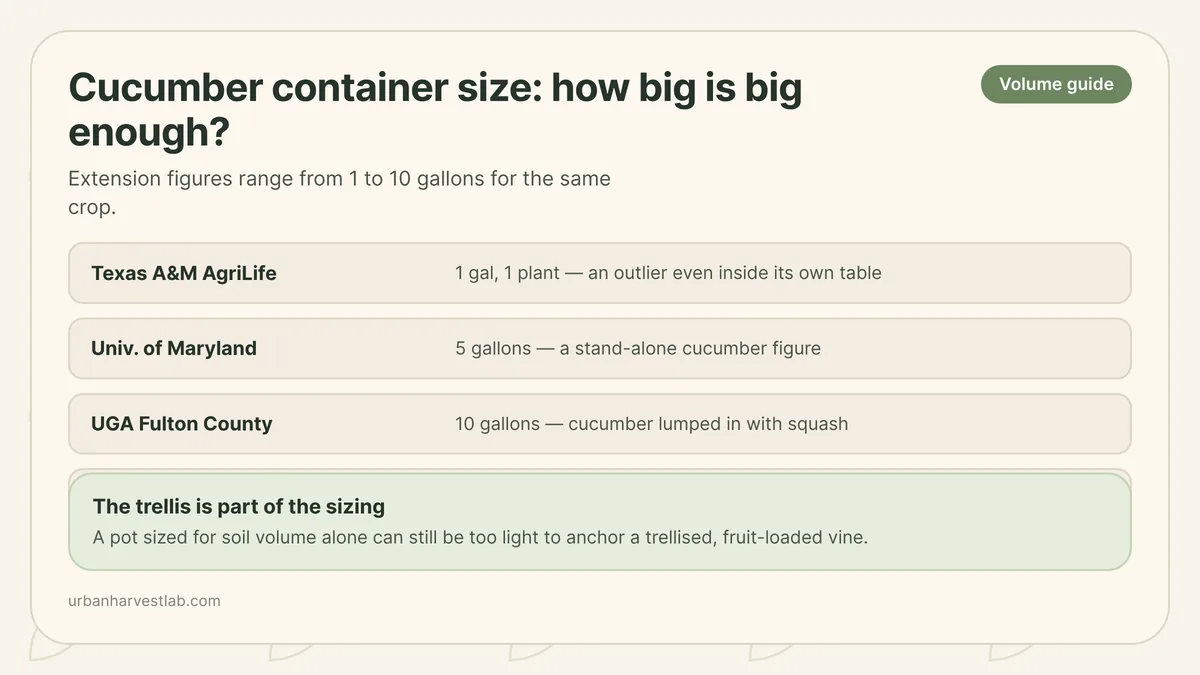
Container size for cucumbers: how big a pot do they really need
Cucumbers are vines with a fruit load to support, and extension sources disagree sharply on how much container that takes. The safer number is bigger than the smallest one you will find.