Shade cloth percentages named by extension sources
| Crop group | Source | Percentage it names | Note |
|---|---|---|---|
| Peppers and tomatoes | Utah State Extension | 18% to 30% | Installed after first fruits begin to reach maturity |
| Bell peppers | University of Georgia | 30% | Worked best in UGA studies |
| Vegetable crops in general | University of Delaware Extension | 20% to 40% | About 30% is the most common recommendation |
| Most vegetables | Penn State Extension | 30% to 50% | Good investment for lettuce and leafy greens; cloth must not touch the plants |
| Vegetables, Wisconsin | Mohican Food Sovereignty fact sheet (SARE) | 30% to 50% | Rule of thumb for Wisconsin |
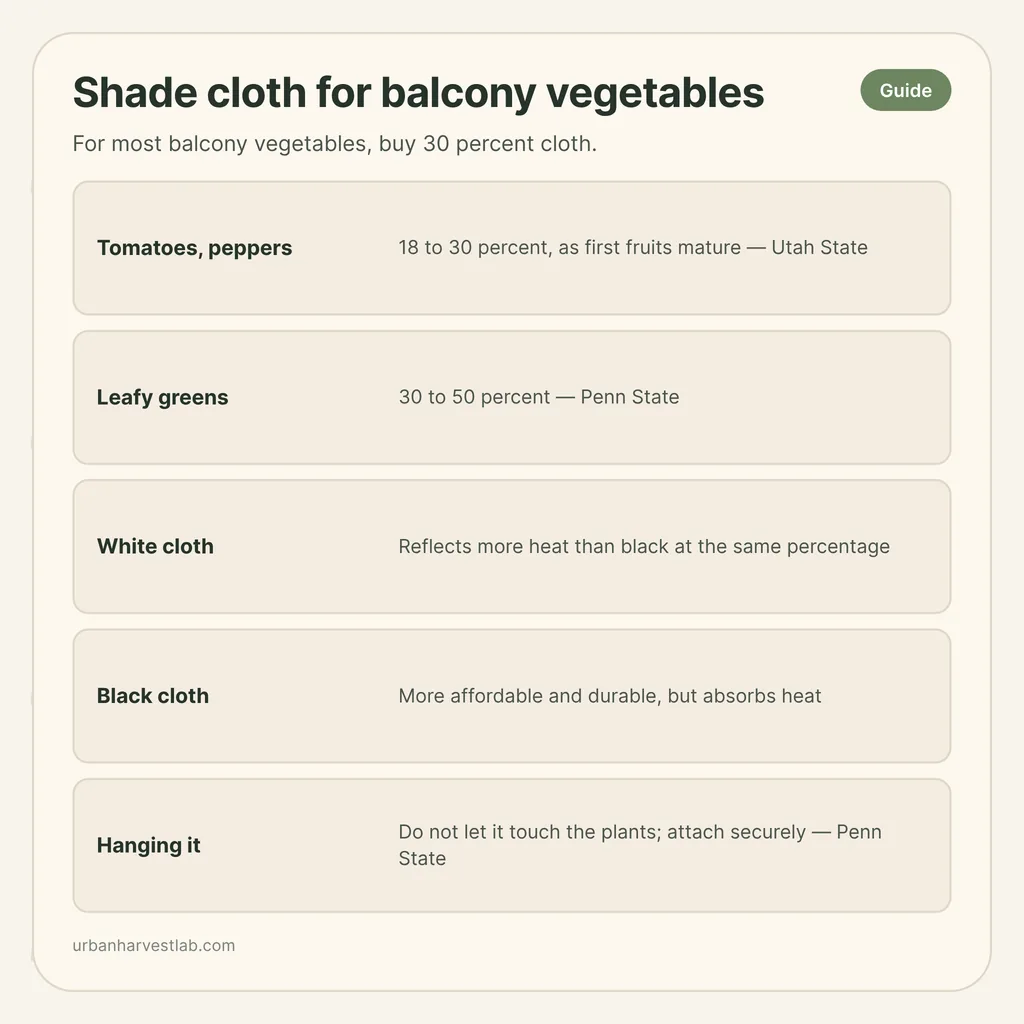
For most balcony vegetables, buy 30 percent cloth. Extension sources span 18 to 50 percent: Utah State gives 18 to 30 percent over peppers and tomatoes, Delaware calls about 30 percent the most common recommendation, and Penn State gives 30 to 50 percent for most vegetables, leafy greens included.
This is about choosing cloth you leave up for a season. If a heatwave is forecast for this week, start with protecting container plants in a heatwave.
What the percentage means
A 30 percent cloth blocks 30 percent of the light. The University of Vermont and University of New Hampshire extension team lists 30, 50, 70 and 80 percent as the common sizes. They add a wrinkle: the percentage describes the light plants use for photosynthesis, so a 50 percent fabric may block less of the radiation that makes heat.
That is the whole tradeoff. Delaware Extension calls it a balancing act: shade enough to reduce the heat load, but not so much that photosynthesis suffers. The Vermont and New Hampshire advice is blunter: do not choose a higher percentage than you need.
Which percentage for which crop
The table above lines up the figures by source. Here is how to read them.
Tomatoes and peppers
Utah State Extension recommends 18 to 30 percent cloth over peppers or tomatoes, installed after the first fruits begin to reach maturity. University of Georgia researchers found that 30 percent cloth worked best for bell peppers. Delaware Extension notes that tomatoes and peppers may benefit from some shading during hot periods.
Notice the timing in the Utah advice. The cloth is aimed at ripening fruit in the hottest weeks, not at the whole life of the plant. For what sunscald looks like and what else prevents it, see tomato sunscald.
Lettuce and other leafy greens
Penn State Extension says that a shade cloth is a good investment if you want to grow lettuce and other leafy greens all through the summer, and recommends 30 to 50 percent for most vegetables. A fact sheet from Wisconsin’s Mohican Food Sovereignty program, hosted by SARE, gives the same 30 to 50 percent as a rule of thumb for Wisconsin vegetables. It says shade cloth can slow bolting in lettuce and spinach and that the air under it can be 5 degrees or more cooler.
Delaware Extension says leafy green production could benefit, potentially extending lettuce through the summer. If your lettuce has already bolted, the causes are in lettuce bolting in containers.
Everything else
For cucumbers, squash, beans and herbs, the sources give no crop-specific figure, so the general vegetable ranges are the closest published guidance: Delaware’s 20 to 40 percent or Penn State’s 30 to 50 percent. Starting at 30 percent sits inside both.
If your balcony is already partly shaded
Cloth costs you light, so add it only to the sunny part. Growing vegetables in shade on a balcony covers what a shaded balcony supports. To find out how many hours of direct sun your pots actually get, see measuring balcony sunlight.
Black, white or aluminized
The Vermont and New Hampshire team (writing about high tunnels) sorts the colors this way:
- White reflects more heat than black at the same percentage and keeps the space cooler. It is typically more expensive and has a slightly shorter lifespan.
- Black is more affordable and durable, but it absorbs heat and can keep a space warmer.
- Aluminized is highly reflective and cools more than white, but it is less durable and more costly.
Delaware Extension says the most common colors are black and green, and that white or aluminized cloth may offer additional cooling.
A USDA Forest Service nursery note gives a rare set of measurements, from a greenhouse in northern Oregon in September. With no shade the growing medium reached 118 °F. Under 63 percent black cloth it reached 108 °F, and under 50 percent white cloth it reached 92 °F. The air temperatures were within a couple of degrees of each other, 88 to 90 °F. The author’s point is that white cloth reflects sunlight, so the root zone stays cooler even where the air does not. Those are greenhouse figures with different percentages for each color, so read them as a direction, not a forecast for your balcony. For a pot, a cooler root zone is the useful part.
If you are buying, browse 30 percent shade cloth on Amazon and check the percentage on the label, since the density, not the color name, is what sets how much light gets through.
Hanging it on a balcony
Penn State Extension is specific: the cloth should not touch the plants, because heat from the cloth can burn them and movement of the cloth in the wind can damage them. It should be securely attached to poles. The USDA Forest Service note makes the same point for greenhouses: cloth supported above the covering with a layer of air underneath works better, because absorbed heat is vented away instead of conducted through.
For a balcony, that means:
- Build or buy a frame taller than the tallest plant, with the cloth stretched above it.
- Orient it horizontally over the crop, as Utah State advises, and add a vertical panel on the side that gets the most sun.
- Fix it firmly. A loose sheet on a balcony is a flapping hazard for both the plants and the people below.
- Leave it easy to lift. The Wisconsin fact sheet notes that shade cloth can be easily removed for watering and harvest.
University of Georgia’s own coverage of container gardening in heat admits the cost: spreading cloth over delicate blooms or vegetables during extraordinary heat may be time consuming and messy-looking, but it can protect the harvest.
When to put it up and take it down
Vermont and New Hampshire extension advice is to apply shade only once adequate light is available and to remove it when days shorten, before the crop no longer receives adequate light. Their example is a tomato that has plenty of light in July but may be light deprived by late September.
Utah State’s timing for fruit crops fits this: cloth goes on as fruit starts to mature. Judge by your crop. Put it up when you see scorched fruit, wilting foliage by mid-afternoon or lettuce bolting, and take it down when the heat breaks.
Sources
- Penn State Extension: Heat proofing your vegetable garden
- Utah State University pest advisory, 23 August 2016 (sunscald)
- University of Delaware Extension: Shadecloth for hot season vegetable and fruit production
- University of Georgia CAES: Too hot for plants
- Mohican Food Sovereignty (SARE): Shade cloth fact sheet A.6
- University of Vermont and University of New Hampshire Extension: High and Dry, issue 7
- USDA Forest Service, Forest Nursery Notes: Cooling with shade
Shade, sun and summer heat on a balcony
Where to go for the emergency plan, sunscald on fruit and lettuce that bolts.
Common questions
What percentage of shade cloth is best for vegetables?
It depends on the crop and how hot your summers are. Penn State Extension recommends 30 to 50 percent for most vegetables. University of Delaware Extension suggests 20 to 40 percent, with about 30 percent the most common recommendation. Utah State Extension gives 18 to 30 percent over peppers and tomatoes.
Is 50 percent shade cloth too much for tomatoes?
Utah State gives 18 to 30 percent for tomatoes and peppers, Delaware calls about 30 percent most common, and University of Georgia researchers found 30 percent worked best for bell peppers. Penn State gives 30 to 50 percent for most vegetables, so 50 percent is inside its range but above the tomato and pepper figures from Utah State.
Does white shade cloth work better than black?
Possibly, for cooling. Delaware Extension says only that white or aluminized cloth may offer additional cooling. The University of Vermont and New Hampshire extension team, writing about high tunnels, says white cloth reflects more heat than black at the same percentage, and aluminized cloth is more reflective still but less durable and more costly. Black is more affordable and durable but absorbs heat.
When should I take shade cloth down?
When days shorten and before the crop no longer gets enough light. University of Vermont and New Hampshire extension advice is to apply shade only once adequate light is available and remove it before the plants are short of light, since a tomato with plenty of light in July can be light deprived by late September.
Related guides

How to protect container plants during a heatwave
Watering more is only one piece of getting containers through a heatwave. This is the wider plan: cutting the heat load, grouping and staging pots, and reviving one that has already dried out.
How much sun does my balcony get: an orientation estimator and one-day tracking method
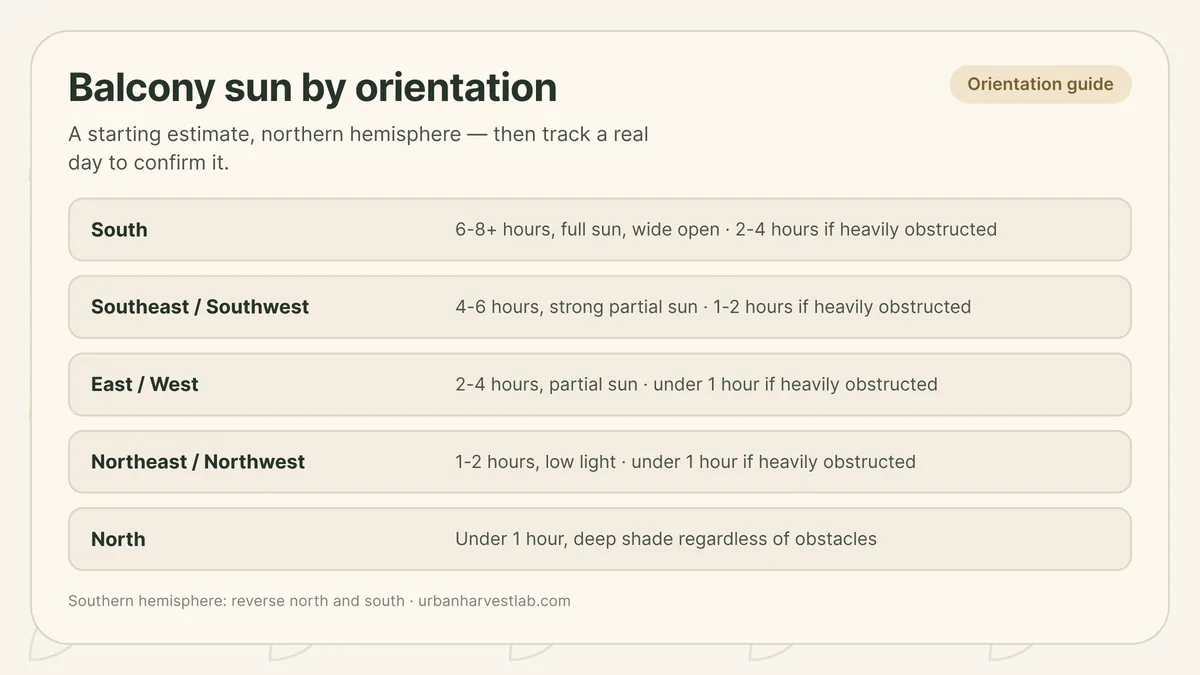
Compass direction and nearby obstacles give a starting range for how much sun a balcony gets. One day of tracking turns that range into a real number.
Growing collard greens in containers: pot size, picking and summer heat
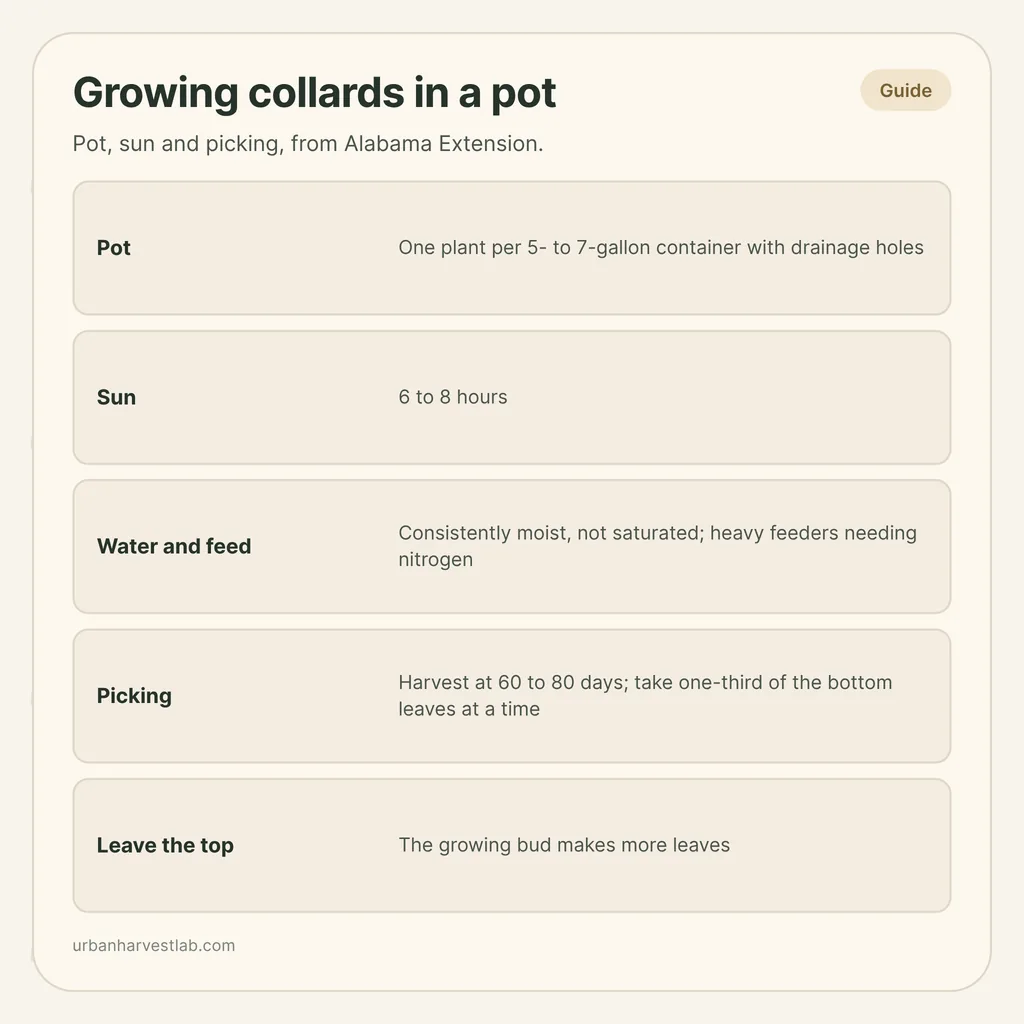
One collard plant in a 5 to 7 gallon pot gives a steady supply of leaves if you pick from the bottom and leave the growing centre alone.